United States (US) Connected Agriculture Market Size & Growth Rate (2026-2032)
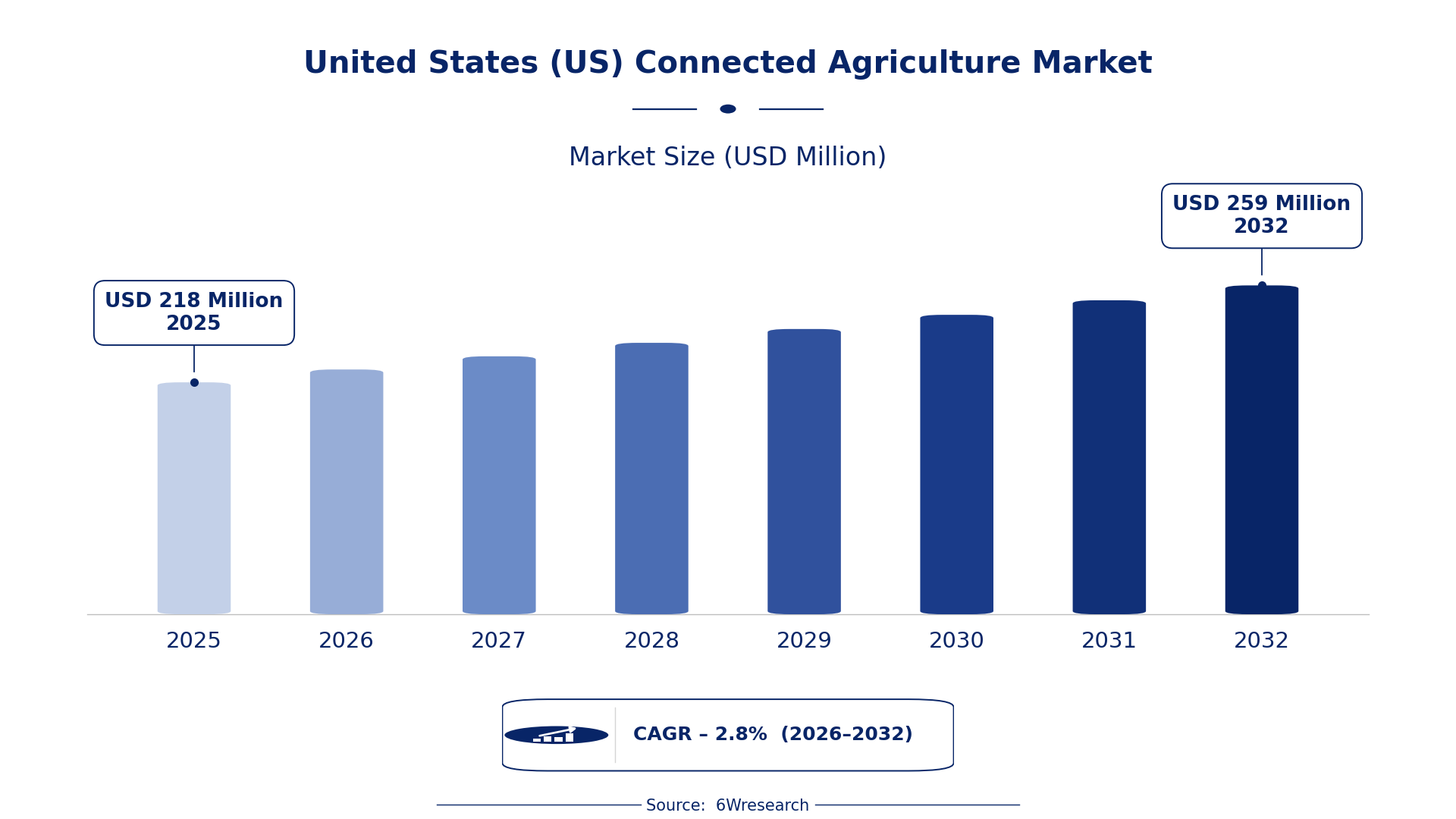
The United States (US) Connected Agriculture Market was estimated at USD 218 Million in 2025 and is projected to reach USD 259 Million by 2032, growing at a CAGR of 2.8% from 2026 to 2032.
United States (US) Connected Agriculture Market Synopsis
The primary force driving the United States Connected Agriculture Market is the rapid adoption of advanced technologies like IoT and AI. Farmers are increasingly turning to these tools to enhance productivity, optimize resource usage, and improve decision-making processes.
This market is characterized by a growing demand for sustainable farming practices and the need for effective resource management. As awareness of the benefits of connected technologies rises, farmers are eager to integrate these innovations into their operations, leading to a dynamic shift in agricultural practices.
United States (US) Connected Agriculture Market Year-wise Growth Rate and Key Drivers
This graph illustrates the annual growth rates of the United States (US) Connected Agriculture Market from 2021 to 2032, highlighting a steady upward trajectory and projected expansion over the forecast period.
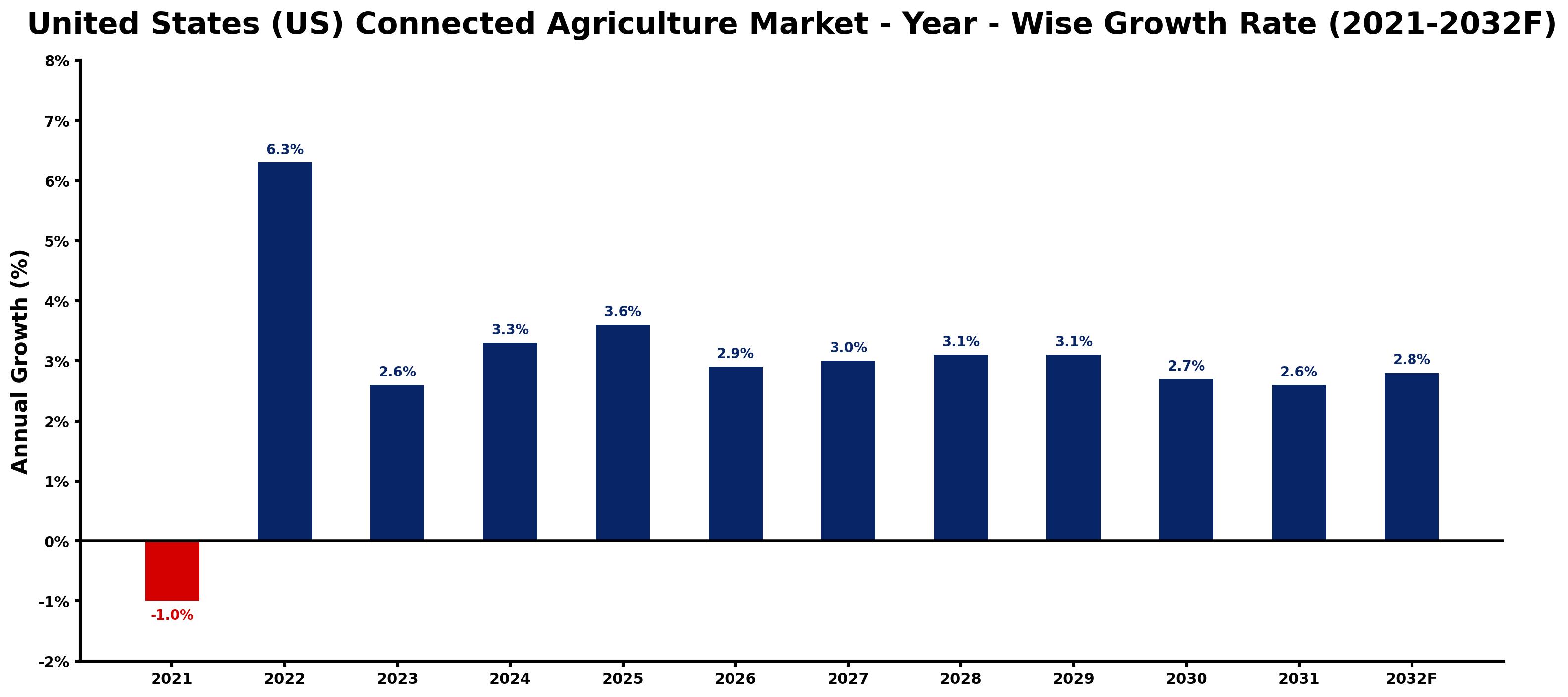
The table below presents the year‑wise growth rates along with the key drivers influencing the market
| Year | Growth Rate | Major Drivers |
| 2021 | -1.0% | Severe drought impacting crop yields across Midwest |
| 2022 | 6.3% | USDA investments in precision agriculture technologies |
| 2023 | 2.6% | Increased adoption of IoT devices among local farmers |
| 2024 | 3.3% | State-funded programs promoting sustainable farming practices |
| 2025 | 3.6% | Growing consumer demand for farm-to-table produce |
| 2026 | 2.9% | Integration of AI for yield prediction models |
| 2027 | 3.0% | Enhanced climate resilience initiatives for agricultural systems |
| 2028 | 3.1% | Rise in agritech startups attracting venture capital |
| 2029 | 3.1% | Implementation of federal policies encouraging smart irrigation |
| 2030 | 2.7% | Collaboration between universities and farmers on tech solutions |
| 2031 | 2.6% | Emergence of blockchain for transparent supply chains |
| 2032 | 2.8% | Government subsidies for eco-friendly farming technologies |
Note: Market size estimations and growth projections presented in this report are based on 6Wresearch's proprietary forecasting methodology, utilizing the latest available industry data, government publications, and primary research inputs.
United States (US) Connected Agriculture Market Key Takeaways
Below are some of the specific key takeaways from the market, including:
- The market is driven by the integration of IoT, AI, and data analytics into farming practices.
- Precision farming, livestock monitoring, and smart irrigation are among the key solutions gaining traction.
- The increasing focus on sustainability and resource efficiency is propelling market growth.
- Challenges include data security, interoperability, and the high initial costs of technology adoption.
- Government initiatives are providing support for technology adoption in agriculture.
Evaluation of Restraints in United States (US) Connected Agriculture Market
The United States Connected Agriculture Market faces several restraints that impede its growth. One major concern is the complexity involved in integrating various technologies, which can lead to confusion among farmers. Data security and privacy issues are also paramount; with increased connectivity comes the risk of data breaches, which can undermine trust in these solutions. Additionally, the high initial investment required for implementing connected agriculture solutions can deter farmers, particularly those operating on smaller scales. Lack of standardized protocols and regulations further complicates matters, leaving many farmers uncertain about the viability of these technologies.
United States (US) Connected Agriculture Market Trends
A key trend in the United States Connected Agriculture Market is the integration of drones and sensors for precision farming. These technologies allow for real-time monitoring of crop health and soil conditions, leading to better decision-making. Smart irrigation systems are also gaining popularity, helping farmers to manage water resources efficiently. on top of that, the application of blockchain technology is becoming prominent for ensuring supply chain transparency, addressing the growing consumer demand for food traceability and safety.
United States (US) Connected Agriculture Market Opportunities
Investors should be keenly aware of the opportunities within the United States Connected Agriculture Market. Technologies such as precision agriculture, IoT devices, and data analytics present substantial growth prospects. Companies focusing on innovative farm management solutions, crop monitoring, and smart irrigation are well-positioned for investment. Additionally, the rise of agri-tech startups that prioritize sustainability, automation, and supply chain efficiency adds another layer of opportunity in this rapidly evolving market.
Government Initiatives in the United States (US) Connected Agriculture Market
Government policies are crucial in shaping the trajectory of the United States Connected Agriculture Market. Various initiatives focus on enhancing agricultural productivity and efficiency through technological adoption, addressing issues of connectivity, and ensuring data security.
- A recently completed initiative involved the rollout of funding programs under the Farm Bill, aimed at promoting smart farming practices.
- Currently, the USDA is actively providing resources and grants for precision agriculture technologies to support farmers transitioning to connected solutions.
- A planned public-private initiative is expected to enhance rural broadband infrastructure by 2028, ensuring reliable connectivity for farmers.
- The Federal Communications Commission (FCC) is working on regulatory frameworks that will address data privacy concerns in agriculture.
- Upcoming workshops by the USDA aim to improve digital literacy among farmers, focusing on the benefits of connected agriculture technologies.
Future Insights of the United States (US) Connected Agriculture Market
Looking ahead to 2026-2032, the United States Connected Agriculture Market is set to expand significantly. As technology continues to evolve, farmers will increasingly adopt smart solutions to streamline operations and enhance productivity. The demand for precision agriculture will drive innovation, fostering a competitive edge for those who embrace these advancements. Additionally, the push for sustainable practices and the necessity for food traceability will further fuel market growth, positioning connected agriculture as a cornerstone of future farming.
United States (US) Connected Agriculture Market Latest Developments
In the past year, the United States Connected Agriculture Market has seen a surge in activity, with numerous advancements in technology and collaborative efforts among stakeholders. The focus remains on enhancing efficiency and sustainability in agricultural practices.
- A major technology vendor announced the launch of an integrated farm management platform in early 2025, aimed at simplifying data analysis for farmers.
- An initiative that began in mid-2025 focuses on developing smart irrigation systems, with several pilot projects currently underway.
- A partnership between agricultural cooperatives and tech firms is expected to roll out a series of IoT devices by Q3 2025 to monitor soil health.
- Research into blockchain applications for supply chain transparency has gained traction, with findings to be shared in upcoming industry forums.
- A planned service upgrade for existing precision farming tools is set to begin by mid-2026, enhancing functionality and user experience.
United States (US) Connected Agriculture Market - Key Attractiveness of the Report
- 10 Years of Market Numbers
- Historical Data Starting from 2022 to 2025
- Base Year: 2025
- Forecast Data until 2032
- Key Performance Indicators Impacting the Market
- Major Upcoming Developments and Projects
Key Highlights of the Report:
- United States (US) Connected Agriculture Market Outlook
- Market Size of United States (US) Connected Agriculture Market, 2025
- Forecast of United States (US) Connected Agriculture Market, 2032
- Historical Data and Forecast of United States (US) Connected Agriculture Revenues & Volume for the Period 2022-2032F
- United States (US) Connected Agriculture Market Trend Evolution
- United States (US) Connected Agriculture Market Drivers and Challenges
- United States (US) Connected Agriculture Price Trends
- United States (US) Connected Agriculture Porter's Five Forces
- United States (US) Connected Agriculture Industry Life Cycle
- Historical Data and Forecast of United States (US) Connected Agriculture Market Revenues & Volume By Component for the Period 2022-2032F
- Historical Data and Forecast of United States (US) Connected Agriculture Market Revenues & Volume By Solution for the Period 2022-2032F
- Historical Data and Forecast of United States (US) Connected Agriculture Market Revenues & Volume By Platforms for the Period 2022-2032F
- Historical Data and Forecast of United States (US) Connected Agriculture Market Revenues & Volume By Services for the Period 2022-2032F
- Historical Data and Forecast of United States (US) Connected Agriculture Market Revenues & Volume By Platforms for the Period 2022-2032F
- Historical Data and Forecast of United States (US) Connected Agriculture Market Revenues & Volume By Device Management for the Period 2022-2032F
- Historical Data and Forecast of United States (US) Connected Agriculture Market Revenues & Volume By Application Enablement for the Period 2022-2032F
- Historical Data and Forecast of United States (US) Connected Agriculture Market Revenues & Volume By Connectivity Management for the Period 2022-2032F
- Historical Data and Forecast of United States (US) Connected Agriculture Market Revenues & Volume By Application for the Period 2022-2032F
- Historical Data and Forecast of United States (US) Connected Agriculture Market Revenues & Volume By Pre-Production Planning and Management for the Period 2022-2032F
- Historical Data and Forecast of United States (US) Connected Agriculture Market Revenues & Volume By In-Production Planning and Management for the Period 2022-2032F
- Historical Data and Forecast of United States (US) Connected Agriculture Market Revenues & Volume By Post-Production Planning and Management for the Period 2022-2032F
- United States (US) Connected Agriculture Import Export Trade Statistics
- Market Opportunity Assessment By Component
- Market Opportunity Assessment By Platforms
- Market Opportunity Assessment By Application
- United States (US) Connected Agriculture Top Companies Market Share
- United States (US) Connected Agriculture Competitive Benchmarking By Technical and Operational Parameters
- United States (US) Connected Agriculture Company Profiles
- United States (US) Connected Agriculture Key Strategic Recommendations






































