United States (US) Dental Sterilization Market Size, Share & Growth Rate
The United States (US) Dental Sterilization Market was estimated at USD 90 Million in 2025 and is projected to reach USD 106 Million by 2032, growing at a CAGR of 2.4% from 2026 to 2032. This growth trajectory is largely driven by an increasing focus on patient safety, spurred by heightened awareness of infection control in dental practices. Additionally, the ongoing evolution of sterilization technologies continues to shape the market landscape, as dental professionals seek efficient and reliable solutions to enhance their practices.
United States (US) Dental Sterilization Market Year-wise Growth Rate and Key Drivers
This graph highlights how the United States (US) Dental Sterilization Market has steadily grown over the years, supported by major growth factors.
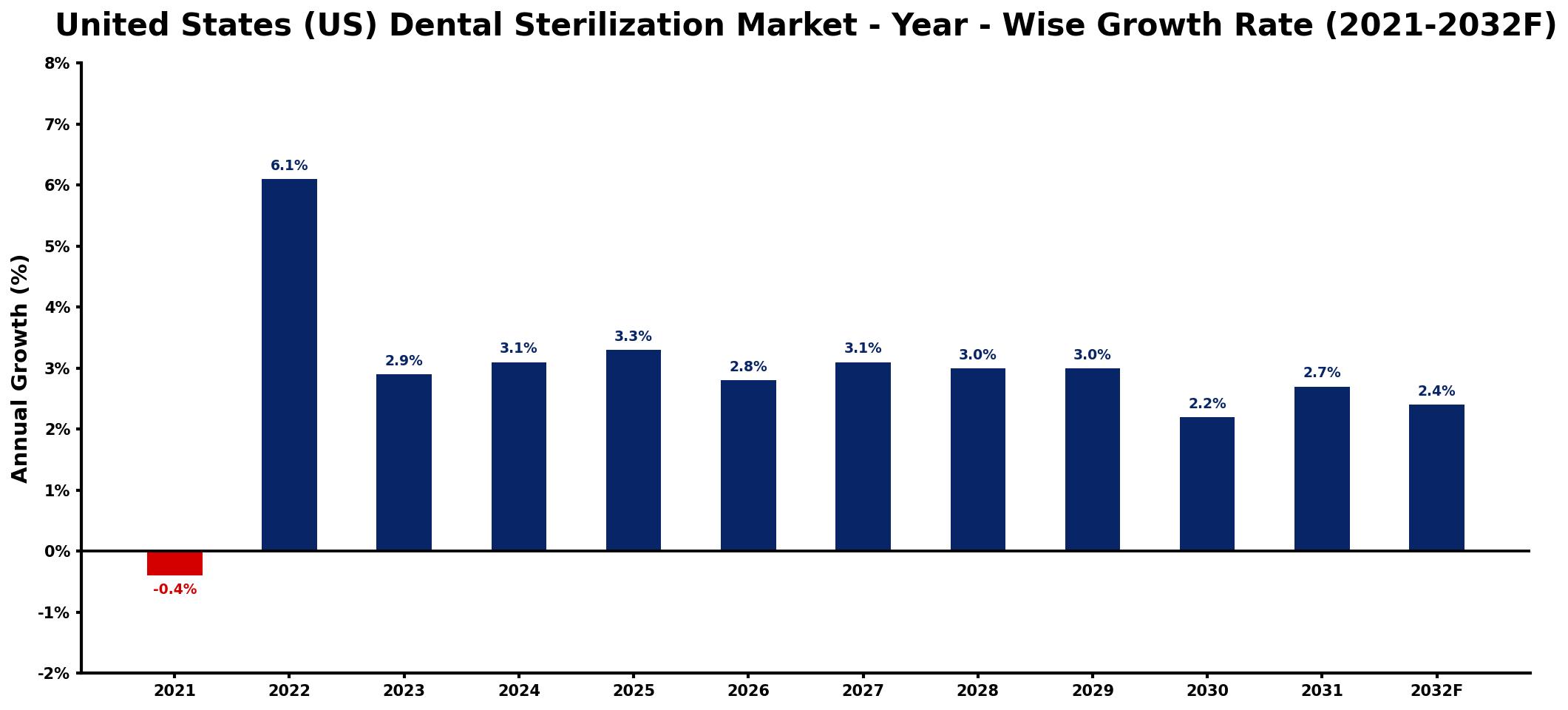
The table below presents the year‑wise growth rates along with the key drivers influencing the market
| Year | Growth Rate | Major Drivers |
| 2021 | -0.4% | Decreased investments in healthcare infrastructure |
| 2022 | 6.1% | Rising focus on infection control |
| 2023 | 2.9% | Increased adoption of advanced technologies |
| 2024 | 3.1% | Growing demand for safety regulations |
| 2025 | 3.3% | growing automotive sector requirements |
| 2026 | 2.8% | Heightened awareness of patient safety |
| 2027 | 3.1% | Surge in preventive healthcare measures |
| 2028 | 3.0% | Enhanced training for healthcare staff |
| 2029 | 3.0% | Growing patient population seeking care |
| 2030 | 2.2% | Increased funding for healthcare innovations |
| 2031 | 2.7% | Expansion of regulatory compliance requirements |
| 2032 | 2.4% | Emergence of new healthcare technologies |
Note: Market size estimations and growth projections presented in this report are based on 6Wresearch's proprietary forecasting methodology, utilizing the latest available industry data, government publications, and primary research inputs.
United States (US) Dental Sterilization Market Synopsis
The most significant force shaping the US Dental Sterilization Market right now is the stringent regulatory environment that governs infection control practices. Compliance with guidelines set by entities like the CDC and OSHA is paramount, prompting dental facilities to invest in advanced sterilization solutions. As a result, the demand for robust sterilization equipment has surged as dental providers navigate these regulatory requirements.
Another critical aspect driving market dynamics is the increasing prevalence of dental diseases, prompting a higher volume of procedures that require stringent sterilization protocols. This surge in demand for dental care, coupled with technological innovations aimed at enhancing sterilization efficacy, positions the US Dental Sterilization Market for continued growth.
United States (US) Dental Sterilization Market Key Takeaways
- The market is primarily driven by heightened awareness surrounding infection control and patient safety.
- Technological advancements in sterilization techniques are essential for improving operational efficiency in dental practices.
- Compliance with regulatory standards is a key factor influencing market dynamics and investment decisions.
- There is a growing trend toward eco-friendly sterilization methods in response to environmental sustainability demands.
- Investment opportunities exist in innovative sterilization technologies and disposable sterilization products.
Evaluation of Restraints in United States (US) Dental Sterilization Market
The US Dental Sterilization Market faces considerable restraints, chiefly stemming from the complexity and cost associated with compliance to evolving regulatory frameworks. Dental practices must invest significantly in both equipment and training to meet the stringent standards enforced by regulatory bodies. Furthermore, the pressing need for environmentally sustainable sterilization technologies challenges manufacturers to innovate while addressing cost-efficiency and performance parameters, which can hinder market responsiveness.
United States (US) Dental Sterilization Market Trends
A notable trend in the US Dental Sterilization Market is the increasing demand for automated sterilization systems that integrate advanced technologies, such as data tracking and remote monitoring. These innovations not only enhance sterilization efficiency but also align with broader trends towards digitalization in healthcare. Furthermore, the market is seeing a shift towards single-use disposable sterilization items, minimizing the risk of cross-contamination and supporting infection control measures.
United States (US) Dental Sterilization Market Opportunities
The US Dental Sterilization Market is rife with investment opportunities, particularly in the realm of advanced sterilization technologies. Companies that focus on developing eco-friendly solutions or efficient sterilization monitoring products stand to benefit from increasing consumer demand for sustainability. Additionally, ongoing research and development aimed at creating innovative sterilization methodologies will likely yield attractive returns as the market evolves.
Government Initiatives in the United States (US) Dental Sterilization Market
Government policies surrounding the US Dental Sterilization Market emphasize safety and the effectiveness of sterilization processes in dental facilities. Regulatory bodies, including the FDA and OSHA, set and enforce guidelines to protect both patients and dental healthcare workers from potential health risks. Continuous public spending on healthcare initiatives further underscores the importance of maintaining high standards of sterilization practices across the industry.
Future Insights of the United States (US) Dental Sterilization Market
Looking ahead to the years 2026-2032, the US Dental Sterilization Market is poised for steady growth. Factors such as an increasing incidence of dental diseases, heightened awareness regarding infection control, and ongoing technological advancements will drive demand. Furthermore, as dental facilities continue to prioritize patient safety, the market will likely see a sustained push for innovative and compliant sterilization solutions, ensuring a robust market outlook.
United States (US) Dental Sterilization Market Latest Developments (2025 - 2026)
Recent industry developments indicate a significant focus on the integration of smart technologies in sterilization equipment, enhancing tracking and monitoring capabilities. Manufacturers are also investing in research to develop more effective and sustainable sterilization techniques. These advancements aim to improve compliance with regulatory standards while meeting the evolving needs of dental practices.
United States (US) Dental Sterilization Market - Key Attractiveness of the Report
- 10 Years of Market Numbers
- Historical Data Starting from 2022 to 2025
- Base Year: 2025
- Forecast Data until 2032
- Key Performance Indicators Impacting the Market
- Major Upcoming Developments and Projects
Key Highlights of the Report:
- United States (US) Dental Sterilization Market Outlook
- Market Size of United States (US) Dental Sterilization Market, 2025
- Forecast of United States (US) Dental Sterilization Market, 2032
- Historical Data and Forecast of United States (US) Dental Sterilization Revenues & Volume for the Period 2022-2032F
- United States (US) Dental Sterilization Market Trend Evolution
- United States (US) Dental Sterilization Market Drivers and Challenges
- United States (US) Dental Sterilization Price Trends
- United States (US) Dental Sterilization Porter's Five Forces
- United States (US) Dental Sterilization Industry Life Cycle
- Historical Data and Forecast of United States (US) Dental Sterilization Market Revenues & Volume By Product for the Period 2022-2032F
- Historical Data and Forecast of United States (US) Dental Sterilization Market Revenues & Volume By Instruments for the Period 2022-2032F
- Historical Data and Forecast of United States (US) Dental Sterilization Market Revenues & Volume By Consumables and Accessories for the Period 2022-2032F
- Historical Data and Forecast of United States (US) Dental Sterilization Market Revenues & Volume By End-use for the Period 2022-2032F
- Historical Data and Forecast of United States (US) Dental Sterilization Market Revenues & Volume By Hospital for the Period 2022-2032F
- Historical Data and Forecast of United States (US) Dental Sterilization Market Revenues & Volume By Dental Clinics for the Period 2022-2032F
- Historical Data and Forecast of United States (US) Dental Sterilization Market Revenues & Volume By Dental Laboratories for the Period 2022-2032F
- United States (US) Dental Sterilization Import Export Trade Statistics
- Market Opportunity Assessment By Product
- Market Opportunity Assessment By End-use
- United States (US) Dental Sterilization Top Companies Market Share
- United States (US) Dental Sterilization Competitive Benchmarking By Technical and Operational Parameters
- United States (US) Dental Sterilization Company Profiles
- United States (US) Dental Sterilization Key Strategic Recommendations






































