United States (US) Educational Toys Market Size, Share & Growth Rate
The United States (US) Educational Toys Market was estimated at USD 177 Million in 2025 and is projected to reach USD 209 Million by 2032, growing at a CAGR of 2.4% from 2026 to 2032. This growth trajectory is fueled by an increasing focus on early childhood education, with parents increasingly prioritizing toys that foster essential skills in their children. The push for STEM education in schools further amplifies demand, as parents and educators seek engaging, innovative tools to make learning enjoyable.
United States (US) Educational Toys Market Year-wise Growth Rate and Key Drivers
This graph highlights how the United States (US) Educational Toys Market has steadily grown over the years, supported by major growth factors.
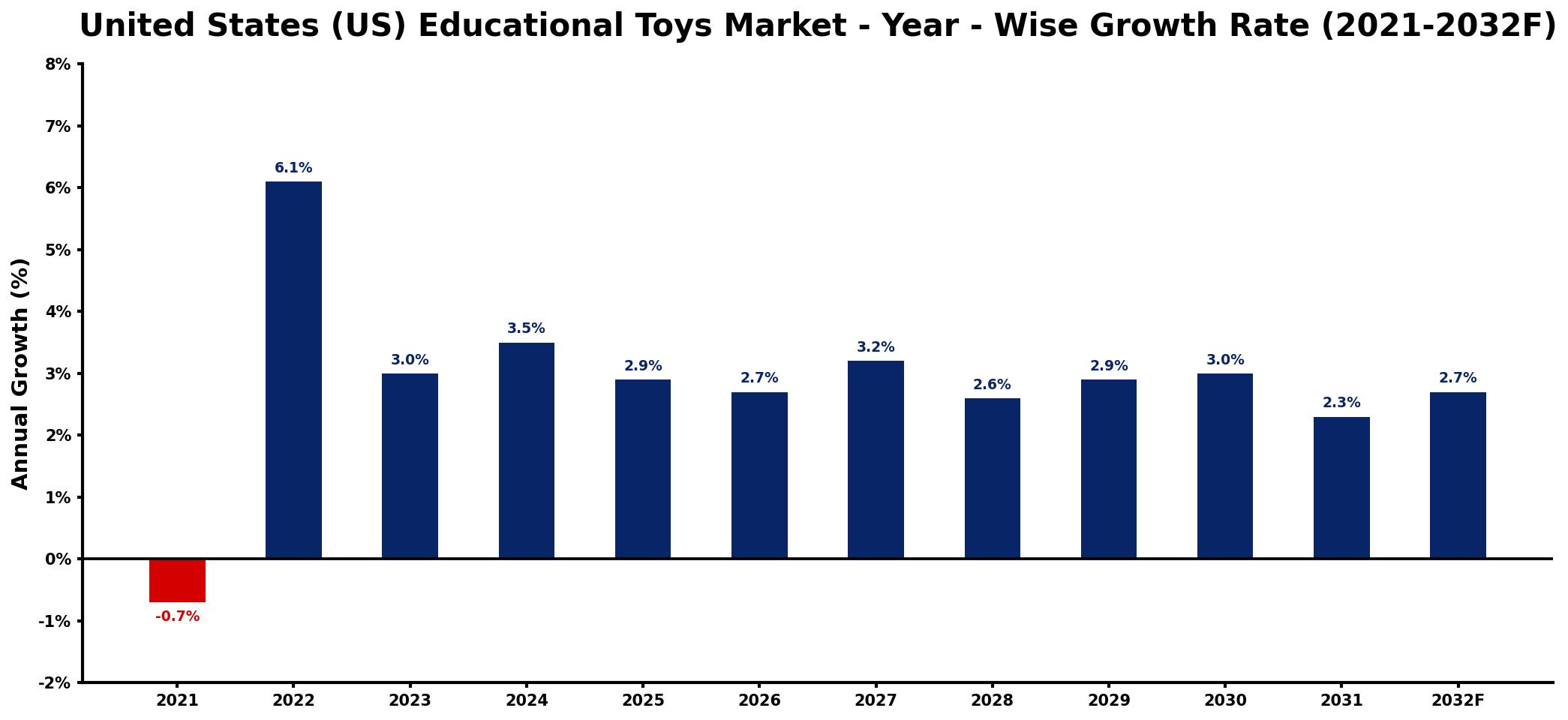
The table below presents the year‑wise growth rates along with the key drivers influencing the market
| Year | Growth Rate | Major Drivers |
| 2021 | -0.7% | reduced consumer spending on leisure |
| 2022 | 6.1% | increased investment in child development |
| 2023 | 3.0% | growing awareness of learning benefits |
| 2024 | 3.5% | expansion of online retail platforms |
| 2025 | 2.9% | rise in parental engagement initiatives |
| 2026 | 2.7% | development of innovative learning methods |
| 2027 | 3.2% | demand for interactive learning experiences |
| 2028 | 2.6% | improved raw material availability |
| 2029 | 2.9% | increased focus on STEM education |
| 2030 | 3.0% | enhanced marketing strategies for families |
| 2031 | 2.3% | emphasis on social learning environments |
| 2032 | 2.7% | growing downstream application demand |
Note: Market size estimations and growth projections presented in this report are based on 6Wresearch's proprietary forecasting methodology, utilizing the latest available industry data, government publications, and primary research inputs.
United States (US) Educational Toys Market Synopsis
As educational toys evolve, a significant trend is the increasing preference for products that promote STEM learning. Parents are increasingly aware of the critical need for science, technology, engineering, and mathematics skills in today's rapidly changing job market. This awareness drives consumer demand for toys that not only entertain but also educate.
Moreover, the market is witnessing a surge in interest toward eco-friendly educational toys. As environmental consciousness grows among consumers, parents are now seeking products that are both sustainable and beneficial for their childrens development. This shift reflects a broader societal trend toward responsible consumption.
United States (US) Educational Toys Market Key Takeaways
- The market is fueled by a heightened emphasis on early childhood education and skill development.
- STEM educational toys are experiencing particularly strong demand as parents focus on future readiness for their children.
- Eco-friendly and sustainable toys are becoming increasingly popular among environmentally conscious consumers.
- Technology-driven toys incorporating interactive features are reshaping the educational toy landscape.
- E-commerce platforms are revolutionizing how educational toys are marketed and sold, broadening their reach across the country.
Evaluation of Restraints in United States (US) Educational Toys Market
Despite the positive growth trajectory, several restraints persist in the US Educational Toys Market. The rise of digital learning platforms poses competition, as many children gravitate toward screens for entertainment and education. This trend can detract from the appeal of traditional educational toys. Additionally, brick-and-mortar stores are facing challenges as consumer shopping habits increasingly shift online, impacting their sales. Manufacturers are also pressured to innovate continuously in response to evolving educational standards, which can strain resources and disrupt production timelines.
United States (US) Educational Toys Market Trends
A significant trend shaping the US Educational Toys Market is the integration of technology into traditional toys. Products featuring augmented reality elements and interactive components are gaining traction as they enhance the learning experience. This fusion of play and technology not only captures children's attention but also deepens their engagement with learning materials.
Additionally, there is a notable rise in personalized educational toys that cater to individual learning styles. Customizable options enable children to engage in learning experiences tailored to their unique interests, further driving demand.
United States (US) Educational Toys Market Opportunities
Investment opportunities in the US Educational Toys Market are plentiful, particularly in segments such as STEM toys and coding kits, which align well with current educational priorities. Companies can explore partnerships with educational institutions to provide targeted learning solutions. The growing interest in sustainability presents avenues for innovation in eco-friendly toy design, appealing to a market segment that values both education and environmental responsibility. Furthermore, emerging technologies like augmented reality can create entirely new dimensions for educational engagement, offering exciting avenues for product development.
Government Initiatives in the United States (US) Educational Toys Market
Government policies regarding educational toys are primarily centered around safety regulations, ensuring that products meet strict standards for child safety. The Consumer Product Safety Commission (CPSC) plays a crucial role in enforcing guidelines concerning potentially harmful substances in toys. Moreover, initiatives to promote STEM education through federal grants and funding highlight a commitment to enhancing educational tools that encourage learning in vital fields.
Future Insights of the United States (US) Educational Toys Market
Looking ahead to 2026-2032, the US Educational Toys Market is poised for robust growth, driven by ongoing advancements in technology and an increasing recognition of the value of educational play. Demand for interactive and skill-building toys will likely continue to rise, alongside a focus on sustainability. As e-commerce becomes further entrenched in shopping habits, the market will likely see diversification in product offerings tailored to a broader range of consumer preferences and age groups.
United States (US) Educational Toys Market Latest Developments (2025 - 2026)
Recent developments within the US Educational Toys Market indicate a growing trend towards interactive learning solutions. Companies are increasingly focusing on incorporating technology into their offerings, creating products that not only educate but also provide an engaging play experience. The market has also seen increased collaborations between educational institutions and toy manufacturers, fostering innovation and aligning products with modern educational curricula.
United States (US) Educational Toys Market - Key Attractiveness of the Report
- 10 Years of Market Numbers
- Historical Data Starting from 2022 to 2025
- Base Year: 2025
- Forecast Data until 2032
- Key Performance Indicators Impacting the Market
- Major Upcoming Developments and Projects
Key Highlights of the Report:
- United States (US) Educational Toys Market Outlook
- Market Size of United States (US) Educational Toys Market, 2025
- Forecast of United States (US) Educational Toys Market, 2032
- Historical Data and Forecast of United States (US) Educational Toys Revenues & Volume for the Period 2022-2032F
- United States (US) Educational Toys Market Trend Evolution
- United States (US) Educational Toys Market Drivers and Challenges
- United States (US) Educational Toys Price Trends
- United States (US) Educational Toys Porter's Five Forces
- United States (US) Educational Toys Industry Life Cycle
- Historical Data and Forecast of United States (US) Educational Toys Market Revenues & Volume By Product Type for the Period 2022-2032F
- Historical Data and Forecast of United States (US) Educational Toys Market Revenues & Volume By Academic toys for the Period 2022-2032F
- Historical Data and Forecast of United States (US) Educational Toys Market Revenues & Volume By Cognitive toys for the Period 2022-2032F
- Historical Data and Forecast of United States (US) Educational Toys Market Revenues & Volume By Motor skills toys for the Period 2022-2032F
- Historical Data and Forecast of United States (US) Educational Toys Market Revenues & Volume By Others for the Period 2022-2032F
- Historical Data and Forecast of United States (US) Educational Toys Market Revenues & Volume By Age Group for the Period 2022-2032F
- Historical Data and Forecast of United States (US) Educational Toys Market Revenues & Volume By 1 ?? 4 years for the Period 2022-2032F
- Historical Data and Forecast of United States (US) Educational Toys Market Revenues & Volume By 4 ?? 8 years for the Period 2022-2032F
- Historical Data and Forecast of United States (US) Educational Toys Market Revenues & Volume By Above 8 years for the Period 2022-2032F
- Historical Data and Forecast of United States (US) Educational Toys Market Revenues & Volume By Others for the Period 2022-2032F
- Historical Data and Forecast of United States (US) Educational Toys Market Revenues & Volume By End-Users for the Period 2022-2032F
- Historical Data and Forecast of United States (US) Educational Toys Market Revenues & Volume By Residential for the Period 2022-2032F
- Historical Data and Forecast of United States (US) Educational Toys Market Revenues & Volume By Commercial for the Period 2022-2032F
- United States (US) Educational Toys Import Export Trade Statistics
- Market Opportunity Assessment By Product Type
- Market Opportunity Assessment By Age Group
- Market Opportunity Assessment By End-Users
- United States (US) Educational Toys Top Companies Market Share
- United States (US) Educational Toys Competitive Benchmarking By Technical and Operational Parameters
- United States (US) Educational Toys Company Profiles
- United States (US) Educational Toys Key Strategic Recommendations






































