United States Musical Instruments Market Year-wise Growth Rate (2021-2031F)
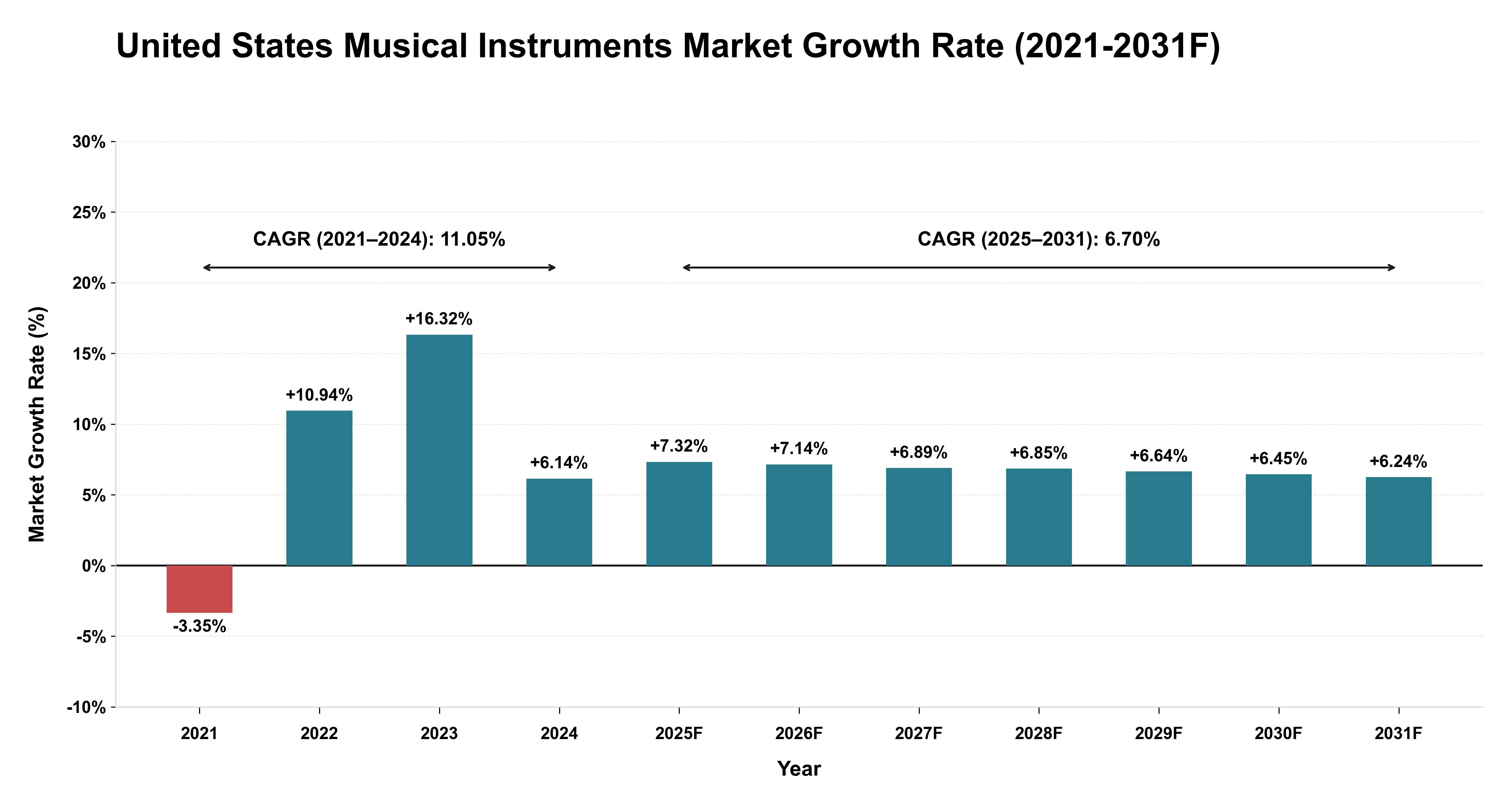
The United States Musical Instruments Market experienced a downturn in 2021 with a growth rate of -3.35%, attributed to the pandemic's impact on discretionary spending. However, from 2022 to 2024, the market rebounded significantly with growth rates of 10.94%, 16.32%, and 6.14% respectively, showcasing a resurgence in consumer demand for musical instruments as live music events resumed and people sought new hobbies. Looking ahead to 2025-2031, the growth trajectory stabilizes but at a slower pace, reflecting a more mature market and steady demand from music enthusiasts rather than the rapid recovery witnessed in the earlier years. The forecasted CAGR of 6.70% indicates a sustainable growth path driven by continuous interest in music education and performance, albeit at a more moderate rate compared to the post-pandemic surge.
Key Highlights of the Report:
- United States (US) Musical Instruments Market Outlook
- Market Size of United States (US) Musical Instruments Market, 2025
- Forecast of United States (US) Musical Instruments Market, 2032
- Historical Data and Forecast of United States (US) Musical Instruments Revenues & Volume for the Period 2022 - 2032F
- United States (US) Musical Instruments Market Trend Evolution
- United States (US) Musical Instruments Market Drivers and Challenges
- United States (US) Musical Instruments Price Trends
- United States (US) Musical Instruments Porter's Five Forces
- United States (US) Musical Instruments Industry Life Cycle
- Historical Data and Forecast of United States (US) Musical Instruments Market Revenues & Volume By Type for the Period 2022 - 2032F
- Historical Data and Forecast of United States (US) Musical Instruments Market Revenues & Volume By Percussion Instruments for the Period 2022 - 2032F
- Historical Data and Forecast of United States (US) Musical Instruments Market Revenues & Volume By String Instruments for the Period 2022 - 2032F
- Historical Data and Forecast of United States (US) Musical Instruments Market Revenues & Volume By Piano & Key Instruments for the Period 2022 - 2032F
- Historical Data and Forecast of United States (US) Musical Instruments Market Revenues & Volume By Organs & Air Blown Instruments for the Period 2022 - 2032F
- Historical Data and Forecast of United States (US) Musical Instruments Market Revenues & Volume By Others for the Period 2022 - 2032F
- Historical Data and Forecast of United States (US) Musical Instruments Market Revenues & Volume By End-users for the Period 2022 - 2032F
- Historical Data and Forecast of United States (US) Musical Instruments Market Revenues & Volume By Commercial Events for the Period 2022 - 2032F
- Historical Data and Forecast of United States (US) Musical Instruments Market Revenues & Volume By Personal Use for the Period 2022 - 2032F
- Historical Data and Forecast of United States (US) Musical Instruments Market Revenues & Volume By Music Production/ Direction for the Period 2022 - 2032F
- Historical Data and Forecast of United States (US) Musical Instruments Market Revenues & Volume By Others for the Period 2022 - 2032F
- United States (US) Musical Instruments Import Export Trade Statistics
- Market Opportunity Assessment By Type
- Market Opportunity Assessment By End-users
- United States (US) Musical Instruments Top Companies Market Share
- United States (US) Musical Instruments Competitive Benchmarking By Technical and Operational Parameters
- United States (US) Musical Instruments Company Profiles
- United States (US) Musical Instruments Key Strategic Recommendations






































