United States Phosphate Fertilizers Market Year-wise Growth Rate (2021-2031F)
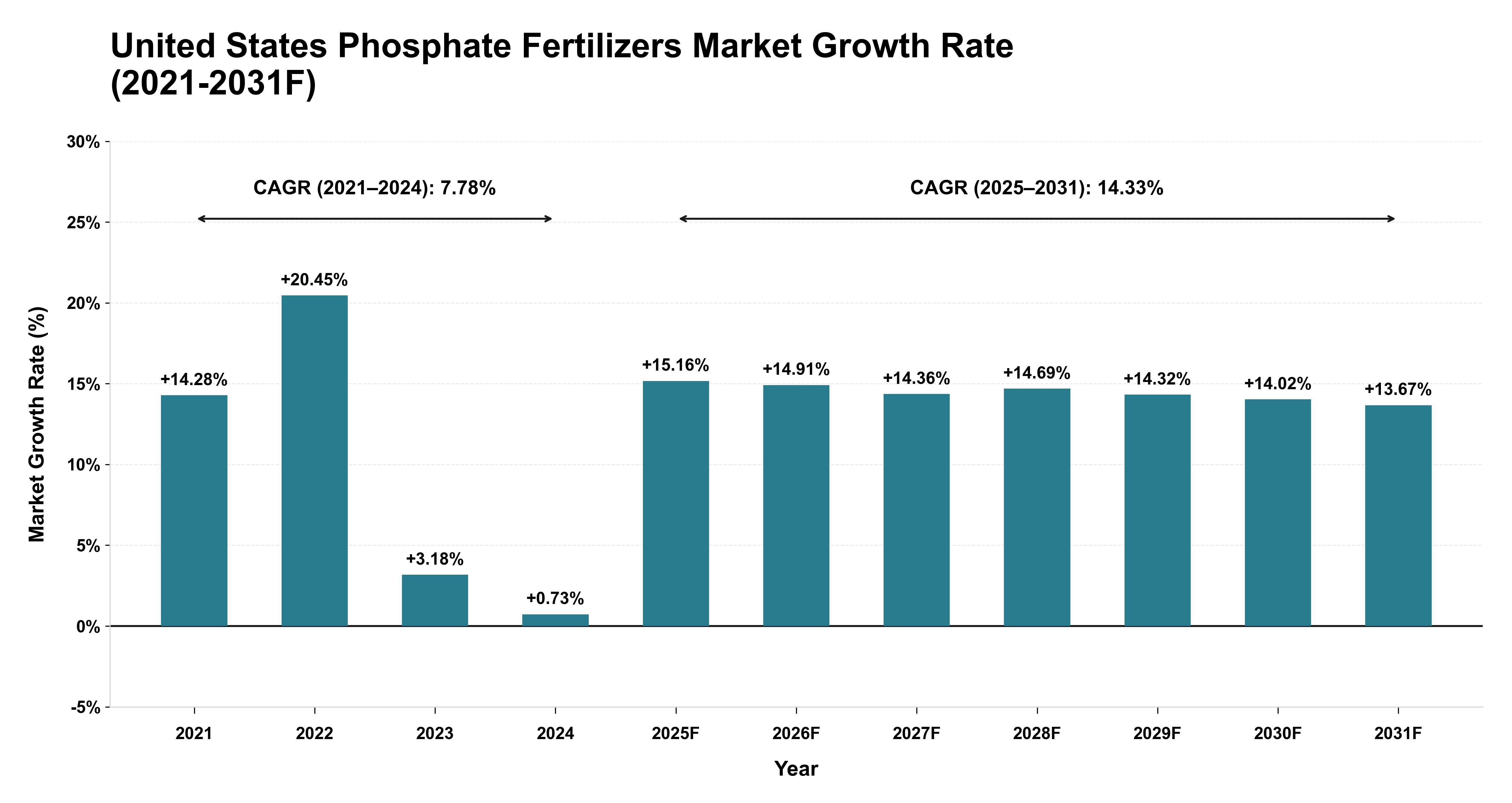
The United States Phosphate Fertilizers Market experienced a robust historical growth trajectory from 2021 to 2024, with a CAGR of 7.78%. This period saw fluctuating growth rates, starting strong at 14.28% in 2021, peaking at 20.45% in 2022, then stabilizing in 2023 at 3.18%, and finally slowing down to 0.73% in 2024. These fluctuations could be attributed to supply chain disruptions, changing agricultural practices, and regulatory adjustments impacting demand dynamics. Looking ahead to the forecast period of 2025-2031 with an expected CAGR of 14.33%, the market is poised for steady growth with consistent annual increases ranging from 13.67% in 2031 to a high of 15.16% in 2025. Anticipated technological advancements in fertilizer production methods and increasing emphasis on sustainable agriculture practices are likely to be key drivers propelling this upward trend over the forecast horizon.
United States (US) Phosphate Fertilizers Market Overview
The United States Phosphate Fertilizers Market is a significant segment of the overall fertilizer industry in the country. Phosphate fertilizers play a crucial role in enhancing crop productivity by providing essential nutrients such as phosphorus to plants. The market is driven by factors such as increasing demand for food production, adoption of modern farming practices, and government support for agricultural development. Key players in the US phosphate fertilizers market include The Mosaic Company, Nutrien Ltd., and CF Industries Holdings, Inc. The market is also influenced by factors like fluctuating raw material prices, environmental concerns regarding phosphate runoff, and regulatory policies. Overall, the US phosphate fertilizers market is expected to witness steady growth in the coming years due to the continuous need for improving agricultural productivity and sustainability.
United States (US) Phosphate Fertilizers Market Trends
The US Phosphate Fertilizers Market is experiencing several key trends. One major trend is the increasing demand for sustainable and environmentally friendly fertilizers, leading to a growing interest in phosphate fertilizers derived from organic sources or produced using innovative technologies to minimize environmental impact. Another notable trend is the rising adoption of precision agriculture techniques, driving the use of phosphate fertilizers that are tailored to specific soil and crop needs for optimal efficiency. Additionally, the market is seeing a shift towards enhanced nutrient formulations that incorporate micronutrients alongside phosphorus to improve plant health and yield. Overall, these trends reflect the industry`s focus on sustainability, efficiency, and innovation in meeting the growing demands of agriculture while minimizing environmental footprint.
United States (US) Phosphate Fertilizers Market Challenges
In the US Phosphate Fertilizers Market, one of the key challenges faced is the fluctuation in raw material prices, particularly phosphate rock, which can impact the overall production costs for fertilizer manufacturers. Additionally, environmental concerns surrounding the use of phosphate fertilizers, such as water pollution and eutrophication, have led to increased regulatory scrutiny and pressure for more sustainable farming practices. Market competitiveness and the presence of alternative fertilizers, like nitrogen and potassium-based products, also pose a challenge for phosphate fertilizer producers in maintaining market share. Furthermore, the global supply chain disruptions and trade uncertainties can impact the availability and pricing of phosphate fertilizers in the US market, making it crucial for industry players to adapt to changing market dynamics and consumer preferences.
United States (US) Phosphate Fertilizers Market Investment Opportunities
The United States phosphate fertilizers market presents several investment opportunities due to factors such as increasing demand for high-yield crops, growing awareness about sustainable agriculture practices, and the need for improved soil fertility. Investors can consider opportunities in companies involved in phosphate mining, manufacturing, distribution, and innovation of new fertilizer products. Additionally, investing in technology-driven solutions for efficient nutrient management and environmental sustainability in the phosphate fertilizers sector could be promising. With the agriculture industry`s continued reliance on fertilizers for crop production, investing in the US phosphate fertilizers market offers potential for growth and profitability, especially for companies focused on sustainability and meeting the evolving needs of modern agriculture practices.
United States (US) Phosphate Fertilizers Market Government Policy
The US government regulates the phosphate fertilizers market through various policies to ensure safety, environmental protection, and fair competition. The Environmental Protection Agency (EPA) sets standards for phosphate fertilizer production to minimize environmental impact and protect human health. The Department of Agriculture (USDA) provides subsidies and support programs to promote domestic production and ensure a stable supply of fertilizers. Additionally, the US government enforces trade policies to prevent unfair practices and ensure fair competition in the market. Overall, government policies aim to balance the needs of farmers, consumers, and the environment in the US phosphate fertilizers market.
United States (US) Phosphate Fertilizers Market Future Outlook
The United States phosphate fertilizers market is expected to witness steady growth in the coming years, driven by factors such as increasing demand for high agricultural productivity, rising focus on sustainable farming practices, and advancements in fertilizer technologies. The market is likely to benefit from the growing awareness among farmers regarding the importance of balanced soil nutrition and the need for efficient crop management practices. Additionally, government initiatives promoting the use of phosphate fertilizers to enhance crop yield and quality are expected to further boost market growth. However, challenges such as fluctuating raw material prices and environmental concerns related to fertilizer runoff may impact market dynamics. Overall, the US phosphate fertilizers market is poised for expansion, with opportunities for market players to innovate and cater to the evolving needs of the agricultural sector.
Key Attractiveness of the Report
- 10 Years of Market Numbers.
- Historical Data Starting from 2022 to 2025.
- Base Year: 2025
- Forecast Data until 2032.
- Key Performance Indicators Impacting the market.
- Major Upcoming Developments and Projects.
Key Highlights of the Report:
- United States (US) Phosphate Fertilizers Market Outlook
- Market Size of United States (US) Phosphate Fertilizers Market, 2025
- Forecast of United States (US) Phosphate Fertilizers Market, 2032
- Historical Data and Forecast of United States (US) Phosphate Fertilizers Revenues & Volume for the Period 2022-2032
- United States (US) Phosphate Fertilizers Market Trend Evolution
- United States (US) Phosphate Fertilizers Market Drivers and Challenges
- United States (US) Phosphate Fertilizers Price Trends
- United States (US) Phosphate Fertilizers Porter's Five Forces
- United States (US) Phosphate Fertilizers Industry Life Cycle
- Historical Data and Forecast of United States (US) Phosphate Fertilizers Market Revenues & Volume By Product for the Period 2022-2032
- Historical Data and Forecast of United States (US) Phosphate Fertilizers Market Revenues & Volume By Monoammonium Phosphate (MAP) for the Period 2022-2032
- Historical Data and Forecast of United States (US) Phosphate Fertilizers Market Revenues & Volume By Diammonium Phosphate (DAP) for the Period 2022-2032
- Historical Data and Forecast of United States (US) Phosphate Fertilizers Market Revenues & Volume By Superphosphate for the Period 2022-2032
- Historical Data and Forecast of United States (US) Phosphate Fertilizers Market Revenues & Volume By Others for the Period 2022-2032
- Historical Data and Forecast of United States (US) Phosphate Fertilizers Market Revenues & Volume By Applications for the Period 2022-2032
- Historical Data and Forecast of United States (US) Phosphate Fertilizers Market Revenues & Volume By Cereals & Grains for the Period 2022-2032
- Historical Data and Forecast of United States (US) Phosphate Fertilizers Market Revenues & Volume By Oilseeds for the Period 2022-2032
- Historical Data and Forecast of United States (US) Phosphate Fertilizers Market Revenues & Volume By Fruits & Vegetables for the Period 2022-2032
- Historical Data and Forecast of United States (US) Phosphate Fertilizers Market Revenues & Volume By Others for the Period 2022-2032
- United States (US) Phosphate Fertilizers Import Export Trade Statistics
- Market Opportunity Assessment By Product
- Market Opportunity Assessment By Applications
- United States (US) Phosphate Fertilizers Top Companies Market Share
- United States (US) Phosphate Fertilizers Competitive Benchmarking By Technical and Operational Parameters
- United States (US) Phosphate Fertilizers Company Profiles
- United States (US) Phosphate Fertilizers Key Strategic Recommendations






































