United States (US) Prepaid Cards Market Size, Share & Growth Rate
The United States (US) Prepaid Cards Market was estimated at USD 410 Million in 2025 and is projected to reach USD 556 Million by 2032, growing at a CAGR of 4.4% from 2026 to 2032. This growth trajectory is driven primarily by the increasing adoption of digital payment solutions and a cultural shift towards cashless transactions. Additionally, the diverse range of prepaid card applications—spanning from payroll to healthcare—reinforces their appeal as flexible financial tools.
United States (US) Prepaid Cards Market Year-wise Growth Rate and Key Drivers
This graph highlights how the United States (US) Prepaid Cards Market has steadily grown over the years, supported by major growth factors.
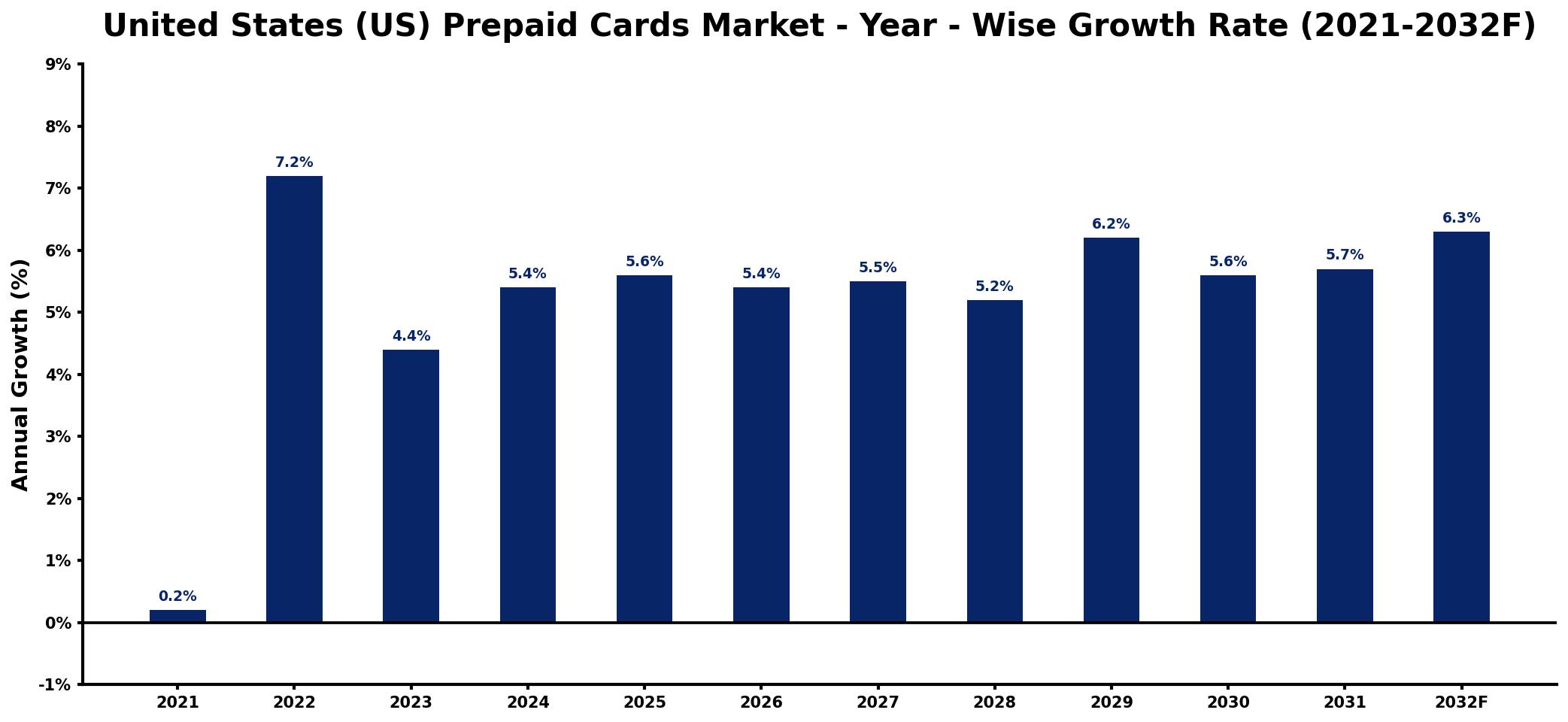
The table below presents the year‑wise growth rates along with the key drivers influencing the market
| Year | Growth Rate | Major Drivers |
| 2021 | 0.2% | Increase in digital payment adoption |
| 2022 | 7.2% | Growth in e-commerce transactions |
| 2023 | 4.4% | Rising demand for financial inclusion |
| 2024 | 5.4% | Expansion of mobile wallet usage |
| 2025 | 5.6% | Investment in fintech innovations |
| 2026 | 5.4% | Surge in online shopping habits |
| 2027 | 5.5% | increased domestic production output |
| 2028 | 5.2% | Increased consumer preference for convenience |
| 2029 | 6.2% | strengthening international trade flows |
| 2030 | 5.6% | Rise in cross-border transactions |
| 2031 | 5.7% | increased production capacity utilization |
| 2032 | 6.3% | Increased focus on security features |
Note: Market size estimations and growth projections presented in this report are based on 6Wresearch's proprietary forecasting methodology, utilizing the latest available industry data, government publications, and primary research inputs.
United States (US) Prepaid Cards Market Synopsis
While the US prepaid cards market has seen remarkable momentum in recent years, propelled by evolving consumer preferences and technological innovations, it is heading toward a phase of sustained expansion. The market is not only responding to immediate trends but is also adapting to a broader financial ecosystem that increasingly prioritizes convenience and inclusivity.
Emerging sectors, such as healthcare and digital wallets, indicate a strong demand for diverse prepaid solutions. As consumer trust grows alongside improvements in security and transparency, the market is set to engage new customer segments and deepen existing relationships.
United States (US) Prepaid Cards Market Key Takeaways
- The market reflects a robust growth outlook, driven by increased digital payment adoption.
- Reloadable prepaid cards are gaining popularity, outperforming single-use options.
- Technological advancements like mobile wallets and contactless payments are reshaping user experiences.
- Consumer demand is shifting towards customizable and eco-friendly prepaid card options.
- Investment opportunities abound in underserved sectors such as healthcare and government benefits.
Evaluation of Restraints in United States (US) Prepaid Cards Market
Despite its growth, the US prepaid cards market faces several significant restraints that can impact its trajectory. Regulatory scrutiny poses challenges, as stakeholders navigate a complex landscape of compliance requirements aimed at preventing fraud and protecting consumers. Moreover, there is ongoing competition from traditional banking products, which can hinder the appeal of prepaid solutions among certain consumer demographics. The perception of hidden fees and limitations associated with prepaid cards remains a hurdle to overcome. Continuous innovation and trust-building measures are essential for the market players to retain consumer confidence.
United States (US) Prepaid Cards Market Trends
Several key trends are shaping the demand for prepaid cards in the United States. A notable shift towards reloadable prepaid cards highlights consumer preferences for flexibility and ongoing usability. Additionally, the rise of digital payments has catalyzed the growth of virtual prepaid cards, allowing users to manage their finances efficiently through mobile applications. Personalization is another emerging trend, with companies offering custom designs and spending limits to enhance user engagement. Eco-friendly initiatives are also gaining traction, as providers embrace sustainability to attract environmentally-conscious consumers.
United States (US) Prepaid Cards Market Opportunities
The US prepaid cards market presents a wealth of investment opportunities. The growing shift toward cashless transactions and the accelerated adoption of digital payments create fertile ground for new prepaid card offerings. Expanding into untapped sectors, such as healthcare, insurance, and government benefits, can lead to significant market share growth. Furthermore, technological innovations, particularly in enhancing security features and user experiences, will be critical for capturing the attention of a broader customer base looking for tailored financial solutions.
Government Initiatives in the United States (US) Prepaid Cards Market
Government policies impacting the US prepaid cards market primarily focus on consumer protection and financial inclusion. The Consumer Financial Protection Bureau (CFPB) plays a crucial role in regulating prepaid cards to ensure transparency regarding fees and terms. Meanwhile, initiatives from the Treasury Department promote access to prepaid cards for underserved populations, aiming to enhance financial inclusion. Regulatory frameworks are designed to strike a balance between innovation and protecting consumer interests in this rapidly evolving landscape.
Future Insights of the United States (US) Prepaid Cards Market
Looking ahead to 2026-2032, the US prepaid cards market is on a promising trajectory. The convergence of increased digital payment adoption and consumer preferences for contactless transactions will likely fuel substantial growth. Continued advancements in technology, combined with a focus on financial literacy and innovative solutions, suggest a vibrant future for the market. The ongoing trend toward cashless economies further underscores the long-term viability of prepaid cards as essential financial tools.
United States (US) Prepaid Cards Market Latest Developments (2025 - 2026)
Recent developments in the US prepaid cards market indicate a significant evolution in both product offerings and consumer engagement strategies. Industry players are increasingly focusing on integrating advanced technologies like blockchain and artificial intelligence to enhance security and streamline user experiences. Additionally, the expansion of partnerships between fintech companies and traditional financial institutions is fostering an ecosystem conducive to innovation, particularly in mobile wallet applications and contactless payment solutions.
United States (US) Prepaid Cards Market - Key Attractiveness of the Report
- 10 Years of Market Numbers
- Historical Data Starting from 2022 to 2025
- Base Year: 2025
- Forecast Data until 2032
- Key Performance Indicators Impacting the Market
- Major Upcoming Developments and Projects
Key Highlights of the Report:
- United States (US) Prepaid Cards Market Outlook
- Market Size of United States (US) Prepaid Cards Market, 2025
- Forecast of United States (US) Prepaid Cards Market, 2032
- Historical Data and Forecast of United States (US) Prepaid Cards Revenues & Volume for the Period 2022-2032F
- United States (US) Prepaid Cards Market Trend Evolution
- United States (US) Prepaid Cards Market Drivers and Challenges
- United States (US) Prepaid Cards Price Trends
- United States (US) Prepaid Cards Porter's Five Forces
- United States (US) Prepaid Cards Industry Life Cycle
- Historical Data and Forecast of United States (US) Prepaid Cards Market Revenues & Volume By Offering for the Period 2022-2032F
- Historical Data and Forecast of United States (US) Prepaid Cards Market Revenues & Volume By General Purpose Card for the Period 2022-2032F
- Historical Data and Forecast of United States (US) Prepaid Cards Market Revenues & Volume By Gift Card for the Period 2022-2032F
- Historical Data and Forecast of United States (US) Prepaid Cards Market Revenues & Volume By Government Benefit/Disbursement Card for the Period 2022-2032F
- Historical Data and Forecast of United States (US) Prepaid Cards Market Revenues & Volume By Incentive/Payroll Card for the Period 2022-2032F
- Historical Data and Forecast of United States (US) Prepaid Cards Market Revenues & Volume By Others for the Period 2022-2032F
- Historical Data and Forecast of United States (US) Prepaid Cards Market Revenues & Volume By Card Type for the Period 2022-2032F
- Historical Data and Forecast of United States (US) Prepaid Cards Market Revenues & Volume By Closed Loop Card for the Period 2022-2032F
- Historical Data and Forecast of United States (US) Prepaid Cards Market Revenues & Volume By Open Loop Card for the Period 2022-2032F
- Historical Data and Forecast of United States (US) Prepaid Cards Market Revenues & Volume By End User for the Period 2022-2032F
- Historical Data and Forecast of United States (US) Prepaid Cards Market Revenues & Volume By Retail for the Period 2022-2032F
- Historical Data and Forecast of United States (US) Prepaid Cards Market Revenues & Volume By Corporate for the Period 2022-2032F
- Historical Data and Forecast of United States (US) Prepaid Cards Market Revenues & Volume By Government/Public Sector for the Period 2022-2032F
- United States (US) Prepaid Cards Import Export Trade Statistics
- Market Opportunity Assessment By Offering
- Market Opportunity Assessment By Card Type
- Market Opportunity Assessment By End User
- United States (US) Prepaid Cards Top Companies Market Share
- United States (US) Prepaid Cards Competitive Benchmarking By Technical and Operational Parameters
- United States (US) Prepaid Cards Company Profiles
- United States (US) Prepaid Cards Key Strategic Recommendations






































