United States (US) Quantum Cryptography Market Size & Growth Rate (2026-2032)
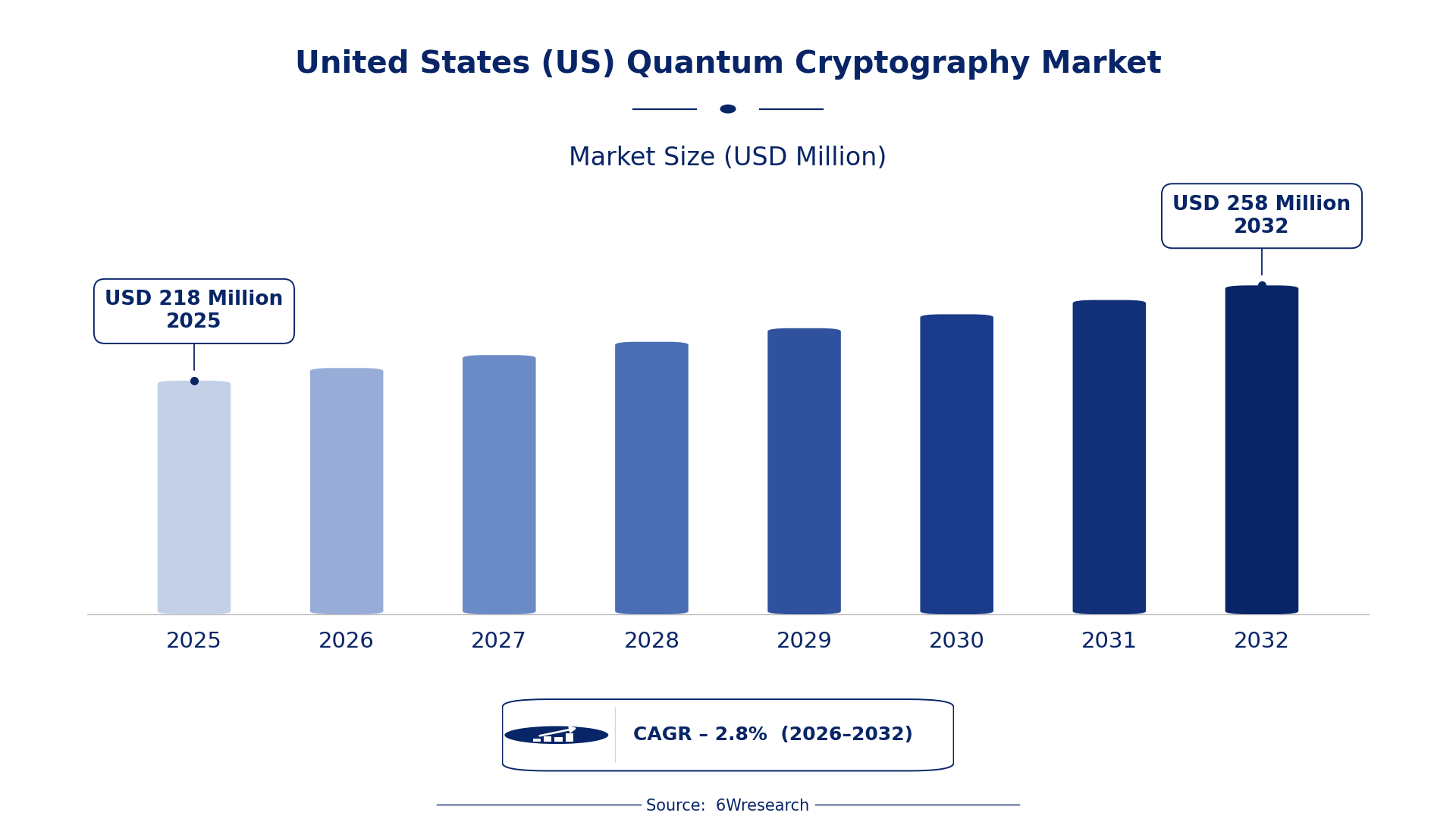
The United States (US) Quantum Cryptography Market was estimated at USD 218 Million in 2025 and is projected to reach USD 258 Million by 2032, growing at a CAGR of 2.8% from 2026 to 2032.
United States (US) Quantum Cryptography Market Synopsis
The US Quantum Cryptography Market is currently witnessing a surge, fueled by escalating cybersecurity threats and advances in quantum technology. As organizations grapple with increasing data breaches, the need for secure communication methods is urgent, positioning quantum cryptography as a leading solution for protecting sensitive information.
Looking ahead, this market is set to experience further growth, propelled by continued investment in research and development by both private and public sectors. As quantum computing capabilities mature, the potential for groundbreaking cryptographic solutions will amplify demand, opening doors for innovative applications across various industries.
United States (US) Quantum Cryptography Market Year-wise Growth Rate and Key Drivers
This graph illustrates the annual growth rates of the United States (US) Quantum Cryptography Market from 2021 to 2032, highlighting a steady upward trajectory and projected expansion over the forecast period.
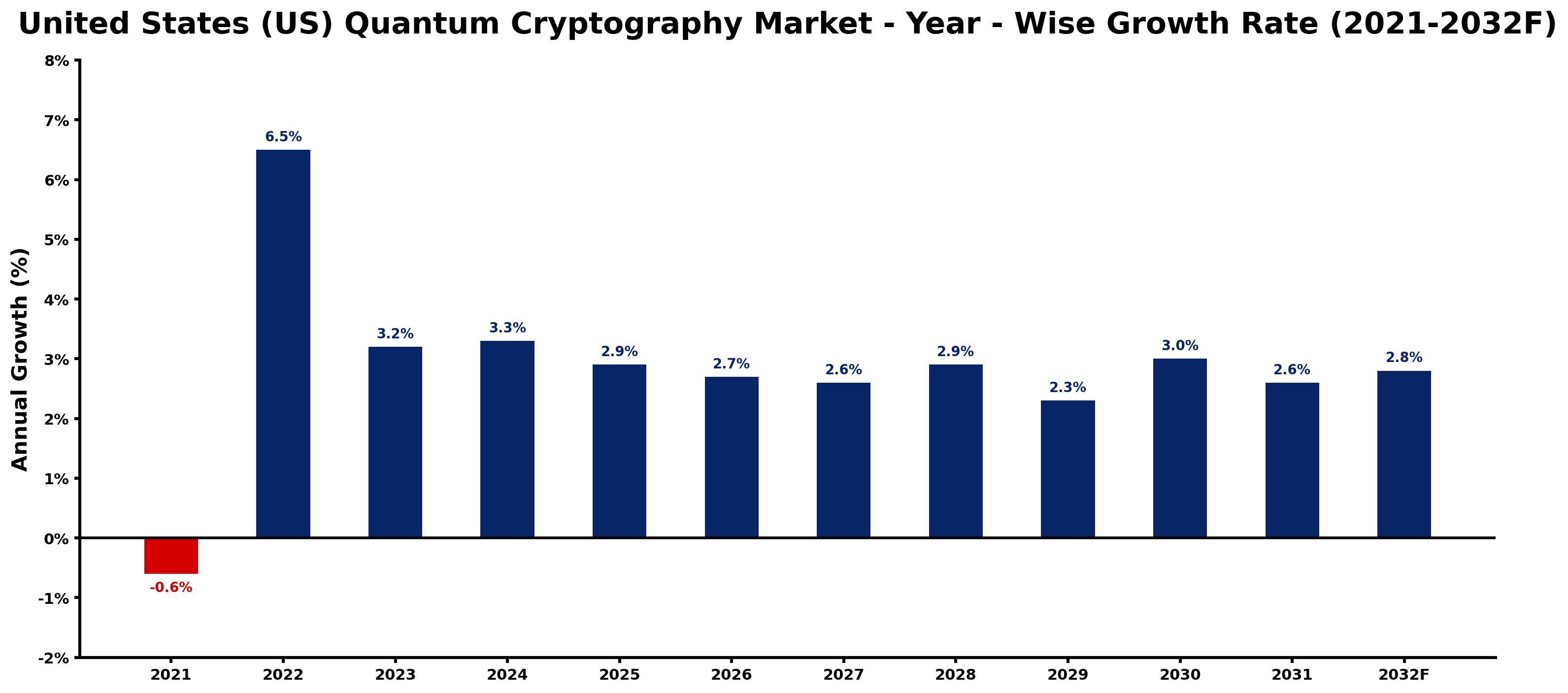
The table below presents the year‑wise growth rates along with the key drivers influencing the market
| Year | Growth Rate | Major Drivers |
| 2021 | -0.6% | Compliance costs from NIST's quantum cybersecurity framework implementation |
| 2022 | 6.5% | Increased federal funding for quantum technology research projects. |
| 2023 | 3.2% | Growing cybersecurity concerns drive demand for quantum encryption. |
| 2024 | 3.3% | Military applications of quantum cryptography spur investment. |
| 2025 | 2.9% | State-level initiatives promote quantum communication infrastructure. |
| 2026 | 2.7% | Advancements in quantum key distribution technology attract businesses. |
| 2027 | 2.6% | Emerging regulations mandate enhanced data protection solutions. |
| 2028 | 2.9% | Private sector partnerships expand quantum development programs. |
| 2029 | 2.3% | Rising threats from cyber attacks heighten encryption needs. |
| 2030 | 3.0% | Educational institutions launch specialized quantum cryptography programs. |
| 2031 | 2.6% | Government contracts prioritize quantum security for defense systems. |
| 2032 | 2.8% | Increased market awareness of quantum advantages boosts adoption. |
Note: Market size estimations and growth projections presented in this report are based on 6Wresearch's proprietary forecasting methodology, utilizing the latest available industry data, government publications, and primary research inputs.
United States (US) Quantum Cryptography Market Key Takeaways
Below are some of the specific key takeaways from the market, including:
- Heightened cybersecurity concerns are driving the adoption of quantum cryptography solutions.
- Quantum key distribution (QKD) technology is gaining traction as a secure means of data encryption.
- Investment in quantum computing research is facilitating advancements in cryptographic technologies.
- The US government is significantly backing initiatives aimed at enhancing quantum cryptography standards.
- Collaborations between public and private sectors are critical in integrating quantum solutions into existing security frameworks.
Evaluation of Restraints in United States (US) Quantum Cryptography Market
Despite its momentum, the US Quantum Cryptography Market faces notable barriers. High implementation costs deter many organizations from fully embracing these advanced solutions. on top of that, the scarcity of skilled professionals proficient in quantum technology hampers deployment efforts. The market also grapples with a lack of standardized protocols, which complicates widespread adoption and can lead to fragmentation in the approach to security. Ensuring the effectiveness of quantum cryptography in light of rapid technological changes and evolving cyber threats remains a key concern for stakeholders.
United States (US) Quantum Cryptography Market Trends
The drive towards adopting quantum cryptography is increasingly evident in various sectors. Businesses are prioritizing quantum key distribution systems due to their unmatched security features, which leverage quantum mechanics for encryption. Additionally, the technology’s application in sectors like finance and healthcare is on the rise, as organizations seek to safeguard critical data against sophisticated cyberattacks. Investment in quantum research initiatives is fueling a more profound understanding of the technology, leading to ongoing innovations and practical applications.
United States (US) Quantum Cryptography Market Opportunities
Investment prospects in the US Quantum Cryptography Market are plentiful. Companies are increasingly aware of the importance of secure communication channels, particularly in an age of relentless cyber threats. Opportunities are abundant in the research and development of cutting-edge encryption algorithms, which could lead to breakthroughs in data security. on top of that, initiatives aiming to commercialize quantum key distribution systems present a lucrative avenue for investors. Collaborations with industry partners can also yield fruitful results as organizations strive to integrate quantum cryptography within their existing security infrastructures.
Government Initiatives in the United States (US) Quantum Cryptography Market
The US government is actively shaping the future of quantum cryptography through targeted policy initiatives aimed at bolstering national cybersecurity. With a strategic focus on advancing quantum technologies, government support is essential in guiding research and establishing standards that enhance security across both public and private sectors. As quantum threats loom, these policies are critical for fostering innovation and ensuring that the US remains at the forefront of global cybersecurity efforts.
- A major funding initiative under the National Quantum Initiative Act, launched in 2018, continues to allocate resources for advancing quantum cryptography research.
- The National Institute of Standards and Technology (NIST) is actively engaged in creating new cryptographic standards that will protect US infrastructure from quantum threats.
- Current projects aimed at establishing public-private partnerships are focused on integrating quantum cryptography into existing cybersecurity frameworks.
- Planned initiatives include a regulatory framework expected to be introduced by 2027, aimed at standardizing quantum encryption protocols across industries.
Future Insights of the United States (US) Quantum Cryptography Market
From 2026 to 2032, the US Quantum Cryptography Market is set for remarkable growth. As quantum computing technology evolves, the demand for quantum cryptography solutions will expand significantly across industries. Government initiatives focused on enhancing cybersecurity infrastructure will further catalyze market growth. Organizations will prioritize the implementation of quantum technologies as they aim to secure their communications against emerging cyber threats, leading to new applications and innovative developments in the sector.
United States (US) Quantum Cryptography Market Latest Developments
In the past year, significant developments have unfolded within the US Quantum Cryptography Market, reflecting a growing commitment to enhancing cybersecurity through quantum technologies. The focus has shifted towards practical implementations of quantum solutions, as organizations seek to stay ahead of sophisticated cyber threats.
- A leading technology vendor launched a new quantum key distribution system in Q1 2025, aimed at financial institutions seeking to protect sensitive transaction data.
- Research initiatives that began in late 2024 to explore quantum encryption methods are currently underway, showing promising results in enhancing data security.
- In early 2025, a collaborative project between government and industry stakeholders was announced to develop quantum-safe infrastructure for critical communication systems.
- Upcoming in mid-2026 is a national awareness campaign to educate businesses about the benefits of quantum cryptography.
United States (US) Quantum Cryptography Market - Key Attractiveness of the Report
- 10 Years of Market Numbers
- Historical Data Starting from 2022 to 2025
- Base Year: 2025
- Forecast Data until 2032
- Key Performance Indicators Impacting the Market
- Major Upcoming Developments and Projects
Key Highlights of the Report:
- United States (US) Quantum Cryptography Market Outlook
- Market Size of United States (US) Quantum Cryptography Market, 2025
- Forecast of United States (US) Quantum Cryptography Market, 2032
- Historical Data and Forecast of United States (US) Quantum Cryptography Revenues & Volume for the Period 2022-2032F
- United States (US) Quantum Cryptography Market Trend Evolution
- United States (US) Quantum Cryptography Market Drivers and Challenges
- United States (US) Quantum Cryptography Price Trends
- United States (US) Quantum Cryptography Porter's Five Forces
- United States (US) Quantum Cryptography Industry Life Cycle
- Historical Data and Forecast of United States (US) Quantum Cryptography Market Revenues & Volume By Component for the Period 2022-2032F
- Historical Data and Forecast of United States (US) Quantum Cryptography Market Revenues & Volume By Solutions for the Period 2022-2032F
- Historical Data and Forecast of United States (US) Quantum Cryptography Market Revenues & Volume By Services for the Period 2022-2032F
- Historical Data and Forecast of United States (US) Quantum Cryptography Market Revenues & Volume By Services for the Period 2022-2032F
- Historical Data and Forecast of United States (US) Quantum Cryptography Market Revenues & Volume By Consulting for the Period 2022-2032F
- Historical Data and Forecast of United States (US) Quantum Cryptography Market Revenues & Volume By Advisory for the Period 2022-2032F
- Historical Data and Forecast of United States (US) Quantum Cryptography Market Revenues & Volume By Deployment for the Period 2022-2032F
- Historical Data and Forecast of United States (US) Quantum Cryptography Market Revenues & Volume By Integration for the Period 2022-2032F
- Historical Data and Forecast of United States (US) Quantum Cryptography Market Revenues & Volume By Support for the Period 2022-2032F
- Historical Data and Forecast of United States (US) Quantum Cryptography Market Revenues & Volume By Maintenance for the Period 2022-2032F
- Historical Data and Forecast of United States (US) Quantum Cryptography Market Revenues & Volume By Security Type for the Period 2022-2032F
- Historical Data and Forecast of United States (US) Quantum Cryptography Market Revenues & Volume By Network for the Period 2022-2032F
- Historical Data and Forecast of United States (US) Quantum Cryptography Market Revenues & Volume By Application Security for the Period 2022-2032F
- Historical Data and Forecast of United States (US) Quantum Cryptography Market Revenues & Volume By Vertical for the Period 2022-2032F
- Historical Data and Forecast of United States (US) Quantum Cryptography Market Revenues & Volume By Government and defense for the Period 2022-2032F
- Historical Data and Forecast of United States (US) Quantum Cryptography Market Revenues & Volume By BFSI for the Period 2022-2032F
- Historical Data and Forecast of United States (US) Quantum Cryptography Market Revenues & Volume By Retail for the Period 2022-2032F
- Historical Data and Forecast of United States (US) Quantum Cryptography Market Revenues & Volume By Healthcare for the Period 2022-2032F
- Historical Data and Forecast of United States (US) Quantum Cryptography Market Revenues & Volume By Automotive for the Period 2022-2032F
- Historical Data and Forecast of United States (US) Quantum Cryptography Market Revenues & Volume By Others (telecom, energy and utilities, logistics, and education) for the Period 2022-2032F
- United States (US) Quantum Cryptography Import Export Trade Statistics
- Market Opportunity Assessment By Component
- Market Opportunity Assessment By Services
- Market Opportunity Assessment By Security Type
- Market Opportunity Assessment By Vertical
- United States (US) Quantum Cryptography Top Companies Market Share
- United States (US) Quantum Cryptography Competitive Benchmarking By Technical and Operational Parameters
- United States (US) Quantum Cryptography Company Profiles
- United States (US) Quantum Cryptography Key Strategic Recommendations






































