United States (US) Real Estate Market Size, Share & Growth Rate
The United States (US) Real Estate Market was estimated at USD 119 Million in 2025 and is projected to reach USD 140 Million by 2032, growing at a CAGR of 2.3% from 2026 to 2032. This growth trajectory is largely fueled by low mortgage rates and a robust job market, which continue to attract buyers. The expanding population, particularly in suburban areas, also plays a critical role in maintaining demand for residential properties.
United States (US) Real Estate Market Year-wise Growth Rate and Key Drivers
This graph highlights how the United States (US) Real Estate Market has steadily grown over the years, supported by major growth factors.
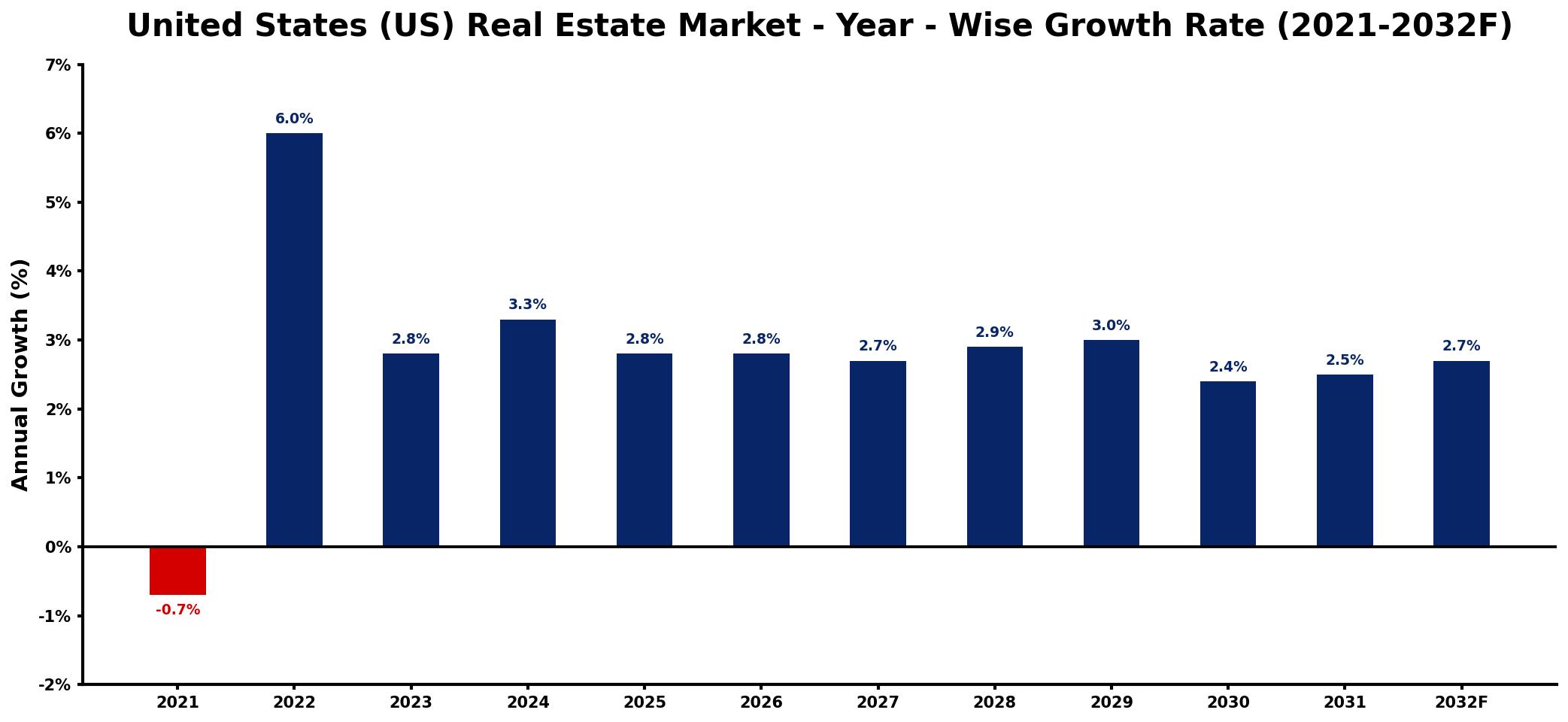
The table below presents the year‑wise growth rates along with the key drivers influencing the market
| Year | Growth Rate | Major Drivers |
| 2021 | -0.7% | decreased consumer confidence in housing |
| 2022 | 6.0% | increased demand for suburban living |
| 2023 | 2.8% | growing interest in eco-friendly homes |
| 2024 | 3.3% | expansion of remote work opportunities |
| 2025 | 2.8% | rising investments in residential developments |
| 2026 | 2.8% | increased availability of financing options |
| 2027 | 2.7% | growing urban redevelopment projects |
| 2028 | 2.9% | higher demand for multi-family units |
| 2029 | 3.0% | rising end-use demand growth |
| 2030 | 2.4% | rising export shipment volumes |
| 2031 | 2.5% | growing downstream application demand |
| 2032 | 2.7% | increased investment in infrastructure projects |
Note: Market size estimations and growth projections presented in this report are based on 6Wresearch's proprietary forecasting methodology, utilizing the latest available industry data, government publications, and primary research inputs.
United States (US) Real Estate Market Synopsis
Currently, the US real estate market is characterized by an unprecedented demand for housing, especially in suburban locales, driven by a shift towards remote work and the desire for larger living spaces. Urban centers, while still competitive, face the challenge of high prices and limited inventory.
The market also shows resilience in the face of rising construction costs and affordability challenges. Potential homebuyers are vying for limited properties, resulting in fast-paced sales and competitive bidding situations, especially for single-family homes.
United States (US) Real Estate Market Key Takeaways
- Demand for suburban homes is surging as buyers seek space and affordability.
- Competition among buyers is intensifying, leading to quicker sales and bidding wars.
- Low mortgage rates continue to stimulate both home purchases and refinancing activities.
- Concerns about climate change are increasingly influencing property values and insurance rates.
- The market shows adaptability, embracing technology such as virtual tours and digital transactions.
Evaluation of Restraints in United States (US) Real Estate Market
Despite its dynamic nature, the US real estate market faces significant constraints. Affordability has become a pressing issue, with home prices escalating faster than wage growth, particularly affecting first-time buyers. The limited inventory further exacerbates this situation, creating intense competition among potential buyers. Additionally, fluctuating interest rates complicate mortgage affordability, leading to uncertainty among consumers. Regulatory hurdles, such as zoning restrictions, can also hinder new developments, placing additional pressure on the market.
United States (US) Real Estate Market Trends
Emerging trends in the US real estate market include a notable rise in demand for sustainable and energy-efficient properties. Homebuyers are increasingly prioritizing these attributes, reflecting a broader awareness of environmental issues. Additionally, as digital transactions gain prominence due to the pandemic, real estate professionals are investing in virtual tours and online marketing strategies. The growth of remote work is also reshaping residential preferences, prompting individuals to consider homes in previously overlooked areas.
United States (US) Real Estate Market Opportunities
Investment opportunities in the US real estate market are diverse. Residential properties, including single-family homes and multi-family units, present substantial prospects for rental income and capital appreciation. Commercial real estate also offers attractive returns, particularly in sectors like industrial properties and retail spaces. Furthermore, the rise of real estate crowdfunding platforms allows a broader base of investors to participate in lucrative real estate projects. For those looking to diversify their portfolios, Real Estate Investment Trusts (REITs) provide a convenient avenue without the need for direct property ownership.
Government Initiatives in the United States (US) Real Estate Market
Government policies play a crucial role in the US real estate landscape. Initiatives like the Federal Housing Administration (FHA) and Fannie Mae support homeownership by providing affordable mortgage options. Tax incentives, including the mortgage interest deduction, are designed to encourage home buying and investment in real estate. Local zoning laws affect land use and development, influencing market dynamics and property values.
Future Insights of the United States (US) Real Estate Market
Looking ahead to 2026-2032, the US real estate market is poised for continued growth, underpinned by persistent demand and a favorable economic environment. However, challenges such as rising construction costs and persistent inventory shortages may temper the pace of growth. Urban areas are anticipated to maintain strong demand for rental properties, while suburban regions will likely continue to attract buyers seeking affordability. The integration of technology in real estate transactions and the evolving work-from-home culture will further shape market trends.
United States (US) Real Estate Market Latest Developments (2025 - 2026)
In recent months, the US real estate market has experienced significant shifts as remote work continues to influence buyer behavior. There has been a marked increase in demand for properties in suburban areas, particularly those offering outdoor space and modern amenities. The adoption of technology in the industry has accelerated, with virtual home tours and online transactions becoming the norm. Meanwhile, ongoing discussions around regulatory reforms aim to address zoning challenges that could facilitate new developments.
United States (US) Real Estate Market - Key Attractiveness of the Report
- 10 Years of Market Numbers
- Historical Data Starting from 2022 to 2025
- Base Year: 2025
- Forecast Data until 2032
- Key Performance Indicators Impacting the Market
- Major Upcoming Developments and Projects
Key Highlights of the Report:
- United States (US) Real Estate Market Outlook
- Market Size of United States (US) Real Estate Market, 2025
- Forecast of United States (US) Real Estate Market, 2032
- Historical Data and Forecast of United States (US) Real Estate Revenues & Volume for the Period 2022-2032F
- United States (US) Real Estate Market Trend Evolution
- United States (US) Real Estate Market Drivers and Challenges
- United States (US) Real Estate Price Trends
- United States (US) Real Estate Porter's Five Forces
- United States (US) Real Estate Industry Life Cycle
- Historical Data and Forecast of United States (US) Real Estate Market Revenues & Volume By Property for the Period 2022-2032F
- Historical Data and Forecast of United States (US) Real Estate Market Revenues & Volume By Residential for the Period 2022-2032F
- Historical Data and Forecast of United States (US) Real Estate Market Revenues & Volume By Commercial for the Period 2022-2032F
- Historical Data and Forecast of United States (US) Real Estate Market Revenues & Volume By Industrial for the Period 2022-2032F
- Historical Data and Forecast of United States (US) Real Estate Market Revenues & Volume By Land for the Period 2022-2032F
- Historical Data and Forecast of United States (US) Real Estate Market Revenues & Volume By Others for the Period 2022-2032F
- Historical Data and Forecast of United States (US) Real Estate Market Revenues & Volume By Type for the Period 2022-2032F
- Historical Data and Forecast of United States (US) Real Estate Market Revenues & Volume By Sales for the Period 2022-2032F
- Historical Data and Forecast of United States (US) Real Estate Market Revenues & Volume By Rental for the Period 2022-2032F
- Historical Data and Forecast of United States (US) Real Estate Market Revenues & Volume By Lease for the Period 2022-2032F
- United States (US) Real Estate Import Export Trade Statistics
- Market Opportunity Assessment By Property
- Market Opportunity Assessment By Type
- United States (US) Real Estate Top Companies Market Share
- United States (US) Real Estate Competitive Benchmarking By Technical and Operational Parameters
- United States (US) Real Estate Company Profiles
- United States (US) Real Estate Key Strategic Recommendations






































