United States (US) Sodium fluoride Market Size, Share & Growth Rate
The United States (US) Sodium fluoride Market was estimated at USD 183 Million in 2025 and is projected to reach USD 215 Million by 2032, growing at a CAGR of 2.3% from 2026 to 2032. This growth trajectory is propelled by an increasing focus on oral health, where sodium fluoride plays a crucial role in dental care products. Furthermore, its necessity in water treatment processes for fluoridation is significantly contributing to the rising demand across various sectors.
United States (US) Sodium fluoride Market Year-wise Growth Rate and Key Drivers
This graph highlights how the United States (US) Sodium fluoride Market has steadily grown over the years, supported by major growth factors.
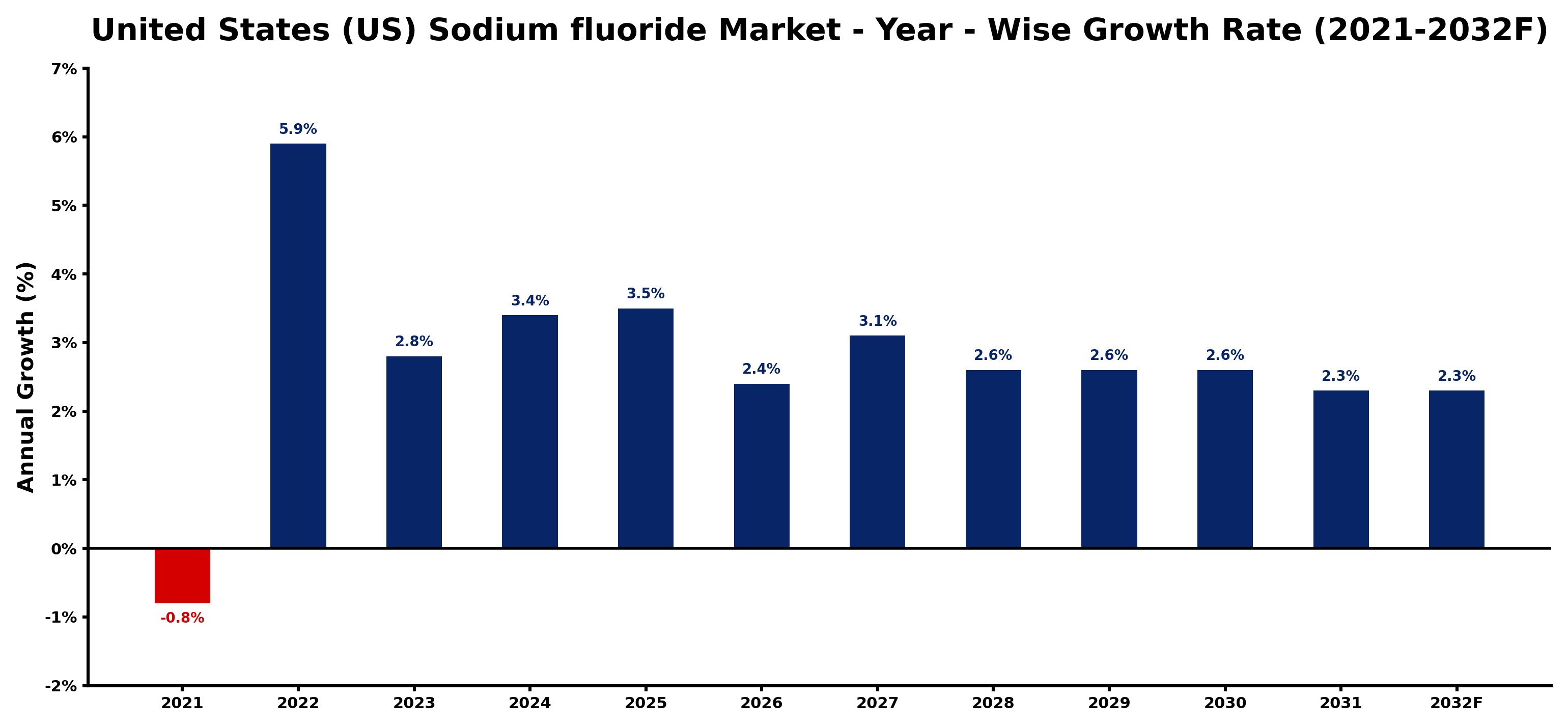
The table below presents the year‑wise growth rates along with the key drivers influencing the market
| Year | Growth Rate | Major Drivers |
| 2021 | -0.8% | Supply chain disruptions led to decreased sodium fluoride availability |
| 2022 | 5.9% | Domestic manufacturers boosted sodium fluoride production through efficiency upgrades |
| 2023 | 2.8% | Sodium fluoride production capacity increases due to rising dental applications |
| 2024 | 3.4% | Export driven demand for specialty chemicals boosts sodium fluoride production |
| 2025 | 3.5% | Export driven pharmaceutical manufacturing boosts sodium fluoride demand significantly |
| 2026 | 2.4% | Fluoride supply chain investments boosted specialty chemical production capacity |
| 2027 | 3.1% | Export driven battery production surge boosts sodium fluoride consumption |
| 2028 | 2.6% | New chemical plants boost sodium fluoride production capabilities across states |
| 2029 | 2.6% | New sodium fluoride production facilities boost local manufacturing capabilities |
| 2030 | 2.6% | Improved sodium fluoride processing technology enhanced product quality and efficiency |
| 2031 | 2.3% | Increased lithium battery production boosts sodium fluoride demand for manufacturing |
| 2032 | 2.3% | Export driven chemical production upgrades bolstered sodium fluoride supply chains |
Note - Market size estimations and growth projections presented in this report are based on 6Wresearch’s advanced forecasting approach, validated with industry datasets as of June 2026.
United States (US) Sodium fluoride Market Synopsis
The demand for sodium fluoride in the United States is underpinned by its essential application in dental care and water fluoridation. As consumers become more conscious of oral health, sodium fluoride's efficacy in preventing cavities drives its incorporation into oral hygiene products.
Additionally, the compound's role in chemical manufacturing further reinforces its market presence. These applications, combined with supportive regulatory frameworks, are key elements propelling market stability and growth.
United States (US) Sodium fluoride Market Key Takeaways
- Significant growth driven by increased awareness of oral health and effective tooth decay prevention.
- Strong applications in dental products and water treatment facilities bolster overall demand.
- Innovation in product formulations is increasingly prevalent to meet consumer preferences.
- Key regulatory bodies, including the EPA and FDA, shape market practices and standards.
- Investment opportunities abound in production, distribution, and technological advancements.
Evaluation of Restraints in United States (US) Sodium fluoride Market
Despite the positive growth outlook, the US Sodium fluoride market faces notable constraints. Increasing competition from alternative fluoride solutions, such as gels and varnishes, presents a challenge as these alternatives often appeal more to consumers seeking convenience. Additionally, rising health concerns regarding excessive fluoride exposure may drive some consumers toward fluoride-free products, thereby affecting overall sodium fluoride demand. Regulatory scrutiny around fluoride levels in both water and oral care products continues to tighten, necessitating companies to adapt quickly to maintain compliance and meet consumer safety expectations.
United States (US) Sodium fluoride Market Trends
Currently, there is a notable shift toward innovation in sodium fluoride product formulations, aimed at addressing evolving consumer preferences for more natural and organic options. The dental care sector particularly emphasizes these trends, prompting manufacturers to explore more sustainable practices and ingredients. Moreover, the ongoing promotion of community water fluoridation programs reflects a robust public health initiative, which continues to foster growth in demand for sodium fluoride.
United States (US) Sodium fluoride Market Opportunities
The United States Sodium fluoride market is ripe with investment prospects. A burgeoning interest in dental hygiene, coupled with a sustained need for fluoride in water treatment facilities, presents numerous avenues for growth. Investors may explore opportunities in companies that focus on the production and distribution of sodium fluoride, as well as research initiatives aimed at discovering new applications and formulations. With preventive healthcare becoming a focal point for consumers, the oral care segment, particularly for sodium fluoride-infused products, shows significant potential for profitability and expansion.
Government Initiatives in the United States (US) Sodium fluoride Market
Government regulations surrounding sodium fluoride emphasize the importance of public health and safety. The Environmental Protection Agency (EPA) sets strict guidelines for fluoride levels in drinking water, ensuring consumer protection against excessive exposure. Concurrently, the Food and Drug Administration (FDA) oversees sodium fluoride in oral health products, maintaining stringent standards for their safe use. The Centers for Disease Control and Prevention (CDC) actively promotes community fluoridation programs, which underscore a commitment to improving dental health across the nation.
Future Insights of the United States (US) Sodium fluoride Market
Looking ahead to 2026-2032, the outlook for the US Sodium fluoride market remains optimistic. Continued emphasis on oral care and preventive health is anticipated to sustain demand. Moreover, technological advancements in sodium fluoride production and application are likely to drive innovation and efficiency, further bolstering market growth. However, companies must remain vigilant regarding regulatory dynamics and consumer preferences to navigate potential challenges effectively and harness opportunities for future development.
United States (US) Sodium fluoride Market Latest Developments (May 2025 - June 2026)
Recent developments in the sodium fluoride market indicate a shift toward sustainable practices, with an increasing number of manufacturers investing in environmentally friendly production processes. Moreover, there is a notable uptick in research collaborations aimed at enhancing the efficacy of sodium fluoride products. Regulatory bodies continue to refine guidelines, ensuring that consumer safety remains paramount while encouraging innovation in the sector.
United States (US) Sodium fluoride Market - Key Attractiveness of the Report
- 10 Years of Market Numbers
- Historical Data Starting from 2022 to 2025
- Base Year: 2025
- Forecast Data until 2032
- Key Performance Indicators Impacting the Market
- Major Upcoming Developments and Projects
Key Highlights of the Report:
- United States (US) Sodium fluoride Market Outlook
- Market Size of United States (US) Sodium fluoride Market, 2025
- Forecast of United States (US) Sodium fluoride Market, 2032
- Historical Data and Forecast of United States (US) Sodium fluoride Revenues & Volume for the Period 2022-2032F
- United States (US) Sodium fluoride Market Trend Evolution
- United States (US) Sodium fluoride Market Drivers and Challenges
- United States (US) Sodium fluoride Price Trends
- United States (US) Sodium fluoride Porter's Five Forces
- United States (US) Sodium fluoride Industry Life Cycle
- Historical Data and Forecast of United States (US) Sodium fluoride Market Revenues & Volume By Grade for the Period 2022-2032F
- Historical Data and Forecast of United States (US) Sodium fluoride Market Revenues & Volume By Food Grade for the Period 2022-2032F
- Historical Data and Forecast of United States (US) Sodium fluoride Market Revenues & Volume By Pharmaceutical Grade for the Period 2022-2032F
- Historical Data and Forecast of United States (US) Sodium fluoride Market Revenues & Volume By Industrial Grade for the Period 2022-2032F
- Historical Data and Forecast of United States (US) Sodium fluoride Market Revenues & Volume By Applications for the Period 2022-2032F
- Historical Data and Forecast of United States (US) Sodium fluoride Market Revenues & Volume By Dental Products for the Period 2022-2032F
- Historical Data and Forecast of United States (US) Sodium fluoride Market Revenues & Volume By Water Treatment for the Period 2022-2032F
- Historical Data and Forecast of United States (US) Sodium fluoride Market Revenues & Volume By Insecticides & Pesticides for the Period 2022-2032F
- Historical Data and Forecast of United States (US) Sodium fluoride Market Revenues & Volume By Pharmaceuticals for the Period 2022-2032F
- Historical Data and Forecast of United States (US) Sodium fluoride Market Revenues & Volume By Others for the Period 2022-2032F
- United States (US) Sodium fluoride Import Export Trade Statistics
- Market Opportunity Assessment By Grade
- Market Opportunity Assessment By Applications
- United States (US) Sodium fluoride Top Companies Market Share
- United States (US) Sodium fluoride Competitive Benchmarking By Technical and Operational Parameters
- United States (US) Sodium fluoride Company Profiles
- United States (US) Sodium fluoride Key Strategic Recommendations






































