Uruguay Decorative Glass Market Year-wise Growth Rate (2021-2031F)
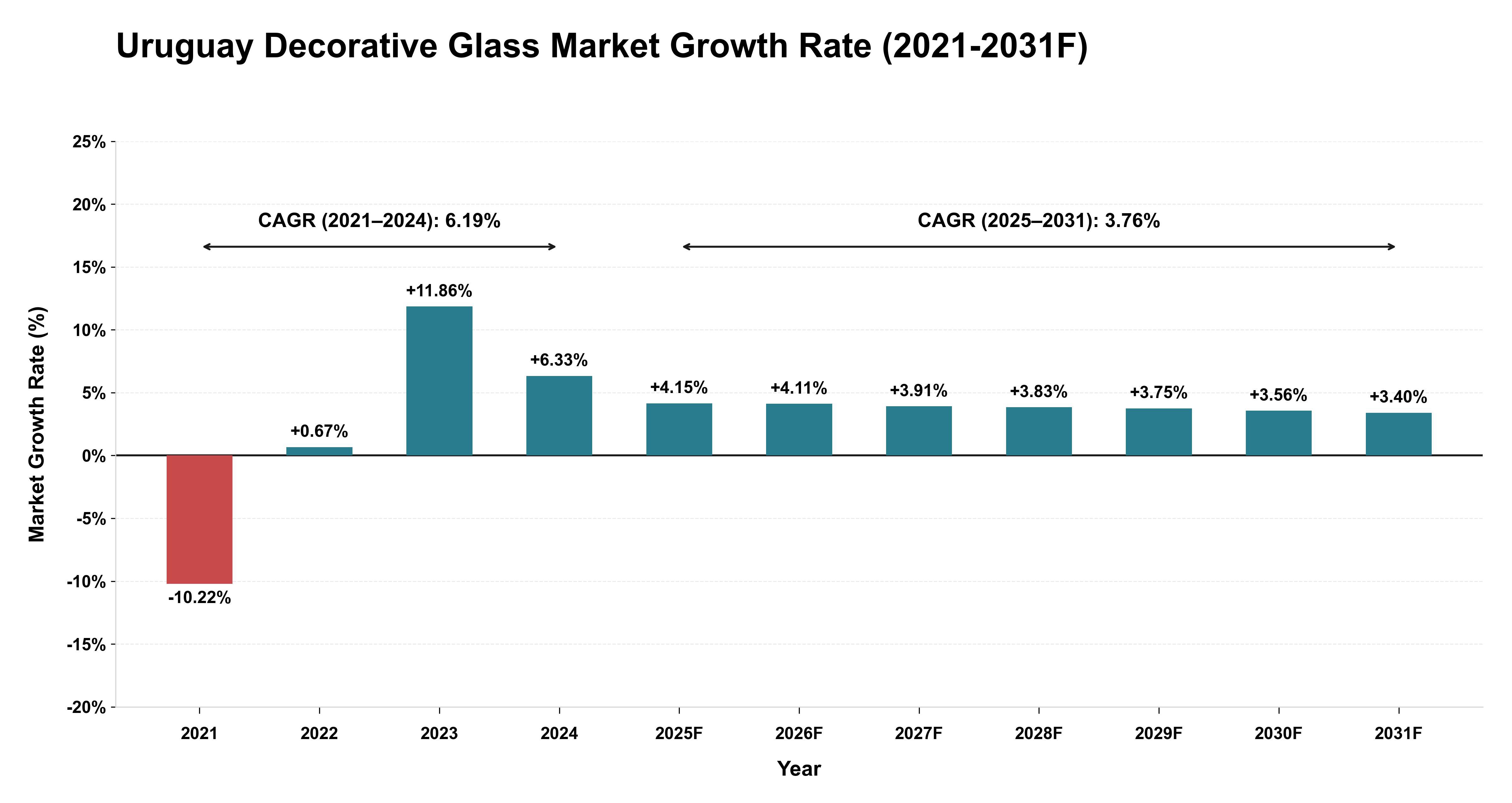
The Uruguay Decorative Glass Market experienced a turbulent period from 2021 to 2024, marked by a sharp decline in 2021 followed by a rebound in 2023 driven by increased construction activity. The historical CAGR of 6.19% reflects this volatility, with fluctuations in demand influenced by shifting consumer preferences and economic conditions. Looking ahead to 2025-2031, the forecast CAGR of 3.76% indicates a more stable growth trajectory, albeit at a slower pace. This deceleration can be attributed to market saturation in certain end-use industries, such as residential construction, coupled with regulatory changes impacting the supply chain dynamics. Despite the moderation in growth rates, technological advancements and sustainable design trends are expected to drive continued demand for decorative glass products in Uruguay.
Key Highlights of the Report:
- Uruguay Decorative Glass Market Outlook
- Market Size of Uruguay Decorative Glass Market, 2025
- Forecast of Uruguay Decorative Glass Market, 2032
- Historical Data and Forecast of Uruguay Decorative Glass Revenues & Volume for the Period 2022-2032F
- Uruguay Decorative Glass Market Trend Evolution
- Uruguay Decorative Glass Market Drivers and Challenges
- Uruguay Decorative Glass Price Trends
- Uruguay Decorative Glass Porter`s Five Forces
- Uruguay Decorative Glass Industry Life Cycle
- Historical Data and Forecast of Uruguay Decorative Glass Market Revenues & Volume By Product for the Period 2022-2032F
- Historical Data and Forecast of Uruguay Decorative Glass Market Revenues & Volume By Low-e for the Period 2022-2032F
- Historical Data and Forecast of Uruguay Decorative Glass Market Revenues & Volume By Special for the Period 2022-2032F
- Historical Data and Forecast of Uruguay Decorative Glass Market Revenues & Volume By Other for the Period 2022-2032F
- Historical Data and Forecast of Uruguay Decorative Glass Market Revenues & Volume By Application for the Period 2022-2032F
- Historical Data and Forecast of Uruguay Decorative Glass Market Revenues & Volume By Commercial Building for the Period 2022-2032F
- Historical Data and Forecast of Uruguay Decorative Glass Market Revenues & Volume By Residential Building for the Period 2022-2032F
- Historical Data and Forecast of Uruguay Decorative Glass Market Revenues & Volume By Public Building for the Period 2022-2032F
- Uruguay Decorative Glass Import Export Trade Statistics
- Market Opportunity Assessment By Product
- Market Opportunity Assessment By Application
- Uruguay Decorative Glass Top Companies Market Share
- Uruguay Decorative Glass Competitive Benchmarking By Technical and Operational Parameters
- Uruguay Decorative Glass Company Profiles
- Uruguay Decorative Glass Key Strategic Recommendations






































