Uruguay Lubricants Market Year-wise Growth Rate (2021-2031F)
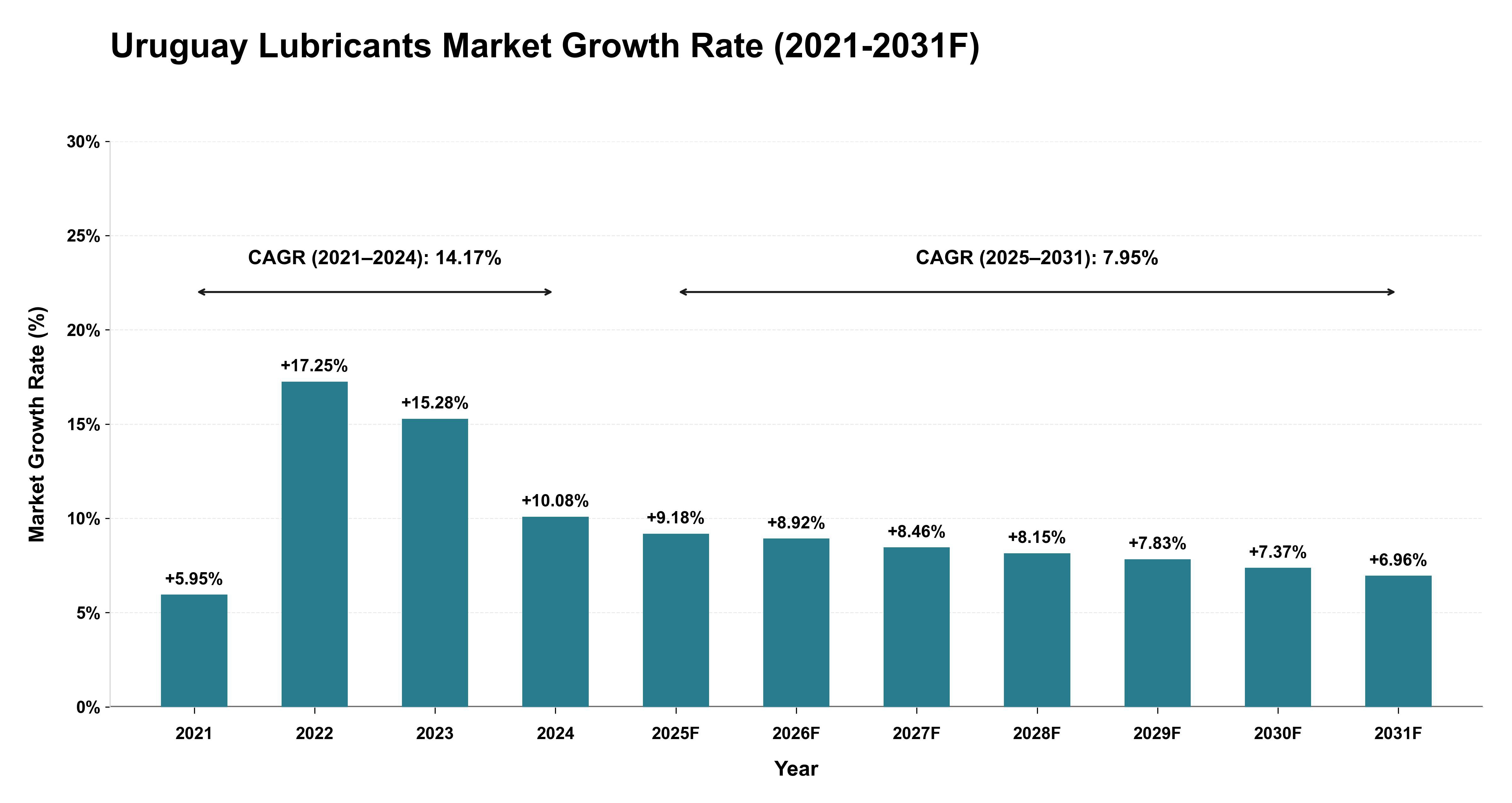
In the period 2021-2024, the Uruguay Lubricants Market demonstrated robust growth, with a notable CAGR of 14.17%. This was underpinned by increasing industrial activities and a growing automotive sector, driving demand for lubricants across various end-use industries. Particularly in 2022 and 2023, with growth rates of 17.25% and 15.28% respectively, the market experienced accelerations propelled by technological advancements and favorable regulatory frameworks promoting sustainable practices. Moving forward into the forecast period of 2025-2031, while still expected to grow at a steady pace with a CAGR of 7.95%, we anticipate a slight deceleration compared to the previous years. This is likely due to market saturation in certain segments and a shift towards more efficient lubricant consumption patterns in line with environmental regulations, leading to a more stable but moderated growth trajectory for the industry.
Key Highlights of the Report:
- Uruguay Lubricants Market Outlook
- Market Size of Uruguay Lubricants Market, 2024
- Forecast of Uruguay Lubricants Market, 2031
- Historical Data and Forecast of Uruguay Lubricants Revenues & Volume for the Period 2021-2031
- Uruguay Lubricants Market Trend Evolution
- Uruguay Lubricants Market Drivers and Challenges
- Uruguay Lubricants Price Trends
- Uruguay Lubricants Porter`s Five Forces
- Uruguay Lubricants Industry Life Cycle
- Historical Data and Forecast of Uruguay Lubricants Market Revenues & Volume By Base oil for the Period 2021-2031
- Historical Data and Forecast of Uruguay Lubricants Market Revenues & Volume By Mineral Oil for the Period 2021-2031
- Historical Data and Forecast of Uruguay Lubricants Market Revenues & Volume By Synthetic Oil for the Period 2021-2031
- Historical Data and Forecast of Uruguay Lubricants Market Revenues & Volume By Bio-based Oil for the Period 2021-2031
- Historical Data and Forecast of Uruguay Lubricants Market Revenues & Volume By Product Type for the Period 2021-2031
- Historical Data and Forecast of Uruguay Lubricants Market Revenues & Volume By Engine Oil for the Period 2021-2031
- Historical Data and Forecast of Uruguay Lubricants Market Revenues & Volume By Hydraulic fluid for the Period 2021-2031
- Historical Data and Forecast of Uruguay Lubricants Market Revenues & Volume By Metalworking fluid for the Period 2021-2031
- Historical Data and Forecast of Uruguay Lubricants Market Revenues & Volume By Gear Oil for the Period 2021-2031
- Historical Data and Forecast of Uruguay Lubricants Market Revenues & Volume By Compressor oil for the Period 2021-2031
- Historical Data and Forecast of Uruguay Lubricants Market Revenues & Volume By Grease for the Period 2021-2031
- Historical Data and Forecast of Uruguay Lubricants Market Revenues & Volume By Turbine Oil for the Period 2021-2031
- Historical Data and Forecast of Uruguay Lubricants Market Revenues & Volume By Others for the Period 2021-2031
- Historical Data and Forecast of Uruguay Lubricants Market Revenues & Volume By End-Use Industry for the Period 2021-2031
- Historical Data and Forecast of Uruguay Lubricants Market Revenues & Volume By Transportation for the Period 2021-2031
- Historical Data and Forecast of Uruguay Lubricants Market Revenues & Volume By Industrial for the Period 2021-2031
- Uruguay Lubricants Import Export Trade Statistics
- Market Opportunity Assessment By Base oil
- Market Opportunity Assessment By Product Type
- Market Opportunity Assessment By End-Use Industry
- Uruguay Lubricants Top Companies Market Share
- Uruguay Lubricants Competitive Benchmarking By Technical and Operational Parameters
- Uruguay Lubricants Company Profiles
- Uruguay Lubricants Key Strategic Recommendations






































