Venezuela Ethyl Alcohol Market Size, Share & Growth Rate
The Venezuela Ethyl Alcohol Market was estimated at USD 498 Million in 2025 and is projected to reach USD 663 Million by 2032, growing at a CAGR of 4.2% from 2026 to 2032. This growth trajectory is primarily influenced by the expanding pharmaceutical sector, coupled with the increasing demand for ethyl alcohol in consumer products such as hand sanitizers and alcoholic beverages. The rising awareness of the benefits associated with ethyl alcohol, especially in personal care, further contributes to a positive outlook for the market.
Venezuela Ethyl Alcohol Market Year-wise Growth Rate and Key Drivers
This graph highlights how the Venezuela Ethyl Alcohol Market has steadily grown over the years, supported by major growth factors.
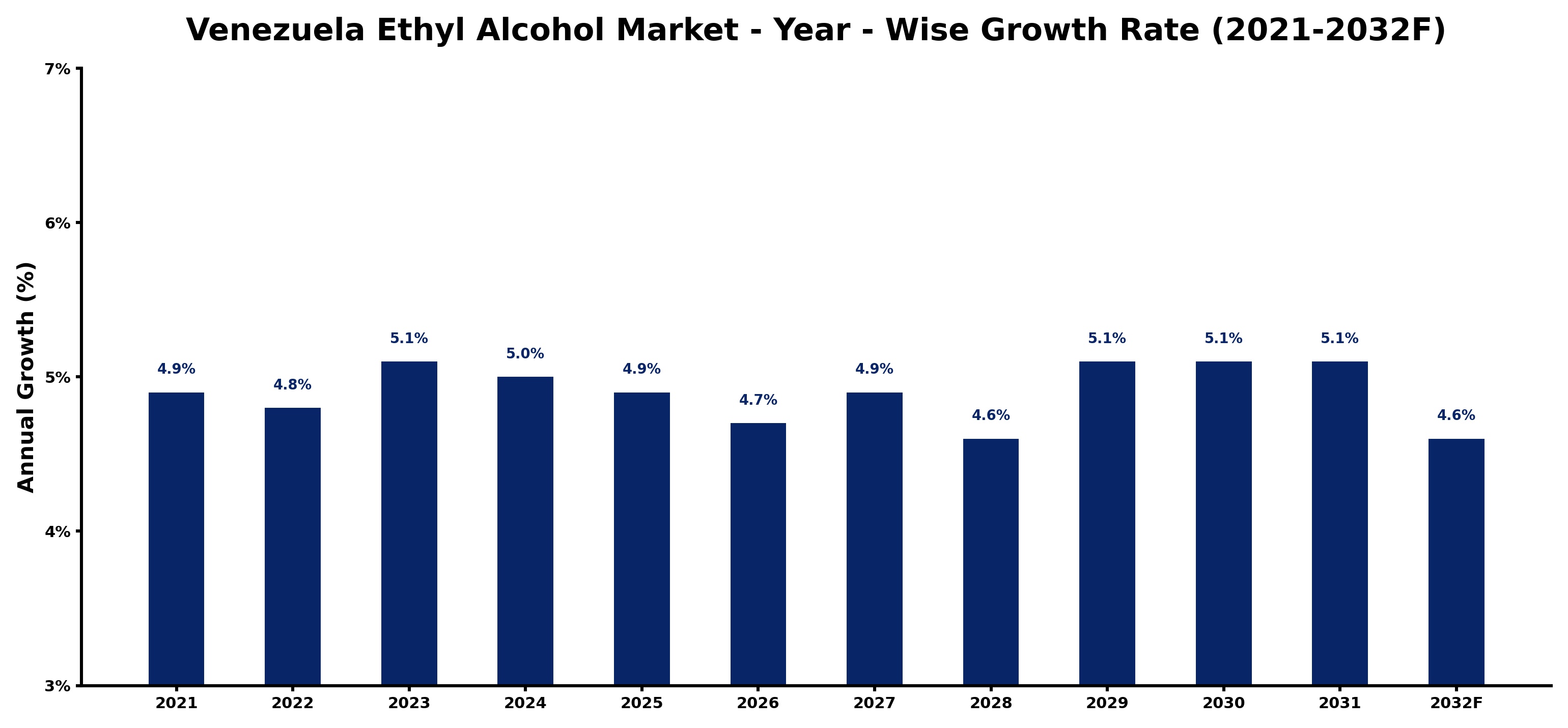
The table below presents the year‑wise growth rates along with the key drivers influencing the market
| Year | Growth Rate | Major Drivers |
| 2021 | 4.9% | Increased demand for sanitizers |
| 2022 | 4.8% | Growth in beverage alcohol sector |
| 2023 | 5.1% | Rising industrial applications expanded |
| 2024 | 5.0% | Cosmetic industry demand surged |
| 2025 | 4.9% | Pharmaceutical sector utilization increased |
| 2026 | 4.7% | Biofuel production expanded significantly |
| 2027 | 4.9% | Export opportunities enhanced revenue |
| 2028 | 4.6% | Regulatory support for production growth |
| 2029 | 5.1% | Sustainable sourcing practices improved |
| 2030 | 5.1% | Innovation in production techniques |
| 2031 | 5.1% | Consumer preference for local products |
| 2032 | 4.6% | Market diversification strategies enhanced |
Note - Market size estimations and growth projections presented in this report are based on 6Wresearch’s advanced forecasting approach, validated with industry datasets as of June 2026.
Venezuela Ethyl Alcohol Market Synopsis
Currently, the most significant force driving the Venezuela Ethyl Alcohol Market is the heightened demand for alcohol-based products, spurred by health concerns stemming from the COVID-19 pandemic. This has resulted in an uptick in production and sales, particularly for items such as sanitizers and disinfectants.
Additionally, the growth of the local alcoholic beverage industry serves as another powerful catalyst. As consumer preferences shift towards quality and variety, domestic producers are finding new avenues for expansion, enhancing their product offerings to meet the evolving market landscape.
Venezuela Ethyl Alcohol Market Key Takeaways
- Significant growth in the pharmaceutical sector is propelling demand for ethyl alcohol.
- Consumer awareness of the advantages of alcohol in personal care is increasing.
- The volatile political and economic environment poses ongoing risks for market participants.
- Government policies designed to support local production are shaping the market dynamics.
- Investors are keenly watching developments in the renewable fuel sector for growth opportunities.
Evaluation of Restraints in Venezuela Ethyl Alcohol Market
The Venezuela Ethyl Alcohol Market grapples with multiple constraints that hinder its expansion. Notably, political instability and economic challenges have led to significant fluctuations in production capabilities and distribution efficiency. Producers face hurdles such as strict government regulations, fluctuating raw material costs, and inadequate infrastructure, which complicate supply chain management. Furthermore, competition from imports and counterfeit products further constrains local producers, complicating their efforts to capture market share.
Venezuela Ethyl Alcohol Market Trends
Current trends indicate a robust rise in the demand for hand sanitizers and disinfectants, a trend exacerbated by the COVID-19 pandemic. This surge in consumption is compelling companies to innovate and diversify their product portfolios. Moreover, there's a growing emphasis on sustainable practices, with manufacturers exploring opportunities to incorporate renewable sources of ethyl alcohol, influenced by shifting consumer preferences towards eco-friendly products.
Venezuela Ethyl Alcohol Market Opportunities
There exists substantial opportunity for growth and investment within the Venezuela Ethyl Alcohol Market, particularly in sectors such as pharmaceuticals and personal care. The rising demand for hand sanitizers as a response to public health initiatives opens doors for both production and export. Additionally, the government's focus on renewable fuels positions ethyl alcohol as a strategic asset in the energy sector, attracting interest from investors looking for sustainable solutions amidst the current economic climate.
Government Initiatives in the Venezuela Ethyl Alcohol Market
Government initiatives concerning the Venezuela Ethyl Alcohol Market are largely centered on the regulation of production, distribution, and pricing. Policies aimed at maintaining affordability for consumers are complemented by efforts to bolster domestic producers through subsidies and restrictions on imports. Furthermore, stringent regulations ensure that quality and safety standards are met, thereby safeguarding public health and aligning local production with international best practices.
Future Insights of the Venezuela Ethyl Alcohol Market
Looking ahead to 2026-2032, the future of the Venezuela Ethyl Alcohol Market remains uncertain due to ongoing political and economic fluctuations. Companies must navigate potential volatility in supply chains and pricing structures, while also remaining alert to changes in consumer behavior and regulatory landscapes. Nevertheless, as the demand for alcohol-based products continues to rise, the market possesses an intrinsic capacity for growth, contingent upon strategic adaptation and resilience amid adversity.
Venezuela Ethyl Alcohol Market Latest Developments (May 2025 - June 2026)
Recent developments in the Venezuela Ethyl Alcohol Market indicate a shift towards increased local production capabilities, driven by a need for greater self-sufficiency. Initiatives to enhance quality control and expand distribution networks are being implemented, providing a clearer pathway for local producers. Moreover, the growing interest in sustainable practices is prompting producers to explore innovative methods for sourcing raw materials, ensuring they remain competitive in the evolving market landscape.
Venezuela Ethyl Alcohol Market - Key Attractiveness of the Report
- 10 Years of Market Numbers
- Historical Data Starting from 2022 to 2025
- Base Year: 2025
- Forecast Data until 2032
- Key Performance Indicators Impacting the Market
- Major Upcoming Developments and Projects
Key Highlights of the Report:
- Venezuela Ethyl Alcohol Market Outlook
- Market Size of Venezuela Ethyl Alcohol Market, 2025
- Forecast of Venezuela Ethyl Alcohol Market, 2032
- Historical Data and Forecast of Venezuela Ethyl Alcohol Revenues & Volume for the Period 2022-2032F
- Venezuela Ethyl Alcohol Market Trend Evolution
- Venezuela Ethyl Alcohol Market Drivers and Challenges
- Venezuela Ethyl Alcohol Price Trends
- Venezuela Ethyl Alcohol Porter's Five Forces
- Venezuela Ethyl Alcohol Industry Life Cycle
- Historical Data and Forecast of Venezuela Ethyl Alcohol Market Revenues & Volume By Grade for the Period 2022-2032F
- Historical Data and Forecast of Venezuela Ethyl Alcohol Market Revenues & Volume By Food Grade for the Period 2022-2032F
- Historical Data and Forecast of Venezuela Ethyl Alcohol Market Revenues & Volume By Industrial Grade for the Period 2022-2032F
- Historical Data and Forecast of Venezuela Ethyl Alcohol Market Revenues & Volume By Pharmaceutical Grade for the Period 2022-2032F
- Historical Data and Forecast of Venezuela Ethyl Alcohol Market Revenues & Volume By Lab Grade for the Period 2022-2032F
- Historical Data and Forecast of Venezuela Ethyl Alcohol Market Revenues & Volume By End-user Industry for the Period 2022-2032F
- Historical Data and Forecast of Venezuela Ethyl Alcohol Market Revenues & Volume By Automotive and Transportation for the Period 2022-2032F
- Historical Data and Forecast of Venezuela Ethyl Alcohol Market Revenues & Volume By Food and Beverage for the Period 2022-2032F
- Historical Data and Forecast of Venezuela Ethyl Alcohol Market Revenues & Volume By Pharmaceutical for the Period 2022-2032F
- Historical Data and Forecast of Venezuela Ethyl Alcohol Market Revenues & Volume By Cosmetics and Personal Care (Includes hand-Sanitizer) for the Period 2022-2032F
- Historical Data and Forecast of Venezuela Ethyl Alcohol Market Revenues & Volume By Other End-user Industries for the Period 2022-2032F
- Venezuela Ethyl Alcohol Import Export Trade Statistics
- Market Opportunity Assessment By Grade
- Market Opportunity Assessment By End-user Industry
- Venezuela Ethyl Alcohol Top Companies Market Share
- Venezuela Ethyl Alcohol Competitive Benchmarking By Technical and Operational Parameters
- Venezuela Ethyl Alcohol Company Profiles
- Venezuela Ethyl Alcohol Key Strategic Recommendations






































