Venezuela Makeup Market Size, Share & Growth Rate
The Venezuela Makeup Market was estimated at USD 382 Million in 2025 and is projected to reach USD 521 Million by 2032, growing at a CAGR of 4.5% from 2026 to 2032. This positive trajectory is largely fueled by a resilient demand for both mass and premium products, as Venezuelans increasingly prioritize quality and innovation in cosmetics despite prevailing economic hurdles. Additionally, the influence of social media and beauty influencers continues to drive purchasing decisions, encouraging consumers to explore a wider array of makeup options.
Venezuela Makeup Market Year-wise Growth Rate and Key Drivers
This graph highlights how the Venezuela Makeup Market has steadily grown over the years, supported by major growth factors.
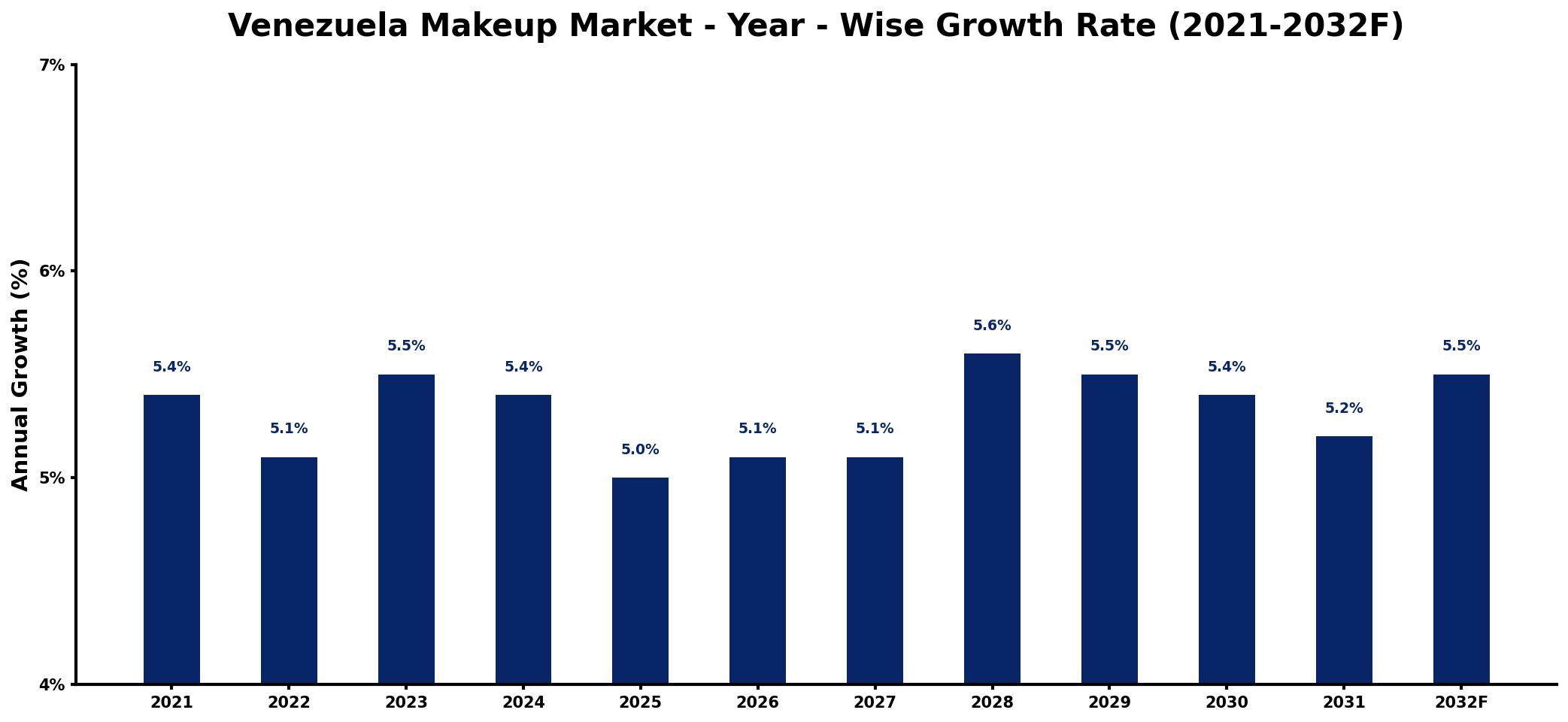
The table below presents the year‑wise growth rates along with the key drivers influencing the market
| Year | Growth Rate | Major Drivers |
| 2021 | 5.4% | Rising consumer spending power |
| 2022 | 5.1% | Increased online retail presence |
| 2023 | 5.5% | Growing interest in beauty trends |
| 2024 | 5.4% | Expansion of local brands |
| 2025 | 5.0% | stronger distribution network expansion |
| 2026 | 5.1% | Emergence of eco-friendly products |
| 2027 | 5.1% | Surge in social media influence |
| 2028 | 5.6% | Growth in influencer partnerships |
| 2029 | 5.5% | Diversification of product offerings |
| 2030 | 5.4% | Increased focus on self-care |
| 2031 | 5.2% | Development of premium segments |
| 2032 | 5.5% | Expansion into emerging markets |
Note: Market size estimations and growth projections presented in this report are based on 6Wresearch's proprietary forecasting methodology, utilizing the latest available industry data, government publications, and primary research inputs.
Venezuela Makeup Market Synopsis
Recent trends indicate a robust performance in the Venezuela makeup market, with consumers actively seeking diverse and innovative products. As brands respond to this growing demand, the market is positioned for further evolution, balancing between local offerings and international influences.
However, the economic landscape poses challenges that necessitate adaptive strategies. Inflationary pressures and supply chain disruptions have affected product affordability and availability, yet these obstacles also present opportunities for brands willing to innovate and align with consumer values.
Venezuela Makeup Market Key Takeaways
- The market is experiencing a shift towards natural, organic, and sustainable makeup products.
- Influencer marketing is a powerful tool in shaping consumer preferences and trends.
- Economic and political challenges significantly influence product availability and pricing.
- There is a strong emphasis on authenticity, inclusivity, and self-expression among consumers.
- The rise of social media is fostering an environment ripe for new product launches and trends.
Evaluation of Restraints in Venezuela Makeup Market
Several key factors currently limit growth in the Venezuela makeup market. Economic instability, characterized by hyperinflation and currency devaluation, affects consumer purchasing power, making higher-priced products less accessible. Furthermore, political tensions have resulted in supply chain disruptions that complicate product imports, creating a scarcity of options in the market. Additionally, the prevalence of counterfeit products and a large informal economy pose significant challenges for legitimate brands seeking to maintain their reputation and market share.
Venezuela Makeup Market Trends
Current trends highlight a growing consumer preference for makeup that not only enhances appearance but also aligns with personal values. A significant rise in demand for cruelty-free, organic, and vegan products is reshaping product offerings in the market. Social media's pivotal role in influencing beauty standards has led to increased engagement with beauty influencers, who are now central to marketing strategies. Additionally, the pandemic has shifted consumer focus towards multifunctional skincare products, emphasizing hydration and protection, reflecting a broader trend of health-conscious consumption.
Venezuela Makeup Market Opportunities
The evolving landscape presents numerous opportunities for investment in the Venezuela makeup market. There is a robust potential for both international and local brands to penetrate this market, particularly through innovative product launches that cater to the discerning tastes of Venezuelan consumers. Engaging local influencers in marketing campaigns can amplify brand visibility and consumer trust. Furthermore, establishing partnerships for distributing international brands could capitalize on the demand for diverse and premium products, especially those that cater to the sustainability trend.
Government Initiatives in the Venezuela Makeup Market
Government policies affecting the Venezuela makeup market are largely characterized by strict regulations and import restrictions. Price controls on cosmetics have been implemented to combat inflation, limiting access to imported products while fostering reliance on domestic brands. High tariffs and stringent import requirements further complicate market entry for foreign companies, creating barriers that limit consumer choices and product variety. Additionally, advertising practices are heavily regulated, influencing how brands communicate their offerings to the market.
Future Insights of the Venezuela Makeup Market
Looking ahead to the period from 2026 to 2032, the Venezuela makeup market is poised for incremental growth despite significant challenges. The drive towards self-expression and inclusivity is expected to shape product development and marketing strategies. Companies will need to focus on affordability and local sourcing to address the economic realities of Venezuelan consumers while leveraging social media to engage with the younger demographic that is increasingly influencing market dynamics.
Venezuela Makeup Market Latest Developments (2025 - 2026)
In recent months, the Venezuela makeup market has seen increased activity as brands adapt to shifting consumer preferences. Local players have been launching new product lines that emphasize sustainability and ethical sourcing, responding to the growing demand for organic options. Simultaneously, beauty influencers have become instrumental in introducing and promoting these products, creating vibrant discussions and trends within social media platforms.
Venezuela Makeup Market - Key Attractiveness of the Report
- 10 Years of Market Numbers
- Historical Data Starting from 2022 to 2025
- Base Year: 2025
- Forecast Data until 2032
- Key Performance Indicators Impacting the Market
- Major Upcoming Developments and Projects
Key Highlights of the Report:
- Venezuela Makeup Market Outlook
- Market Size of Venezuela Makeup Market, 2025
- Forecast of Venezuela Makeup Market, 2032
- Historical Data and Forecast of Venezuela Makeup Revenues & Volume for the Period 2022-2032F
- Venezuela Makeup Market Trend Evolution
- Venezuela Makeup Market Drivers and Challenges
- Venezuela Makeup Price Trends
- Venezuela Makeup Porter's Five Forces
- Venezuela Makeup Industry Life Cycle
- Historical Data and Forecast of Venezuela Makeup Market Revenues & Volume By Product for the Period 2022-2032F
- Historical Data and Forecast of Venezuela Makeup Market Revenues & Volume By Powders for the Period 2022-2032F
- Historical Data and Forecast of Venezuela Makeup Market Revenues & Volume By Gels for the Period 2022-2032F
- Historical Data and Forecast of Venezuela Makeup Market Revenues & Volume By Lotions for the Period 2022-2032F
- Historical Data and Forecast of Venezuela Makeup Market Revenues & Volume By Others for the Period 2022-2032F
- Historical Data and Forecast of Venezuela Makeup Market Revenues & Volume By Application for the Period 2022-2032F
- Historical Data and Forecast of Venezuela Makeup Market Revenues & Volume By Lips for the Period 2022-2032F
- Historical Data and Forecast of Venezuela Makeup Market Revenues & Volume By Eyes for the Period 2022-2032F
- Historical Data and Forecast of Venezuela Makeup Market Revenues & Volume By Face for the Period 2022-2032F
- Historical Data and Forecast of Venezuela Makeup Market Revenues & Volume By Others for the Period 2022-2032F
- Historical Data and Forecast of Venezuela Makeup Market Revenues & Volume By Distribution Channel for the Period 2022-2032F
- Historical Data and Forecast of Venezuela Makeup Market Revenues & Volume By Supermarkets/hypermarkets for the Period 2022-2032F
- Historical Data and Forecast of Venezuela Makeup Market Revenues & Volume By Exclusive Brand Stores for the Period 2022-2032F
- Historical Data and Forecast of Venezuela Makeup Market Revenues & Volume By Online/e-commerce Channels for the Period 2022-2032F
- Historical Data and Forecast of Venezuela Makeup Market Revenues & Volume By Others for the Period 2022-2032F
- Venezuela Makeup Import Export Trade Statistics
- Market Opportunity Assessment By Product
- Market Opportunity Assessment By Application
- Market Opportunity Assessment By Distribution Channel
- Venezuela Makeup Top Companies Market Share
- Venezuela Makeup Competitive Benchmarking By Technical and Operational Parameters
- Venezuela Makeup Company Profiles
- Venezuela Makeup Key Strategic Recommendations






































