Venezuela Polio Vaccine Market Size, Share & Growth Rate
The Venezuela Polio Vaccine Market was estimated at USD 166 Million in 2025 and is projected to reach USD 224 Million by 2032, growing at a CAGR of 4.4% from 2026 to 2032. This growth is driven primarily by the urgent need for improved vaccination coverage amidst the ongoing health crises and renewed efforts from governmental and international organizations to support immunization programs. Despite economic challenges, the focus on public health and the importance of vaccine accessibility are central to the projected market growth.
Venezuela Polio Vaccine Market Year-wise Growth Rate and Key Drivers
This graph highlights how the Venezuela Polio Vaccine Market has steadily grown over the years, supported by major growth factors.
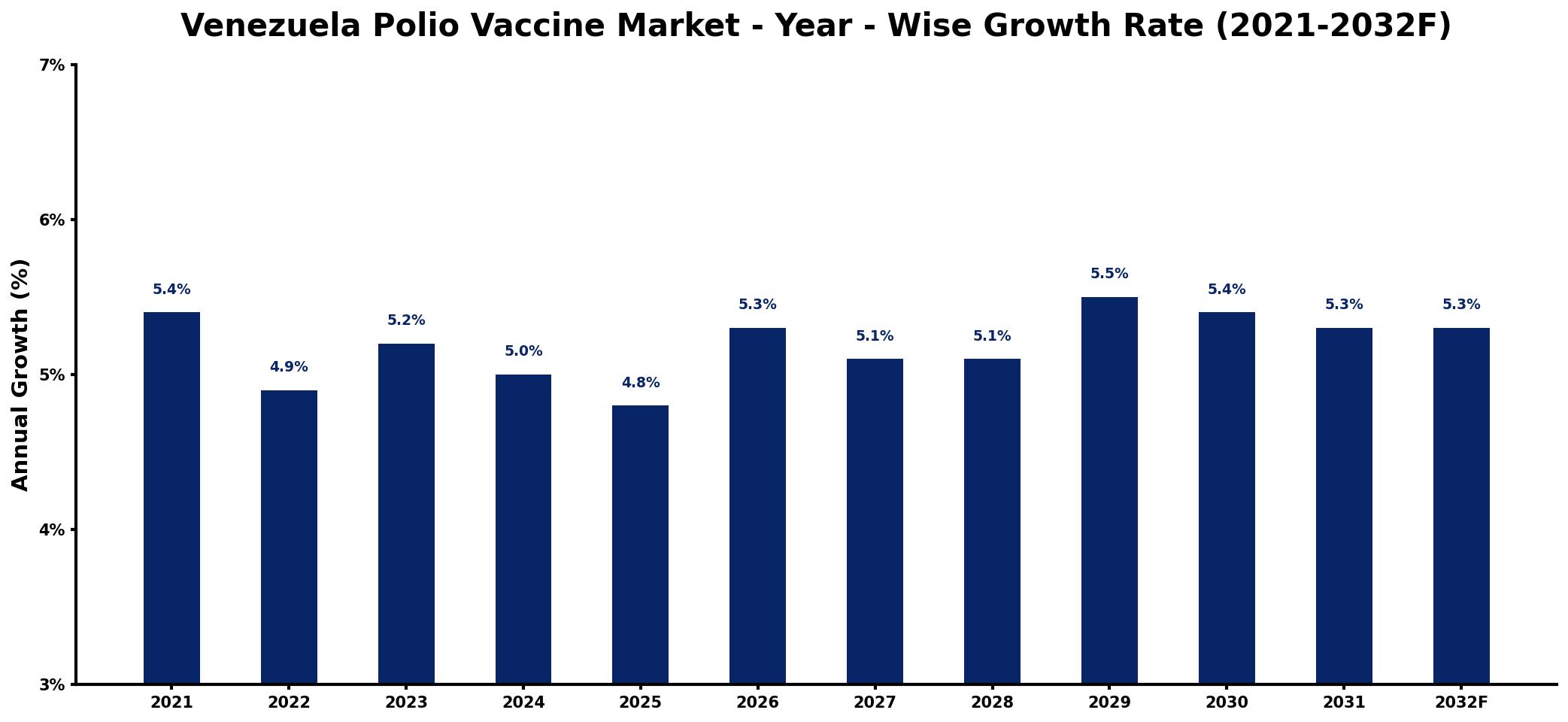
The table below presents the year‑wise growth rates along with the key drivers influencing the market
| Year | Growth Rate | Major Drivers |
| 2021 | 5.4% | Increased healthcare investments nationwide |
| 2022 | 4.9% | Rising public health awareness campaigns |
| 2023 | 5.2% | Expansion of healthcare infrastructure projects |
| 2024 | 5.0% | Growing demand for preventive measures |
| 2025 | 4.8% | Strengthened international health partnerships |
| 2026 | 5.3% | Enhanced distribution network capabilities |
| 2027 | 5.1% | Increased funding for health research |
| 2028 | 5.1% | Improved access to healthcare services |
| 2029 | 5.5% | Surge in community health initiatives |
| 2030 | 5.4% | Strengthened regulatory health frameworks |
| 2031 | 5.3% | Boosted collaboration with NGOs |
| 2032 | 5.3% | Increased focus on health education |
Note: Market size estimations and growth projections presented in this report are based on 6Wresearch's proprietary forecasting methodology, utilizing the latest available industry data, government publications, and primary research inputs.
Venezuela Polio Vaccine Market Synopsis
While the Venezuela Polio Vaccine Market has historically faced substantial hurdles due to economic instability, recent initiatives signal a potential recovery. Government vaccination campaigns aimed at reaching underserved populations are crucial in combating the threat of polio outbreaks, even as the distribution of vaccines remains erratic.
The dual impact of international aid and local awareness campaigns has created a critical momentum for vaccine adoption. However, the underlying issues related to healthcare infrastructure and political uncertainty continue to overshadow these positive developments, necessitating a comprehensive strategy to ensure sustainable access to polio vaccines.
Venezuela Polio Vaccine Market Key Takeaways
- The market is currently valued at USD 166 Million, with significant growth expected by 2032.
- Government initiatives are pivotal for increasing vaccination rates amid ongoing economic struggles.
- International partnerships are critical for the availability and distribution of polio vaccines.
- Low public awareness and vaccine hesitancy in some regions pose risks for disease resurgence.
- Investment opportunities exist in the manufacturing and innovative formulation of vaccines.
Evaluation of Restraints in Venezuela Polio Vaccine Market
The Venezuela Polio Vaccine Market is significantly constrained by the broader socio-economic and political landscape. Ongoing political instability complicates resource allocation and disrupts healthcare operations. Insufficient funding leads to inadequate supplies and logistics challenges, which hinder effective vaccination efforts. Additionally, the healthcare systems collapse limits access to facilities and trained professionals, exacerbating the already alarming vaccination coverage rates. These systemic issues make it challenging to achieve the universal vaccination goals necessary for polio eradication.
Venezuela Polio Vaccine Market Trends
A notable trend in the Venezuela Polio Vaccine Market is the increasing demand for innovative vaccine solutions. Healthcare providers and authorities are showing a preference for new-generation vaccines that promise greater efficacy and a more user-friendly administration process. This shift is accompanied by a growing recognition among the public of vaccination's role in disease prevention, spurred by targeted educational campaigns. Collaborations between vaccine developers and government agencies are also emerging as crucial to enhancing vaccine accessibility, indicating a trend toward more integrated approaches to public health.
Venezuela Polio Vaccine Market Opportunities
Investment opportunities in the Venezuela Polio Vaccine Market are emerging primarily in response to the country's pressing need for enhanced immunization programs. Potential investors can explore partnerships with local healthcare providers to boost distribution networks, thereby improving vaccine accessibility. There is also a significant opportunity for research and development focused on creating advanced polio vaccine formulations that address the unique challenges faced in Venezuela. This presents an avenue for investors to not only contribute to public health but also secure long-term returns in a recovering market.
Government Initiatives in the Venezuela Polio Vaccine Market
Government policies in Venezuela focus heavily on free vaccination programs as a means to achieve widespread immunization. The Ministry of Health is dedicated to organizing regular vaccination campaigns, particularly in remote and underserved communities, to minimize the risk of polio outbreaks. These efforts are supported by collaborations with international health organizations, which help secure vaccine supplies and technical support. Regulatory agencies work to ensure the quality and safety of vaccines, underpinning the government's commitment to public health priorities.
Future Insights of the Venezuela Polio Vaccine Market
Looking forward, the Venezuela Polio Vaccine Market will likely navigate a complex landscape shaped by economic recovery efforts and continued public health challenges. The anticipated investments in healthcare infrastructure and vaccine distribution are expected to gradually improve access to immunization programs. However, achieving lasting impacts will depend on sustained international cooperation and a politically stable environment that prioritizes public health. Enhanced public awareness and engagement will also be vital in driving vaccination rates toward eradication goals.
Venezuela Polio Vaccine Market Latest Developments (2025 - 2026)
Recent developments in the Venezuela Polio Vaccine Market indicate a renewed focus on vaccination campaigns, with various international organizations ramping up their support in light of political developments. The Ministry of Health has intensified efforts to improve logistics and distribution, aiming to reach populations that have been historically underserved. Additionally, discussions around public-private partnerships have gained traction, presenting a pathway for more innovative approaches to vaccine accessibility in the near future.
Venezuela Polio Vaccine Market - Key Attractiveness of the Report
- 10 Years of Market Numbers
- Historical Data Starting from 2022 to 2025
- Base Year: 2025
- Forecast Data until 2032
- Key Performance Indicators Impacting the Market
- Major Upcoming Developments and Projects
Key Highlights of the Report:
- Venezuela Polio Vaccine Market Outlook
- Market Size of Venezuela Polio Vaccine Market, 2025
- Forecast of Venezuela Polio Vaccine Market, 2032
- Historical Data and Forecast of Venezuela Polio Vaccine Revenues & Volume for the Period 2022-2032F
- Venezuela Polio Vaccine Market Trend Evolution
- Venezuela Polio Vaccine Market Drivers and Challenges
- Venezuela Polio Vaccine Price Trends
- Venezuela Polio Vaccine Porter's Five Forces
- Venezuela Polio Vaccine Industry Life Cycle
- Historical Data and Forecast of Venezuela Polio Vaccine Market Revenues & Volume By Type for the Period 2022-2032F
- Historical Data and Forecast of Venezuela Polio Vaccine Market Revenues & Volume By Oral Polio Vaccine (OPV) for the Period 2022-2032F
- Historical Data and Forecast of Venezuela Polio Vaccine Market Revenues & Volume By Inactivated Poliomyelitis Vaccine (IPV) for the Period 2022-2032F
- Historical Data and Forecast of Venezuela Polio Vaccine Market Revenues & Volume By Application for the Period 2022-2032F
- Historical Data and Forecast of Venezuela Polio Vaccine Market Revenues & Volume By Public for the Period 2022-2032F
- Historical Data and Forecast of Venezuela Polio Vaccine Market Revenues & Volume By Private for the Period 2022-2032F
- Venezuela Polio Vaccine Import Export Trade Statistics
- Market Opportunity Assessment By Type
- Market Opportunity Assessment By Application
- Venezuela Polio Vaccine Top Companies Market Share
- Venezuela Polio Vaccine Competitive Benchmarking By Technical and Operational Parameters
- Venezuela Polio Vaccine Company Profiles
- Venezuela Polio Vaccine Key Strategic Recommendations






































