Vietnam 3D Printed Eyewear Market (2026-2032) | Forecast, Demand, Strategy, Revenue, Segments, Value, Competitive, Trends, Size, Investment Trends, Pricing Analysis, Companies, Supply, Segmentation, Drivers, Consumer Insights, Industry, Challenges, Strategic Insights, Analysis, Opportunities, Restraints, Outlook, Growth, Competition, Share
Market Forecast By Material Type (Nylon, Metal, Resins, Others), By Technology (SLS, SLA, Multi Jet Fusion, DLP, FDM), By Application (Sunglasses, Optical Glasses, Sports Glasses, Safety glasses) And Competitive Landscape
| Product Code: ETC11537012 | Publication Date: Apr 2025 | Updated Date: Jun 2026 | Product Type: Market Research Report | |
| Publisher: 6Wresearch | Author: Bhawna Singh | No. of Pages: 70 | No. of Figures: 35 | No. of Tables: 5 |
Vietnam 3D Printed Eyewear Market Growth Rate
According to 6Wresearch internal database and industry insights, the Vietnam 3D Printed Eyewear Market is estimated to grow at a compound annual growth rate (CAGR) of 14.2% during the forecast period (2026–2032).
Vietnam 3D Printed Eyewear Market Year-wise Growth Rate and Key Drivers
This graph highlights how the Vietnam 3D Printed Eyewear Market has steadily grown over the past five years, supported by major growth factors.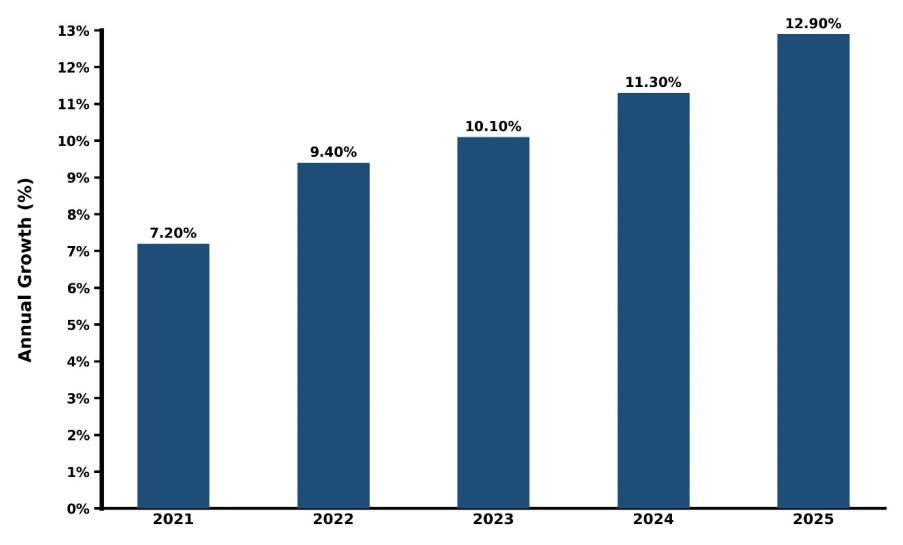
Below is an evaluation of year-wise growth rate along with growth drivers:
| Year | Est. Annual Growth (%) | Growth Drivers |
| 2021 | 7.2% | Nascent use of rapid prototyping by local luxury optical stores to generate unique frame designs. |
| 2022 | 9.4% | Release of localized facial scanning software capable of virtual frame fitting and customization processes. |
| 2023 | 10.1% | Enhanced provision of professional contract rapid prototyping services providing precision powder bed fusion. |
| 2024 | 11.3% | Creation of digital-to-customer marketing channels and localized e-commerce websites focused on fashion customized products. |
| 2025 | 12.9% | Convergence of urban customer interest in sustainable and zero waste lifestyle products and ultra-lightweight frame construction. |
Topics Covered in the Vietnam 3D Printed Eyewear Market Report
The Vietnam 3D Printed Eyewear Industry report covers the market by material type, technology, and application. The market report provides an unbiased and detailed analysis of ongoing market trends, opportunities, and drivers, which help stakeholders devise and align their market strategies according to the current and future market dynamics.
Vietnam 3D Printed Eyewear Market Highlights
| Report Name | Vietnam 3D Printed Eyewear Market |
| Forecast period | 2026-2032 |
| CAGR | 14.2% |
| Growing Sector | Consumer Goods & Advanced Manufacturing |
Vietnam 3D Printed Eyewear Market Synopsis
Vietnam 3D Printed Eyewear Market is experiencing a period of rapid modernization as it moves away from conventional and mass-produced frame design to extremely personalized and additive manufacturing-based eye protection products. The term 3D Printed Eyewear refers to the process of producing glasses and sunglasses by utilizing 3D printing or additive manufacturing rather than the conventional process of manufacturing through molding or cutting.
Evaluation of Growth Drivers in Vietnam 3D Printed Eyewear Market (2026–2032)
Below are some major drivers and their influence on the market dynamics:
| Drivers | Primary Segment Affected | Why It Matters (Evidence) |
| Demand for Hyper-Personalization | Optical Glasses, Customized Frames | Traditional injection-molded frames ignore small facial variances, driving consumers toward custom-calibrated nose bridges and temple lengths. |
| Supply Chain De-risking & On-Demand Production | Material Procurement, Inventory Management | Additive manufacturing allows retailers to print single-unit batches on demand, removing the financial risk of unsold inventory write-offs. |
| Performance Enhancements in Materials | Nylon, High-Performance Photopolymers | With the development of flexible, tough, and moisture-resistant polymers in the market, products can enjoy extended longevity. |
| Introduction of Mobile Biometric Scanning Technologies | Booking Websites, Virtual Stores | The prevalence of depth-sensitive mobile phone camera technologies helps people capture their measurements without leaving their homes. |
| Transition towards Sustainable Fashion | Sustainable Materials, Sustainable Manufacturing Processes | The powder bed approach uses material powders not fused during the production process, a feature that resonates well with eco-conscious youth. |
Vietnam 3D Printed Eyewear Market is poised for growth, exhibiting a CAGR of 14.2% during the forecast period (2026-2032). With the advent of 3D printing technologies in the production of eyewear, it has now become easier to manufacture frames that are more ergonomic, durable, and designed to fit the wearer's unique facial features, thereby leading to improved levels of user comfort. Furthermore, the rapid expansion of the retail optical segment, growing number of fashion-conscious individuals, and increased adoption of digital design tools have led to the accelerated uptake of this technology in Vietnam.
Evaluation of Restraints in Vietnam 3D Printed Eyewear Market
Below are some major restraints and their influence on the market dynamics:
| Restraints | Primary Segment Affected | What This Means (Evidence) |
| High Initial Hardware Investment | Local Labs, Technology Providers | Industrial-grade Selective Laser Sintering hardware demands massive upfront capital layouts, slowing market entry for independent optometry labs. |
| Extensive Post-Processing Requirements | Surface Finishing, Resins | Raw as-printed parts feature naturally coarse or ridged surfaces, requiring extensive tumbling, polishing, and dyeing steps to mirror acetate. |
| Imported Costs of Highly Advanced Raw Materials | Buying Material, Import Processes | High customs tariffs on advanced materials, including biocompatible powders and liquid photopolymers, make their cost higher. |
| Industry Lack of Standard Sizes | 3D Printing Design and Inspection | Lack of standard sizing across all of the industry can cause inconsistent results from various software applications used. |
| Negative Consumer Perception Factors | Sunglasses Premium Models | The average customer tends to think that "printed" means low-quality products made of cheap plastic. |
Vietnam 3D Printed Eyewear Market Challenges
There are several practical and structural challenges that the Vietnam 3D Printed Eyewear Industry may face in its transition from niche adoption to wider commercial scale. One of the key challenges is the high cost of 3D printing machinery, design software and advanced materials, which leads to a relatively expensive production process compared to conventional injection-molded eyewear manufacturing. Cost barrier limits adoption primarily to premium and customized eyewear segments rather than mass market applications.
Another important challenge is the limited consumer awareness and acceptance of 3D printed eyewear products, especially in price-sensitive markets where customers still prefer conventional frames available in optical retail stores. In addition, the market faces a skills gap in digital eyewear design and parametric modeling, as producing 3D printed frames requires specialized expertise in CAD design and additive manufacturing processes, which is still developing in Vietnam’s optical industry.
Vietnam 3D Printed Eyewear Market Trends
Some of the major trends influencing the landscape of Vietnam 3D Printed Eyewear Market are mentioned below:
- Integration of Biometric Depth-Sensing Try-On Portals: Optical storefronts are rapidly deploying software engines that capture specific inter-pupillary and temple coordinates, automatically scaling the underlying print file to ensure a flawless ergonomic fit before production.
- Use of Screws-less, Monolithic Flex-Hinges: Eyewear manufacturers are now making use of the additional benefits of additive manufacturing structures to create flexible hinges by designing them within the frame itself without using loose metallic screws or pins.
- Implementation of Renewable Castor Leaf Polyamides: The frame series is moving towards using high performance eco-friendly material by using powdered forms of plants to create their products.
Investment Opportunities in the Vietnam 3D Printed Eyewear Market
The major investment areas in the Vietnam 3D Printed Eyewear Market include:
- Setting up Joint Additive Fashion Manufacturing Facilities: There are significant investment potentials in the setting up of dedicated additive fashion manufacturing centres designed to manufacture frames at scale for independent local fashion designers.
- Development of White-Label Face-Scanning APIs: Capitalizing on software services by providing boutique optical chains with plug-and-play biometric matching scripts represents a highly scalable business model.
- Premium Laser-Sintered Titanium Frame Services: Moving up the value chain by installing direct metal laser melting lines to offer high-end, custom-fitted luxury titanium glasses to affluent consumer demographics.
Top 5 Leading Players in Vietnam 3D Printed Eyewear Market
Below are some of the leading companies contributing to the Vietnam 3D printed eyewear market growth:
1. 3D Smart Solutions (3DS)
| Company Name | 3D Smart Solutions (3DS) |
|---|---|
| Established Year | 2012 |
| Headquarters | Thu Duc District, Ho Chi Minh City, Vietnam |
| Website | Click Here |
3D Smart Solutions operates a massive industrial additive manufacturing facility in Vietnam under its specialized 3Dmanufacturer brand.
2. Mat Bao Optical
| Company Name | Mat Bao Optical |
|---|---|
| Established Year | 2004 |
| Headquarters | District 3, Ho Chi Minh City, Vietnam |
| Website | - |
Mat Bao Optical is an established premium optical retail company operating widespread retail storefront networks across urban centers.
3. Materialise Vietnam
| Company Name | Materialise Vietnam |
|---|---|
| Established Year | 2000 (Local Office Entry) |
| Headquarters | Tan Binh District, Ho Chi Minh City, Vietnam |
| Website | Click Here |
Materialise operates as an elite global provider of additive manufacturing software suites and specialized industrial printing lines.
4. EyeQ Optical
| Company Name | EyeQ Optical |
|---|---|
| Established Year | 2017 |
| Headquarters | Hanoi, Vietnam |
| Website | - |
EyeQ Optical operates as an agile, digital-forward retail and design brand focused on delivering high-tech optometry concepts to younger demographics.
5. Duy Tan Plastics (Additive Division)
| Company Name | Duy Tan Plastics (Additive Division) |
|---|---|
| Established Year | 1987 |
| Headquarters | District 5, Ho Chi Minh City, Vietnam |
| Website | Click Here |
Duy Tan Plastics is a highly prominent industrial giant in traditional mass plastic injection molding across Vietnam.
Government Initiatives being implemented in the Vietnam 3D Printed Eyewear Market
The government of Vietnam does not have any specific initiatives pertaining to the development of the 3D printed eyewear market. The country's government supports initiatives related to adopting Industry 4.0, digital manufacturing technologies, and high-valued consumer goods industry. Programs such as the National Digital Transformation Program (until 2025, vision 2030) encourage the private sector in implementing advanced manufacturing methods such as additive manufacturing technologies for customized manufacturing. This has helped optical manufacturers and emerging players to incorporate 3D printing in their manufacturing process.
Future Insights of the Vietnam 3D Printed Eyewear Market
In the coming period, the Vietnam 3D printed eyewear market is likely to experience the adoption of mass customization techniques, digitalized retail operations, and the manufacturing of eco-friendly eyewear products. With customers' growing interest in fashionable and comfortable eyewear, it can be anticipated that brands will utilize AI-powered facial scanning, along with parametric design technology, to offer personalized frames to their clients. Such practices will enhance customer satisfaction with the service provided and reduce the dependency on inventory in optical retail stores. Additionally, technological progress will enable the use of lighter-weight nylon blends and bio-based resins in 3D printed frames.
Market Segmentation Analysis
The report offers a comprehensive study of the following market segments and their leading categories:
By Material Type – Nylon Dominates the Market
The nylon segment is projected to grow in the coming years due to its flexibility, lightweight properties, and high durability. The nylon material, particularly PA12, is one of the most popular types of plastic material that can be utilized in SLS printing technology to manufacture eyewear frames that are durable but comfortable at the same time. This type of material can endure daily use and impact.
By Technology – SLS Dominates the Market
According to Kiran, Senior Research Analyst, 6Wresearch, the Selective Laser Sintering (SLS) technology is projected to gain traction as it enables the production of highly durable and precise eyewear frames without requiring support structures. SLS is widely preferred for mass customization because it supports complex geometries, lightweight structures, and high production efficiency, making it the leading technology in eyewear 3D printing.
By Application – Optical Glasses Dominate the Market
The optical glasses segment occupies a large share of the Vietnam 3D Printed Eyewear Market due to the growing need for personalized prescription eyewear. Through 3D printing technology, it becomes possible to make frame modifications to match each person’s face structure. This ensures maximum comfort while wearing the eyewear and better vision through optical adjustment.
Key Attractiveness of the Report
- 10 Years of Market Numbers.
- Historical Data Starting from 2022 to 2025.
- Base Year: 2025.
- Forecast Data until 2032.
- Key Performance Indicators Impacting the Market.
- Major Upcoming Developments and Projects.
Key Highlights of the Report:
- Vietnam 3D Printed Eyewear Market Outlook
- Market Size of Vietnam 3D Printed Eyewear Market, 2025
- Forecast of Vietnam 3D Printed Eyewear Market, 2032
- Historical Data and Forecast of Vietnam 3D Printed Eyewear Revenues & Volume for the Period 2022-2032
- Vietnam 3D Printed Eyewear Market Trend Evolution
- Vietnam 3D Printed Eyewear Market Drivers and Challenges
- Vietnam 3D Printed Eyewear Price Trends
- Vietnam 3D Printed Eyewear Porter's Five Forces
- Vietnam 3D Printed Eyewear Industry Life Cycle
- Historical Data and Forecast of Vietnam 3D Printed Eyewear Market Revenues & Volume By Material Type for the Period 2022-2032
- Historical Data and Forecast of Vietnam 3D Printed Eyewear Market Revenues & Volume By Nylon for the Period 2022-2032
- Historical Data and Forecast of Vietnam 3D Printed Eyewear Market Revenues & Volume By Metal for the Period 2022-2032
- Historical Data and Forecast of Vietnam 3D Printed Eyewear Market Revenues & Volume By Resins for the Period 2022-2032
- Historical Data and Forecast of Vietnam 3D Printed Eyewear Market Revenues & Volume By Others for the Period 2022-2032
- Historical Data and Forecast of Vietnam 3D Printed Eyewear Market Revenues & Volume By Technology for the Period 2022-2032
- Historical Data and Forecast of Vietnam 3D Printed Eyewear Market Revenues & Volume By SLS for the Period 2022-2032
- Historical Data and Forecast of Vietnam 3D Printed Eyewear Market Revenues & Volume By SLA for the Period 2022-2032
- Historical Data and Forecast of Vietnam 3D Printed Eyewear Market Revenues & Volume By Multi Jet Fusion for the Period 2022-2032
- Historical Data and Forecast of Vietnam 3D Printed Eyewear Market Revenues & Volume By DLP for the Period 2022-2032
- Historical Data and Forecast of Vietnam 3D Printed Eyewear Market Revenues & Volume By FDM for the Period 2022 - 2032
- Historical Data and Forecast of Vietnam 3D Printed Eyewear Market Revenues & Volume By Application for the Period 2022-2032
- Historical Data and Forecast of Vietnam 3D Printed Eyewear Market Revenues & Volume By Sunglasses for the Period 2022-2032
- Historical Data and Forecast of Vietnam 3D Printed Eyewear Market Revenues & Volume By Optical Glasses for the Period 2022-2032
- Historical Data and Forecast of Vietnam 3D Printed Eyewear Market Revenues & Volume By Sports Glasses for the Period 2022-2032
- Historical Data and Forecast of Vietnam 3D Printed Eyewear Market Revenues & Volume By Safety glasses for the Period 2022-2032
- Vietnam 3D Printed Eyewear Import Export Trade Statistics
- Market Opportunity Assessment By Material Type
- Market Opportunity Assessment By Technology
- Market Opportunity Assessment By Application
- Vietnam 3D Printed Eyewear Top Companies Market Share
- Vietnam 3D Printed Eyewear Competitive Benchmarking By Technical and Operational Parameters
- Vietnam 3D Printed Eyewear Company Profiles
- Vietnam 3D Printed Eyewear Key Strategic Recommendations
Market Covered
The report offers an extensive study of the following market segments:
By Material Type
- Nylon
- Metal
- Resins
- Others
By Technology
- SLS
- SLA
- Multi Jet Fusion
- DLP
- FDM
By Application
- Sunglasses
- Optical Glasses
- Sports Glasses
- Safety glasses
Vietnam 3D Printed Eyewear Market (2026-2032): FAQs
Vietnam 3D Printed Eyewear Market is anticipated to grow at a compound annual growth rate (CAGR) of 14.2% during the forecast period (2026-2032).
Increasing demand for customized eyewear, development of lighter frame design, and digital manufacturing technology are key factors.
Challenges include high cost, low levels of awareness, and scalability problems.
Optical glasses are expected to dominate due to increasing demand for personalized prescription eyewear.
6Wresearch actively monitors the Vietnam 3D Printed Eyewear Market and publishes its comprehensive annual report, highlighting emerging trends, growth drivers, revenue analysis, and forecast outlook. Our insights help businesses to make data-backed strategic decisions with ongoing market dynamics. Our analysts track relevent industries related to the Vietnam 3D Printed Eyewear Market, allowing our clients with actionable intelligence and reliable forecasts tailored to emerging regional needs.
Yes, we provide customisation as per your requirements. To learn more, feel free to contact us on sales@6wresearch.com
| 1 Executive Summary |
| 2 Introduction |
| 2.1 Key Highlights of the Report |
| 2.2 Report Description |
| 2.3 Market Scope & Segmentation |
| 2.4 Research Methodology |
| 2.5 Assumptions |
| 3 Vietnam 3D Printed Eyewear Market Overview |
| 3.1 Vietnam Country Macro Economic Indicators |
| 3.2 Vietnam 3D Printed Eyewear Market Revenues & Volume, 2022 & 2032F |
| 3.3 Vietnam 3D Printed Eyewear Market - Industry Life Cycle |
| 3.4 Vietnam 3D Printed Eyewear Market - Porter's Five Forces |
| 3.5 Vietnam 3D Printed Eyewear Market Revenues & Volume Share, By Material Type, 2022 & 2032F |
| 3.6 Vietnam 3D Printed Eyewear Market Revenues & Volume Share, By Technology, 2022 & 2032F |
| 3.7 Vietnam 3D Printed Eyewear Market Revenues & Volume Share, By Application, 2022 & 2032F |
| 4 Vietnam 3D Printed Eyewear Market Dynamics |
| 4.1 Impact Analysis |
| 4.2 Market Drivers |
| 4.2.1 Increasing adoption of 3D printing technology in the manufacturing sector in Vietnam |
| 4.2.2 Growing demand for customizable and unique eyewear products |
| 4.2.3 Rising awareness about sustainable and eco-friendly production methods |
| 4.3 Market Restraints |
| 4.3.1 High initial investment costs for setting up 3D printing facilities |
| 4.3.2 Limited availability of skilled professionals in the field of 3D printing technology |
| 4.3.3 Quality control challenges in the production of 3D printed eyewear |
| 5 Vietnam 3D Printed Eyewear Market Trends |
| 6 Vietnam 3D Printed Eyewear Market, By Types |
| 6.1 Vietnam 3D Printed Eyewear Market, By Material Type |
| 6.1.1 Overview and Analysis |
| 6.1.2 Vietnam 3D Printed Eyewear Market Revenues & Volume, By Material Type, 2022 - 2032F |
| 6.1.3 Vietnam 3D Printed Eyewear Market Revenues & Volume, By Nylon, 2022 - 2032F |
| 6.1.4 Vietnam 3D Printed Eyewear Market Revenues & Volume, By Metal, 2022 - 2032F |
| 6.1.5 Vietnam 3D Printed Eyewear Market Revenues & Volume, By Resins, 2022 - 2032F |
| 6.1.6 Vietnam 3D Printed Eyewear Market Revenues & Volume, By Others, 2022 - 2032F |
| 6.2 Vietnam 3D Printed Eyewear Market, By Technology |
| 6.2.1 Overview and Analysis |
| 6.2.2 Vietnam 3D Printed Eyewear Market Revenues & Volume, By SLS, 2022 - 2032F |
| 6.2.3 Vietnam 3D Printed Eyewear Market Revenues & Volume, By SLA, 2022 - 2032F |
| 6.2.4 Vietnam 3D Printed Eyewear Market Revenues & Volume, By Multi Jet Fusion, 2022 - 2032F |
| 6.2.5 Vietnam 3D Printed Eyewear Market Revenues & Volume, By DLP, 2022 - 2032F |
| 6.2.6 Vietnam 3D Printed Eyewear Market Revenues & Volume, By FDM, 2022 - 2032F |
| 6.3 Vietnam 3D Printed Eyewear Market, By Application |
| 6.3.1 Overview and Analysis |
| 6.3.2 Vietnam 3D Printed Eyewear Market Revenues & Volume, By Sunglasses, 2022 - 2032F |
| 6.3.3 Vietnam 3D Printed Eyewear Market Revenues & Volume, By Optical Glasses, 2022 - 2032F |
| 6.3.4 Vietnam 3D Printed Eyewear Market Revenues & Volume, By Sports Glasses, 2022 - 2032F |
| 6.3.5 Vietnam 3D Printed Eyewear Market Revenues & Volume, By Safety glasses, 2022 - 2032F |
| 7 Vietnam 3D Printed Eyewear Market Import-Export Trade Statistics |
| 7.1 Vietnam 3D Printed Eyewear Market Export to Major Countries |
| 7.2 Vietnam 3D Printed Eyewear Market Imports from Major Countries |
| 8 Vietnam 3D Printed Eyewear Market Key Performance Indicators |
| 8.1 Percentage increase in the number of 3D printing technology training programs in Vietnam |
| 8.2 Number of partnerships between eyewear brands and 3D printing technology companies |
| 8.3 Rate of adoption of sustainable materials in 3D printed eyewear production |
| 9 Vietnam 3D Printed Eyewear Market - Opportunity Assessment |
| 9.1 Vietnam 3D Printed Eyewear Market Opportunity Assessment, By Material Type, 2022 & 2032F |
| 9.2 Vietnam 3D Printed Eyewear Market Opportunity Assessment, By Technology, 2022 & 2032F |
| 9.3 Vietnam 3D Printed Eyewear Market Opportunity Assessment, By Application, 2022 & 2032F |
| 10 Vietnam 3D Printed Eyewear Market - Competitive Landscape |
| 10.1 Vietnam 3D Printed Eyewear Market Revenue Share, By Companies, 2025 |
| 10.2 Vietnam 3D Printed Eyewear Market Competitive Benchmarking, By Operating and Technical Parameters |
| 11 Company Profiles |
| 12 Recommendations |
| 13 Disclaimer |
Global Go To Market Strategy - 2030
Export potential enables firms to identify high-growth global markets with greater confidence by combining advanced trade intelligence with a structured quantitative methodology. The framework analyzes emerging demand trends and country-level import patterns while integrating macroeconomic and trade datasets such as GDP and population forecasts, bilateral import–export flows, tariff structures, elasticity differentials between developed and developing economies, geographic distance, and import demand projections. Using weighted trade values from 2020–2024 as the base period to project country-to-country export potential for 2030, these inputs are operationalized through calculated drivers such as gravity model parameters, tariff impact factors, and projected GDP per-capita growth. Through an analysis of hidden potentials, demand hotspots, and market conditions that are most favorable to success, this method enables firms to focus on target countries, maximize returns, and global expansion with data, backed by accuracy.
By factoring in the projected importer demand gap that is currently unmet and could be potential opportunity, it identifies the potential for the Exporter (Country) among 190 countries, against the general trade analysis, which identifies the biggest importer or exporter.
To discover high-growth global markets and optimize your business strategy:
Click Here
Pricing
- Single User License$ 1,995
- Department License$ 2,400
- Site License$ 3,120
- Global License$ 3,795

Leadership Perspectives from Industry Events
Search
Thought Leadership and Analyst Meet





Our Clients








6WResearch In News
- India Export Attractiveness Tracker 2026
- India Air Conditioner Market Set for Strong Rebound in 2026 After Weather-Led Correction and GST-Driven Recovery: 6Wresearch
- ADAS in India: How Automatic Emergency Braking, Blind Spot Detection & Driver Monitoring are Transforming Road Safety
- Doha a strategic location for EV manufacturing hub: IPA Qatar
- Demand for luxury TVs surging in the GCC, says Samsung
- Empowering Growth: The Thriving Journey of Bangladesh’s Cable Industry
Latest Reports
- Nicaragua RPG Gaming Market (2026-2032)
- New Zealand RPG Gaming Market (2026-2032)
- Netherlands RPG Gaming Market (2026-2032)
- Nauru RPG Gaming Market (2026-2032)
- Namibia RPG Gaming Market (2026-2032)
- Mozambique RPG Gaming Market (2026-2032)
- Montenegro RPG Gaming Market (2026-2032)
- Mongolia RPG Gaming Market (2026-2032)
- Monaco RPG Gaming Market (2026-2032)
- Micronesia RPG Gaming Market (2026-2032)
Industry Events and Analyst Meet

EV India Expo 2026

HIMTEX 2026

India Refining Summit 2026

India EV Show 2026

EV tech India Expo 2026
Whitepaper
- Middle East & Africa Commercial Security Market Click here to view more.
- Middle East & Africa Fire Safety Systems & Equipment Market Click here to view more.
- GCC Drone Market Click here to view more.
- Middle East Lighting Fixture Market Click here to view more.
- GCC Physical & Perimeter Security Market Click here to view more.


