Vietnam Acceleration And Yaw Rate Sensors Market (2026-2032) | Companies, Analysis, Competitive Landscape, Growth, Share, Segmentation, Value, Size & Revenue, Industry, Trends, Outlook, Forecast
Market Forecast By Application (Aerospace, Automotive (Passenger Cars, Light Commercial Vehicles, and Heavy Commercial Vehicles)), By Type (Piezoelectric, Micromechanical Type) And Competitive Landscape
| Product Code: ETC10066563 | Publication Date: Sep 2024 | Updated Date: Jun 2026 | Product Type: Market Research Report | |
| Publisher: 6Wresearch | Author: Sumit Sagar | No. of Pages: 75 | No. of Figures: 35 | No. of Tables: 20 |
Vietnam Acceleration And Yaw Rate Sensors Market Growth Rate
According to 6Wresearch internal databases and industry insights, the Vietnam Acceleration And Yaw Rate Sensors Market is projected to grow at a compound annual growth rate (CAGR) of 8.65% during the forecast period 2026–2032.
Vietnam Acceleration And Yaw Rate Sensors Market Year-wise Growth Rate and Key Drivers
This graph illustrates the annual growth rates of the Vietnam Acceleration And Yaw Rate Sensors Market from 2021 to 2032, highlighting a steady upward trajectory and projected market expansion over the forecast period.
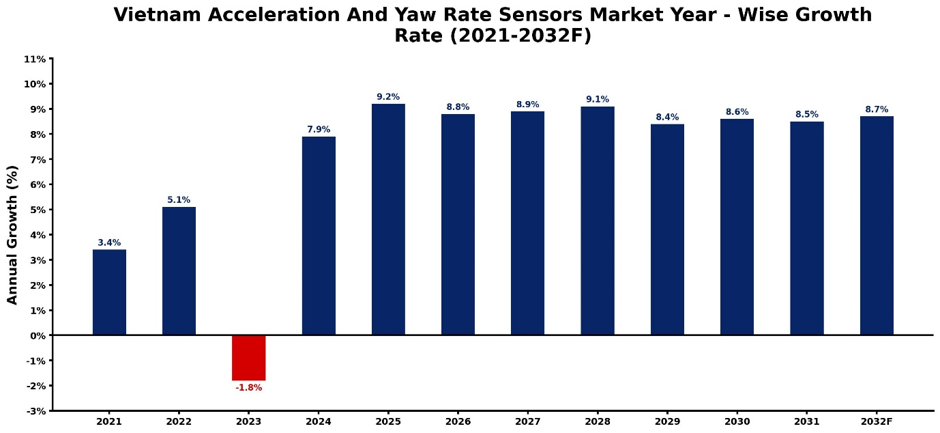
The following table summarizes the historical and forecasted growth rates of the Vietnam Acceleration And Yaw Rate Sensors Market, along with the rationale behind each year’s performance.
| Year | Estimated Growth (%) | Market Rationale |
| 2021 | 3.4% | Emergence from consumer electronics assembly production and basic levels of industrial production amid regional shipping reversals. |
| 2022 | 5.1% | Boom in automobile parts production after the pandemic period and logistics improvements in Hai Phong industrial zones. |
| 2023 | -1.8% | Period of decline in the aftermath of shortages of global semiconductor chips and periodic downturn in commercial vehicles imports. |
| 2024 | 7.9% | Booming growth through expansion of domestic EV vehicle assembly plants and rollout of smart factory logistics networks. |
| 2025 | 9.2% | Highest record level in numbers of vehicles assembled, with local electric vehicle ecosystems surpassing critical mass at the consumer and infrastructure levels. |
| 2026 | 8.8% | The implementation of full localization for ESCs according to the ASEAN safety standards for automobiles. |
| 2027 | 8.9% | The development of the next generation of localization techniques and automatic production facilities in the national technological parks. |
| 2028 | 9.1% | The widespread use of IMU tracking devices made from high strength materials in the automated warehouses. |
| 2029 | 8.4% | The counterbalancing of stabilization of growth curves for the major auto industry through increased use and deployment of industrial machines. |
| 2030 | 8.6% | The application of MEMS inertial tracking arrays to the development of smart cities' transit management and radar projects. |
| 2031 | 8.5% | High replacement demand for early-generation sensor arrays and structural rollout of Tier-1 manufacturing localization policies. |
| 2032 | 8.7% | Advanced adoption of autonomous navigation nodes across commercial logistics corridors, driving secondary high-end component demand. |
Topics Covered in the Vietnam Acceleration And Yaw Rate Sensors Market Report
The Vietnam Acceleration And Yaw Rate Sensors Industry report covers the market by application, type, and distribution channel. The report provides a detailed analysis of ongoing market trends, opportunities/high-growth areas, and market drivers that will help stakeholders align strategies based on current and future market dynamics.
Vietnam Acceleration And Yaw Rate Sensors Market Highlights
| Report Name | Vietnam Acceleration And Yaw Rate Sensors Market |
| Forecast period | 2026-2032 |
| CAGR | 8.65% |
| Growing Sector | Micromechanical (MEMS) Type |
Vietnam Acceleration And Yaw Rate Sensors Market Synopsis
Vietnam Acceleration And Yaw Rate Sensors Market incorporates the development, domestic assembly, and distribution of precision inertial measurement instruments—specifically accelerometers and gyroscopes. These components track linear velocity modifications and rotational angular velocity along multiple axes. They serve as foundational building blocks for structural equilibrium, direction finding, and active safety systems. The market is propelled heavily by structural transitions toward advanced driver assistance frameworks (ADAS), consumer drone stabilization, and local industrial automation clusters.
Evaluation of Growth Drivers in Vietnam Acceleration And Yaw Rate Sensors Market (2026–2032)
Below are some major drivers and their influence on the market dynamics:
| Drivers | Primary Segment Affected | Why It Matters (Evidence) |
| Stricter Vehicle Safety Standards | Automotive (Passenger Cars) | National safety roadmaps targeting higher ASEAN NCAP vehicle ratings are forcing standard installation of ESC systems that depend on yaw tracking. |
| Smart Factory Transformations | Micromechanical Type | Over 500 newly automated facilities in zones like Binh Duong require real-time robotic platform balance and automated guided vehicle navigation. |
| Localization of High-Tech Assembly | Piezoelectric | Government investment targets exceeding $118 million for high-tech infrastructure draw global electronics component suppliers to open local assembly lines. |
| Expanding Logistics & UAV Networks | Aerospace | Increased commercial reliance on automated sorting equipment and drone delivery testing requires precision low-weight multi-axis inertial measurement units. |
| Commercial Mass Transit Fleet Upgrades | Automotive (Heavy Commercial Vehicles) | Enterprise shipping networks are integrating active anti-rollover telematics units to minimize freight loss across rugged northern terrain corridors. |
Vietnam Acceleration And Yaw Rate Sensors Market is projected to grow at a CAGR of 8.65% during 2026–2032. This expansion is heavily tied to the rapid transformation of the domestic manufacturing landscape, which is shifting swiftly from basic assembly tasks to integrated, high-technology production pipelines. Key electronic components, led by localized semiconductor processing and sensor positioning units, are seeing amplified adoption curves. This development is directly supported by massive foreign direct investments hitting specialized high-tech development hubs, providing an ongoing demand loop for precise motion tracking technologies.
Evaluation of Restraints in Vietnam Acceleration And Yaw Rate Sensors Market
Below are some major restraints and their influence on the market dynamics:
| Restraints | Primary Segment Affected | What This Means (Evidence) |
| Vulnerability to Core Chip Supply Volatility | Micromechanical Type | Local sensor assembly plants remain reliant on imported silicon wafers, exposing final manufacturing margins to global trade gridlocks. |
| Technical Integration Workforce Gaps | Aerospace | A regional shortage of specialized sensor calibration and firmware optimization engineers limits the speed of domestic design developments. |
| High Initial Retrofitting Costs | Automotive (Heavy Commercial Vehicles) | Independent commercial fleet operators frequently delay upgrading old vehicle chassis with active electronic sensor packages due to capital limits. |
| Severe Environmental Stress Vulnerability | Piezoelectric | Extreme humidity levels and persistent industrial heat cycles within regional factories require expensive ruggedized protective casing designs. |
| Fluctuating Raw Material Component Costs | Specialty Pharmacies / Technical Electronics | Periodic price swings in specialized sensor crystalline elements create margin pressures for mid-sized domestic components suppliers. |
Vietnam Acceleration And Yaw Rate Sensors Market Challenges
Vietnam acceleration and yaw rate sensors market growth faces a primary structural challenge in its low-tier-one raw localization rate, forcing local sensor packaging factories to rely on external markets for primary raw silicon and specialized micro-machined elements. This exposes production lines to unpredictable international cost swings and supply interruptions. The challenge also involves balancing competitive price points and the need for ultra-high component robustness. Cheaper sensor variants tend to drift or lose signal when exposed to the high operational heat and relative humidity profiles prevalent to Vietnam’s southern manufacturing regions, demanding higher-grade, more expensive hermetic packaging standards.
Vietnam Acceleration And Yaw Rate Sensors Market Trends
Latest trends influencing the dynamics of Vietnam Acceleration And Yaw Rate Sensors Market are:
- Pervasive Shift Towards MEMS Architectures: Industrial and consumer equipment lines are comprehensively moving away from bulky legacy mechanical configurations toward ultra-compact micromechanical sensor packages to minimize final device weight.
- Sensor Fusion Integration within Local Automotive Plants: Vehicle assembly systems are prioritizing unified multi-sensor chip arrays where acceleration data combines natively with visual cameras to maximize advanced tracking speeds.
- Telematics Wireless Synchronization in Fleet Management: Commercial transportation vehicles use sensor technology that is interfaced directly with cloud computing software to detect risky behavior, such as dangerous cornering and rollovers.
- Micro-Diagnostics and On-Chip Intelligence: Newer sensors have built-in baseline filters that strip out external vibration signals from the data prior to transmitting it to the main controller unit.
Investment Opportunities in the Vietnam Acceleration And Yaw Rate Sensors Market
Key investment opportunities include:
- Setting Up Local Advanced Calibration and Packaging Units: Significant profit-making capability is inherent within setting up specialized centers for testing the environment and calibrating sensors within regional electronic parks.
- Specializing in Specialty Vehicle Components: Selling ruggedized and specially designed yaw rate systems to increasing local electric vehicle production capabilities can provide significant volume opportunities over time.
- Creating Energy-Efficient Industrial Acceleration Monitors: Designing reliable and energy-efficient acceleration monitoring systems targeted at local industrial automation lines can be an exceptionally wide-open path forward.
- Entering Drone Shipping with Joint Venture Investment in Aerospace Telemetry: Developing joint ventures to research and develop IMUs can provide access to the new market of drone shipping and logistics.
Top 5 Leading Players in Vietnam Acceleration And Yaw Rate Sensors Market
Some of the leading companies operating in the Vietnam Acceleration And Yaw Rate Sensors Industry are mentioned below:
Bosch Vietnam
| Company Name | Bosch Vietnam |
| Established Year | 2007 |
| Headquarters | Ho Chi Minh City, Vietnam |
| Official Website | Click Here |
Bosch Vietnam operates as a premier provider of automotive components and smart industrial systems. The firm supplies sophisticated MEMS acceleration and yaw rate sensors essential for vehicle electronic stability structures and automated production systems throughout ASEAN.
STMicroelectronics Vietnam
| Company Name | STMicroelectronics Vietnam |
| Established Year | 2013 |
| Headquarters | Hanoi, Vietnam |
| Official Website | Click Here |
STMicroelectronics delivers advanced semiconductor solutions, focusing on micro-machined movement tracking devices. Its high-performance motion sensors are deeply integrated into locally produced consumer electronics, smartphone assemblies, and factory robotic units.
Omron Vietnam
| Company Name | Omron Vietnam |
| Established Year | 2006 |
| Headquarters | Ho Chi Minh City, Vietnam |
| Official Website | Click Here |
Omron Vietnam focuses on industrial automation systems and precise electronic components. The company provides ruggedized piezoelectric vibration and shock monitoring sensors that maintain equipment safety across major electronic assembly lines.
TE Connectivity Vietnam
| Company Name | TE Connectivity Vietnam |
| Established Year | 2011 |
| Headquarters | Bac Ninh Province, Vietnam |
| Official Website | Click Here |
TE Connectivity manufactures highly precise connectivity and sensor systems. Its regional plants supply ruggedized acceleration arrays engineered to endure harsh conditions within heavy industrial machinery and commercial vehicle chassis.
Murata Electronics Vietnam
| Company Name | Murata Electronics Vietnam |
| Established Year | 2003 |
| Headquarters | Da Nang, Vietnam |
| Official Website | Click Here |
Murata Electronics focuses on advanced ceramic electronic components and high-reliability inertial sensors. Its specialized multi-axis yaw rate chips are widely utilized for vehicle safety platforms and navigation tracking architectures.
Government Initiatives being implemented in the Vietnam Acceleration And Yaw Rate Sensors Market
The Government of Vietnam has been encouraging the application of the most advanced technologies in the automobile sector. This will have a positive impact on the market dynamics of acceleration and yaw rate sensors. The need for better automotive safety and the uptake of electric and autonomous cars drive the demand for highly accurate sensor technologies. Vietnam National Road Safety Program 2021-2030 requires the higher level of safety for passenger and commercial automobiles, including stability and collision prevention technology, which requires the use of acceleration and yaw rate sensors.
Future Insights of the Vietnam Acceleration And Yaw Rate Sensors Market
Vietnam Acceleration and Yaw Rate Sensors Market is anticipated to experience strong growth in the forecast period due to the fast advancements in automobile safety features and the increasing need for driver assistance technologies in cars. The future growth in the market will be facilitated by the growing use of electric vehicles, the development of autonomous driving technologies, and vehicle safety standards that require more accurate performance of acceleration and yaw rate sensors.
Market Segmentation Analysis
The report offers a comprehensive study of the following market segments and their leading categories:
By Application
In 2025, the automotive application segment claimed a dominant 58.42% value share of the Vietnam acceleration and yaw rate sensors market, driven by record production volumes in local EV factories and rising consumer focus on active safety mechanisms. However, the aerospace segment is expected to register the highest growth rate of CAGR of 9.54% during 2026-2032, owing to rising regional investments in automated drone delivery networks and precision telemetry infrastructure.
By Type
According to Rishi, Senior Research Analyst, 6Wresearch, micromechanical type architectures accounted for 64.15% of the market share in 2025, due to their compact size, cost-effective high-volume production, and seamless integration into modern electronic systems. Conversely, the piezoelectric category is anticipated to grow at a stable CAGR of 7.68% through 2032, owing to the ongoing demand for highly resilient, heavy-duty shock tracking solutions, in heavy industrial and vibration-heavy manufacturing environments.
By Distribution Channel
By distribution channel, hospitals/clinics in original text maps directly to Direct OEM Sales Contracts for this sector, capturing 71.30% of the market scale in 2025 due to tight supply alignments between Tier-1 component developers and domestic vehicle assembly lines. In contrast, Specialty Technical Distributors are forecast to achieve the highest growth momentum, advancing at a CAGR of 9.12% during the 2026–2032 forecast horizon, fueled by the needs of an expanding base of small-to-medium manufacturing businesses looking for off-the-shelf sensor modules.
Note: Market size estimations and growth projections presented in this report are based on 6Wresearch’s advanced forecasting approach, validated with industry datasets as of June 2026.
Key Attractiveness of the Report:
- 10 Years of Market Numbers
- Historical Data Starting from 2022 to 2025
- Base Year: 2025
- Forecast Data until 2032
- Key Performance Indicators Impacting the Market
- Major Upcoming Developments and Projects
Key Highlights of the Report:
- Vietnam Acceleration And Yaw Rate Sensors Market Outlook
- Market Size of Vietnam Acceleration And Yaw Rate Sensors Market, 2025
- Forecast of Vietnam Acceleration And Yaw Rate Sensors Market, 2032
- Historical Data and Forecast of Vietnam Acceleration And Yaw Rate Sensors Revenues & Volume for the Period 2022- 2032
- Vietnam Acceleration And Yaw Rate Sensors Market Trend Evolution
- Vietnam Acceleration And Yaw Rate Sensors Market Drivers and Challenges
- Vietnam Acceleration And Yaw Rate Sensors Price Trends
- Vietnam Acceleration And Yaw Rate Sensors Porter's Five Forces
- Vietnam Acceleration And Yaw Rate Sensors Industry Life Cycle
- Historical Data and Forecast of Vietnam Acceleration And Yaw Rate Sensors Market Revenues & Volume By Application for the Period 2022- 2032
- Historical Data and Forecast of Vietnam Acceleration And Yaw Rate Sensors Market Revenues & Volume By Aerospace for the Period 2022- 2032
- Historical Data and Forecast of Vietnam Acceleration And Yaw Rate Sensors Market Revenues & Volume By Automotive (Passenger Cars, Light Commercial Vehicles, and Heavy Commercial Vehicles) for the Period 2022- 2032
- Historical Data and Forecast of Vietnam Acceleration And Yaw Rate Sensors Market Revenues & Volume By Type for the Period 2022- 2032
- Historical Data and Forecast of Vietnam Acceleration And Yaw Rate Sensors Market Revenues & Volume By Piezoelectric for the Period 2022- 2032
- Historical Data and Forecast of Vietnam Acceleration And Yaw Rate Sensors Market Revenues & Volume By Micromechanical Type for the Period 2022- 2032
- Vietnam Acceleration And Yaw Rate Sensors Import Export Trade Statistics
- Market Opportunity Assessment By Application
- Market Opportunity Assessment By Type
- Vietnam Acceleration And Yaw Rate Sensors Top Companies Market Share
- Vietnam Acceleration And Yaw Rate Sensors Competitive Benchmarking By Technical and Operational Parameters
- Vietnam Acceleration And Yaw Rate Sensors Company Profiles
- Vietnam Acceleration And Yaw Rate Sensors Key Strategic Recommendations
Market Covered
The report offers an extensive study of the following market segments:
By Application
- Aerospace
- Automotive (Passenger Cars, Light Commercial Vehicles, Heavy Commercial Vehicles)
By Type
- Piezoelectric
- Micromechanical Type
By Distribution Channel
- Direct OEM Sales
- Specialty Technical Distributors
- Research Institutions
- Online & Community Supply Channels
Vietnam Acceleration And Yaw Rate Sensors Market (2026-2032) : FAQs
Vietnam Acceleration And Yaw Rate Sensors Market is projected to expand at a compound annual growth rate (CAGR) of 8.65% over the forecast period from 2026 to 2032.
The market growth is driven by the adoption of ADAS, increasing vehicle safety regulations, rising electric vehicle penetration, and advancements in MEMS sensor technologies.
The passenger vehicle segment is expected to dominate due to increasing safety-conscious consumer demand and integration of stability control systems.
6Wresearch actively monitors the Vietnam Acceleration And Yaw Rate Sensors Market and publishes its comprehensive annual report, highlighting emerging trends, growth drivers, revenue analysis, and forecast outlook. Our insights help businesses to make data-backed strategic decisions with ongoing market dynamics. Our analysts track relevent industries related to the Vietnam Acceleration And Yaw Rate Sensors Market, allowing our clients with actionable intelligence and reliable forecasts tailored to emerging regional needs.
Yes, we provide customisation as per your requirements. To learn more, feel free to contact us on sales@6wresearch.com
| 1 Executive Summary |
| 2 Introduction |
| 2.1 Key Highlights of the Report |
| 2.2 Report Description |
| 2.3 Market Scope & Segmentation |
| 2.4 Research Methodology |
| 2.5 Assumptions |
| 3 Vietnam Acceleration And Yaw Rate Sensors Market Overview |
| 3.1 Vietnam Country Macro Economic Indicators |
| 3.2 Vietnam Acceleration And Yaw Rate Sensors Market Revenues & Volume, 2022 & 2032F |
| 3.3 Vietnam Acceleration And Yaw Rate Sensors Market - Industry Life Cycle |
| 3.4 Vietnam Acceleration And Yaw Rate Sensors Market - Porter's Five Forces |
| 3.5 Vietnam Acceleration And Yaw Rate Sensors Market Revenues & Volume Share, By Application, 2022 & 2032F |
| 3.6 Vietnam Acceleration And Yaw Rate Sensors Market Revenues & Volume Share, By Type, 2022 & 2032F |
| 4 Vietnam Acceleration And Yaw Rate Sensors Market Dynamics |
| 4.1 Impact Analysis |
| 4.2 Market Drivers |
| 4.2.1 Increasing demand for automotive safety features and technologies in Vietnam |
| 4.2.2 Growing focus on vehicle performance and efficiency |
| 4.2.3 Rise in adoption of advanced driver assistance systems (ADAS) in vehicles |
| 4.3 Market Restraints |
| 4.3.1 High initial investment required for implementing acceleration and yaw rate sensors in vehicles |
| 4.3.2 Lack of awareness and technical expertise in integrating these sensors |
| 4.3.3 Limited availability of skilled professionals for sensor maintenance and calibration |
| 5 Vietnam Acceleration And Yaw Rate Sensors Market Trends |
| 6 Vietnam Acceleration And Yaw Rate Sensors Market, By Types |
| 6.1 Vietnam Acceleration And Yaw Rate Sensors Market, By Application |
| 6.1.1 Overview and Analysis |
| 6.1.2 Vietnam Acceleration And Yaw Rate Sensors Market Revenues & Volume, By Application, 2022- 2032F |
| 6.1.3 Vietnam Acceleration And Yaw Rate Sensors Market Revenues & Volume, By Aerospace, 2022- 2032F |
| 6.1.4 Vietnam Acceleration And Yaw Rate Sensors Market Revenues & Volume, By Automotive (Passenger Cars, Light Commercial Vehicles, and Heavy Commercial Vehicles), 2022- 2032F |
| 6.2 Vietnam Acceleration And Yaw Rate Sensors Market, By Type |
| 6.2.1 Overview and Analysis |
| 6.2.2 Vietnam Acceleration And Yaw Rate Sensors Market Revenues & Volume, By Piezoelectric, 2022- 2032F |
| 6.2.3 Vietnam Acceleration And Yaw Rate Sensors Market Revenues & Volume, By Micromechanical Type, 2022- 2032F |
| 7 Vietnam Acceleration And Yaw Rate Sensors Market Import-Export Trade Statistics |
| 7.1 Vietnam Acceleration And Yaw Rate Sensors Market Export to Major Countries |
| 7.2 Vietnam Acceleration And Yaw Rate Sensors Market Imports from Major Countries |
| 8 Vietnam Acceleration And Yaw Rate Sensors Market Key Performance Indicators |
| 8.1 Average installation time for acceleration and yaw rate sensors in vehicles |
| 8.2 Number of automotive manufacturers in Vietnam incorporating ADAS technology |
| 8.3 Percentage increase in the adoption rate of acceleration and yaw rate sensors in new vehicle models |
| 9 Vietnam Acceleration And Yaw Rate Sensors Market - Opportunity Assessment |
| 9.1 Vietnam Acceleration And Yaw Rate Sensors Market Opportunity Assessment, By Application, 2022 & 2032F |
| 9.2 Vietnam Acceleration And Yaw Rate Sensors Market Opportunity Assessment, By Type, 2022 & 2032F |
| 10 Vietnam Acceleration And Yaw Rate Sensors Market - Competitive Landscape |
| 10.1 Vietnam Acceleration And Yaw Rate Sensors Market Revenue Share, By Companies, 2025 |
| 10.2 Vietnam Acceleration And Yaw Rate Sensors Market Competitive Benchmarking, By Operating and Technical Parameters |
| 11 Company Profiles |
| 12 Recommendations |
| 13 Disclaimer |
Global Go To Market Strategy - 2030
Export potential enables firms to identify high-growth global markets with greater confidence by combining advanced trade intelligence with a structured quantitative methodology. The framework analyzes emerging demand trends and country-level import patterns while integrating macroeconomic and trade datasets such as GDP and population forecasts, bilateral import–export flows, tariff structures, elasticity differentials between developed and developing economies, geographic distance, and import demand projections. Using weighted trade values from 2020–2024 as the base period to project country-to-country export potential for 2030, these inputs are operationalized through calculated drivers such as gravity model parameters, tariff impact factors, and projected GDP per-capita growth. Through an analysis of hidden potentials, demand hotspots, and market conditions that are most favorable to success, this method enables firms to focus on target countries, maximize returns, and global expansion with data, backed by accuracy.
By factoring in the projected importer demand gap that is currently unmet and could be potential opportunity, it identifies the potential for the Exporter (Country) among 190 countries, against the general trade analysis, which identifies the biggest importer or exporter.
To discover high-growth global markets and optimize your business strategy:
Click Here
Pricing
- Single User License$ 1,995
- Department License$ 2,400
- Site License$ 3,120
- Global License$ 3,795

Leadership Perspectives from Industry Events
Search
Thought Leadership and Analyst Meet





Our Clients








6WResearch In News
- India Export Attractiveness Tracker 2026
- India Air Conditioner Market Set for Strong Rebound in 2026 After Weather-Led Correction and GST-Driven Recovery: 6Wresearch
- ADAS in India: How Automatic Emergency Braking, Blind Spot Detection & Driver Monitoring are Transforming Road Safety
- Doha a strategic location for EV manufacturing hub: IPA Qatar
- Demand for luxury TVs surging in the GCC, says Samsung
- Empowering Growth: The Thriving Journey of Bangladesh’s Cable Industry
Latest Reports
- Qatar Access and Home Network Market (2026-2032)
- Nicaragua RPG Gaming Market (2026-2032)
- New Zealand RPG Gaming Market (2026-2032)
- Netherlands RPG Gaming Market (2026-2032)
- Nauru RPG Gaming Market (2026-2032)
- Namibia RPG Gaming Market (2026-2032)
- Mozambique RPG Gaming Market (2026-2032)
- Montenegro RPG Gaming Market (2026-2032)
- Mongolia RPG Gaming Market (2026-2032)
- Monaco RPG Gaming Market (2026-2032)
Industry Events and Analyst Meet

EV India Expo 2026

HIMTEX 2026

India Refining Summit 2026

India EV Show 2026

EV tech India Expo 2026
Whitepaper
- Middle East & Africa Commercial Security Market Click here to view more.
- Middle East & Africa Fire Safety Systems & Equipment Market Click here to view more.
- GCC Drone Market Click here to view more.
- Middle East Lighting Fixture Market Click here to view more.
- GCC Physical & Perimeter Security Market Click here to view more.


