Vietnam Agronomic Amino Acids Market Size & Growth Rate
According to 6Wresearch internal database and industry insights, the Vietnam Agronomic Amino Acids Market was valued at USD 35 Million in 2025 and is projected to reach USD 78.35 Million by 2032, growing at a CAGR of approximately 12.2% during 2026–2032.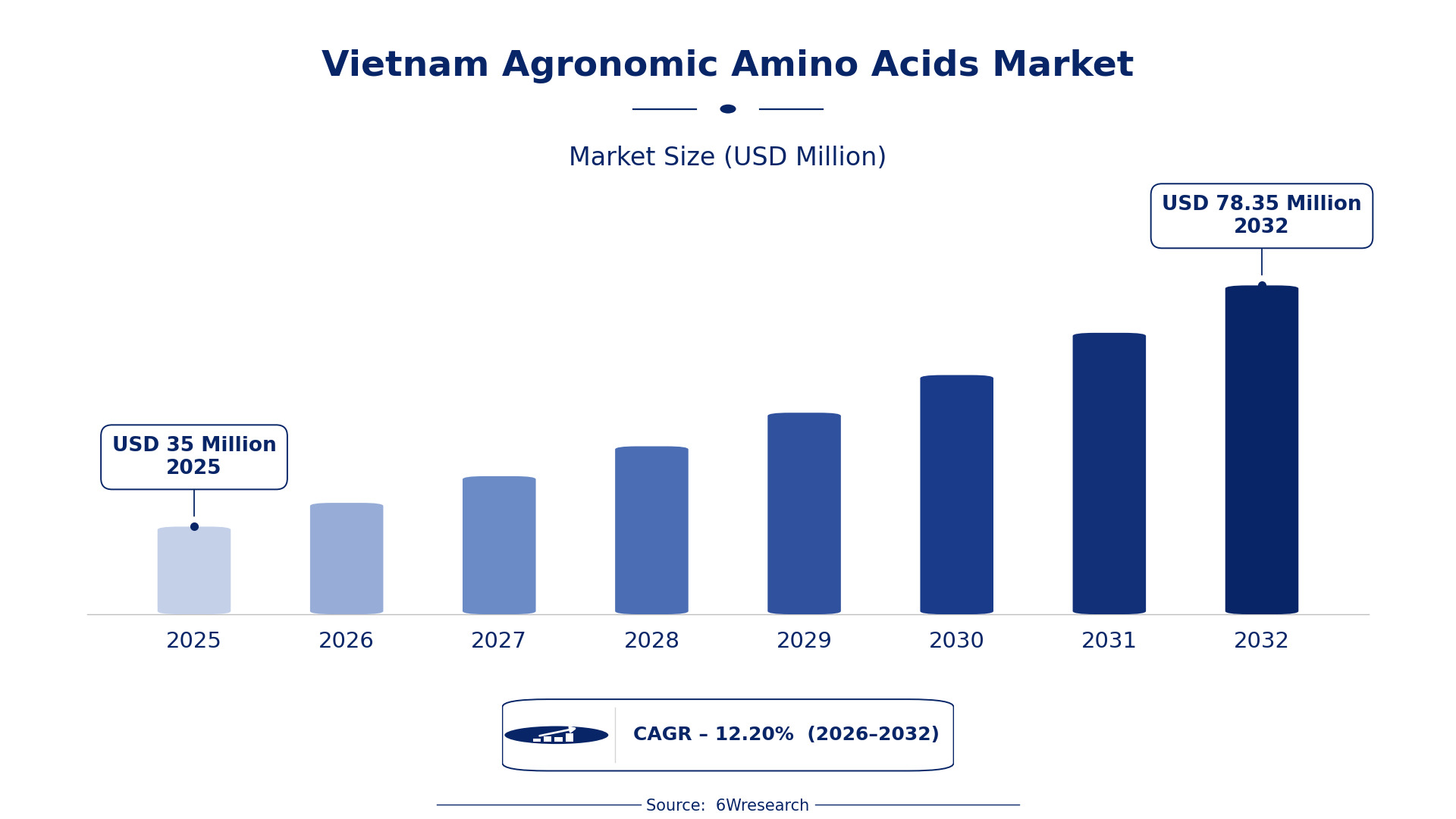
Vietnam Agronomic Amino Acids Market Highlights
| Report Metric | Details |
| Report Name | Vietnam Agronomic Amino Acids Market |
| Market Size 2025 | USD 35 Million |
| Market Size 2032 | USD 78.35 Million |
| Absolute Growth 2025–2032 | USD 43.35 Million |
| CAGR 2026–2032 | 12.20% |
| Peak Annual Growth | 13.6% (2029) |
| Forecast Period | 2026–2032 |
| Historical Data | 2022–2025 |
| Base Year | 2025 |
| Leading Type, 2025 | Lysine (24% share) |
| Leading Source, 2025 | Plant-based (26% share) |
| Leading Application, 2025 | Soil Amendment (21% share) |
| Fastest-Growing Type | Arginine (15.1% CAGR) |
| Fastest-Growing Source | Foliar (14.6% CAGR) |
| Fastest-Growing Application | Crop Resistance (14.1% CAGR) |
| Growing Sector | Perennial fruit and coffee cultivation |
| Key End Users | Rice growers, coffee and pepper plantations, fruit orchard operators, vegetable farms, farmer cooperatives, agri-input distributors and fertiliser blenders |
Vietnam Agronomic Amino Acids Market Year-wise Growth Rate and Key Drivers (2022–2032)
This graph illustrates the annual growth rates of the Vietnam Agronomic Amino Acids Market from 2022 to 2032, highlighting a steady upward trajectory and projected market expansion over the forecast period.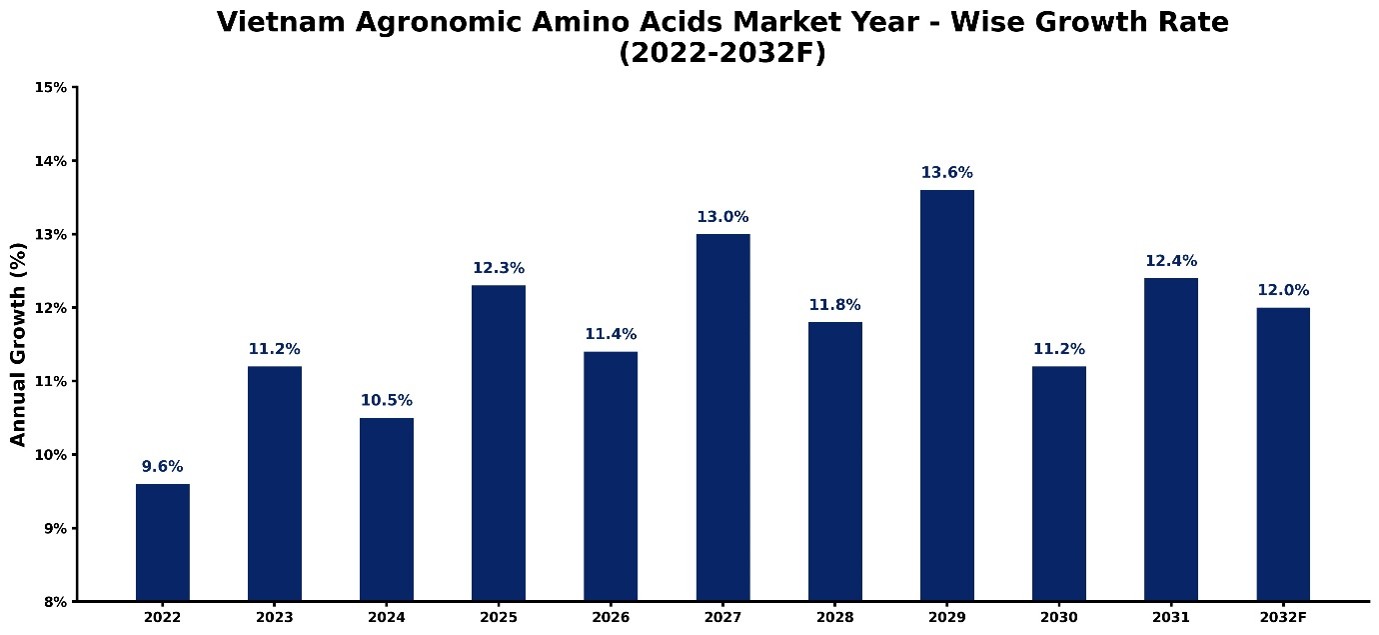
The following table presents the estimated annual growth rate for each year together with the principal factor influencing market performance. The values are intended to highlight year-specific drivers rather than to provide a direct comparison between individual years.
| Year | Estimated Annual Growth (%) | Market Rationale |
| 2022 | 9.6 | Fertiliser price spikes following the Russia-Ukraine conflict squeezed farm margins and kept spending on premium crop nutrition products modest. |
| 2023 | 11.2 | Record rice exports of about 8.1 million tonnes raised grower incomes and revived spending on yield-supporting nutrition inputs. |
| 2024 | 10.5 | Typhoon Yagi in September 2024 damaged northern crops and disrupted planting calendars, delaying purchases of crop nutrition inputs. |
| 2025 | 12.3 | The launch of low-emission rice pilots in the Mekong Delta covering 100,000 hectares boosted demand for efficiency-oriented nutrient products. |
| 2026 | 11.4% | Growth will be moderated by one-off trial purchases associated with the pilots, which are not expected to recur as buyers return to standard programs. |
| 2027 | 13 | Wider commercial use of drone-based spraying is expected to cut application labour costs and broaden uptake of liquid nutrition products. |
| 2028 | 11.8 | Rising competition from lower-priced imported biostimulants is expected to compress selling prices and moderate value growth. |
| 2029 | 13.6 | Entry of locally produced fermentation-derived amino acids is expected to lower input costs and widen adoption among smallholders. |
| 2030 | 11.2 | Early adopters in mature rice areas are expected to reach saturation, which will moderate growth. |
| 2031 | 12.4 | Recurring drought and salinity events are expected to renew demand for stress-protection inputs across the Mekong Delta and Central Highlands. |
| 2032 | 12 | A larger market base is expected to temper growth, even as precision application broadens usage among commercial growers. |
Note: Market size estimations and growth projections presented in this report are based on 6Wresearch’s proprietary forecasting methodology, utilizing the latest available industry data, government publications, and primary research inputs.
Vietnam Agronomic Amino Acids Market Synopsis
The Vietnam Agronomic Amino Acids Market is gaining traction, as more and more farmers are using amino acid-based fertilizers and biostimulants to enhance crop growth, nutrient absorption and plant resilience. These products support plant metabolism, help crops tolerate environmental stresses such as drought, salinity and contribute to improved crop quality and productivity.
The market is driven by the growing demand for sustainable agricultural inputs, the increasing focus on efficient nutrient management and the need to maintain the quality of export-oriented crops such as coffee, fruits, vegetables and pepper.
Market Dynamics Impact Analysis (2026–2032)
| Factor | Type | Impact | Primary Segment Affected |
| Export-oriented, residue-compliant farming | Driver | High | Crop Resistance |
| Expansion of durian and coffee plantations | Driver | High | Bud Growth and Leaves Development |
| Local formulation from agro-industrial by-products | Opportunity | High | Plant-based |
| Seed treatment and coated seed adoption | Opportunity | Medium | Seed |
| Dependence on imported inputs | Restraint | High | Synthetic |
| Fragmented smallholder farmland | Restraint | Medium | Soil |
| Limited technical extension capacity | Challenge | High | Foliar |
| Variation in product quality and labelling | Challenge | Medium | Treatment Method |
Evaluation of Drivers in Vietnam Agronomic Amino Acids Market (2026–2032)
Below are some major drivers and their influence on market dynamics.
| Drivers | Primary Segment Affected | Why It Matters (Evidence) |
| Export-oriented, residue-compliant farming | Crop Resistance | Export buyers set tight residue limits, so growers use amino acids to build stress tolerance with fewer chemical inputs. Vietnam’s agriculture, forestry and fisheries exports reached about USD 62.5 billion in 2024. |
| Expansion of durian plantings | Bud Growth and Leaves Development | Orchard growers use amino acids to support flowering, flush and fruit set in young trees. Durian exports passed USD 3 billion in 2024 after formal market access to China opened in 2022. |
| Recurring salinity and drought events | Soil Amendment | Amino acids act as osmoprotectants and improve nutrient uptake in stressed soils, so salinity and drought raise demand for corrective inputs. The Mekong Delta suffered severe saline intrusion in 2016, 2020 and 2024. |
| Fertigation-based coffee management | Foliar | Drip fertigation and foliar feeding allow precise dosing of amino acids to coffee trees and lift nutrient efficiency during dry spells. Vietnam cultivates roughly 700,000 hectares of coffee, mainly in the Central Highlands. |
Vietnam Agronomic Amino Acids Market is expected to grow at a CAGR of 12.2% during the forecast period (2026–2032). Rising rural incomes and expanding digital access among farmers, which shorten the path from product information to purchase, are some of the major aspects driving market growth. For example, around 78 million Vietnamese were online in early 2024, and mobile advisory services and online input retail are widening the buyer base beyond traditional dealers.
Cooperatives and processor-linked contract farming are consolidating purchasing and pushing standardized input programs. Private investment in formulation and blending capacity is improving local product availability, and better warehousing and last-mile logistics are lowering delivery costs to remote growing areas.
Evaluation of Restraints in Vietnam Agronomic Amino Acids Market
Below are some major restraints and their influence on market dynamics.
| Market Restraint | Primary Segment Affected | Why It Matters (Evidence) |
| Dependence on imported raw materials | Synthetic | Imported feedstock exposes local producers to foreign price swings and shipping delays, which raises ex-factory prices. Vietnam imports virtually all of its potash requirement, showing how deeply fertiliser supply chains rely on overseas sources. |
| Fragmented smallholder farmland | Soil | Small plots raise the cost of reaching and educating each buyer, which slows the spread of new products. Average farm holdings are below one hectare for most households. |
| Price-sensitive discretionary spending | Plant-based | Growers prioritise basal NPK and cut optional inputs first when margins tighten, so amino acid sales fall faster than staple fertiliser sales. Rice alone occupies about 7 million hectares, so budget cuts affect very large volumes. |
| Weather-related loss of foliar effectiveness | Foliar | Rain shortly after spraying washes nutrients off leaves, lowering efficacy and farmer confidence in repeat purchases. The Mekong Delta wet season lasts roughly six months. |
Vietnam Agronomic Amino Acids Market Challenges
Despite Vietnam agronomic amino acids market growth, there are several hinderances that affects its overall trajectory. For example, technical extension capacity is thin, with roughly 9 million farming households relying largely on dealer advice for dosage and timing, which limits correct use and repeat purchases.
In addition, product quality assurance varies across 34 provincial-level administrations, so labelled free amino acid content is not always comparable, weakening buyer trust in premium brands.
Moreover, distribution runs on dealer credit repaid at harvest, often after a rice cycle of about 100 days, concentrating bargaining power in the channel and squeezing manufacturer margins. Compatibility of amino acid formulations with common pesticide tank mixes also needs wider field validation, delaying multi-purpose product launches.
Vietnam Agronomic Amino Acids Market Trends
Below are some of the trends influencing the dynamics of the Vietnam Agronomic Amino Acids Market:
- Shift from Chemical-Only to Integrated Nutrition Programmes: Growers in rice, coffee and fruit regions are combining amino acids with conventional fertilisers to hold yields at lower chemical rates. Agronomists and dealers now promote seasonal nutrition calendars rather than single-product sales.
- Shift from Imported Finished Goods to Locally Formulated Biostimulants: Domestic blenders increasingly buy amino acid concentrates and formulate liquid products in Vietnam, using regional agro-processing and aquaculture by-products as raw material. Locally registered brands now sit alongside multinational products in Mekong Delta dealer shops.
- Transition from Conventional to Organic-Oriented Production: The organic agriculture development project approved in 2020 is steering producers of tea, vegetables and fruit towards inputs of biological origin. Certified farms prefer plant-based and fermentation-derived amino acids over synthetic alternatives.
Investment Opportunities in the Vietnam Agronomic Amino Acids Market
Some of the investment opportunities in the Vietnam Agronomic Amino Acids Market are mentioned below.
- Regional Hydrolysate Production Plants: Pangasius, shrimp and rice-bran residues in the Mekong Delta provide abundant low-cost protein feedstock. Investors can build enzymatic hydrolysis plants producing liquid and powder amino acid concentrates for crop use.
- Foliar-Grade Formulations for Perennial Crops: Durian, coffee and pepper growers in Dak Lak, Lam Dong and the Southeast need fully soluble, chelated amino acid products for flowering and fruit development. Suppliers can invest in liquid and soluble powder lines with micronutrient chelation.
- Seed Treatment and Coating Products: Certified rice seed demand in the Mekong Delta and Red River Delta offers a base for amino acid seed primers that improve germination and early vigour. Investors can supply seed-grade formulations and coating services.
Leading Players in Vietnam Agronomic Amino Acids Market
Below is a list of leading companies contributing significantly to the Vietnam Agronomic Amino Acids Market growth:
1. Ajinomoto Co., Inc.
|
Field |
Details |
|---|---|
|
Company Name |
Ajinomoto Co., Inc. |
|
Established Year |
1909 |
|
Headquarters |
Tokyo, Japan |
|
Official Website |
Ajinomoto Co., Inc. is a global amino acid producer whose fermentation expertise supports animal nutrition and agricultural applications. Its Vietnam operations make it a recognised supplier of amino acid-based inputs in the national market.
2. CJ CheilJedang Corp.
|
Field |
Details |
|---|---|
|
Company Name |
CJ CheilJedang Corp. |
|
Established Year |
1953 |
|
Headquarters |
Seoul, South Korea |
|
Official Website |
CJ CheilJedang Corp. is a leading producer of fermentation-derived amino acids, including lysine and methionine. It serves Vietnam through its regional commercial network and supplies raw materials used in downstream nutrition products.
3. Evonik Industries AG
|
Field |
Details |
|---|---|
|
Company Name |
Evonik Industries AG |
|
Established Year |
2007 |
|
Headquarters |
Essen, Germany |
|
Official Website |
Evonik Industries AG is a specialty chemicals group and a major global supplier of methionine. It serves Vietnam through regional distribution and technical support for amino acid-based nutrition applications.
4. Yara International ASA
|
Field |
Details |
|---|---|
|
Company Name |
Yara International ASA |
|
Established Year |
1905 |
|
Headquarters |
Oslo, Norway |
|
Official Website |
Yara International ASA is a crop nutrition company offering fertilisers and foliar specialty products. Its local presence in Vietnam supports growers of high-value horticultural and plantation crops.
5. Loc Troi Group
|
Field |
Details |
|---|---|
|
Company Name |
Loc Troi Group |
|
Established Year |
1993 |
|
Headquarters |
Long Xuyen, Vietnam |
|
Official Website |
Loc Troi Group is a Vietnamese agricultural inputs and agribusiness company serving rice and other crop growers. It plays a domestic role in crop protection, nutrition products and farmer advisory services, particularly in the Mekong Delta.
Government Initiatives in the Vietnam Agronomic Amino Acids Industry
In Vietnam, the Law on Crop Production No. 31/2018/QH14, which came into effect on 1 January 2020 (Vietnamese Government Data), regulates agronomic inputs, and fertilizer products including amino acid formulations must be registered and quality tested prior to sale.
Implementation is managed by the Ministry of Agriculture and Environment through its Department of Crop Production and Plant Protection, which deals with product registration and field programs. Decision 1490/QD-TTg in 2023 aims to develop one million hectares of high-quality, low-emission rice in the Mekong Delta by 2030, with a pilot of 100,000 hectares by 2025, and rewards balanced fertilizer application with reduced chemical input.
Future Insight of the Vietnam Agronomic Amino Acids Market
Several developments are expected to extend demand for the Vietnam Agronomic Amino Acids Market over the forecast period (2026-2032). Wider use of precision agronomy tools, including soil sensing and satellite-based crop monitoring, will allow growers to apply nutrition inputs in measured doses. Vietnam’s net-zero commitment for 2050 and the planned 5,000 km expressway network by 2030 will further encourage lower-emission farming and faster distribution to inland growing areas. Continued foreign investment in agri-input manufacturing and local formulation capacity will broaden product availability, and stronger digital advisory services will improve dealer and farmer knowledge of product use.
Market Segmentation Analysis
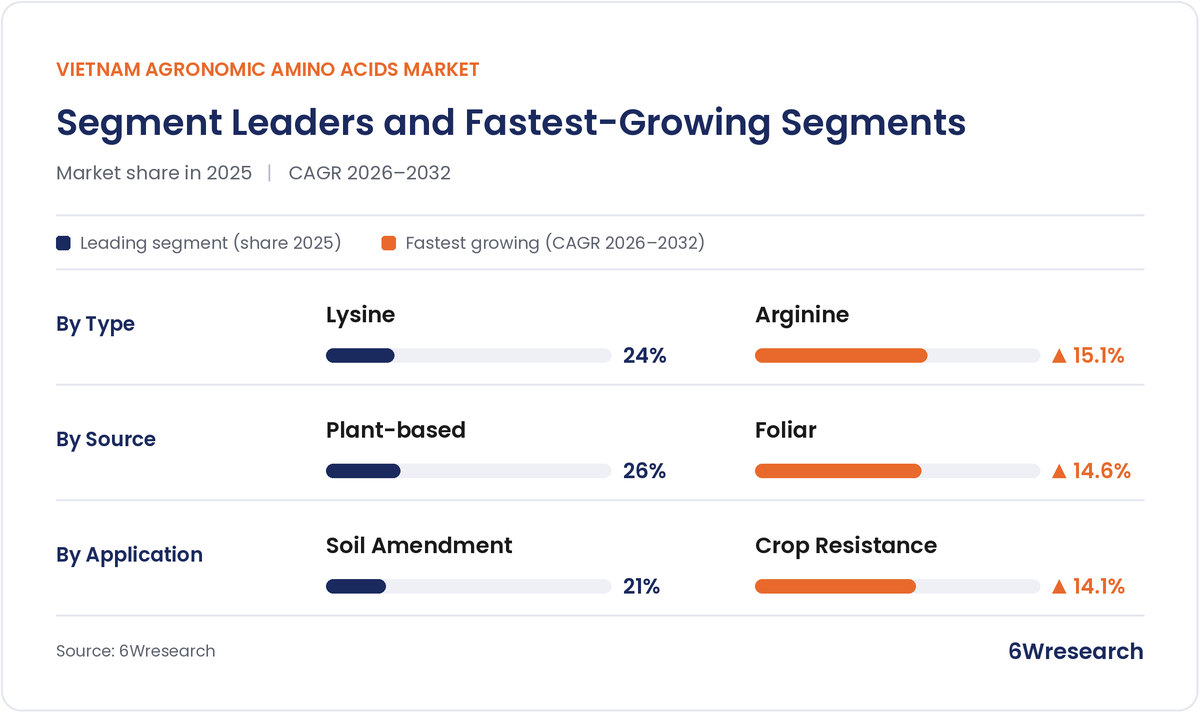
The report offers a comprehensive study of the Vietnam Agronomic Amino Acids Market across its key segments. The chart below highlights the leading segment by market share in 2025 and the fastest-growing segment by CAGR over 2026–2032, followed by a detailed analysis of each segment.
By Type – Lysine Leads, Arginine Expected to Grow Fastest
According to Summon Datta, Research Assistant Manager, 6Wresearch, Lysine led the Vietnam Agronomic Amino Acids Market in 2025 with a 24% share, supported by wide availability from feed-grade fermentation supply chains and its long use in rice and vegetable nutrition programmes. On the contrary, Arginine is expected to record the fastest growth at a CAGR of 15.1% during 2026–2032, driven by its role in nitrogen storage and plant stress signalling in perennial fruit and coffee crops.
By Source – Plant-based Leads, Foliar Expected to Grow Fastest
Plant-based sources accounted for the largest share of 26% in 2025, as abundant soybean meal, rice bran and agro-processing residues give hydrolysate producers low-cost feedstock and suit the move towards organic-oriented inputs. On the other hand, Foliar delivery is projected to expand at a CAGR of 14.6% over 2026–2032, owing to growing drone spraying services across Mekong Delta provinces and the need for rapid nutrient correction in fruit orchards.
By Application – Soil Amendment Leads, Crop Resistance Expected to Grow Fastest
Soil Amendment held the leading 21% share in 2025, reflecting widespread acid sulphate soils in the Mekong Delta and nutrient-poor basalt soils in the Central Highlands, where amino acids improve nutrient availability and microbial activity. At the same time, Crop Resistance is forecast to grow fastest at a CAGR of 14.1% during 2026–2032, as recurring drought, salinity and heat episodes raise demand for protective inputs.
Key Attractiveness of the Report
- 10 Years of Market Numbers
- Historical Data Starting from 2022 to 2025
- Base Year 2025
- Forecast Data until 2032
- Key Performance Indicators Impacting the Market
- Major Upcoming Developments and Projects
Key Highlights of the Report:
- Vietnam Agronomic Amino Acids Market Outlook
- Market Size of Vietnam Agronomic Amino Acids Market, 2025
- Forecast of Vietnam Agronomic Amino Acids Market, 2032
- Historical Data and Forecast of Vietnam Agronomic Amino Acids Revenues & Volume for the Period 2022-2032
- Vietnam Agronomic Amino Acids Market Trend Evolution
- Vietnam Agronomic Amino Acids Market Drivers and Challenges
- Vietnam Agronomic Amino Acids Price Trends
- Vietnam Agronomic Amino Acids Porter's Five Forces
- Vietnam Agronomic Amino Acids Industry Life Cycle
- Historical Data and Forecast of Vietnam Agronomic Amino Acids Market Revenues & Volume By Type for the Period 2022-2032
- Historical Data and Forecast of Vietnam Agronomic Amino Acids Market Revenues & Volume By Lysine for the Period 2022-2032
- Historical Data and Forecast of Vietnam Agronomic Amino Acids Market Revenues & Volume By Thymine for the Period 2022-2032
- Historical Data and Forecast of Vietnam Agronomic Amino Acids Market Revenues & Volume By Methionine for the Period 2022-2032
- Historical Data and Forecast of Vietnam Agronomic Amino Acids Market Revenues & Volume By Glutamic Acid for the Period 2022-2032
- Historical Data and Forecast of Vietnam Agronomic Amino Acids Market Revenues & Volume By Alanine for the Period 2022-2032
- Historical Data and Forecast of Vietnam Agronomic Amino Acids Market Revenues & Volume By Leucine for the Period 2022-2032
- Historical Data and Forecast of Vietnam Agronomic Amino Acids Market Revenues & Volume By Arginine for the Period 2022-2032
- Historical Data and Forecast of Vietnam Lysine Agronomic Amino Acids Market Revenues & Volume By Others for the Period 2022-2032
- Historical Data and Forecast of Vietnam Agronomic Amino Acids Market Revenues & Volume By Source for the Period 2022-2032
- Historical Data and Forecast of Vietnam Agronomic Amino Acids Market Revenues & Volume By Plant-based for the Period 2022-2032
- Historical Data and Forecast of Vietnam Agronomic Amino Acids Market Revenues & Volume By Animal-based for the Period 2022-2032
- Historical Data and Forecast of Vietnam Agronomic Amino Acids Market Revenues & Volume By Synthetic for the Period 2022-2032
- Historical Data and Forecast of Vietnam Agronomic Amino Acids Market Revenues & Volume By Treatment Method for the Period 2022-2032
- Historical Data and Forecast of Vietnam Agronomic Amino Acids Market Revenues & Volume By Foliar for the Period 2022-2032
- Historical Data and Forecast of Vietnam Agronomic Amino Acids Market Revenues & Volume By Seed for the Period 2022-2032
- Historical Data and Forecast of Vietnam Agronomic Amino Acids Market Revenues & Volume By Soil for the Period 2022-2032
- Historical Data and Forecast of Vietnam Agronomic Amino Acids Market Revenues & Volume By Others for the Period 2022-2032
- Historical Data and Forecast of Vietnam Agronomic Amino Acids Market Revenues & Volume By Application for the Period 2022-2032
- Historical Data and Forecast of Vietnam Agronomic Amino Acids Market Revenues & Volume By Soil Amendment for the Period 2022-2032
- Historical Data and Forecast of Vietnam Agronomic Amino Acids Market Revenues & Volume By Chlorophyll Synthesis for the Period 2022-2032
- Historical Data and Forecast of Vietnam Agronomic Amino Acids Market Revenues & Volume By Roots Development for the Period 2022-2032
- Historical Data and Forecast of Vietnam Agronomic Amino Acids Market Revenues & Volume By Bud Growth and Leaves Development for the Period 2022-2032
- Historical Data and Forecast of Vietnam Agronomic Amino Acids Market Revenues & Volume By Crop Resistance for the Period 2022-2032
- Historical Data and Forecast of Vietnam Agronomic Amino Acids Market Revenues & Volume By Ripening for the Period 2022-2032
- Historical Data and Forecast of Vietnam Agronomic Amino Acids Market Revenues & Volume By Others for the Period 2022-2032
- Vietnam Agronomic Amino Acids Import Export Trade Statistics
- Market Opportunity Assessment By Type
- Market Opportunity Assessment By Source
- Market Opportunity Assessment By Application
- Vietnam Agronomic Amino Acids Top Companies Market Share
- Vietnam Agronomic Amino Acids Competitive Benchmarking By Technical and Operational Parameters
- Vietnam Agronomic Amino Acids Company Profiles
- Vietnam Agronomic Amino Acids Key Strategic Recommendations
Market Covered
The report offers an extensive study of the following market segments.
By Type
- Lysine
- Thymine
- Methionine
- Glutamic Acid
- Alanine
- Leucine
- Arginine
- Others
By Source
- Plant-based
- Animal-based
- Synthetic
- Treatment Method
- Foliar
- Seed
- Soil
- Others
By Application
- Soil Amendment
- Chlorophyll Synthesis
- Roots Development
- Bud Growth and Leaves Development
- Crop Resistance
- Ripening
- Others































