Vietnam AI Cybersecurity Market Size & Growth Rate
According to 6Wresearch internal database and industry insights, the Vietnam AI Cybersecurity Market was valued at USD 309.2 Million in 2025 and is projected to reach USD 1,482.66 Million by 2032, growing at a CAGR of approximately 25.1% during 2026–2032.
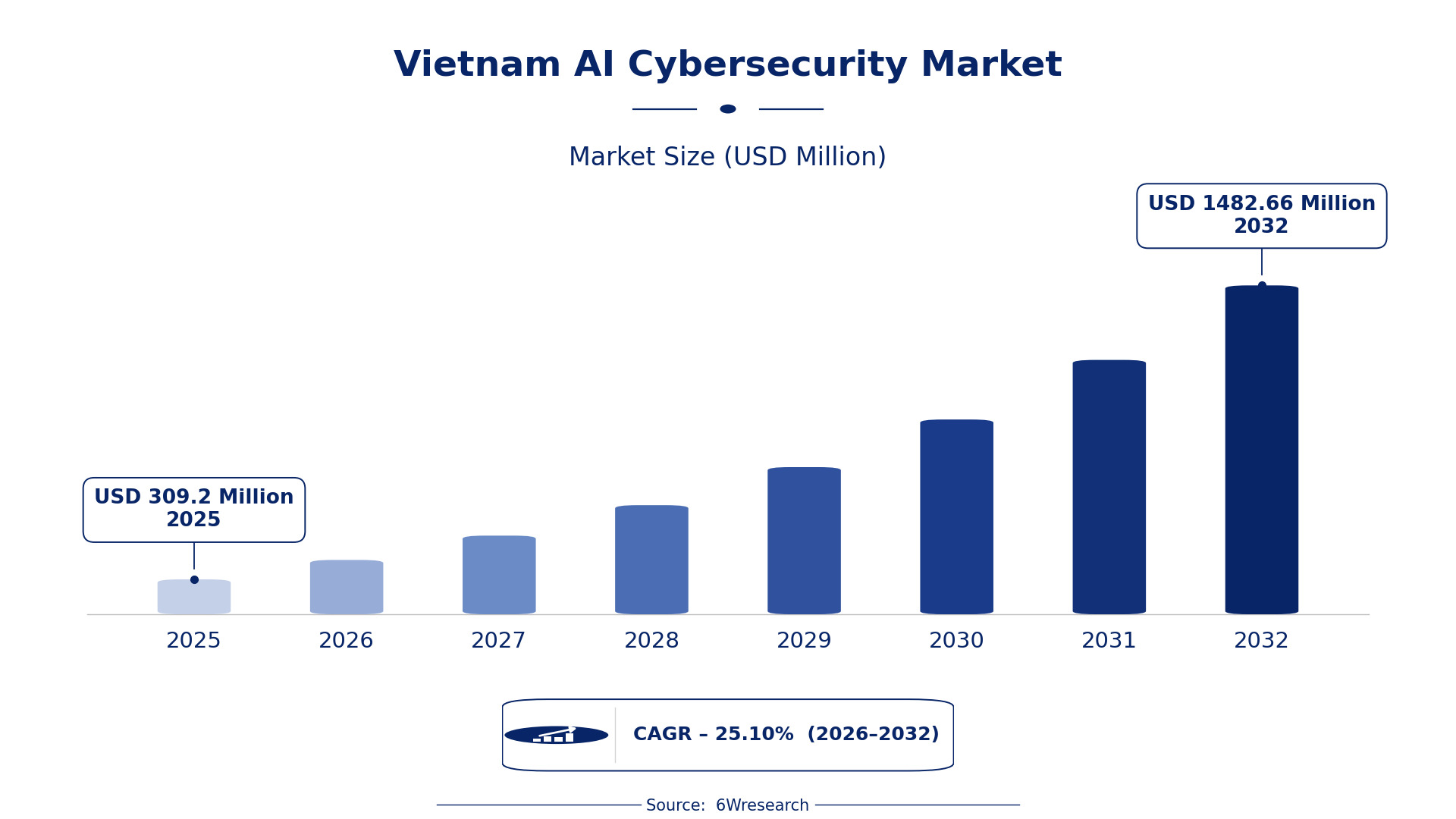
Vietnam AI Cybersecurity Market Highlights
| Report Metric | Details |
| Report Name | Vietnam AI Cybersecurity Market (2026-2032) |
| Market Size 2025 | USD 309.2 Million |
| Market Size 2032 | USD 1,482.66 Million |
| Absolute Growth 2025–2032 | USD 1,173.46 Million |
| CAGR 2026–2032 | 25.10% |
| Peak Annual Growth | 27.8% (2031) |
| Forecast Period | 2026–2032 |
| Historical Data | 2022–2025 |
| Base Year | 2025 |
| Leading Security Type, 2025 | Network Security (34% share) |
| Leading Deployment Mode, 2025 | On-Premises (52% share) |
| Leading Organization Size, 2025 | Large Enterprises (68% share) |
| Leading End User, 2025 | BFSI (36% share) |
| Fastest-Growing Security Type | Cloud Security (29.6% CAGR) |
| Fastest-Growing Deployment Mode | Cloud-Based (28.0% CAGR) |
| Fastest-Growing Organization Size | Small and Medium-sized (28.4% CAGR) |
| Fastest-Growing End User | Healthcare (28.8% CAGR) |
| Growing Sector | Managed AI security services for financial institutions and digital infrastructure operators |
| Key End Users | Banks and financial institutions, telecom operators, data centre operators, hospitals and healthcare networks, retail and e-commerce chains, and public sector agencies |
Vietnam AI Cybersecurity Market Year-wise Growth Rate and Key Drivers (2022–2032)
This graph illustrates the annual growth rates of the Vietnam AI Cybersecurity Market from 2022 to 2032, highlighting a steady upward trajectory and projected market expansion over the forecast period.
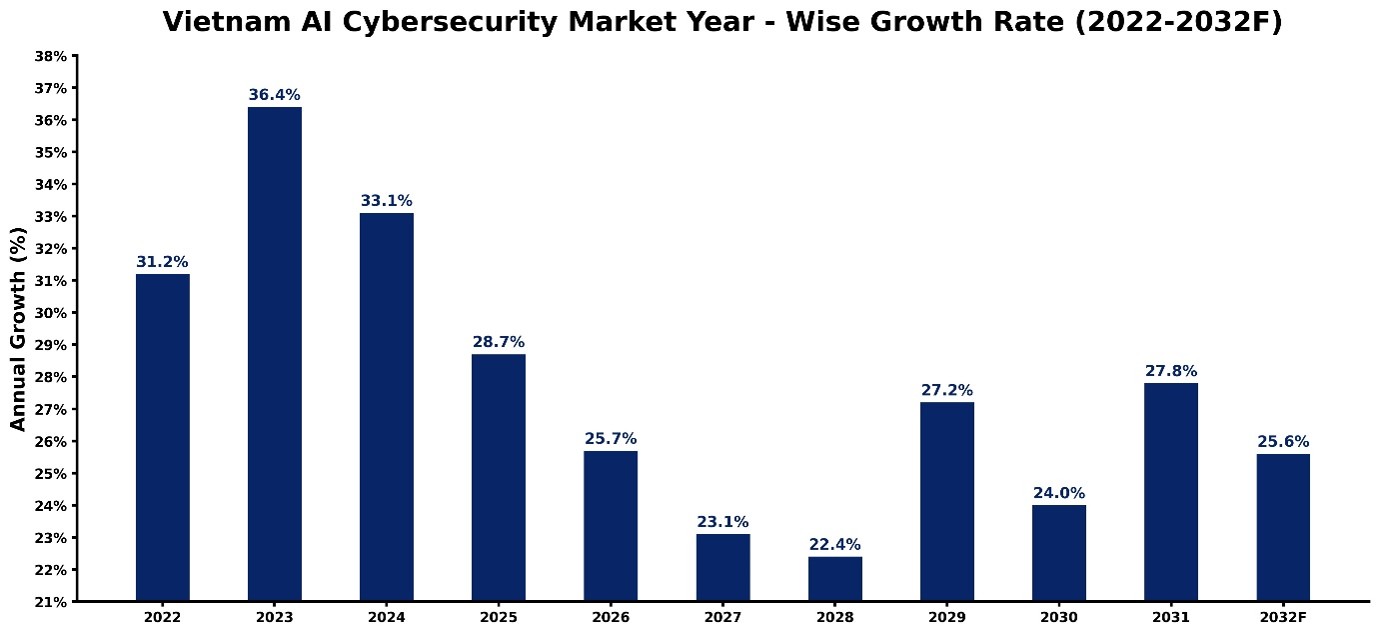
The following table presents the estimated annual growth rate for each year together with the principal factor influencing market performance. The values are intended to highlight year-specific drivers rather than to provide a direct comparison between individual years.
| Year | Estimated Annual Growth (%) | Market Rationale |
| 2022 | 31.2 | Data localisation requirements and growing demand for domestic cybersecurity solutions. |
| 2023 | 36.4 | Personal data protection regulations and increased investment in threat detection systems. |
| 2024 | 33.1 | Rising cybersecurity awareness following ransomware attacks and growing demand for data protection. |
| 2025 | 28.7 | Implementation of data governance regulations and increasing AI-enabled fraud risks. |
| 2026 | 25.7% | Wider adoption of AI-based security solutions by large enterprises. |
| 2027 | 23.1 | Growing demand for automated threat detection and incident response solutions. |
| 2028 | 22.4 | Cloud adoption is increasing, driving demand for integrated cybersecurity infrastructure. |
| 2029 | 27.2 | Government AI development initiatives and rising demand for AI-powered security tools. |
| 2030 | 24 | Cybersecurity platform upgrades and increasing demand for subscription-based security services. |
| 2031 | 27.8 | Growing use of autonomous AI agents and advanced AI-driven cyberattack prevention systems. |
| 2032 | 25.6 | Rising demand for managed detection and response services and continuous security monitoring. |
Note: Market size estimations and growth projections presented in this report are based on 6Wresearch’s proprietary forecasting methodology, utilizing the latest available industry data, government publications, and primary research inputs.
Vietnam AI Cybersecurity Market Synopsis
The Vietnam AI Cybersecurity Market is expected to witness continuous growth in the coming years. This industry comprises machine-learning-based threat detection, endpoint detection and response, network analytics, fraud analytics and security automation platforms, together with managed detection services. Growth is supported by stricter data protection obligations, a banking sector adopting biometric and AI-based transaction monitoring, rapidly rising AI-enabled fraud and ransomware, and expanding domestic data centre capacity led by Viettel and FPT. Despite this, a limited pool of specialists combining AI and security skills and budget constraints among smaller firms continue to slow deployment.
Market Dynamics Impact Analysis (2026–2032)
| Factor | Type | Impact | Primary Segment Affected |
| Expanding data protection and cybersecurity legislation | Driver | High | Large Enterprises |
| Rising ransomware and AI-enabled fraud | Driver | High | BFSI |
| Managed detection and response for mid-sized firms | Opportunity | High | Small and Medium-sized |
| Sovereign data centre and hosting expansion | Opportunity | Medium | Cloud Security |
| Shortage of AI-security specialists | Restraint | High | Endpoint Security |
| Currency exposure on imported platforms | Restraint | Medium | On-Premises |
| Compliance uncertainty during rule implementation | Challenge | Medium | Cloud-Based |
| Limited local-language training data | Challenge | Medium | Application Security |
Evaluation of Drivers in Vietnam AI Cybersecurity Market (2026–2032)
Below are some major drivers and their influence on market dynamics.
| Drivers | Primary Segment Affected | Why It Matters (Evidence) |
| Mandatory biometric verification in online banking | Application Security | Face-matched authentication for higher-value transfers creates demand for liveness detection, deepfake screening and mobile application hardening. |
| Large and fast-growing online population | IT and Telecommunications | More connected users and services widen the attack surface and generate telemetry volumes that only machine-learning models can analyse at scale. |
| Commercial rollout of 5G networks | Network Security | Virtualised core networks and edge nodes multiply traffic and entry points, so operators need AI-based traffic analytics and anomaly detection. |
| Data centre and hosting capacity expansion | Cloud Security | New facilities bring more customer workloads that require automated posture management and workload protection. |
The Vietnam AI Cybersecurity Market is expected to grow at a CAGR of 25.1% during the forecast period 2026–2032. Rising enterprise technology spending is widening the base of connected systems that need automated protection, as organisations replace manual monitoring with AI-assisted operations. A growing pool of domestic software engineers and offshore development teams is increasing release frequency and software volume, which raises the amount of code requiring continuous automated security testing.
In addition, wider AI use in everyday business processes is creating new model, data and identity assets that need dedicated controls. Foreign direct investment disbursements reached USD 25.35 billion in 2024, bringing multinational security standards into local supply chains. Expanding subsea and domestic network capacity is also improving the reach of remote analytics and managed detection services, stimulating Vietnam AI Cybersecurity Market growth.
Evaluation of Restraints in Vietnam AI Cybersecurity Market
Below are some major restraints and their influence on market dynamics.
| Market Restraint | Primary Segment Affected | Why It Matters (Evidence) |
| Shortage of AI-security specialists | Endpoint Security | Few professionals combine machine-learning and incident-response skills, so model tuning and alert triage depend on scarce staff and slow deployment. |
| Import dependence and currency exposure | Large Enterprises | Most advanced AI security platforms are supplied by foreign vendors and priced in US dollars, so a weaker dong raises licence and renewal costs. |
| Legacy and fragmented IT estates | Healthcare | Older hospital information systems and unpatched devices are difficult to instrument with AI agents, which delays rollout and limits data quality. |
| Licensing and conformity requirements | Network Security | Providers must hold business licences and conformity certification before supplying certain information security products, which lengthens market entry for new foreign vendors. |
Vietnam AI Cybersecurity Market Challenges
In terms of market challenges, affordability remains uneven as over 97% of Vietnamese enterprises are small or medium-sized, and many treat AI platforms as discretionary spending beyond basic antivirus, which narrows the addressable customer base for vendors. Compliance uncertainty persists as implementing rules for the Personal Data Protection Law, effective January 2026, are still being clarified, causing buyers to defer purchases until obligations are defined. Model quality is limited by scarce Vietnamese-language and local threat data, so detection tools generate false alerts that overburden small security teams. Meanwhile, three dominant telecom groups can bundle security with connectivity and hosting contracts, compressing margins for independent and foreign providers.
Trends in the Vietnam AI Cybersecurity Market
Below are some of the trends shaping the Vietnam AI Cybersecurity Market growth.
- Shift from Signature-Based Tools to Behavioural AI Detection: Vietnamese organisations are replacing signature-based antivirus with behaviour-based detection after high-profile ransomware incidents exposed the limits of perimeter defences.
- Transition from Passwords to Biometric Identity Verification: Banks are moving from one-time passwords to face-matched authentication following Decision 2345/QD-NHNN, effective July 2024. Attackers increasingly use synthetic faces and cloned voices, so liveness detection and device-binding analytics are gaining priority.
- Security Prioritised over Rapid Rollout in AI Adoption: Enterprises piloting generative AI assistants are adding controls for prompt injection, data leakage and model access before scaling usage. FPT and Viettel are building domestic AI platforms hosted in local facilities, which keeps sensitive data in country.
Investment Opportunities in the Vietnam AI Cybersecurity Industry
Some of the investment opportunities in the Vietnam AI Cybersecurity Market are mentioned below.
- Managed Detection and Response for Mid-Sized Firms: Hiring gaps leave mid-sized firms without round-the-clock monitoring, creating demand for outsourced security. Investors can supply managed detection and response subscriptions, security operations centre capacity and automated incident playbooks.
- Workload and Data Centre Security Platforms: New colocation and hyperscale facilities in Hanoi and Ho Chi Minh City are adding workloads that need continuous protection. Investment areas include workload protection platforms, posture management and encrypted key management hosted in country.
- Vietnamese-Language Threat Intelligence and Scam Detection: Phishing and investment scams in Vietnamese are rising faster than global tools can detect them. Investors can build Vietnamese-language threat intelligence feeds and natural-language models that flag scam messages, fake websites and voice fraud.
Leading Players in Vietnam AI Cybersecurity Market
Stated below are some of the leading companies contributing significantly to the Vietnam AI Cybersecurity Market share:
1. Viettel Group
| Company Name | Viettel Group |
| Established Year | 1989 |
| Headquarters | Hanoi, Vietnam |
| Official Website | Click Here |
Viettel Group is a state-owned telecommunications and technology conglomerate whose cybersecurity arm provides threat monitoring, security operations and AI-enabled defence products. It is a major supplier to government bodies and large enterprises in Vietnam.
2. FPT Corporation
| Company Name | FPT Corporation |
| Established Year | 1988 |
| Headquarters | Hanoi, Vietnam |
| Official Website | Click Here |
FPT Corporation is a Vietnamese technology group offering systems integration, managed security services and AI platforms. It serves financial institutions, public agencies and enterprises across the domestic market.
3. CMC Corporation
| Company Name | CMC Corporation |
| Established Year | 1993 |
| Headquarters | Hanoi, Vietnam |
| Official Website | Click Here |
CMC Corporation is a Vietnamese information technology group whose cybersecurity and telecom units provide security operations centre services and data centre hosting. It is an established provider to banks and enterprise customers.
4. Bkav Corporation
| Company Name | Bkav Corporation |
| Established Year | 1995 |
| Headquarters | Hanoi, Vietnam |
| Official Website | Click Here |
Bkav Corporation is a Vietnamese cybersecurity company developing antivirus, endpoint protection and AI-based email and fraud protection products. It is widely recognised among domestic consumers, enterprises and public sector users.
5. Fortinet
| Company Name | Fortinet |
| Established Year | 2000 |
| Headquarters | Sunnyvale, California, United States |
| Official Website | Click Here |
Fortinet is a global network security vendor supplying firewalls, secure networking and AI-assisted threat detection platforms. It serves Vietnamese telecom operators, enterprises and public agencies through local offices and channel partners.
Government Initiatives in the Vietnam AI Cybersecurity Industry
Vietnam’s Law on Cybersecurity, effective January 2019, and the Law on Network Information Security, effective July 2016, form the base of the regulatory regime, supplemented by Decree 13/2023 on personal data protection and the Law on Data, effective July 2025. Resolution 57-NQ/TW, issued in December 2024, ranks science, technology and digital transformation as the main growth driver, while the National AI Strategy aims to place Vietnam among the top 50 countries worldwide in AI by 2030.
Implementation is led by the Ministry of Public Security through its cybersecurity and high-tech crime prevention department, alongside the State Bank of Vietnam, which enforces Circular 09/2020/TT-NHNN on banking information system safety. The National Committee on Digital Transformation, chaired by the Prime Minister, coordinates delivery of the national programme approved under Decision 749/QD-TTg in June 2020, which sets a 2030 horizon for digital government, economy and society.
Future Insight of the Vietnam AI Cybersecurity Market
Growth through 2032 will be supported by deeper enterprise use of generative and agentic AI, which creates new assets needing dedicated monitoring. New AI governance and data rules will give buyers a clear basis for security investment, while investment in sovereign AI computing capacity should anchor demand for in-country services. The Digital Technology Industry Law takes effect in January 2026, while the digital economy is targeted to reach 30% of GDP by 2030. Next-generation mobile networks and expanding subsea connectivity will further raise the traffic that automated defences must analyse.
Market Segmentation Analysis
The report offers a comprehensive study of the Vietnam AI Cybersecurity Market across its key segments. The chart below highlights the leading segment by market share in 2025 and the fastest-growing segment by CAGR over 2026–2032, followed by a detailed analysis of each segment.
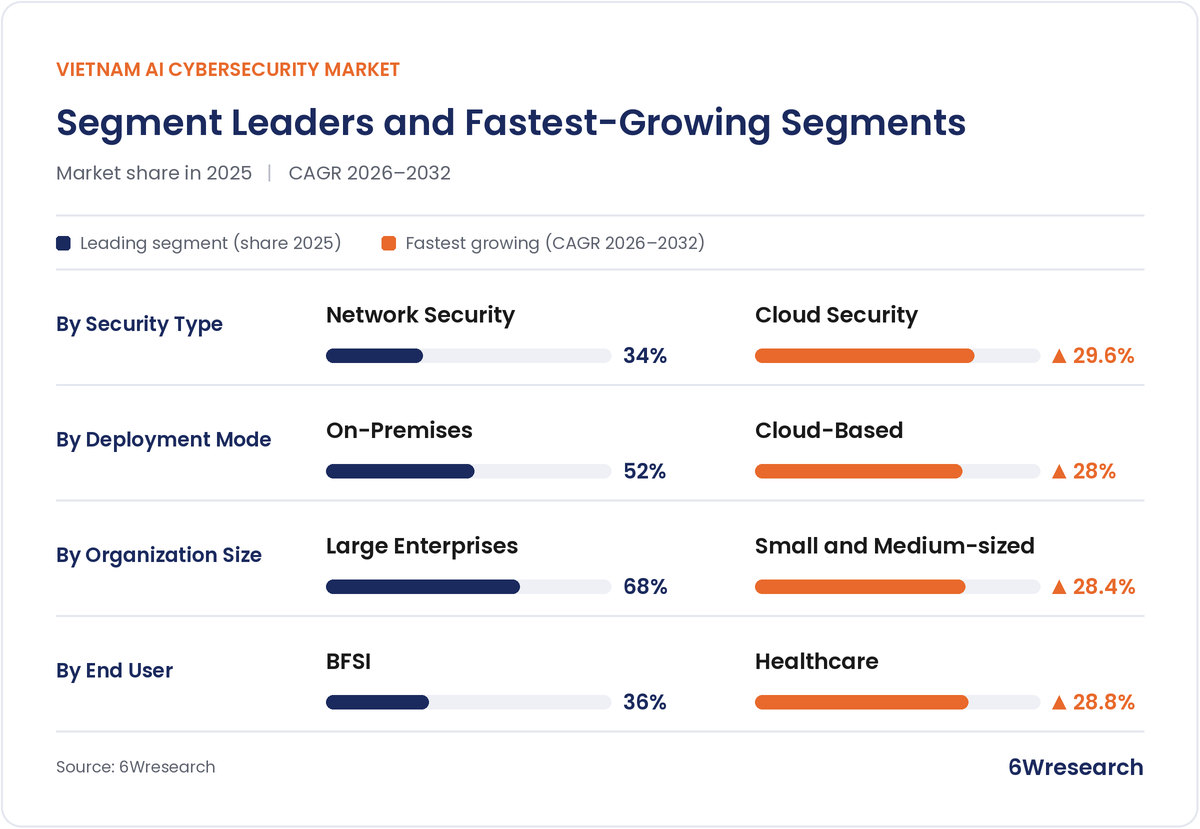
By Security Type – Network Security Leads, Cloud Security Expected to Grow Fastest
According to Sachin Kumar Rai, Senior Research Analyst at 6Wresearch, Network Security accounted for the largest share of 34% in 2025, supported by the traffic-monitoring needs of operators running large national networks and data centres. Meanwhile, Cloud Security is expected to record the fastest CAGR of 29.6% during 2026–2032, driven by expanding colocation and hyperscale capacity in Hanoi and Ho Chi Minh City and the rising number of enterprise workloads hosted in country.
By Deployment Mode – On-Premises Leads, Cloud-Based Expected to Grow Fastest
On-Premises deployment held 52% of the market in 2025, as data localisation duties and sector rules on core system safety keep sensitive workloads inside domestic facilities. On the other hand, Cloud-Based deployment is projected to grow at the fastest CAGR of 28% during 2026–2032, as domestic data centre operators add in-country capacity that satisfies residency rules and subscription-based detection services lower upfront costs.
By Organization Size – Large Enterprises Leads, Small and Medium-sized Expected to Grow Fastest
Large Enterprises commanded 68% of revenues in 2025 because conglomerates, state-owned groups and multinational subsidiaries hold the largest data assets and dedicated security budgets in Vietnam. Apart from this, Small and Medium-sized firms are forecast to expand at a CAGR of 28.4% through 2032, as subscription-based managed services and locally supported platforms make AI-driven protection affordable for businesses that form most of the country’s enterprise base.
By End User – BFSI Leads, Healthcare Expected to Grow Fastest
BFSI led in 2025 with a 36% share, reflecting State Bank of Vietnam rules on biometric authentication and information system safety, together with the sector’s exposure to fraud and ransomware. However, healthcare is projected to be the fastest-growing end user at a CAGR of 28.8% from 2026 to 2032, as hospitals digitise patient records and face rising ransomware targeting of sensitive health data.
Key Attractiveness of the Report
- 10 Years of Market Numbers
- Historical Data from 2022 to 2025
- Base Year 2025
- Forecast Data until 2032
- Key Performance Indicators Impacting the Market
- Major Upcoming Developments and Projects
Key Highlights of the Report:
- Vietnam AI Cybersecurity Market Outlook
- Market Size of Vietnam AI Cybersecurity Market, 2025
- Forecast of Vietnam AI Cybersecurity Market, 2032
- Historical Data and Forecast of Vietnam AI Cybersecurity Revenues & Volume for the Period 2022-2032
- Vietnam AI Cybersecurity Market Trend Evolution
- Vietnam AI Cybersecurity Market Drivers and Challenges
- Vietnam AI Cybersecurity Price Trends
- Vietnam AI Cybersecurity Porter's Five Forces
- Vietnam AI Cybersecurity Industry Life Cycle
- Historical Data and Forecast of Vietnam AI Cybersecurity Market Revenues & Volume By Security Type for the Period 2022-2032
- Historical Data and Forecast of Vietnam AI Cybersecurity Market Revenues & Volume By Network Security for the Period 2022-2032
- Historical Data and Forecast of Vietnam AI Cybersecurity Market Revenues & Volume By Endpoint Security for the Period 2022-2032
- Historical Data and Forecast of Vietnam AI Cybersecurity Market Revenues & Volume By Application Security for the Period 2022-2032
- Historical Data and Forecast of Vietnam AI Cybersecurity Market Revenues & Volume By Cloud Security for the Period 2022-2032
- Historical Data and Forecast of Vietnam AI Cybersecurity Market Revenues & Volume By Deployment Mode for the Period 2022-2032
- Historical Data and Forecast of Vietnam AI Cybersecurity Market Revenues & Volume By On-Premises for the Period 2022-2032
- Historical Data and Forecast of Vietnam AI Cybersecurity Market Revenues & Volume By Cloud-Based for the Period 2022-2032
- Historical Data and Forecast of Vietnam AI Cybersecurity Market Revenues & Volume By Organization Size for the Period 2022-2032
- Historical Data and Forecast of Vietnam AI Cybersecurity Market Revenues & Volume By Small and Medium-sized for the Period 2022-2032
- Historical Data and Forecast of Vietnam AI Cybersecurity Market Revenues & Volume By Large Enterprises for the Period 2022-2032
- Historical Data and Forecast of Vietnam AI Cybersecurity Market Revenues & Volume By End User for the Period 2022-2032
- Historical Data and Forecast of Vietnam AI Cybersecurity Market Revenues & Volume By BFSI for the Period 2022-2032
- Historical Data and Forecast of Vietnam AI Cybersecurity Market Revenues & Volume By IT and Telecommunications for the Period 2022-2032
- Historical Data and Forecast of Vietnam AI Cybersecurity Market Revenues & Volume By Healthcare for the Period 2022-2032
- Historical Data and Forecast of Vietnam AI Cybersecurity Market Revenues & Volume By Retail for the Period 2022-2032
- Vietnam AI Cybersecurity Import Export Trade Statistics
- Market Opportunity Assessment By Security Type
- Market Opportunity Assessment By Deployment Mode
- Market Opportunity Assessment By Organization Size
- Market Opportunity Assessment By End User
- Vietnam AI Cybersecurity Top Companies Market Share
- Vietnam AI Cybersecurity Competitive Benchmarking By Technical and Operational Parameters
- Vietnam AI Cybersecurity Company Profiles
- Vietnam AI Cybersecurity Key Strategic Recommendations
Market Covered
The report offers an extensive study of the following market segments.
By Security Type
- Network Security
- Endpoint Security
- Application Security
- Cloud Security
By Deployment Mode
- On-Premises
- Cloud-Based
By Organization Size
- Small and Medium-sized
- Large Enterprises
By End User
- BFSI
- IT and Telecommunications
- Healthcare
- Retail































