Vietnam Bleaching Chemicals Market Size, Share & Growth Rate
The Vietnam Bleaching Chemicals Market was estimated at USD 419 Million in 2025 and is projected to reach USD 592 Million by 2032, growing at a CAGR of 5.1% from 2026 to 2032. The rapid expansion of the textile and paper industries in Vietnam is a primary driver of this growth. As these sectors seek to enhance their production efficiency and meet international quality standards, the demand for high-quality bleaching chemicals continues to rise.
Vietnam Bleaching Chemicals Market Year-wise Growth Rate and Key Drivers
This graph highlights how the Vietnam Bleaching Chemicals Market has steadily grown over the years, supported by major growth factors.
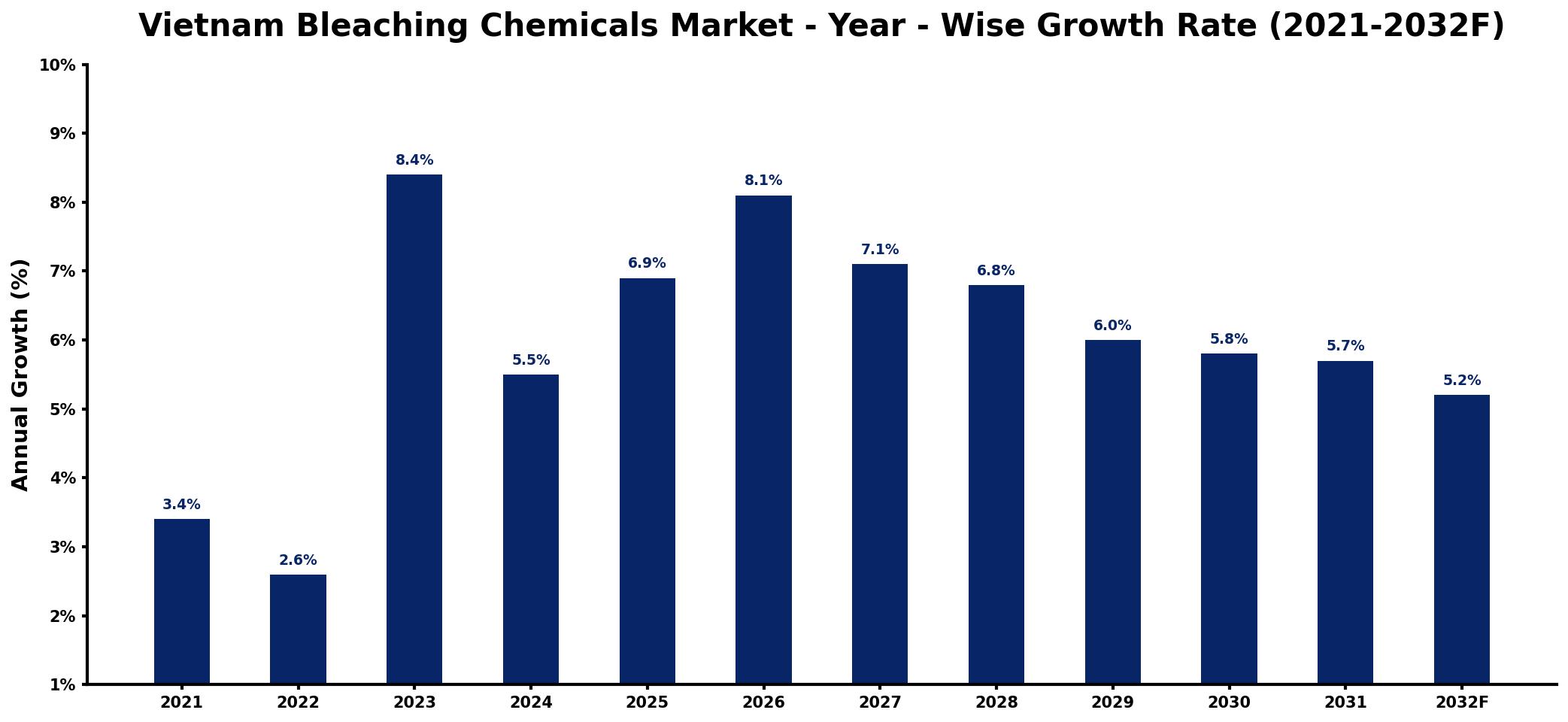
The table below presents the year‑wise growth rates along with the key drivers influencing the market
| Year | Growth Rate | Major Drivers |
| 2021 | 3.4% | Rising demand from textile industry |
| 2022 | 2.6% | Increased usage in paper production |
| 2023 | 8.4% | Expansion of household cleaning sector |
| 2024 | 5.5% | Growth in water treatment facilities |
| 2025 | 6.9% | Boost in personal care products |
| 2026 | 8.1% | Higher adoption in food processing |
| 2027 | 7.1% | Investment in manufacturing technologies |
| 2028 | 6.8% | Emergence of eco-friendly alternatives |
| 2029 | 6.0% | Strengthening regulations on hygiene standards |
| 2030 | 5.8% | Increased focus on sustainable practices |
| 2031 | 5.7% | Growing market for industrial applications |
| 2032 | 5.2% | Rising awareness on health safety |
Note: Market size estimations and growth projections presented in this report are based on 6Wresearch's proprietary forecasting methodology, utilizing the latest available industry data, government publications, and primary research inputs.
Vietnam Bleaching Chemicals Market Synopsis
The most influential factor currently shaping the Vietnam Bleaching Chemicals Market is the increasing focus on sustainable manufacturing practices. With environmental regulations tightening, industries are actively seeking eco-friendly bleaching alternatives that reduce their ecological footprint. This shift is not only driven by compliance but also by consumer preference for greener products.
Furthermore, the integration of advanced technologies in the production of bleaching chemicals is enhancing operational efficiencies. As companies navigate the dual pressures of performance and sustainability, the market landscape is evolving to prioritize innovative solutions that satisfy both business goals and environmental responsibilities.
Vietnam Bleaching Chemicals Market Key Takeaways
- The market is primarily fueled by the textile and paper industries, which heavily rely on effective bleaching agents.
- Growing environmental concerns are pushing manufacturers to explore sustainable alternatives.
- Technological advancements are enhancing the quality and efficiency of bleaching chemicals.
- COVID-19 has significantly impacted supply chains, but recovery is underway.
- Regulatory pressures are likely to further reshape the market towards eco-friendly solutions.
Evaluation of Restraints in Vietnam Bleaching Chemicals Market
While the Vietnam Bleaching Chemicals Market is poised for growth, several restraints exist that may impede progress. Regulatory challenges pose significant hurdles, as authorities are increasingly imposing strict standards on chemical usage to mitigate environmental risks. Moreover, the transition toward more sustainable chemical options can require significant investment in research and development, which may be a barrier for smaller players in the market. As industries grapple with these issues, the pace of adoption for innovative solutions may vary.
Vietnam Bleaching Chemicals Market Trends
Several current trends are shaping the Vietnam Bleaching Chemicals Market. The shift toward biodegradable and non-toxic bleaching agents is gaining traction, reflecting a broader commitment to sustainability across industrial sectors. Additionally, the integration of digital technologies, such as automation and data analytics, is transforming the manufacturing processes, ensuring consistency and quality in bleaching applications.
Moreover, there is an increasing emphasis on circular economy practices, with companies exploring ways to recycle and repurpose bleaching chemicals. This trend is likely to intensify as businesses seek not just to comply with regulations, but also to improve their sustainability credentials in a competitive global marketplace.
Vietnam Bleaching Chemicals Market Opportunities
Opportunities abound for stakeholders within the Vietnam Bleaching Chemicals Market. The ongoing expansion of the textile and paper industries creates a consistent demand for bleaching agents. Businesses that prioritize innovation in eco-friendly bleaching solutions are well-positioned to capitalize on the growing consumer preference for sustainable products. Additionally, collaborations with research institutions and investments in R&D could lead to breakthroughs in more efficient and less harmful bleaching processes, further driving market growth.
Government Initiatives in the Vietnam Bleaching Chemicals Market
The Vietnamese government is increasingly focused on sustainability in industrial practices, which extends to the bleaching chemicals sector. Public spending initiatives aim to support the development of environmentally friendly technologies and encourage manufacturers to adopt sustainable practices. Regulatory frameworks are being strengthened to ensure compliance with international environmental standards, thereby fostering a market environment that emphasizes sustainability and innovation.
Future Insights of the Vietnam Bleaching Chemicals Market
Looking ahead to the period from 2026 to 2032, the Vietnam Bleaching Chemicals Market is expected to undergo significant transformation driven by technological advancements and a stronger commitment to sustainability. As industries increasingly prioritize eco-friendly solutions, investments in research and development will be crucial. Furthermore, the successful navigation of regulatory landscapes will likely determine which companies thrive in this evolving market. In summary, those who can innovate and adapt will be best positioned to capture the opportunities that lie ahead.
Vietnam Bleaching Chemicals Market Latest Developments (2025 - 2026)
Recent developments in the Vietnam Bleaching Chemicals Market indicate a growing interest in sustainable practices, with several companies exploring new biodegradable bleaching agents. Innovations in manufacturing processes are also on the rise, as firms seek to enhance product efficiency while reducing environmental impact. Additionally, the market is witnessing an uptick in collaborations between chemical manufacturers and technology firms aimed at developing smarter, greener solutions that align with emerging global standards.
Vietnam Bleaching Chemicals Market - Key Attractiveness of the Report
- 10 Years of Market Numbers
- Historical Data Starting from 2022 to 2025
- Base Year: 2025
- Forecast Data until 2032
- Key Performance Indicators Impacting the Market
- Major Upcoming Developments and Projects
Key Highlights of the Report:
- Vietnam Bleaching Chemicals Market Outlook
- Market Size of Vietnam Bleaching Chemicals Market, 2025
- Forecast of Vietnam Bleaching Chemicals Market, 2032
- Historical Data and Forecast of Vietnam Bleaching Chemicals Revenues & Volume for the Period 2022-2032F
- Vietnam Bleaching Chemicals Market Trend Evolution
- Vietnam Bleaching Chemicals Market Drivers and Challenges
- Vietnam Bleaching Chemicals Price Trends
- Vietnam Bleaching Chemicals Porter's Five Forces
- Vietnam Bleaching Chemicals Industry Life Cycle
- Historical Data and Forecast of Vietnam Bleaching Chemicals Market Revenues & Volume By Type for the Period 2022-2032F
- Historical Data and Forecast of Vietnam Bleaching Chemicals Market Revenues & Volume By Chlorine for the Period 2022-2032F
- Historical Data and Forecast of Vietnam Bleaching Chemicals Market Revenues & Volume By Chlorine Dioxide for the Period 2022-2032F
- Historical Data and Forecast of Vietnam Bleaching Chemicals Market Revenues & Volume By Sodium Hypochlorite for the Period 2022-2032F
- Historical Data and Forecast of Vietnam Bleaching Chemicals Market Revenues & Volume By Calcium Hypochlorite for the Period 2022-2032F
- Historical Data and Forecast of Vietnam Bleaching Chemicals Market Revenues & Volume By Sodium Dichloroisocyanurate for the Period 2022-2032F
- Historical Data and Forecast of Vietnam Bleaching Chemicals Market Revenues & Volume By Others for the Period 2022-2032F
- Historical Data and Forecast of Vietnam Bleaching Chemicals Market Revenues & Volume By Application for the Period 2022-2032F
- Historical Data and Forecast of Vietnam Bleaching Chemicals Market Revenues & Volume By Cosmetic & Personal Care for the Period 2022-2032F
- Historical Data and Forecast of Vietnam Bleaching Chemicals Market Revenues & Volume By Textile Industry for the Period 2022-2032F
- Historical Data and Forecast of Vietnam Bleaching Chemicals Market Revenues & Volume By Household Industry for the Period 2022-2032F
- Historical Data and Forecast of Vietnam Bleaching Chemicals Market Revenues & Volume By Food Additive for the Period 2022-2032F
- Historical Data and Forecast of Vietnam Bleaching Chemicals Market Revenues & Volume By Pulp Bleaching for the Period 2022-2032F
- Historical Data and Forecast of Vietnam Bleaching Chemicals Market Revenues & Volume By Others for the Period 2022-2032F
- Vietnam Bleaching Chemicals Import Export Trade Statistics
- Market Opportunity Assessment By Type
- Market Opportunity Assessment By Application
- Vietnam Bleaching Chemicals Top Companies Market Share
- Vietnam Bleaching Chemicals Competitive Benchmarking By Technical and Operational Parameters
- Vietnam Bleaching Chemicals Company Profiles
- Vietnam Bleaching Chemicals Key Strategic Recommendations






































