Vietnam Cargo Shipping Market Size, Share & Growth Rate
The Vietnam Cargo Shipping Market was estimated at USD 336 Million in 2025 and is projected to reach USD 474 Million by 2032, growing at a CAGR of 5.0% from 2026 to 2032. This robust growth trajectory is propelled by Vietnam's strategic positioning as a logistics hub in Southeast Asia, bolstered by the government's substantial investments in port infrastructure. Additionally, the increasing demand from export-oriented sectors, such as textiles and electronics, is further fueling the need for efficient and reliable shipping services.
Vietnam Cargo Shipping Market Year-wise Growth Rate and Key Drivers
This graph highlights how the Vietnam Cargo Shipping Market has steadily grown over the years, supported by major growth factors.
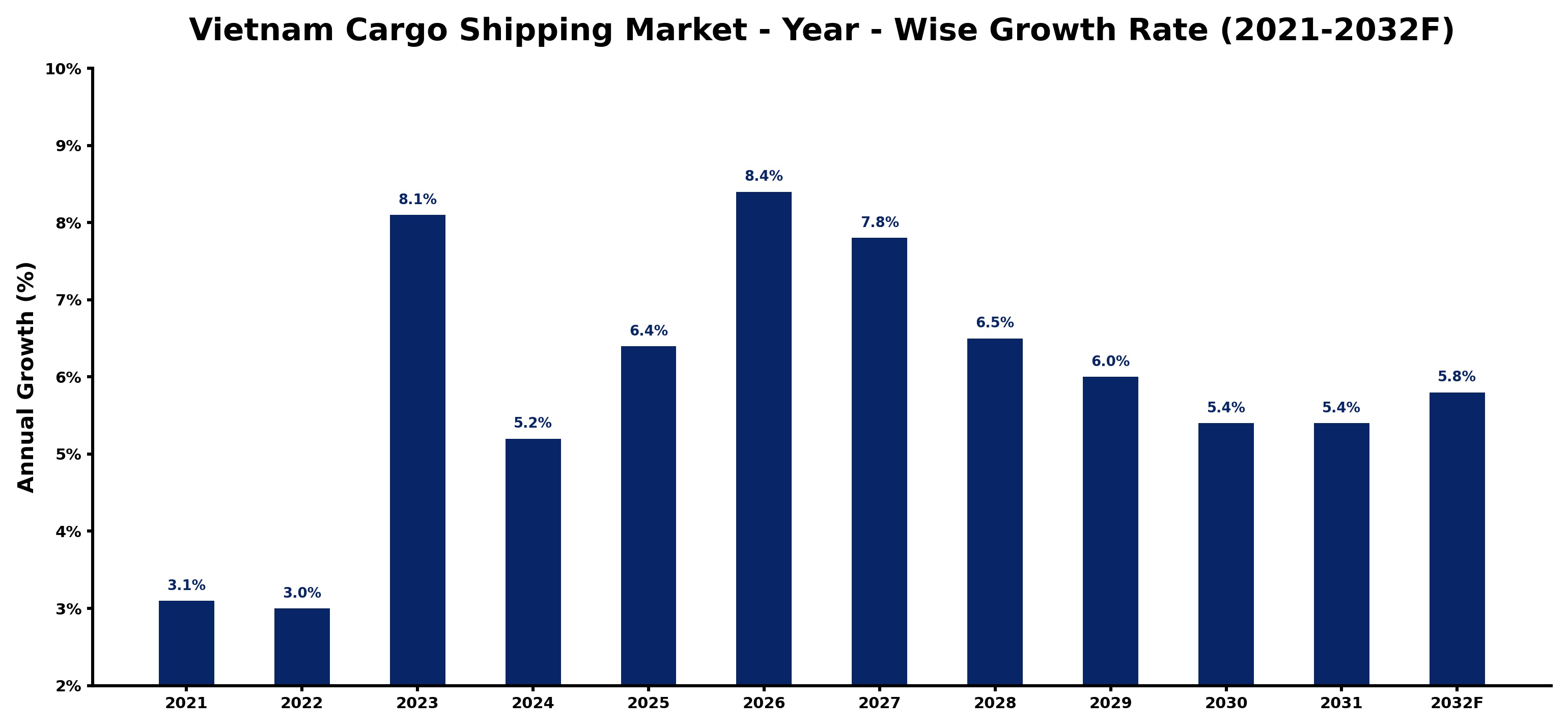
The table below presents the year‑wise growth rates along with the key drivers influencing the market
| Year | Growth Rate | Major Drivers |
| 2021 | 3.1% | Expansion of commercial construction activities |
| 2022 | 3.0% | Increasing smart city development projects |
| 2023 | 8.1% | Government infrastructure modernization initiatives |
| 2024 | 5.2% | Growing renewable energy integration projects |
| 2025 | 6.4% | Growing urbanization and commercial development |
| 2026 | 8.4% | Rising electricity demand across industries |
| 2027 | 7.8% | Increasing industrial infrastructure investments |
| 2028 | 6.5% | Expansion of commercial construction activities |
| 2029 | 6.0% | Rising electricity demand across industries |
| 2030 | 5.4% | Expansion of commercial construction activities |
| 2031 | 5.4% | Expansion of commercial construction activities |
| 2032 | 5.8% | Expansion of manufacturing activities |
Note - Market size estimations and growth projections presented in this report are based on 6Wresearch's advanced forecasting approach, validated with industry datasets as of June 2026.
Vietnam Cargo Shipping Market Synopsis
The recent momentum in Vietnam's cargo shipping market reflects a dynamic shift as international trade and domestic production rebound from the impacts of the COVID-19 pandemic. The resurgence of demand is evident, and companies are adapting by modernizing fleets and optimizing routes to enhance service delivery.
Looking ahead, the market is poised for sustainable growth, driven by ongoing advancements in shipping technology and a growing emphasis on environmental sustainability. As the Vietnamese economy continues to expand, the cargo shipping sector is expected to play a pivotal role in facilitating trade and economic development.
Vietnam Cargo Shipping Market Key Takeaways
- Vietnam's strategic location enhances its position as a key logistics hub in Southeast Asia.
- Continuous government investment in port infrastructure is vital for market efficiency.
- The recovery from COVID-19 has reinvigorated demand, particularly in export-driven industries.
- Sustainability initiatives are becoming critical as the industry adapts to regulatory pressures.
- Technological advancements in shipping are reshaping operational efficiencies and service delivery.
Evaluation of Restraints in Vietnam Cargo Shipping Market
Despite the promising growth trajectory, the Vietnam Cargo Shipping Market faces significant restraints. Global economic uncertainties, including trade tensions and geopolitical issues, can disrupt shipping demand and complicate supply chain management. Furthermore, strict environmental regulations are increasingly impacting operational costs and necessitating investments in cleaner technologies. Shipping companies must navigate these complexities while remaining competitive in a rapidly evolving marketplace.
Vietnam Cargo Shipping Market Trends
Current trends shaping the Vietnam Cargo Shipping Market include a strong focus on digital transformation, with companies increasingly adopting advanced logistics solutions for better operational visibility and efficiency. Moreover, sustainability is gaining traction, with shipping firms seeking to adopt greener practices to comply with environmental regulations. The demand for integrated logistics services is also growing, as shippers look for seamless supply chain solutions to optimize their operations.
Vietnam Cargo Shipping Market Opportunities
Genuine growth opportunities are emerging in the Vietnam Cargo Shipping Market, particularly in the realm of e-commerce logistics. The rapid expansion of online retail creates a need for agile shipping solutions capable of meeting the demands of quick deliveries. Furthermore, investments in port modernization and logistics infrastructure are expected to attract foreign shipping investments, enhancing operational capabilities. Companies that prioritize sustainability and technological innovation are well-positioned to capitalize on these opportunities.
Government Initiatives in the Vietnam Cargo Shipping Market
The Vietnamese government has been actively investing in enhancing port infrastructure and streamlining logistics frameworks. Key initiatives include the development of deep-water ports and the expansion of existing facilities to accommodate larger vessels. Additionally, the government supports programs aimed at promoting eco-friendly shipping practices, as part of a broader commitment to sustainability and reducing carbon emissions in the logistics sector.
Future Insights of the Vietnam Cargo Shipping Market
From 2026 to 2032, the Vietnam Cargo Shipping Market is expected to evolve significantly. The integration of digital technologies will likely revolutionize logistics operations, leading to improved efficiency and transparency. As global supply chains become increasingly complex, Vietnam's strategic location will further enhance its importance as a regional logistics center. The focus on sustainability will continue to shape the market, with advancements in green shipping technologies playing a critical role in future developments.
Vietnam Cargo Shipping Market Latest Developments (May 2025 - June 2026)
Recent developments in the Vietnam Cargo Shipping Market indicate a shift towards enhanced operational efficiencies and digitalization. Shipping companies are exploring innovative partnerships to streamline logistics processes and improve service delivery. Meanwhile, the government continues to prioritize investment in port infrastructure to handle increasing shipping volumes and enhance Vietnam's competitive edge in regional trade.
Vietnam Cargo Shipping Market - Key Attractiveness of the Report
- 10 Years of Market Numbers
- Historical Data Starting from 2022 to 2025
- Base Year: 2025
- Forecast Data until 2032
- Key Performance Indicators Impacting the Market
- Major Upcoming Developments and Projects
Key Highlights of the Report:
- Vietnam Cargo Shipping Market Outlook
- Market Size of Vietnam Cargo Shipping Market, 2025
- Forecast of Vietnam Cargo Shipping Market, 2032
- Historical Data and Forecast of Vietnam Cargo Shipping Revenues & Volume for the Period 2022-2032F
- Vietnam Cargo Shipping Market Trend Evolution
- Vietnam Cargo Shipping Market Drivers and Challenges
- Vietnam Cargo Shipping Price Trends
- Vietnam Cargo Shipping Porter's Five Forces
- Vietnam Cargo Shipping Industry Life Cycle
- Historical Data and Forecast of Vietnam Cargo Shipping Market Revenues & Volume By Cargo Infrastructure for the Period 2022-2032F
- Historical Data and Forecast of Vietnam Cargo Shipping Market Revenues & Volume By Port Developments in Asia for the Period 2022-2032F
- Historical Data and Forecast of Vietnam Cargo Shipping Market Revenues & Volume By Port Developments in Europe for the Period 2022-2032F
- Historical Data and Forecast of Vietnam Cargo Shipping Market Revenues & Volume By Port Developments in North America for the Period 2022-2032F
- Historical Data and Forecast of Vietnam Cargo Shipping Market Revenues & Volume By Port Developments in South America for the Period 2022-2032F
- Historical Data and Forecast of Vietnam Cargo Shipping Market Revenues & Volume By Port Developments in Africa for the Period 2022-2032F
- Historical Data and Forecast of Vietnam Cargo Shipping Market Revenues & Volume By Cargo Type for the Period 2022-2032F
- Historical Data and Forecast of Vietnam Cargo Shipping Market Revenues & Volume By Container Cargo for the Period 2022-2032F
- Historical Data and Forecast of Vietnam Cargo Shipping Market Revenues & Volume By Bulk Cargo for the Period 2022-2032F
- Historical Data and Forecast of Vietnam Cargo Shipping Market Revenues & Volume By General Cargo for the Period 2022-2032F
- Historical Data and Forecast of Vietnam Cargo Shipping Market Revenues & Volume By Oil & Gas for the Period 2022-2032F
- Historical Data and Forecast of Vietnam Cargo Shipping Market Revenues & Volume By Industry Type for the Period 2022-2032F
- Historical Data and Forecast of Vietnam Cargo Shipping Market Revenues & Volume By Food, Manufacturing for the Period 2022-2032F
- Historical Data and Forecast of Vietnam Cargo Shipping Market Revenues & Volume By Oil & Ores for the Period 2022-2032F
- Historical Data and Forecast of Vietnam Cargo Shipping Market Revenues & Volume By Electrical & Electronics for the Period 2022-2032F
- Vietnam Cargo Shipping Import Export Trade Statistics
- Market Opportunity Assessment By Cargo Infrastructure
- Market Opportunity Assessment By Cargo Type
- Market Opportunity Assessment By Industry Type
- Vietnam Cargo Shipping Top Companies Market Share
- Vietnam Cargo Shipping Competitive Benchmarking By Technical and Operational Parameters
- Vietnam Cargo Shipping Company Profiles
- Vietnam Cargo Shipping Key Strategic Recommendations






































