Vietnam Cultivator and Tiller Machinery Market Size, Share & Growth Rate
The Vietnam Cultivator and Tiller Machinery Market was estimated at USD 241 Million in 2025 and is projected to reach USD 339 Million by 2032, growing at a CAGR of 5.0% from 2026 to 2032. This growth trajectory is fueled by the increasing need for efficient land preparation and cultivation methods among farmers, driven by both technological advancements and the governments push for agricultural mechanization. As farmers seek to enhance productivity and reduce labor costs, the demand for modern tilling and cultivating machinery is expected to rise steadily.
Vietnam Cultivator and Tiller Machinery Market Year-wise Growth Rate and Key Drivers
This graph highlights how the Vietnam Cultivator and Tiller Machinery Market has steadily grown over the years, supported by major growth factors.
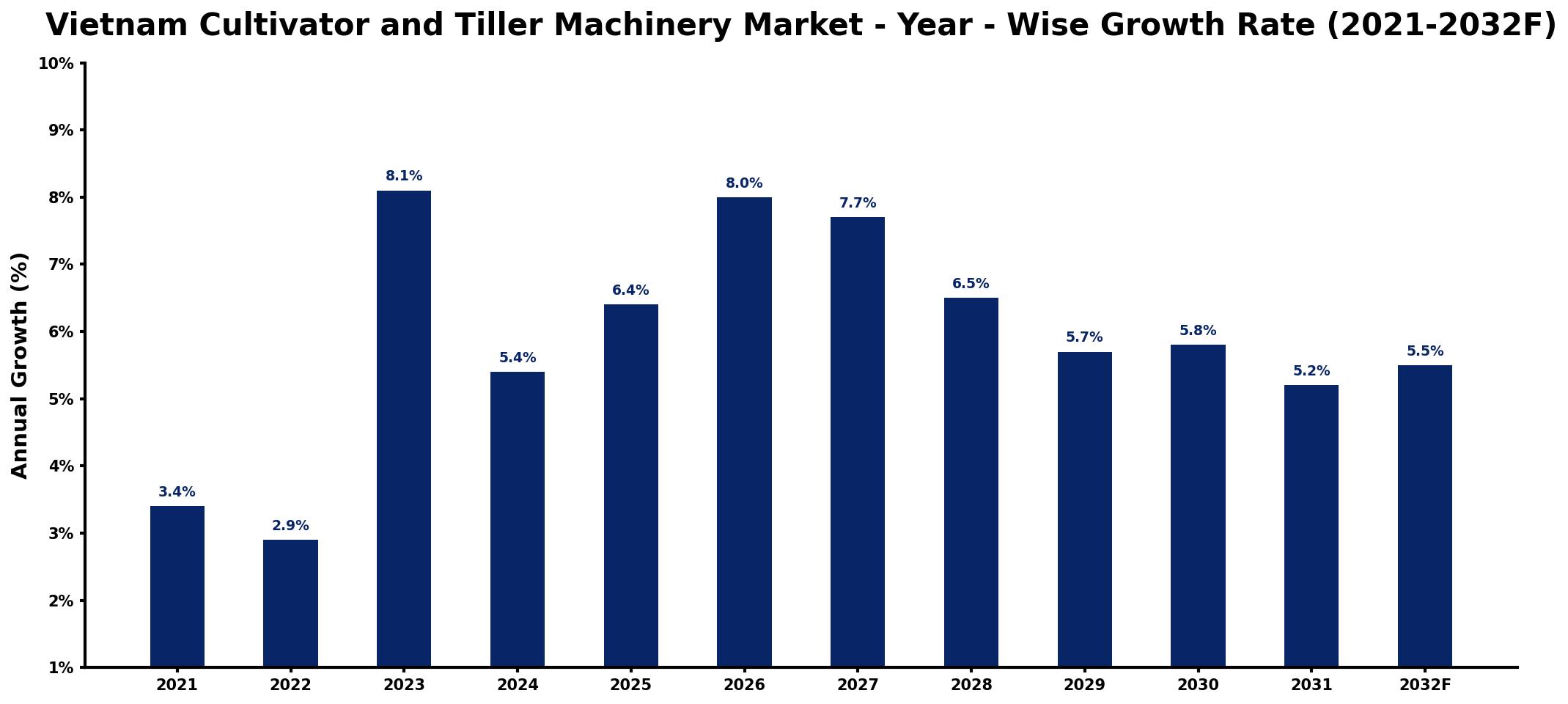
The table below presents the year‑wise growth rates along with the key drivers influencing the market
| Year | Growth Rate | Major Drivers |
| 2021 | 3.4% | Growing agricultural sector investment |
| 2022 | 2.9% | Increased mechanization of farming |
| 2023 | 8.1% | Rise in export-oriented agriculture |
| 2024 | 5.4% | Adoption of advanced farming techniques |
| 2025 | 6.4% | Government support for modernization |
| 2026 | 8.0% | Expansion of rural infrastructure projects |
| 2027 | 7.7% | Surge in smallholder farmer adoption |
| 2028 | 6.5% | Growing demand for sustainable practices |
| 2029 | 5.7% | Increased access to financing options |
| 2030 | 5.8% | Technological advancements in agriculture |
| 2031 | 5.2% | Rising consumer demand for efficiency |
| 2032 | 5.5% | Strengthening agricultural supply chains |
Note: Market size estimations and growth projections presented in this report are based on 6Wresearch's proprietary forecasting methodology, utilizing the latest available industry data, government publications, and primary research inputs.
Vietnam Cultivator and Tiller Machinery Market Synopsis
Recent trends in Vietnams cultivator and tiller machinery market indicate a strong shift towards mechanization, with farmers embracing new technologies to improve their yield. However, despite this momentum, traditional farming methods still dominate, highlighting the need for a comprehensive transition towards more efficient agricultural practices.
As the market evolves, manufacturers are tailoring their offerings to the diverse requirements of local farmers. This adaptability is crucial, as it aligns product capabilities with the unique agricultural practices found in various regions of Vietnam.
Vietnam Cultivator and Tiller Machinery Market Key Takeaways
- The market is expected to grow significantly, driven by government initiatives supporting agricultural modernization.
- Farmers are increasingly adopting mechanized solutions, although traditional practices still prevail in many areas.
- Customization of machinery to cater to specific farming needs is becoming a key competitive differentiator among manufacturers.
- Smaller, cost-effective equipment is gaining traction, particularly in light of economic fluctuations.
- Access to finance for purchasing machinery remains a barrier for many farmers, affecting adoption rates.
Evaluation of Restraints in Vietnam Cultivator and Tiller Machinery Market
While the Vietnam cultivator and tiller machinery market shows promise, several restraints hinder its full potential. The financial constraints faced by farmers often limit their ability to invest in modern machinery, leading to a reliance on traditional practices. Additionally, the rural areas frequently lack adequate maintenance and repair services, which diminishes the reliability of purchased equipment. Furthermore, the gradual adaptation to mechanized agriculture is impeded by farmers' resistance to changing age-old practices, complicating the market's growth.
Vietnam Cultivator and Tiller Machinery Market Trends
A notable trend in this market is the increasing incorporation of smart technology in agricultural machinery. Features such as GPS navigation and precision farming tools are being integrated into tillers and cultivators, enhancing efficiency and accuracy. Additionally, theres a growing preference for environmentally friendly equipment, as farmers become more aware of sustainable practices. These trends not only reflect a shift in farmer preferences but also highlight the need for manufacturers to innovate continuously to stay competitive in a dynamic market.
Vietnam Cultivator and Tiller Machinery Market Opportunities
Significant opportunities exist within the Vietnam cultivator and tiller machinery market, particularly in the areas of product innovation and targeted financing solutions. As demand for mechanized farming grows, there is a clear need for manufacturers to develop equipment tailored to specific crops and soil types in Vietnam. Additionally, partnerships with financial institutions to create accessible financing options could greatly increase machinery adoption, empowering farmers to transition from traditional methods to modern, efficient practices.
Government Initiatives in the Vietnam Cultivator and Tiller Machinery Market
The Vietnamese government has been proactive in promoting agricultural mechanization through various initiatives and policies aimed at enhancing productivity. Efforts include subsidies for machinery purchases and training programs for farmers to effectively utilize modern equipment. These initiatives not only seek to improve agricultural output but also aim to modernize the agricultural sector overall, ensuring its sustainability and competitiveness in both domestic and international markets.
Future Insights of the Vietnam Cultivator and Tiller Machinery Market
Looking ahead to 2026-2032, the Vietnam cultivator and tiller machinery market is poised for significant growth. As the agricultural sector continues to embrace mechanization, we can expect advancements in technology to drive demand for innovative equipment. In addition, as economic conditions stabilize, improved access to finance will facilitate higher investments in agricultural machinery. Overall, the alignment of market trends with governmental support is likely to foster a more robust environment for the adoption of cultivators and tillers in Vietnam.
Vietnam Cultivator and Tiller Machinery Market Latest Developments (2025 - 2026)
The Vietnam cultivator and tiller machinery market has witnessed several strategic developments in recent months. Industry players have begun to focus on enhancing the technological capabilities of their products, integrating features aimed at improving operational efficiency and user-friendliness. Additionally, there has been a noticeable rise in collaborations between manufacturers and financial institutions to create tailored financing solutions, making it easier for farmers to invest in necessary equipment. These movements indicate a proactive approach to addressing existing market challenges and catering to the evolving needs of Vietnamese farmers.
Vietnam Cultivator and Tiller Machinery Market - Key Attractiveness of the Report
- 10 Years of Market Numbers
- Historical Data Starting from 2022 to 2025
- Base Year: 2025
- Forecast Data until 2032
- Key Performance Indicators Impacting the Market
- Major Upcoming Developments and Projects
Key Highlights of the Report:
- Vietnam Cultivator and Tiller Machinery Market Outlook
- Market Size of Vietnam Cultivator and Tiller Machinery Market, 2025
- Forecast of Vietnam Cultivator and Tiller Machinery Market, 2032
- Historical Data and Forecast of Vietnam Cultivator and Tiller Machinery Revenues & Volume for the Period 2022-2032F
- Vietnam Cultivator and Tiller Machinery Market Trend Evolution
- Vietnam Cultivator and Tiller Machinery Market Drivers and Challenges
- Vietnam Cultivator and Tiller Machinery Price Trends
- Vietnam Cultivator and Tiller Machinery Porter's Five Forces
- Vietnam Cultivator and Tiller Machinery Industry Life Cycle
- Historical Data and Forecast of Vietnam Cultivator and Tiller Machinery Market Revenues & Volume By Product Type for the Period 2022-2032F
- Historical Data and Forecast of Vietnam Cultivator and Tiller Machinery Market Revenues & Volume By Cultivators for the Period 2022-2032F
- Historical Data and Forecast of Vietnam Cultivator and Tiller Machinery Market Revenues & Volume By Tillers for the Period 2022-2032F
- Historical Data and Forecast of Vietnam Cultivator and Tiller Machinery Market Revenues & Volume By for the Period 2022-2032F
- Historical Data and Forecast of Vietnam Cultivator and Tiller Machinery Market Revenues & Volume By Application for the Period 2022-2032F
- Historical Data and Forecast of Vietnam Cultivator and Tiller Machinery Market Revenues & Volume By Agriculture for the Period 2022-2032F
- Historical Data and Forecast of Vietnam Cultivator and Tiller Machinery Market Revenues & Volume By Garden for the Period 2022-2032F
- Vietnam Cultivator and Tiller Machinery Import Export Trade Statistics
- Market Opportunity Assessment By Product Type
- Market Opportunity Assessment By Application
- Vietnam Cultivator and Tiller Machinery Top Companies Market Share
- Vietnam Cultivator and Tiller Machinery Competitive Benchmarking By Technical and Operational Parameters
- Vietnam Cultivator and Tiller Machinery Company Profiles
- Vietnam Cultivator and Tiller Machinery Key Strategic Recommendations






































