Vietnam Distilled Water Market Size, Share & Growth Rate
The Vietnam Distilled Water Market was estimated at USD 278 Million in 2025 and is projected to reach USD 393 Million by 2032, growing at a CAGR of 5.1% from 2026 to 2032. This upward trajectory is fueled primarily by increasing demand from the healthcare and pharmaceutical sectors, where high-purity water is critical for various applications. Furthermore, a growing emphasis on quality control in industrial processes is propelling the market forward, as more industries recognize the importance of utilizing distilled water to maintain compliance with stringent regulations.
Vietnam Distilled Water Market Year-wise Growth Rate and Key Drivers
This graph highlights how the Vietnam Distilled Water Market has steadily grown over the years, supported by major growth factors.
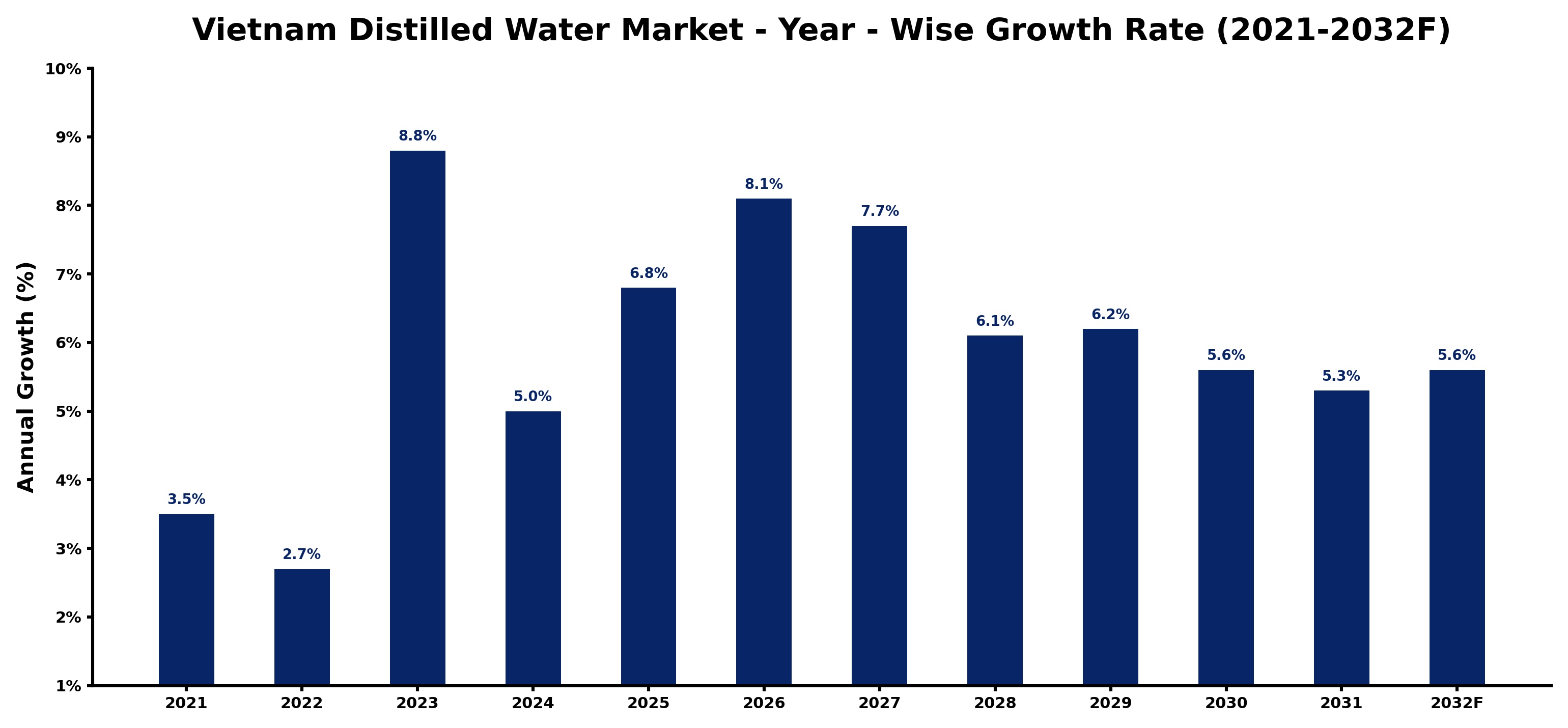
The table below presents the year‑wise growth rates along with the key drivers influencing the market
| Year | Growth Rate | Major Drivers |
| 2021 | 3.5% | Health awareness drove demand growth |
| 2022 | 2.7% | Urbanization increased consumption rates |
| 2023 | 8.8% | E-commerce platforms expanded reach |
| 2024 | 5.0% | Sustainability trends influenced preferences |
| 2025 | 6.8% | Industrial applications boosted sales |
| 2026 | 8.1% | Technological advancements improved quality |
| 2027 | 7.7% | Export opportunities enhanced market size |
| 2028 | 6.1% | Consumer education raised product awareness |
| 2029 | 6.2% | Partnerships expanded distribution networks |
| 2030 | 5.6% | Government regulations supported industry growth |
| 2031 | 5.3% | Innovative packaging attracted consumers |
| 2032 | 5.6% | Rising disposable incomes increased purchases |
Note - Market size estimations and growth projections presented in this report are based on 6Wresearch’s advanced forecasting approach, validated with industry datasets as of June 2026.
Vietnam Distilled Water Market Synopsis
Currently, the Vietnam Distilled Water Market is experiencing significant growth as it becomes a staple in healthcare, pharmaceuticals, and various industrial applications. The purity and lack of contaminants in distilled water make it a key ingredient in drug formulations and the maintenance of medical equipment, thereby boosting its demand across multiple sectors.
As awareness regarding safe drinking water continues to rise among consumers, there is a notable increase in domestic consumption of distilled water as well. This trend, combined with the expansion of end-user industries such as electronics manufacturing and automotive, underlines the market's potential for sustained growth in the coming years.
Vietnam Distilled Water Market Key Takeaways
- The market is driven by heightened demand from healthcare and pharmaceutical sectors.
- Rising awareness about the importance of safe water is boosting domestic consumption.
- Stringent quality standards across industries are supporting market expansion.
- Increased competition necessitates high-quality standards and effective marketing strategies.
- Environmental concerns are influencing perceptions and regulations surrounding bottled water.
Evaluation of Restraints in Vietnam Distilled Water Market
While the Vietnam Distilled Water Market shows promising growth prospects, certain limitations persist. The market is characterized by fierce competition, with numerous players providing similar products. To distinguish themselves, companies must ensure consistent quality and invest in robust marketing and distribution channels. Additionally, the emphasis on water purity necessitates strict adherence to quality control measures and regulatory standards, which can pose operational challenges. Concerns regarding plastic waste from water bottling also loom large, potentially affecting consumer sentiment and necessitating industry shifts toward sustainable practices.
Vietnam Distilled Water Market Trends
Emerging trends in the Vietnam Distilled Water Market indicate a shift towards sustainable packaging solutions, as companies aim to address environmental concerns surrounding plastic waste. Additionally, technological advancements in distillation processes are enhancing production efficiency and water quality. There is also a growing focus on health and wellness, further pushing consumers towards safe and pure drinking water options. As regulatory bodies tighten standards, industries are increasingly turning to high-purity distilled water to ensure compliance.
Vietnam Distilled Water Market Opportunities
The landscape for investment in the Vietnam Distilled Water Market is promising, particularly as healthcare and pharmaceutical sectors expand. Companies have an opportunity to innovate by developing advanced distillation technologies that enhance efficiency while addressing sustainability challenges. Furthermore, tapping into the growing domestic market for safe drinking water presents a lucrative avenue for companies looking to diversify their offerings and reach more consumers. Expansion into emerging industries, such as electronics and automotive, will also open new avenues for growth.
Government Initiatives in the Vietnam Distilled Water Market
The Vietnamese government has recognized the importance of ensuring safe and pure water sources for its population and industries. Consequently, various policies and initiatives have been launched to promote water quality standards and sustainability in water management. Public investment in infrastructure and regulations aimed at controlling pollution and ensuring water safety are also contributing to the market's favorable environment.
Future Insights of the Vietnam Distilled Water Market
Looking ahead to 2026-2032, the Vietnam Distilled Water Market is expected to witness robust growth, driven by the ongoing expansion of healthcare and pharmaceutical applications. Increased urbanization and rising consumer awareness regarding water safety will continue to propel demand for distilled water in residential settings. Additionally, as industries strive to meet stringent quality requirements, the reliance on high-purity distilled water will remain essential, positioning the market for sustained long-term growth.
Vietnam Distilled Water Market Latest Developments (May 2025 - June 2026)
Recent industry developments suggest a shift towards more sustainable practices in the Vietnam Distilled Water Market. Companies are increasingly focusing on eco-friendly packaging solutions to mitigate plastic waste, as well as investing in innovative technologies to enhance distillation processes. Additionally, partnerships between manufacturers and healthcare facilities are becoming more common, aimed at ensuring high-quality water supply for critical applications.
Vietnam Distilled Water Market - Key Attractiveness of the Report
- 10 Years of Market Numbers
- Historical Data Starting from 2022 to 2025
- Base Year: 2025
- Forecast Data until 2032
- Key Performance Indicators Impacting the Market
- Major Upcoming Developments and Projects
Key Highlights of the Report:
- Vietnam Distilled Water Market Outlook
- Market Size of Vietnam Distilled Water Market, 2025
- Forecast of Vietnam Distilled Water Market, 2032
- Historical Data and Forecast of Vietnam Distilled Water Revenues & Volume for the Period 2022-2032F
- Vietnam Distilled Water Market Trend Evolution
- Vietnam Distilled Water Market Drivers and Challenges
- Vietnam Distilled Water Price Trends
- Vietnam Distilled Water Porter's Five Forces
- Vietnam Distilled Water Industry Life Cycle
- Historical Data and Forecast of Vietnam Distilled Water Market Revenues & Volume By Types for the Period 2022-2032F
- Historical Data and Forecast of Vietnam Distilled Water Market Revenues & Volume By Pharmaceutical Grade for the Period 2022-2032F
- Historical Data and Forecast of Vietnam Distilled Water Market Revenues & Volume By Industrial Grade for the Period 2022-2032F
- Historical Data and Forecast of Vietnam Distilled Water Market Revenues & Volume By Applications for the Period 2022-2032F
- Historical Data and Forecast of Vietnam Distilled Water Market Revenues & Volume By Drinking for the Period 2022-2032F
- Historical Data and Forecast of Vietnam Distilled Water Market Revenues & Volume By Chemical and Biological Laboratories for the Period 2022-2032F
- Historical Data and Forecast of Vietnam Distilled Water Market Revenues & Volume By Automotive Cooling Systems and Batteries for the Period 2022-2032F
- Historical Data and Forecast of Vietnam Distilled Water Market Revenues & Volume By Medical for the Period 2022-2032F
- Historical Data and Forecast of Vietnam Distilled Water Market Revenues & Volume By Others for the Period 2022-2032F
- Vietnam Distilled Water Import Export Trade Statistics
- Market Opportunity Assessment By Types
- Market Opportunity Assessment By Applications
- Vietnam Distilled Water Top Companies Market Share
- Vietnam Distilled Water Competitive Benchmarking By Technical and Operational Parameters
- Vietnam Distilled Water Company Profiles
- Vietnam Distilled Water Key Strategic Recommendations






































