Vietnam Gum And Wood Chemicals Market Size, Share & Growth Rate
The Vietnam Gum And Wood Chemicals Market was estimated at USD 388 Million in 2025 and is projected to reach USD 546 Million by 2032, growing at a CAGR of 5.0% from 2026 to 2032. This growth trajectory is largely driven by the expansion of the woodworking and construction sectors, which rely heavily on natural chemicals for adhesives, coatings, and binders. The market is also witnessing increased demand from the pharmaceutical and textile industries, underscoring the versatile applications of these products in Vietnam's evolving industrial landscape.
Vietnam Gum And Wood Chemicals Market Year-wise Growth Rate and Key Drivers
This graph highlights how the Vietnam Gum And Wood Chemicals Market has steadily grown over the years, supported by major growth factors.
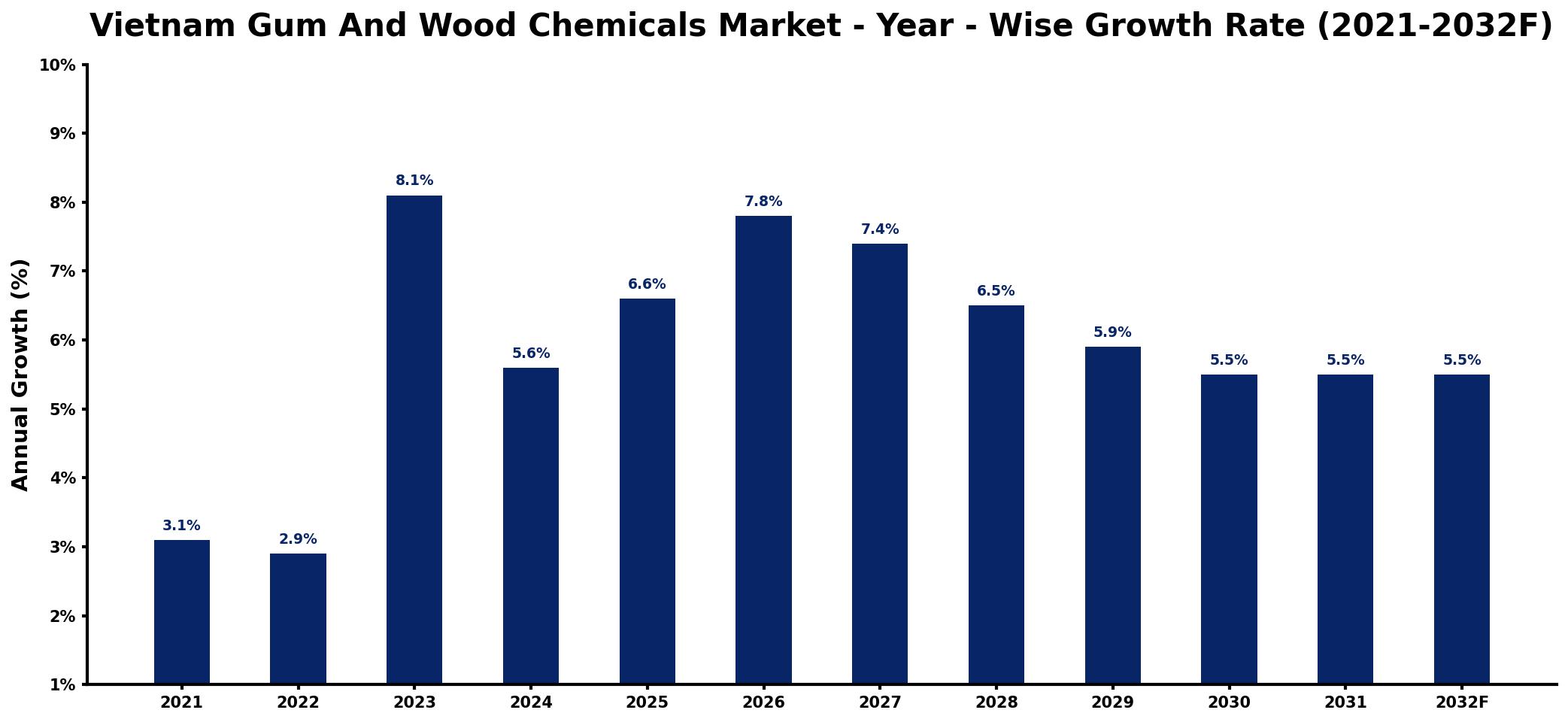
The table below presents the year‑wise growth rates along with the key drivers influencing the market
| Year | Growth Rate | Major Drivers |
| 2021 | 3.1% | Rising demand from construction sector |
| 2022 | 2.9% | Increased investments in manufacturing |
| 2023 | 8.1% | Expansion in export opportunities |
| 2024 | 5.6% | Growth in furniture production industry |
| 2025 | 6.6% | Surge in domestic consumption trends |
| 2026 | 7.8% | Development of sustainable alternatives |
| 2027 | 7.4% | Technological advancements in production |
| 2028 | 6.5% | Strengthening supply chain networks |
| 2029 | 5.9% | Growing focus on eco-friendly practices |
| 2030 | 5.5% | Increased urbanization and infrastructure |
| 2031 | 5.5% | Expansion of regional trade agreements |
| 2032 | 5.5% | Rising consumer awareness initiatives |
Note: Market size estimations and growth projections presented in this report are based on 6Wresearch's proprietary forecasting methodology, utilizing the latest available industry data, government publications, and primary research inputs.
Vietnam Gum And Wood Chemicals Market Synopsis
In recent years, the Vietnam gum and wood chemicals market has become a focal point of growth, reflecting the countrys cultural ties to herbal medicine and sustainable practices. As industries increasingly turn to natural alternatives, the demand for gum and wood chemicals has surged, particularly in sectors like construction, textiles, and personal care.
Current trends indicate a notable shift towards eco-friendly production practices, which align with rising environmental consciousness. The local production capabilities are expanding, allowing for a diverse range of applications that cater to both domestic and international markets.
Vietnam Gum And Wood Chemicals Market Key Takeaways
- The market is projected to grow significantly, reaching USD 546 Million by 2032.
- Diverse applications across various industries are driving demand for gum and wood chemicals.
- Environmental sustainability is a major focus influencing industry practices and innovation.
- Competition from synthetic alternatives continues to challenge market players.
- Recent disruptions in global supply chains necessitated a shift in strategies for market participants.
Evaluation of Restraints in Vietnam Gum And Wood Chemicals Market
Despite promising growth, the Vietnam gum and wood chemicals market faces considerable challenges. Environmental concerns surrounding deforestation and the sustainability of sourcing materials have led to increased scrutiny and calls for compliance with stricter regulations. The volatility in raw material pricing also poses risks, as fluctuations in the global wood product market can impact cost structures. Furthermore, as synthetic alternatives gain popularity, natural products must continually demonstrate their efficacy and sustainability to maintain market share.
Vietnam Gum And Wood Chemicals Market Trends
A notable trend within the Vietnam gum and wood chemicals market is the rise of eco-friendly formulations. Industries are increasingly focused on sourcing sustainable materials, reflecting a broader global movement towards greener practices. Additionally, technological advancements in extraction and processing techniques are enhancing the efficiency and quality of gum and wood chemicals. This innovation paves the way for new applications in the cosmetics and food sectors, broadening the market's potential.
Vietnam Gum And Wood Chemicals Market Opportunities
The opportunities for growth in the Vietnam gum and wood chemicals market are significant. As traditional medicine and herbal remedies regain popularity, there is potential for expansion in these sectors. Furthermore, the increasing demand for biodegradable and sustainable products presents a compelling case for investment in research and development. Companies can also capitalize on opportunities in emerging markets abroad, leveraging Vietnam's natural resource advantages.
Government Initiatives in the Vietnam Gum And Wood Chemicals Market
The Vietnamese government has been proactive in promoting sustainable practices in the natural products sector, encouraging investments in eco-friendly technologies and sustainable sourcing. Various public programs aim to support industries transitioning towards green alternatives, providing incentives for research in natural chemical applications. These initiatives align with Vietnam's broader commitment to environmental conservation and sustainable economic growth.
Future Insights of the Vietnam Gum And Wood Chemicals Market
Looking ahead to 2026-2032, the Vietnam gum and wood chemicals market is poised for robust growth. As industrial diversification continues, along with an increased focus on sustainability, the demand for natural chemicals is expected to rise. Companies that adapt to changing consumer preferences and invest in innovative, eco-friendly solutions will likely be the most successful in capturing market share. This proactive approach will not only enhance competitiveness but also contribute to the overall health of Vietnam's economy.
Vietnam Gum And Wood Chemicals Market Latest Developments (2025 - 2026)
In the recent months, the Vietnam gum and wood chemicals market has witnessed a series of strategic collaborations aimed at enhancing production capabilities and sustainability. Innovations in extraction methods have also come to the forefront, allowing manufacturers to increase yield while minimizing environmental impact. Additionally, the market is adapting to supply chain challenges by diversifying supplier networks and exploring local sourcing options.
Vietnam Gum And Wood Chemicals Market - Key Attractiveness of the Report
- 10 Years of Market Numbers
- Historical Data Starting from 2022 to 2025
- Base Year: 2025
- Forecast Data until 2032
- Key Performance Indicators Impacting the Market
- Major Upcoming Developments and Projects
Key Highlights of the Report:
- Vietnam Gum And Wood Chemicals Market Outlook
- Market Size of Vietnam Gum And Wood Chemicals Market, 2025
- Forecast of Vietnam Gum And Wood Chemicals Market, 2032
- Historical Data and Forecast of Vietnam Gum And Wood Chemicals Revenues & Volume for the Period 2022-2032F
- Vietnam Gum And Wood Chemicals Market Trend Evolution
- Vietnam Gum And Wood Chemicals Market Drivers and Challenges
- Vietnam Gum And Wood Chemicals Price Trends
- Vietnam Gum And Wood Chemicals Porter's Five Forces
- Vietnam Gum And Wood Chemicals Industry Life Cycle
- Historical Data and Forecast of Vietnam Gum And Wood Chemicals Market Revenues & Volume By Product Type for the Period 2022-2032F
- Historical Data and Forecast of Vietnam Gum And Wood Chemicals Market Revenues & Volume By Gum Arabic for the Period 2022-2032F
- Historical Data and Forecast of Vietnam Gum And Wood Chemicals Market Revenues & Volume By Guar Gum for the Period 2022-2032F
- Historical Data and Forecast of Vietnam Gum And Wood Chemicals Market Revenues & Volume By Wood Chemicals for the Period 2022-2032F
- Historical Data and Forecast of Vietnam Gum And Wood Chemicals Market Revenues & Volume By Charcoal for the Period 2022-2032F
- Historical Data and Forecast of Vietnam Gum And Wood Chemicals Market Revenues & Volume By Tannic Acid for the Period 2022-2032F
- Historical Data and Forecast of Vietnam Gum And Wood Chemicals Market Revenues & Volume By End-User for the Period 2022-2032F
- Historical Data and Forecast of Vietnam Gum And Wood Chemicals Market Revenues & Volume By Commercial for the Period 2022-2032F
- Historical Data and Forecast of Vietnam Gum And Wood Chemicals Market Revenues & Volume By Industrial for the Period 2022-2032F
- Historical Data and Forecast of Vietnam Gum And Wood Chemicals Market Revenues & Volume By Household for the Period 2022-2032F
- Historical Data and Forecast of Vietnam Gum And Wood Chemicals Market Revenues & Volume By Sales Channel for the Period 2022-2032F
- Historical Data and Forecast of Vietnam Gum And Wood Chemicals Market Revenues & Volume By Direct Sales for the Period 2022-2032F
- Historical Data and Forecast of Vietnam Gum And Wood Chemicals Market Revenues & Volume By Distributor for the Period 2022-2032F
- Vietnam Gum And Wood Chemicals Import Export Trade Statistics
- Market Opportunity Assessment By Product Type
- Market Opportunity Assessment By End-User
- Market Opportunity Assessment By Sales Channel
- Vietnam Gum And Wood Chemicals Top Companies Market Share
- Vietnam Gum And Wood Chemicals Competitive Benchmarking By Technical and Operational Parameters
- Vietnam Gum And Wood Chemicals Company Profiles
- Vietnam Gum And Wood Chemicals Key Strategic Recommendations






































