Vietnam Ingots Market Summary
The vietnam ingots market was estimated at USD 240 Million in 2025 and is projected to reach USD 339 Million by 2032, growing at a CAGR of 7.8% from 2026 to 2032.
Vietnam Ingots Market Year-wise Growth Rate and Key Drivers
This graph highlights how the Vietnam Ingots Market has steadily grown over the past five years, supported by major growth factors.
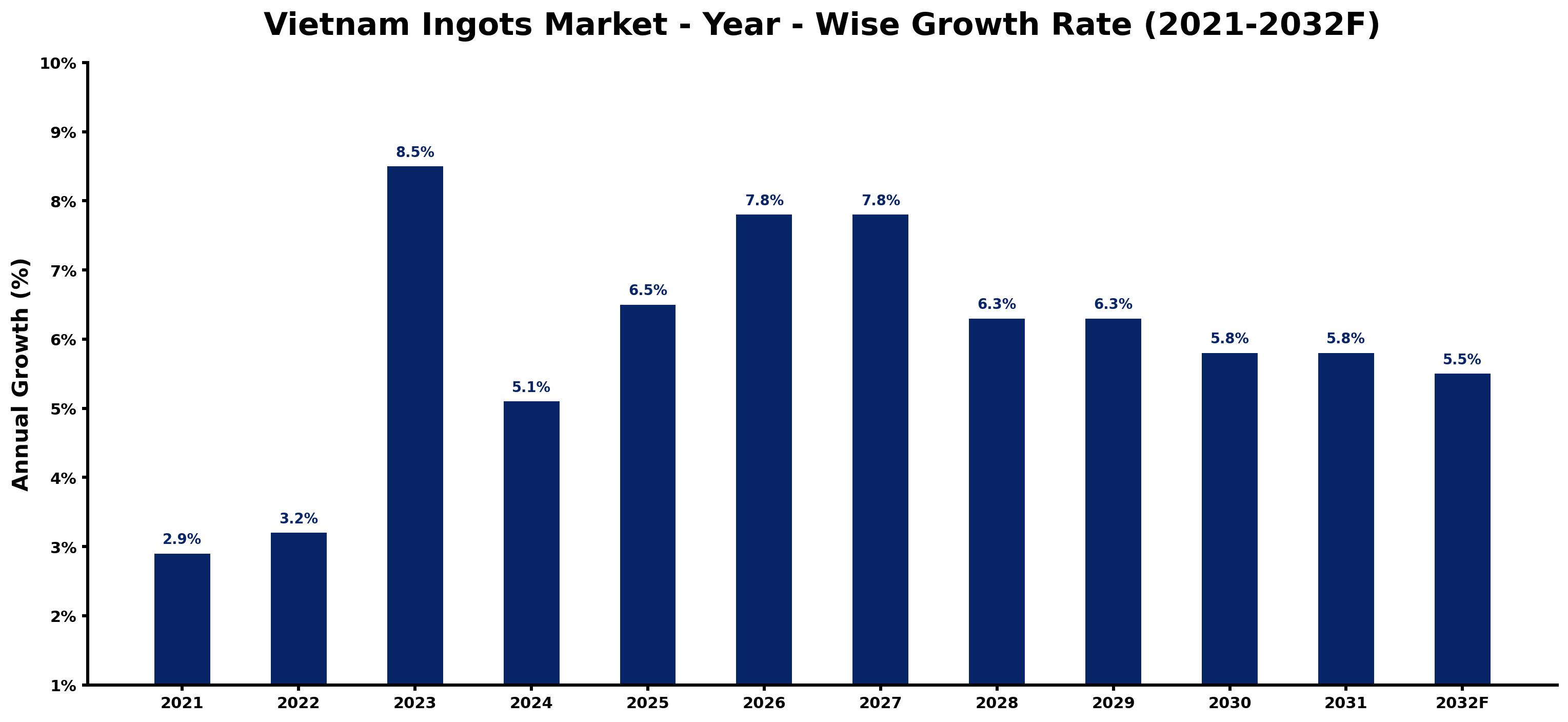
The table below presents the year wise growth rates along with the key drivers influencing the market
| Year | Growth Rate | Major Drivers |
| 2021 | 2.9% | Vietnam's manufacturing sector began recovering, fueling demand for quality ingots. |
| 2022 | 3.2% | Infrastructure projects expanded, increasing the need for robust metal supplies like ingots. |
| 2023 | 8.5% | International investment in local production facilities fostered ingot market competition and innovation. |
| 2024 | 5.1% | Sustainable practices gained traction, prompting manufacturers to seek eco-friendly ingot solutions. |
| 2025 | 6.5% | Technological enhancements in metallurgy improved ingot quality and production efficiency significantly. |
| 2026 | 7.8% | Rural electrification projects accelerated, creating new demand for ingots in power grid upgrades. |
| 2027 | 7.8% | Rising export opportunities to ASEAN markets spurred local ingot production capacities. |
| 2028 | 6.3% | Economic diversification focused on high-value industries, enhancing ingot application in various sectors. |
| 2029 | 6.3% | Digital transformation in manufacturing streamlined supply chains, optimizing ingot distribution processes. |
| 2030 | 5.8% | Increased urbanization led to greater demands for construction materials, including ingots. |
| 2031 | 5.8% | Emerging local startups introduced innovative materials, challenging traditional ingot production methods. |
| 2032 | 5.5% | Global market shifts necessitated adaptability in ingot production to maintain competitive edge. |
Note - Market size estimations and growth projections presented in this report are based on 6Wresearch's advanced forecasting approach, validated with industry datasets as of June 2026.
Vietnam Ingots Market Synopsis
The Vietnam Ingots Market is projected to reach 7.8% and witness significant growth during the forecast period (2026-2032). This market encompasses the production, consumption, and trade of metal ingots, essential semi-finished products utilized across various sectors including construction, automotive, machinery, and electronics.
Vietnam Ingots Market Growth Drivers
The burgeoning demand for metal ingots in Vietnam is primarily driven by several key factors:
- The construction industry in Vietnam is witnessing robust growth, fueled by comprehensive infrastructure development projects aimed at modernizing urban areas and building new facilities, which in turn increases the demand for metal ingots.
- As the country's automotive sector expands, manufacturers increasingly rely on metal ingots, which serve as essential raw materials for producing vehicle components and assembly lines.
- The rise of the machinery industry contributes to the growing consumption of ingots, as they are integral to manufacturing heavy machinery and equipment used in various industrial processes.
- Demand dynamics are further enhanced by Vietnam's strategic location, offering export opportunities as the country serves as a supplier of metal ingots to regional markets.
- Technological advancements in the production processes of metal ingots facilitate higher efficiency and lower costs, thereby boosting overall market attractiveness.
Vietnam Ingots Market Challenges and Restraints
While the Vietnam Ingots Market presents numerous growth opportunities, it also faces several challenges that could impede its progress:
- Volatility in global metal prices affects manufacturers' profitability, as fluctuations can disrupt pricing strategies and operating margins.
- Geopolitical factors can complicate trade dynamics, impacting supply chains and the stability of metal ingot availability for local industries.
- Adapting to technological shifts requires substantial investment, which may be a barrier for smaller companies looking to innovate and compete effectively.
- Environmental regulations are becoming increasingly stringent; companies must ensure compliance to mitigate risks associated with production-related environmental impacts.
- The ongoing effects of the COVID-19 pandemic have led to lasting changes in consumer behavior, with implications for the demand patterns of specific ingot applications.
Vietnam Ingots Market Government Investment and Initiatives
The Vietnamese government has been proactive in fostering the growth of the ingots market through various initiatives and investments. A focus on infrastructure development has led to increased public spending in construction and materials, further stimulating demand for metal ingots. The government has also introduced policies that incentivize technological advancements in the production of metal products, granting financial support for companies investing in efficient manufacturing practices.
Additionally, the government is actively working to enhance the regulatory framework surrounding environmental compliance, which includes initiatives aimed at minimizing the ecological footprint of ingot production. These efforts aim to ensure that the market can thrive sustainably while enhancing Vietnam's competitive edge in the regional and global metal markets.
Vietnam Ingots Market Latest Developments (May 2025 - June 2026)
Recent developments in the Vietnam Ingots Market indicate a pivot towards modernization and sustainability. Companies are investing in new technologies to improve production efficiency and reduce energy consumption, which is crucial given the rising awareness of environmental issues. Furthermore, a noticeable shift in export strategies has emerged, with many companies seeking to penetrate new international markets.
The Vietnam government's continued support for infrastructure projects has also been a key theme during this period, promoting higher demand for ingots. As companies adapt to the evolving market landscape, new partnerships and collaborations have begun to form, aimed at leveraging synergies in production and distribution.
Vietnam Ingots Market - Key Attractiveness of the Report
- 10 Years of Market Numbers
- Historical Data Starting from 2022 to 2025
- Base Year: 2025
- Forecast Data until 2032
- Key Performance Indicators Impacting the Market
- Major Upcoming Developments and Projects
Key Highlights of the Report:
- Vietnam Ingots Market Outlook
- Market Size of Vietnam Ingots Market, 2025
- Forecast of Vietnam Ingots Market, 2032
- Historical Data and Forecast of Vietnam Ingots Revenues & Volume for the Period 2022-2032F
- Vietnam Ingots Market Trend Evolution
- Vietnam Ingots Market Drivers and Challenges
- Vietnam Ingots Price Trends
- Vietnam Ingots Porter's Five Forces
- Vietnam Ingots Industry Life Cycle
- Historical Data and Forecast of Vietnam Ingots Market Revenues & Volume By Product Types for the Period 2022-2032F
- Historical Data and Forecast of Vietnam Ingots Market Revenues & Volume By Single Crystals for the Period 2022-2032F
- Historical Data and Forecast of Vietnam Ingots Market Revenues & Volume By Copper Alloys for the Period 2022-2032F
- Historical Data and Forecast of Vietnam Ingots Market Revenues & Volume By Material Types for the Period 2022-2032F
- Historical Data and Forecast of Vietnam Ingots Market Revenues & Volume By Aluminium for the Period 2022-2032F
- Historical Data and Forecast of Vietnam Ingots Market Revenues & Volume By Steel for the Period 2022-2032F
- Historical Data and Forecast of Vietnam Ingots Market Revenues & Volume By Gold for the Period 2022-2032F
- Historical Data and Forecast of Vietnam Ingots Market Revenues & Volume By Tin for the Period 2022-2032F
- Historical Data and Forecast of Vietnam Ingots Market Revenues & Volume By Others for the Period 2022-2032F
- Historical Data and Forecast of Vietnam Ingots Market Revenues & Volume By Applications for the Period 2022-2032F
- Historical Data and Forecast of Vietnam Ingots Market Revenues & Volume By Petroleum for the Period 2022-2032F
- Historical Data and Forecast of Vietnam Ingots Market Revenues & Volume By Oil & Gas for the Period 2022-2032F
- Historical Data and Forecast of Vietnam Ingots Market Revenues & Volume By Chemical for the Period 2022-2032F
- Historical Data and Forecast of Vietnam Ingots Market Revenues & Volume By Marine for the Period 2022-2032F
- Historical Data and Forecast of Vietnam Ingots Market Revenues & Volume By Others for the Period 2022-2032F
- Vietnam Ingots Import Export Trade Statistics
- Market Opportunity Assessment By Product Types
- Market Opportunity Assessment By Material Types
- Market Opportunity Assessment By Applications
- Vietnam Ingots Top Companies Market Share
- Vietnam Ingots Competitive Benchmarking By Technical and Operational Parameters
- Vietnam Ingots Company Profiles
- Vietnam Ingots Key Strategic Recommendations






































