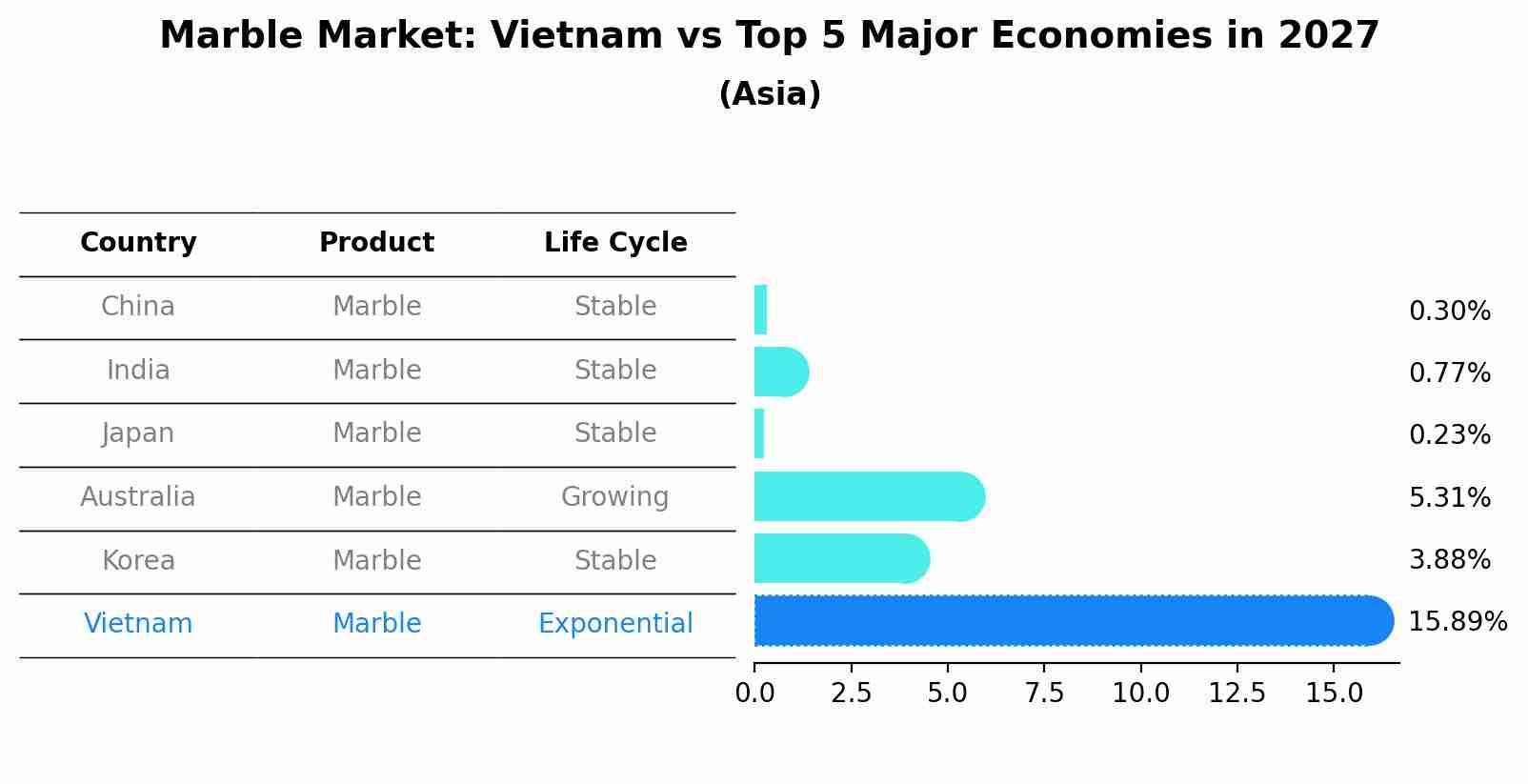
Marble Market: Vietnam vs Top 5 Major Economies in 2027 (Asia)
The Marble market in Vietnam is projected to grow at a exponential growth rate of 15.89% by 2027, highlighting the country's increasing focus on advanced technologies within the Asia region, where China holds the dominant position, followed closely by India, Japan, Australia and South Korea, shaping overall regional demand.
Vietnam Marble Market Growth Rate
According to 6Wresearch internal database and industry insights, the Vietnam Marble Market is projected to grow at a compound annual growth rate (CAGR) of 8.7% during the forecast period 2026–2032.
Topics Covered in the Vietnam Marble Market Report
The Vietnam Marble Market report thoroughly covers the market by colour type and application. It provides an unbiased and detailed analysis of ongoing market trends, opportunities, challenges, and market drivers, helping stakeholders align their strategies with current and future market dynamics.
Vietnam Marble Market Highlights
| Report Name |
Vietnam Marble Market |
| Forecast period | 2026-2032 |
| CAGR | 8.7% |
| Growing Sector | Construction Materials & Natural Stones |
Vietnam Marble Market Synopsis
The Vietnam Marble Market is predicted to undergo steady growth. It is proliferated by growing infrastructure development and increasing need for premium construction materials. The country’s abundant natural stone reserves and competitive labour costs position it as a major exporter in the global marble industry. Swift urbanization and the expansion of residential and commercial construction projects are propelling the need for high-quality marble products. Additionally, increasing international need for aesthetically appealing and durable materials is supporting local manufacturers to augment production capabilities and deploy advanced processing technologies.
Evaluation of Growth Drivers in the Vietnam Marble Market
Below mentioned are some prominent drivers and their influence on the Vietnam Marble Market dynamics:
| Drivers | Primary Segment Affected | Why It Matters (Evidence) |
| Rising Construction Activities | Building & Construction | Drives demand for marble in flooring, walls, and decorative applications. |
| Export Growth | All Colour Types | Vietnam’s marble exports are increasing due to global demand. |
| Tourism & Infrastructure Development | Statues and Monuments | Growth in tourism boosts demand for decorative marble structures. |
| Technological Advancements | Furniture | Improves cutting, finishing, and customization capabilities. |
| Urbanization | Building & Construction | High-quality construction materials requirement is growing and expanding cities are the reason for it. |
The Vietnam Marble Market is projected to grow at a CAGR of 8.7% from 2026 to 2032. Growth is driven by increasing construction activities, strong export demand, and technological advancements in marble processing. The rising demand for decorative and high-quality natural stones in both domestic and international markets further strengthens the market outlook. Additionally, expanding investments in infrastructure development, growth in real estate projects, and increasing preference for premium interior materials are further accelerating market expansion.
Evaluation of Restraints in the Vietnam Marble Market
Below mentioned are some major restraints and their influence on the Vietnam Marble Market dynamics:
| Restraints | Primary Segment Affected | What This Means (Evidence) |
| Environmental Regulations | Mining Activities | Strict quarrying regulations limit extraction capacity. |
| High Transportation Costs | Export Market | Increases overall pricing of marble products globally. |
| Skilled Labor Shortage | Processing Units | Impacts finishing quality and productivity. |
| Fluctuating Raw Material Availability | All Segments | Affects consistent supply. |
| Competition from Alternatives | Building & Construction | The need for natural marble slows down owing to synthetic materials |
Vietnam Marble Market Challenges
The Vietnam Marble Industry faces challenges such as strict environmental regulations on quarrying activities and the need for sustainable extraction practices. Profitability can get affected owing to increased transportation costs and dependability on export markets and competition from engineered stones and ceramics poses a threat to natural marble need. The industry also faces challenges related to maintaining consistent quality standards and managing changing raw material availability and lack of access to advanced processing technologies among small manufacturers can limit productivity.
Vietnam Marble Market Trends
Several key trends are influencing the growth of the Vietnam Marble Market:
- Increasing Demand for Premium White Marble: Owing to white marble’s aesthetic appeal in luxury construction projects, white marble is getting famous.
- Adoption of Advanced Processing Technologies: To augment efficiency and product quality, manufacturers are allocating funds in CNC cutting and polishing technologies.
- Focus on Sustainable Quarrying Practices: Companies are deploying eco-friendly mining techniques, to align with regulations and decrease environmental affect.
- Growth in Customized Marble Products: To encourage creative innovation among producers, the need for personalised designs in furniture and interiors is increasing.
Investment Opportunities in the Vietnam Marble Industry
Key investment opportunities in the Vietnam Marble Market include:
- Expansion of Export-Oriented Production: To provide to worldwide requirement, fund allocation in export-focused processing units is highly necessary.
- Development of Value-Added Products: For higher margins, prospects are present in creating finished marble goods and they include tiles and furniture.
- Sustainable Mining Technologies: To meet with regulatory requirements, fund allocation in environmentally friendly quarrying methods is essential.
Top 5 Leading Players in the Vietnam Marble Market
Below is the list of prominent companies leading in the Vietnam Marble Market:
1. Nhat Huy Natural Stone
| Company Name | Nhat Huy Natural Stone |
|---|---|
| Established Year | 1998 |
| Headquarters | Hanoi, Vietnam |
| Official Website | Click Here |
Nhat Huy Natural Stone is a renowned player known for its strong quarry ownership and extensive range of marble products.
2. Bao Lai Marble One Member Company Limited
| Company Name | Bao Lai Marble One Member Company Limited |
|---|---|
| Established Year | 2010 |
| Headquarters | Yen Bai, Vietnam |
| Official Website | Click Here |
Bao Lai Marble specializes in high-quality white marble extraction and processing. With modern production facilities and large reserves, the company provides to both domestic construction needs and international demand for high-grade marble products.
3. Hoang Gia Mineral Group JSC
| Company Name | Hoang Gia Mineral Group JSC |
|---|---|
| Established Year | 2007 |
| Headquarters | Nghe An, Vietnam |
| Official Website | - |
Hoang Gia Mineral Group functions across the marble value chain, including mining, processing, and value-added products. The company is known for its focus on efficiency, sustainability, and consistent product quality.
4. Vietduc Marble
| Company Name | Vietduc Marble |
|---|---|
| Established Year | 2004 |
| Headquarters | Hanoi, Vietnam |
| Official Website | - |
Vietduc Marble is known for supplying a broad variety of marble slabs and tiles used in construction and interior design. The company focusses on quality control and customized solutions to meet diverse customer requirements.
5. Nam Giang Natural Stone Co Ltd
| Company Name | Nam Giang Natural Stone Co., Ltd. |
|---|---|
| Established Year | 2006 |
| Headquarters | Quang Nam, Vietnam |
| Official Website | Click Here |
Nam Giang Natural Stone is a rising manufacturer focusing on natural marble products for construction and decorative uses. The company is strengthening its market presence through reliable supply, competitive pricing, and expanding export capabilities.
Government Regulations Introduced in the Vietnam Marble Market
According to Vietnamese government data, marble extraction and processing must meet with environmental protection laws and mining regulations and strict licensing for quarry operations are established by the Ministry of Natural Resources and Environment. This is done to make sure sustainable resource utilization and initiatives like the “Vietnam Green Growth Strategy” support eco-friendly industrial practices. Additionally, export regulations need adherence to quality standards to sustain competitiveness in global markets. While infrastructure development programs encourage the transportation and logistics of marble products.
Future Insights of the Vietnam Marble Market
The Vietnam Marble Market Growth is expected to experience continuously increase. This is owing to increasing construction activities and rising global demand for natural stones. Developments in processing technologies and a rising focus on sustainability will shape the future of the industry. The growth of export markets and the development of high-value marble products are likely to accelerate long-term growth and government initiatives encouraging infrastructure and sustainable mining practices will further solidify the market outlook. Furthermore, rising deployment of automation and digital tools in marble processing is predicted to augment functional efficiency and decrease material wastage.
Market Segmentation Analysis
The report offers a comprehensive study of the following market segments and their leading categories:
By Colour Type – White Marble to dominate the market
White marble is expected to dominate the Vietnam Marble Market Share due to its high demand in luxury construction and interior design. Its aesthetic appeal, durability, and versatility make it a preferred choice for flooring, countertops, and wall cladding in residential and commercial projects.
By Application – Building & Construction to dominate the market
According to Mansi Ahuja, Senior Research Analyst at 6Wresearch, the Building & Construction segment is anticipated to lead the market due to increasing infrastructure development and urbanization.
Key Attractiveness of the Report
- 10 Years of Market Numbers.
- Historical Data Starting from 2022 to 2025.
- Base Year: 2025.
- Forecast Data until 2032.
- Key Performance Indicators Impacting the Market.
- Major Upcoming Developments and Projects.
Key Highlights of the Report:
- · Vietnam Marble Market Outlook
- Market Size of Vietnam Marble Market, 2025
- Forecast of Vietnam Marble Market, 2032
- Historical Data and Forecast of Vietnam Marble Revenues & Volume for the Period 2022-2032
- Vietnam Marble Market Trend Evolution
- Vietnam Marble Market Drivers and Challenges
- Vietnam Marble Price Trends
- Vietnam Marble Porter's Five Forces
- Vietnam Marble Industry Life Cycle
- Historical Data and Forecast of Vietnam Marble Market Revenues & Volume By Colour Type for the Period 2022-2032
- Historical Data and Forecast of Vietnam Marble Market Revenues & Volume By White for the Period 2022-2032
- Historical Data and Forecast of Vietnam Marble Market Revenues & Volume By Black for the Period 2022-2032
- Historical Data and Forecast of Vietnam Marble Market Revenues & Volume By Yellow for the Period 2022-2032
- Historical Data and Forecast of Vietnam Marble Market Revenues & Volume By Red for the Period 2022-2032
- Historical Data and Forecast of Vietnam Marble Market Revenues & Volume By Others for the Period 2022-2032
- Historical Data and Forecast of Vietnam Marble Market Revenues & Volume By Application for the Period 2022-2032
- Historical Data and Forecast of Vietnam Marble Market Revenues & Volume By Building & Construction for the Period 2022-2032
- Historical Data and Forecast of Vietnam Marble Market Revenues & Volume By Statues and Monuments for the Period 2022-2032
- Historical Data and Forecast of Vietnam Marble Market Revenues & Volume By Furniture for the Period 2022-2032
- Historical Data and Forecast of Vietnam Marble Market Revenues & Volume By Others for the Period 2022-2032
- Vietnam Marble Import Export Trade Statistics
- Market Opportunity Assessment By Colour Type
- Market Opportunity Assessment By Application
- Vietnam Marble Top Companies Market Share
- Vietnam Marble Competitive Benchmarking By Technical and Operational Parameters
- Vietnam Marble Company Profiles
- Vietnam Marble Key Strategic Recommendations
Market Covered
The report offers a comprehensive study of the following segments:
By Colour Type:
- White
- Black
- Yellow
- Red
- Others
By Application:
- Building & Construction
- Statues and Monuments
- Furniture
- Others






































