Vietnam Power Convertor Market Summary
The vietnam power convertor market was estimated at USD 766 Million in 2025 and is projected to reach USD 1089 Million by 2032, growing at a CAGR of 8.4% from 2026 to 2032.
Vietnam Power Convertor Market Year-wise Growth Rate and Key Drivers
This graph highlights how the Vietnam Power Convertor Market has steadily grown over the past five years, supported by major growth factors.
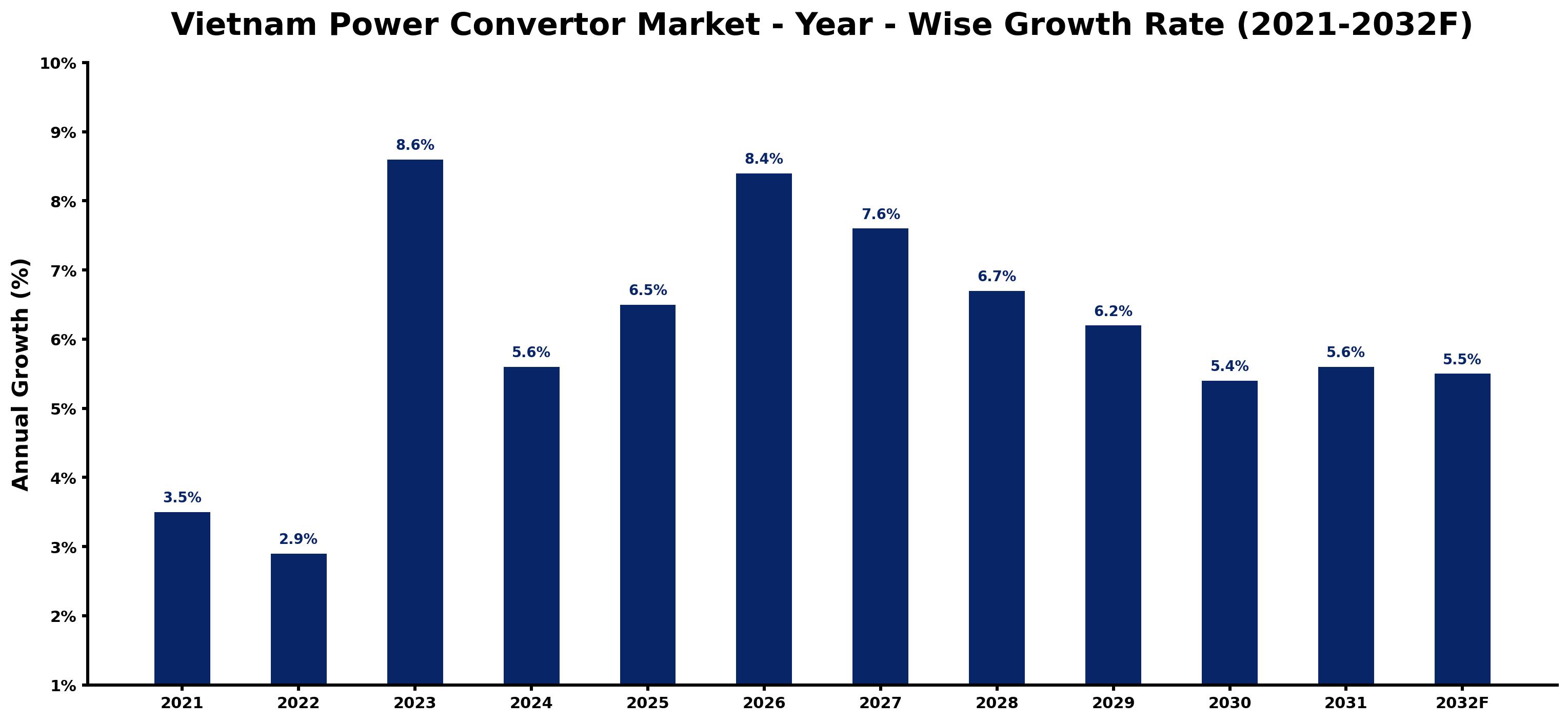
The table below presents the year wise growth rates along with the key drivers influencing the market
| Year | Growth Rate | Major Drivers |
| 2021 | 3.5% | Manufacturing relocation to Vietnam intensifies demand for efficient power converters. |
| 2022 | 2.9% | Investment in smart grid technology becomes pivotal for enhancing energy efficiency. |
| 2023 | 8.6% | Rural electrification projects highlight the need for reliable power conversion solutions. |
| 2024 | 5.6% | Legacy energy infrastructure failures prompt upgrades in power conversion systems. |
| 2025 | 6.5% | Increased foreign direct investment boosts the local power converter manufacturing sector. |
| 2026 | 8.4% | Energy consumption patterns shift due to urbanization and industrial growth. |
| 2027 | 7.6% | Focus on renewable energy integration necessitates advanced power conversion technologies. |
| 2028 | 6.7% | Local production capabilities are strengthened through collaborative ventures with global firms. |
| 2029 | 6.2% | Emerging technologies like IoT require innovative power conversion solutions for smart applications. |
| 2030 | 5.4% | Electric vehicle adoption creates new demands for high-efficiency charging systems. |
| 2031 | 5.6% | Environmental concerns influence the market towards sustainable and efficient power solutions. |
| 2032 | 5.5% | Technological advancements in power electronics redefine the operational capabilities of converters. |
Note - Market size estimations and growth projections presented in this report are based on 6Wresearch's advanced forecasting approach, validated with industry datasets as of June 2026.
Vietnam Power Convertor Market Synopsis
The Vietnam Power Convertor Market is projected to reach 8.4% and witness significant growth during the forecast period (2026-2032). This market encompasses the production, distribution, and utilization of power converters, which are critical components in transforming electrical power from one form to another, such as converting alternating current (AC) to direct current (DC) and vice versa. The surge in demand for power converters is driven by various factors including industrial growth, renewable energy adoption, and the burgeoning electronics manufacturing sector.
Vietnam Power Convertor Market Growth Drivers
Several factors are propelling the growth of the Vietnam Power Convertor Market. As the nation rapidly industrializes, the requirement for power converters across various applications has increased. Key drivers include:
- The expansion of Vietnam's industrial sector necessitating reliable power supply systems that integrate power converters for smooth operations.
- Significant growth in the electronics manufacturing industry which relies heavily on power converters as essential components in numerous electronic devices.
- The Vietnamese government's commitment to renewable energy technologies, including solar and wind, necessitating efficient power conversion systems to make renewable energy grid-compatible.
- Rising energy consumption among diverse sectors, which amplifies the need for effective power distribution solutions involving power converters.
- Ongoing infrastructure projects that stimulate demand for robust power supply frameworks, thereby driving the power converter market further.
Vietnam Power Convertor Market Challenges and Restraints
While the Vietnam Power Convertor Market shows promising growth potential, it faces several challenges that could hinder its progress:
- The presence of imported products creates stiff competition, posing challenges for local manufacturers who may struggle to compete on pricing and technology.
- Ensuring the quality and reliability of power converters remains critical; manufacturers face difficulties in meeting international quality standards which are vital for consumer trust.
- Fluctuations in raw material prices can lead to increased manufacturing costs, impacting the overall pricing strategy and profitability of power converter manufacturers.
- The lack of a well-developed supply chain can lead to delays and increased costs in sourcing components necessary for power converter production.
- Market players must adapt to rapid technological advancements in power conversion technologies, which require ongoing investment in research and development.
Vietnam Power Convertor Market Government Investment and Initiatives
The Vietnamese government has initiated several policies and investments aimed at boosting the power converter market. These initiatives are focused on enhancing technological capabilities and promoting sustainable energy practices:
- The government is actively investing in renewable energy projects, with a focus on integrating power converters to facilitate efficient energy conversion and distribution.
- Public funding has been directed towards research and development in power converter technologies, encouraging innovation within the industry.
- Initiatives to improve infrastructure and ensure reliable energy supply are being prioritized, directly influencing the demand for advanced power converters.
- Government incentives for manufacturers of renewable energy technologies, including power converters, foster a competitive environment for local producers.
- Collaboration with international organizations to enhance regulatory frameworks and quality standards for power converter products is being pursued to streamline market growth.
Vietnam Power Convertor Market Latest Developments (May 2025 - June 2026)
In the period from May 2025 to June 2026, the Vietnam Power Convertor Market has witnessed noteworthy developments that could influence its trajectory:
- There has been a marked increase in government initiatives promoting green energy solutions, thereby boosting the integration of power converters into sustainable energy systems.
- Technological advancements have led to the introduction of more efficient and compact power converters, addressing the industry need for high-performance solutions.
- Industry collaborations aimed at improving supply chain management have been forged, which could enhance the availability and reduce lead times for power converters.
- The economic recovery following the COVID-19 pandemic has rejuvenated demand across various sectors, positively impacting the power converter market.
- There is an uptick in demand for advanced power management solutions, which are driving innovations in power converter designs and functionalities.
Vietnam Power Convertor Market - Key Attractiveness of the Report
- 10 Years of Market Numbers
- Historical Data Starting from 2022 to 2025
- Base Year: 2025
- Forecast Data until 2032
- Key Performance Indicators Impacting the Market
- Major Upcoming Developments and Projects
Key Highlights of the Report:
- Vietnam Power Convertor Market Outlook
- Market Size of Vietnam Power Convertor Market, 2025
- Forecast of Vietnam Power Convertor Market, 2032
- Historical Data and Forecast of Vietnam Power Convertor Revenues & Volume for the Period 2022-2032F
- Vietnam Power Convertor Market Trend Evolution
- Vietnam Power Convertor Market Drivers and Challenges
- Vietnam Power Convertor Price Trends
- Vietnam Power Convertor Porter's Five Forces
- Vietnam Power Convertor Industry Life Cycle
- Historical Data and Forecast of Vietnam Power Convertor Market Revenues & Volume By Product Types for the Period 2022-2032F
- Historical Data and Forecast of Vietnam Power Convertor Market Revenues & Volume By Low Voltage Power Converter for the Period 2022-2032F
- Historical Data and Forecast of Vietnam Power Convertor Market Revenues & Volume By High Voltage Power Converter for the Period 2022-2032F
- Historical Data and Forecast of Vietnam Power Convertor Market Revenues & Volume By Applications for the Period 2022-2032F
- Historical Data and Forecast of Vietnam Power Convertor Market Revenues & Volume By Electronics for the Period 2022-2032F
- Historical Data and Forecast of Vietnam Power Convertor Market Revenues & Volume By Industrial for the Period 2022-2032F
- Historical Data and Forecast of Vietnam Power Convertor Market Revenues & Volume By Infrastructure & Transportation for the Period 2022-2032F
- Historical Data and Forecast of Vietnam Power Convertor Market Revenues & Volume By Power Utilities for the Period 2022-2032F
- Historical Data and Forecast of Vietnam Power Convertor Market Revenues & Volume By Others for the Period 2022-2032F
- Vietnam Power Convertor Import Export Trade Statistics
- Market Opportunity Assessment By Product Types
- Market Opportunity Assessment By Applications
- Vietnam Power Convertor Top Companies Market Share
- Vietnam Power Convertor Competitive Benchmarking By Technical and Operational Parameters
- Vietnam Power Convertor Company Profiles
- Vietnam Power Convertor Key Strategic Recommendations






































