Vietnam Smokeless Tobacco Product Market Size, Share & Growth Rate
The Vietnam Smokeless Tobacco Product Market was estimated at USD 213 Million in 2025 and is projected to reach USD 301 Million by 2032, growing at a CAGR of 5.1% from 2026 to 2032. This growth trajectory is largely fueled by entrenched cultural practices and the persistent popularity of smokeless products like snuff and chewing tobacco, particularly in rural communities. As these products are perceived as traditional and intertwined with local customs, they continue to attract a loyal consumer base despite mounting health concerns.
Vietnam Smokeless Tobacco Product Market Year-wise Growth Rate and Key Drivers
This graph highlights how the Vietnam Smokeless Tobacco Product Market has steadily grown over the years, supported by major growth factors.
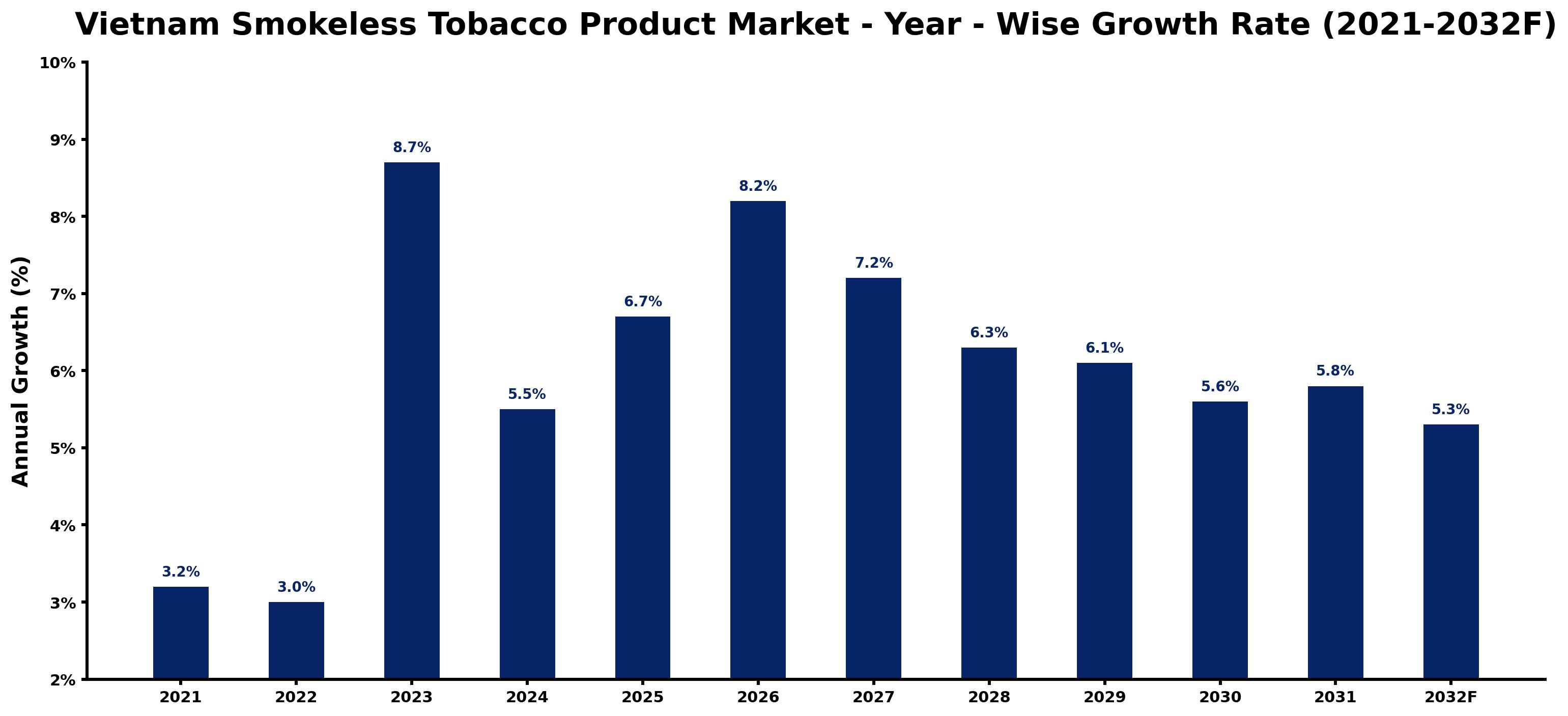
The table below presents the year‑wise growth rates along with the key drivers influencing the market
| Year | Growth Rate | Major Drivers |
| 2021 | 3.2% | Growing renewable energy integration projects |
| 2022 | 3.0% | Growing renewable energy integration projects |
| 2023 | 8.7% | Growing urbanization and commercial development |
| 2024 | 5.5% | Expansion of transportation and logistics networks |
| 2025 | 6.7% | Growing renewable energy integration projects |
| 2026 | 8.2% | Increasing smart city development projects |
| 2027 | 7.2% | Expansion of transportation and logistics networks |
| 2028 | 6.3% | Government infrastructure modernization initiatives |
| 2029 | 6.1% | Government infrastructure modernization initiatives |
| 2030 | 5.6% | Government infrastructure modernization initiatives |
| 2031 | 5.8% | Increasing industrial infrastructure investments |
| 2032 | 5.3% | Increasing industrial infrastructure investments |
Note - Market size estimations and growth projections presented in this report are based on 6Wresearch’s advanced forecasting approach, validated with industry datasets as of June 2026.
Vietnam Smokeless Tobacco Product Market Synopsis
In Vietnam, smokeless tobacco products have established a stronghold, primarily driven by cultural significance and regional consumption preferences. While urban areas show a gradual shift toward healthier alternatives, rural regions maintain a robust demand for traditional tobacco products. This dichotomy exemplifies how deeply rooted these customs are in Vietnamese society.
Despite a backdrop of increasing health awareness and regulatory scrutiny, the market's resilience is notable. Smokeless tobacco products like snuff and chewing tobacco are not only affordable and accessible but also carry a sense of identity for certain consumer groups, which fuels ongoing consumption. The interplay between tradition and modern health consciousness makes this market particularly fascinating.
Vietnam Smokeless Tobacco Product Market Key Takeaways
- Significant cultural relevance continues to drive demand for smokeless tobacco products in Vietnam.
- The market is characterized by a blend of domestic and international manufacturers catering to diverse consumer preferences.
- Increased health awareness presents challenges, but traditional consumption habits remain strong.
- Growing interest in potentially less harmful alternatives like nicotine pouches is shaping consumer behavior.
- The impact of COVID-19 has temporarily altered consumption patterns, prompting shifts towards more health-conscious choices.
Evaluation of Restraints in Vietnam Smokeless Tobacco Product Market
The Vietnam Smokeless Tobacco Product Market is grappling with a myriad of restraints that impede its growth. A heightened awareness of health risks associated with smokeless tobacco use has begun to sway consumer perceptions, leading to a decline in uptake among certain demographics. Regulatory challenges further complicate the landscape, as the government implements stricter tobacco control policies amidst rising public health initiatives. Additionally, competition from emerging alternatives like electronic cigarettes and vaping devices poses a significant threat, as these products are often marketed as less harmful, attracting consumers away from traditional smokeless options. The overall impact of these factors is a cautious consumer base more discerning about their tobacco choices.
Vietnam Smokeless Tobacco Product Market Trends
The market for smokeless tobacco in Vietnam is witnessing notable trends that signal shifting consumer preferences. There is an increasing interest in innovative products, such as nicotine pouches and tobacco-free alternatives, which are perceived as less harmful options. This shift is driven by a younger generation of consumers who are more health-conscious and inclined to explore alternatives that align with their lifestyle choices. Additionally, manufacturers are diversifying product lines to include these alternatives, responding to a growing demand for options that mitigate traditional health risks associated with tobacco consumption.
Vietnam Smokeless Tobacco Product Market Opportunities
Despite the challenges, the Vietnam Smokeless Tobacco Product Market presents numerous opportunities for growth and investment. The increasing interest in tobacco-free alternatives opens doors for innovation within the market. Manufacturers can capitalize on the rising trend of health-conscious consumerism by introducing products that align with this ethos. Furthermore, regional expansion into untapped rural markets where traditional usage remains strong presents a chance for sustained growth. Collaboration with local cultural influencers could also enhance brand loyalty and consumer engagement.
Government Initiatives in the Vietnam Smokeless Tobacco Product Market
The Vietnamese government has taken significant steps to address the health implications associated with tobacco use. Public spending on anti-tobacco campaigns has increased, aiming to educate the populace about the risks linked to tobacco consumption. Initiatives promoting stricter regulations and compliance requirements for tobacco products are also evident, aimed at reducing consumption and protecting public health. These policies are shaping the market landscape, making it essential for manufacturers to adapt to evolving regulatory frameworks while also exploring opportunities for compliance-friendly product innovations.
Future Insights of the Vietnam Smokeless Tobacco Product Market
Looking ahead to the period between 2026 and 2032, the Vietnam Smokeless Tobacco Product Market is poised for dynamic evolution. Cultural factors will continue to play a crucial role, with traditional products maintaining a stronghold in rural areas. However, the growing influence of health awareness and regulatory challenges will drive the market toward innovation, with manufacturers increasingly prioritizing product diversification. As the landscape shifts, opportunities for lower-risk alternatives will proliferate, fundamentally altering consumer preferences and potentially reshaping the smokeless tobacco market as a whole.
Vietnam Smokeless Tobacco Product Market Latest Developments (May 2025 - June 2026)
Recent developments in the Vietnam Smokeless Tobacco Product Market highlight a growing response to consumer demand for lower-risk alternatives. Companies have begun to launch new products that align with health-conscious trends, focusing on formulations that reduce traditional health risks. Additionally, regulatory changes aimed at controlling traditional tobacco use have led to increased investments in marketing strategies that emphasize cultural heritage while promoting newer alternatives. Manufacturers are also exploring partnerships with local retailers to enhance product accessibility, responding to shifts in consumer purchasing behaviors since the COVID-19 pandemic.
Vietnam Smokeless Tobacco Product Market - Key Attractiveness of the Report
- 10 Years of Market Numbers
- Historical Data Starting from 2022 to 2025
- Base Year: 2025
- Forecast Data until 2032
- Key Performance Indicators Impacting the Market
- Major Upcoming Developments and Projects
Key Highlights of the Report:
- Vietnam Smokeless Tobacco Product Market Outlook
- Market Size of Vietnam Smokeless Tobacco Product Market, 2025
- Forecast of Vietnam Smokeless Tobacco Product Market, 2032
- Historical Data and Forecast of Vietnam Smokeless Tobacco Product Revenues & Volume for the Period 2022-2032F
- Vietnam Smokeless Tobacco Product Market Trend Evolution
- Vietnam Smokeless Tobacco Product Market Drivers and Challenges
- Vietnam Smokeless Tobacco Product Price Trends
- Vietnam Smokeless Tobacco Product Porter's Five Forces
- Vietnam Smokeless Tobacco Product Industry Life Cycle
- Historical Data and Forecast of Vietnam Smokeless Tobacco Product Market Revenues & Volume By Product Type for the Period 2022-2032F
- Historical Data and Forecast of Vietnam Smokeless Tobacco Product Market Revenues & Volume By Chewing Tobacco for the Period 2022-2032F
- Historical Data and Forecast of Vietnam Smokeless Tobacco Product Market Revenues & Volume By Snuff for the Period 2022-2032F
- Historical Data and Forecast of Vietnam Smokeless Tobacco Product Market Revenues & Volume By Others for the Period 2022-2032F
- Historical Data and Forecast of Vietnam Smokeless Tobacco Product Market Revenues & Volume By Distribution Channel for the Period 2022-2032F
- Historical Data and Forecast of Vietnam Smokeless Tobacco Product Market Revenues & Volume By Online for the Period 2022-2032F
- Historical Data and Forecast of Vietnam Smokeless Tobacco Product Market Revenues & Volume By Offline for the Period 2022-2032F
- Vietnam Smokeless Tobacco Product Import Export Trade Statistics
- Market Opportunity Assessment By Product Type
- Market Opportunity Assessment By Distribution Channel
- Vietnam Smokeless Tobacco Product Top Companies Market Share
- Vietnam Smokeless Tobacco Product Competitive Benchmarking By Technical and Operational Parameters
- Vietnam Smokeless Tobacco Product Company Profiles
- Vietnam Smokeless Tobacco Product Key Strategic Recommendations






































