Vietnam Traditional Leather Market Size, Share & Growth Rate
The Vietnam Traditional Leather Market was estimated at USD 422 Million in 2025 and is projected to reach USD 598 Million by 2032, growing at a CAGR of 5.1% from 2026 to 2032. This growth trajectory reflects the enduring appreciation for artisanal craftsmanship that characterizes the market. As consumers increasingly seek unique, high-quality products, the blend of traditional techniques with modern aesthetics is likely to attract both domestic and international buyers.
Vietnam Traditional Leather Market Year-wise Growth Rate and Key Drivers
This graph highlights how the Vietnam Traditional Leather Market has steadily grown over the years, supported by major growth factors.
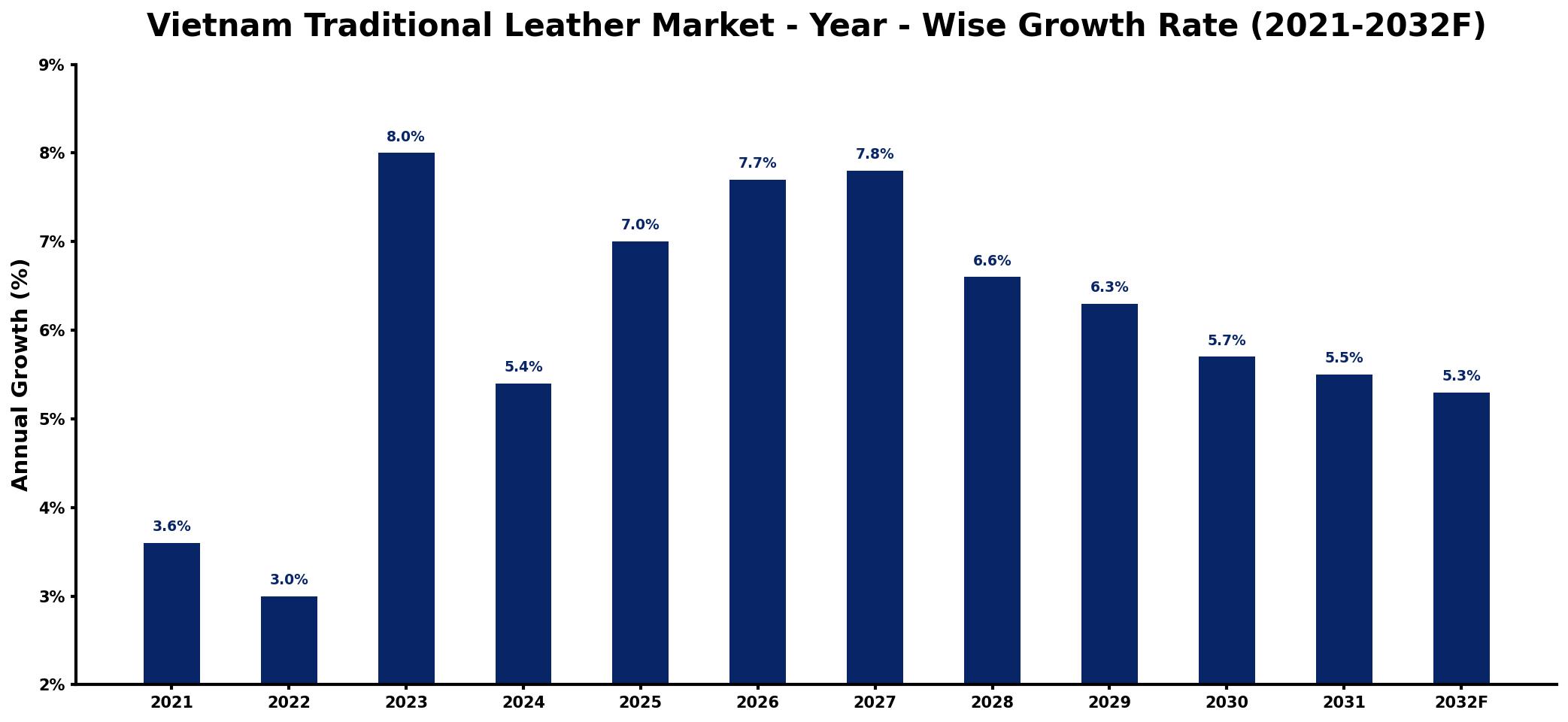
The table below presents the year‑wise growth rates along with the key drivers influencing the market
| Year | Growth Rate | Major Drivers |
| 2021 | 3.6% | Rising consumer spending habits |
| 2022 | 3.0% | Increased exports to Asia |
| 2023 | 8.0% | Growing online shopping platforms |
| 2024 | 5.4% | Expansion of retail outlets |
| 2025 | 7.0% | Investment in sustainable materials |
| 2026 | 7.7% | Boost in domestic tourism sector |
| 2027 | 7.8% | Emergence of artisan workshops |
| 2028 | 6.6% | Strengthening of local craftsmanship |
| 2029 | 6.3% | Adoption of eco-friendly practices |
| 2030 | 5.7% | Growth in fashion collaborations |
| 2031 | 5.5% | Diversification of product offerings |
| 2032 | 5.3% | Enhancement of supply chain efficiency |
Note: Market size estimations and growth projections presented in this report are based on 6Wresearch's proprietary forecasting methodology, utilizing the latest available industry data, government publications, and primary research inputs.
Vietnam Traditional Leather Market Synopsis
The Vietnam traditional leather market stands at a crossroads, balancing the cherished legacy of its artisanal roots with the challenges presented by modern consumerism. While recent trends have highlighted a resurgence in demand for handcrafted leather goods, the future hinges on preserving these traditional practices amidst changing market dynamics.
Despite the pressures from mass-produced alternatives, the markets authentic appeal remains strong. Consumers are increasingly valuing the storytelling aspect behind each handcrafted piece, leading to a sustained interest in unique and culturally rich leather products.
Vietnam Traditional Leather Market Key Takeaways
- Artisanal craftsmanship remains a cornerstone of the market, drawing consumers who appreciate quality and authenticity.
- The evolution of consumer preferences presents both challenges and opportunities for traditional artisans.
- COVID-19 has impacted production and distribution, resulting in shifts towards practical leather goods.
- Efforts to promote traditional craftsmanship are essential to ensure the survival of this rich heritage.
- Niche markets are emerging as potential avenues for growth, allowing artisans to reach new audiences.
Evaluation of Restraints in Vietnam Traditional Leather Market
The primary restraints holding back the Vietnam traditional leather market include the decline in skilled artisans and the pervasive preference for synthetic materials among some consumer segments. While the market boasts a rich history, the advancement of technology and the appeal of lower-cost, mass-produced leather products pose significant threats. The need for increased public awareness and appreciation of traditional techniques is imperative, as is the exploration of educational programs to foster the next generation of artisans.
Vietnam Traditional Leather Market Trends
Emerging trends in the Vietnam traditional leather market showcase a blend of innovation and heritage. There is a growing inclination towards sustainable practices, with consumers preferring eco-friendly leather products. Moreover, the integration of modern design elements into traditional goods has become increasingly prevalent, appealing to a wider audience. Online platforms are also playing a critical role, providing artisans with access to global markets while increasing brand visibility.
Vietnam Traditional Leather Market Opportunities
Genuine growth opportunities within the Vietnam traditional leather market lie in the exploration of niche segments that focus on sustainability and ethical sourcing. Collaborations between artisans and designers can result in innovative products that retain traditional elements while appealing to contemporary tastes. Additionally, expanding e-commerce channels can significantly increase reach, catering to a growing international demand for handcrafted leather goods.
Government Initiatives in the Vietnam Traditional Leather Market
The Vietnamese government has initiated various programs aimed at promoting traditional craftsmanship and supporting local artisans. These initiatives often focus on funding training programs to enhance skills, as well as marketing campaigns that highlight the cultural significance of traditional leather products. Public funding for heritage preservation projects also plays a crucial role in ensuring that artisan communities thrive in the modern economy.
Future Insights of the Vietnam Traditional Leather Market
From 2026 to 2032, the Vietnam traditional leather market is expected to evolve significantly, driven by increasing consumer interest in sustainable practices and authentic craftsmanship. The fusion of modern aesthetics with traditional techniques will likely set a new standard, attracting a diverse consumer base. Market stakeholders who embrace these changes, while advocating for the preservation of artisanal methods, are poised to thrive in this dynamic landscape.
Vietnam Traditional Leather Market Latest Developments (2025 - 2026)
In recent months, the Vietnam traditional leather market has witnessed notable shifts in production strategies as artisans adapt to evolving consumer demands. A surge in collaborative projects between traditional craftsmen and contemporary designers is enhancing product diversity. Additionally, increased efforts in marketing traditional leather goods through digital platforms are gaining momentum, positioning artisans to better engage with a global audience.
Vietnam Traditional Leather Market - Key Attractiveness of the Report
- 10 Years of Market Numbers
- Historical Data Starting from 2022 to 2025
- Base Year: 2025
- Forecast Data until 2032
- Key Performance Indicators Impacting the Market
- Major Upcoming Developments and Projects
Key Highlights of the Report:
- Vietnam Traditional Leather Market Outlook
- Market Size of Vietnam Traditional Leather Market, 2025
- Forecast of Vietnam Traditional Leather Market, 2032
- Historical Data and Forecast of Vietnam Traditional Leather Revenues & Volume for the Period 2022-2032F
- Vietnam Traditional Leather Market Trend Evolution
- Vietnam Traditional Leather Market Drivers and Challenges
- Vietnam Traditional Leather Price Trends
- Vietnam Traditional Leather Porter's Five Forces
- Vietnam Traditional Leather Industry Life Cycle
- Historical Data and Forecast of Vietnam Traditional Leather Market Revenues & Volume By Raw Material for the Period 2022-2032F
- Historical Data and Forecast of Vietnam Traditional Leather Market Revenues & Volume By Bovine for the Period 2022-2032F
- Historical Data and Forecast of Vietnam Traditional Leather Market Revenues & Volume By Goat for the Period 2022-2032F
- Historical Data and Forecast of Vietnam Traditional Leather Market Revenues & Volume By Sheep for the Period 2022-2032F
- Historical Data and Forecast of Vietnam Traditional Leather Market Revenues & Volume By Pig for the Period 2022-2032F
- Historical Data and Forecast of Vietnam Traditional Leather Market Revenues & Volume By Exotic Leather for the Period 2022-2032F
- Historical Data and Forecast of Vietnam Traditional Leather Market Revenues & Volume By Finishing Type for the Period 2022-2032F
- Historical Data and Forecast of Vietnam Traditional Leather Market Revenues & Volume By Aniline for the Period 2022-2032F
- Historical Data and Forecast of Vietnam Traditional Leather Market Revenues & Volume By Semi-aniline for the Period 2022-2032F
- Historical Data and Forecast of Vietnam Traditional Leather Market Revenues & Volume By Pigmented for the Period 2022-2032F
- Historical Data and Forecast of Vietnam Traditional Leather Market Revenues & Volume By Antiqued for the Period 2022-2032F
- Historical Data and Forecast of Vietnam Traditional Leather Market Revenues & Volume By Embossed for the Period 2022-2032F
- Historical Data and Forecast of Vietnam Traditional Leather Market Revenues & Volume By Others for the Period 2022-2032F
- Historical Data and Forecast of Vietnam Traditional Leather Market Revenues & Volume By End-User for the Period 2022-2032F
- Historical Data and Forecast of Vietnam Traditional Leather Market Revenues & Volume By Footwear for the Period 2022-2032F
- Historical Data and Forecast of Vietnam Traditional Leather Market Revenues & Volume By Interior for the Period 2022-2032F
- Historical Data and Forecast of Vietnam Traditional Leather Market Revenues & Volume By Furnishing for the Period 2022-2032F
- Historical Data and Forecast of Vietnam Traditional Leather Market Revenues & Volume By Automobile for the Period 2022-2032F
- Historical Data and Forecast of Vietnam Traditional Leather Market Revenues & Volume By Sporting Goods for the Period 2022-2032F
- Historical Data and Forecast of Vietnam Traditional Leather Market Revenues & Volume By Luxury GoodS for the Period 2022-2032F
- Historical Data and Forecast of Vietnam Traditional Leather Market Revenues & Volume By Wallets Garments for the Period 2022-2032F
- Vietnam Traditional Leather Import Export Trade Statistics
- Market Opportunity Assessment By Raw Material
- Market Opportunity Assessment By Finishing Type
- Market Opportunity Assessment By End-User
- Vietnam Traditional Leather Top Companies Market Share
- Vietnam Traditional Leather Competitive Benchmarking By Technical and Operational Parameters
- Vietnam Traditional Leather Company Profiles
- Vietnam Traditional Leather Key Strategic Recommendations






































