Vietnam Winding Wire Market Size, Share & Growth Rate
The Vietnam Winding Wire Market was estimated at USD 192 Million in 2025 and is projected to reach USD 271 Million by 2032, growing at a CAGR of 5.0% from 2026 to 2032. This upward trajectory is primarily driven by the booming electrical and electronics sectors, where the demand for high-quality winding wires is escalating. The push for energy-efficient solutions and innovative electrical components further fuels the market, encouraging manufacturers to invest in advanced technologies and sustainable materials.
Vietnam Winding Wire Market Year-wise Growth Rate and Key Drivers
This graph highlights how the Vietnam Winding Wire Market has steadily grown over the years, supported by major growth factors.
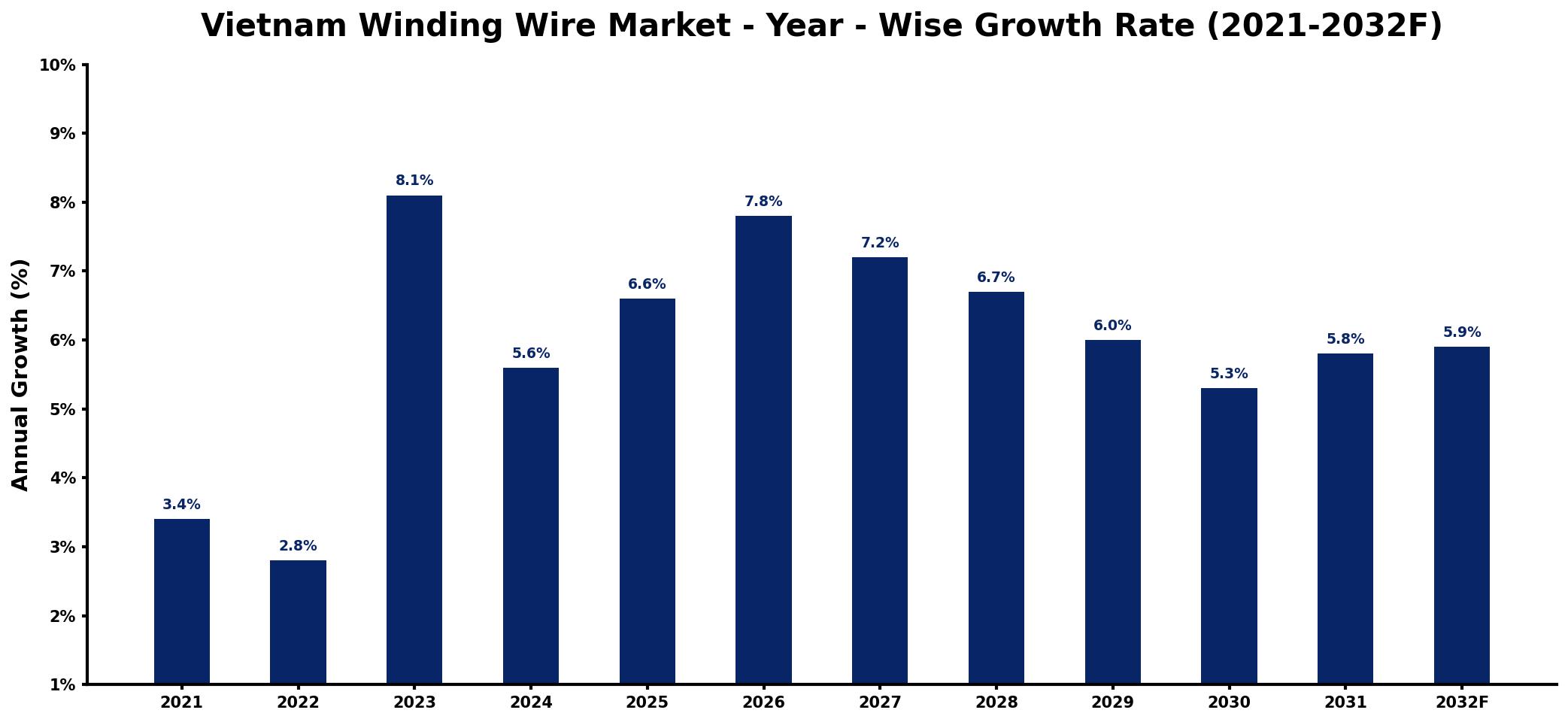
The table below presents the year‑wise growth rates along with the key drivers influencing the market
| Year | Growth Rate | Major Drivers |
| 2021 | 3.4% | Rising demand from automotive sector |
| 2022 | 2.8% | Growth in renewable energy investments |
| 2023 | 8.1% | Expansion of electronics manufacturing facilities |
| 2024 | 5.6% | Increase in construction activities |
| 2025 | 6.6% | Surge in electric vehicle production |
| 2026 | 7.8% | Growing demand for energy efficiency |
| 2027 | 7.2% | Development of smart grid technologies |
| 2028 | 6.7% | Investment in industrial automation projects |
| 2029 | 6.0% | Enhancement of telecommunications infrastructure |
| 2030 | 5.3% | Boost in consumer electronics sales |
| 2031 | 5.8% | expanding healthcare application demand |
| 2032 | 5.9% | Rising focus on sustainable practices |
Note: Market size estimations and growth projections presented in this report are based on 6Wresearch's proprietary forecasting methodology, utilizing the latest available industry data, government publications, and primary research inputs.
Vietnam Winding Wire Market Synopsis
In recent years, the Vietnam winding wire market has witnessed significant momentum, spurred by the rapid growth of the electrical equipment industry. As the market continues to evolve, it is now strategically positioned to leverage technological advancements, enhancing the efficiency and performance of winding wire applications.
Looking ahead, the industry is set to capitalize on emerging opportunities presented by the electric vehicle and renewable energy sectors. These trends not only promise to boost demand but also challenge manufacturers to innovate continuously, ensuring their products meet the growing standards of quality and efficiency.
Vietnam Winding Wire Market Key Takeaways
- The market is experiencing strong growth due to increased demand from electrical and electronics applications.
- Technological advancements in winding wire materials are enhancing performance and conductivity.
- Manufacturers are focusing on eco-friendly solutions to meet regulatory and market demands.
- Emerging industries, such as electric vehicles, present new avenues for growth.
- The market is adapting to post-pandemic dynamics while seeking to overcome supply chain challenges.
Evaluation of Restraints in Vietnam Winding Wire Market
Despite the positive outlook, the Vietnam winding wire market faces several constraints that could impede growth. Competition from alternative conductor materials is intensifying, as industries look for cost-effective and efficient solutions. Additionally, maintaining the quality of winding wires while balancing production costs remains a challenge for manufacturers. Compliance with electrical wiring standards and evolving technology adds another layer of complexity, making it essential for companies to innovate constantly and adapt to changing market requirements.
Vietnam Winding Wire Market Trends
Current trends in the Vietnam winding wire market include a noticeable shift towards the production of high-performance, energy-efficient winding wires. Manufacturers are increasingly adopting advanced materials that improve conductivity while minimizing environmental impact. Moreover, the integration of smart technologies in electrical applications is driving demand for more sophisticated winding wire solutions, which are designed to support the growing complexity of modern electrical systems.
Vietnam Winding Wire Market Opportunities
Opportunities for growth within the Vietnam winding wire market are vast, particularly as industries transition towards renewable energy sources. The rise of electric vehicles offers substantial potential for winding wire manufacturers to supply components critical for efficient motor operation. Furthermore, investments in electrical infrastructure and smart grid technology will likely stimulate demand for high-quality winding wires, ensuring companies that adapt and innovate can capture significant market share.
Government Initiatives in the Vietnam Winding Wire Market
The Vietnamese government has recognized the importance of the electrical sector and is implementing initiatives to bolster the industry. Investments in infrastructure, public spending on renewable energy projects, and incentives for manufacturers adopting eco-friendly practices are shaping the landscape. These policies not only support domestic growth but also attract foreign investment, creating a favorable environment for the winding wire market.
Future Insights of the Vietnam Winding Wire Market
From 2026 to 2032, the Vietnam winding wire market is poised for significant evolution, driven by technological advancements and shifting consumer preferences. The demand for energy-efficient and sustainable electrical solutions will continue to grow, pushing manufacturers to innovate. Additionally, as industries embrace more sophisticated technologies, the need for reliable and high-performance winding wires will become more critical, positioning this market for robust growth.
Vietnam Winding Wire Market Latest Developments (2025 - 2026)
Recent industry developments indicate a strong focus on R&D initiatives aimed at enhancing the efficiency and sustainability of winding wires. Manufacturers are exploring new materials and production techniques that align with global standards for performance and environmental responsibility. There is also a noticeable increase in collaborations and partnerships within the industry to foster innovation and meet evolving market demands.
Vietnam Winding Wire Market - Key Attractiveness of the Report
- 10 Years of Market Numbers
- Historical Data Starting from 2022 to 2025
- Base Year: 2025
- Forecast Data until 2032
- Key Performance Indicators Impacting the Market
- Major Upcoming Developments and Projects
Key Highlights of the Report:
- Vietnam Winding Wire Market Outlook
- Market Size of Vietnam Winding Wire Market, 2025
- Forecast of Vietnam Winding Wire Market, 2032
- Historical Data and Forecast of Vietnam Winding Wire Revenues & Volume for the Period 2022-2032F
- Vietnam Winding Wire Market Trend Evolution
- Vietnam Winding Wire Market Drivers and Challenges
- Vietnam Winding Wire Price Trends
- Vietnam Winding Wire Porter's Five Forces
- Vietnam Winding Wire Industry Life Cycle
- Historical Data and Forecast of Vietnam Winding Wire Market Revenues & Volume By Product for the Period 2022-2032F
- Historical Data and Forecast of Vietnam Winding Wire Market Revenues & Volume By Copper Winding Wire for the Period 2022-2032F
- Historical Data and Forecast of Vietnam Winding Wire Market Revenues & Volume By Aluminum Winding Wire for the Period 2022-2032F
- Vietnam Winding Wire Import Export Trade Statistics
- Market Opportunity Assessment By Product
- Vietnam Winding Wire Top Companies Market Share
- Vietnam Winding Wire Competitive Benchmarking By Technical and Operational Parameters
- Vietnam Winding Wire Company Profiles
- Vietnam Winding Wire Key Strategic Recommendations






































