Vietnam Wood Preservatives Market Size, Share & Growth Rate
The Vietnam Wood Preservatives Market was estimated at USD 296 Million in 2025 and is projected to reach USD 417 Million by 2032, growing at a CAGR of 5.0% from 2026 to 2032. This upward trajectory is primarily driven by the flourishing construction industry in Vietnam, which has significantly increased the demand for treated wood products. Additionally, rising environmental awareness has prompted a shift towards sustainable building practices, further bolstering the need for effective wood preservation solutions.
Vietnam Wood Preservatives Market Year-wise Growth Rate and Key Drivers
This graph highlights how the Vietnam Wood Preservatives Market has steadily grown over the years, supported by major growth factors.
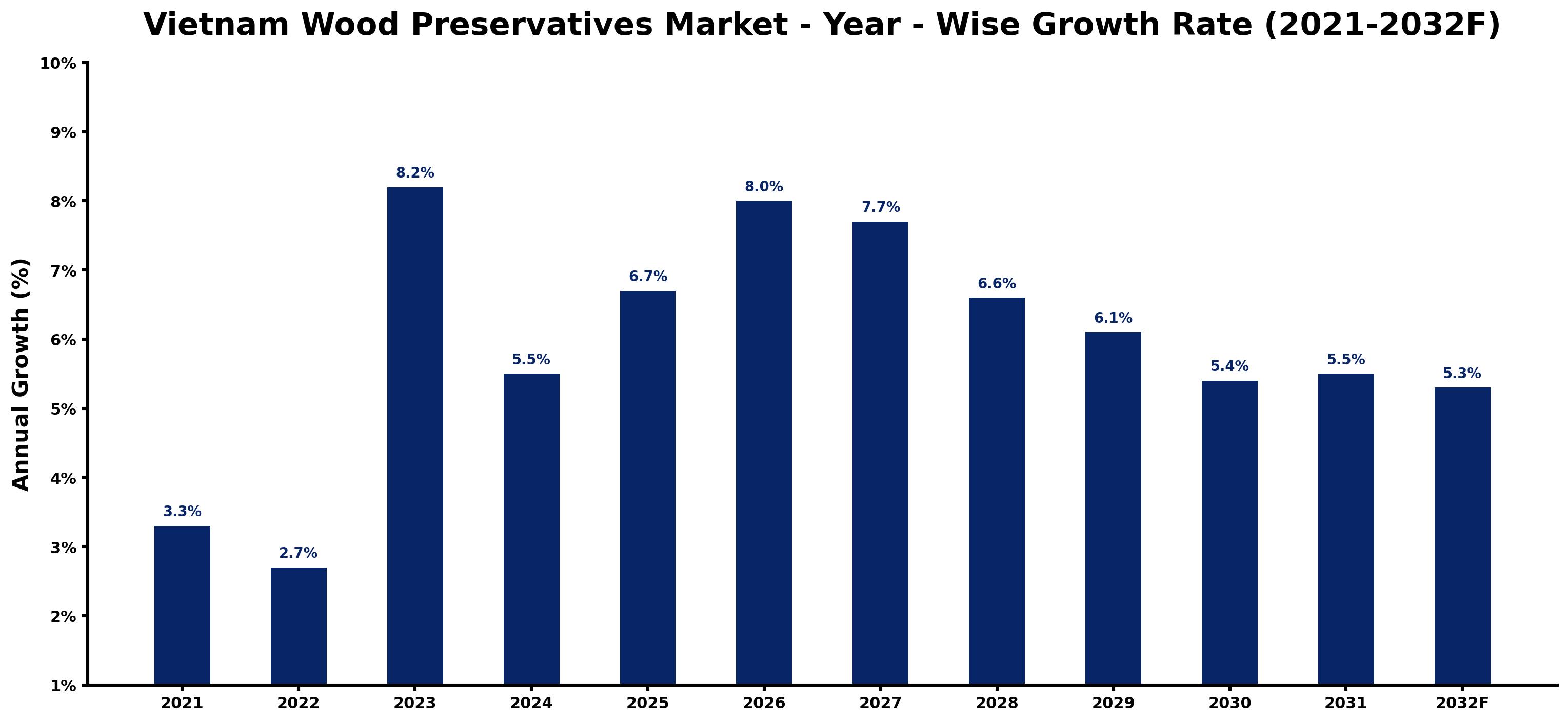
The table below presents the year‑wise growth rates along with the key drivers influencing the market
| Year | Growth Rate | Major Drivers |
| 2021 | 3.3% | Growing urbanization and commercial development |
| 2022 | 2.7% | Expansion of manufacturing activities |
| 2023 | 8.2% | Growing renewable energy integration projects |
| 2024 | 5.5% | Increasing smart city development projects |
| 2025 | 6.7% | Growing renewable energy integration projects |
| 2026 | 8.0% | Growing urbanization and commercial development |
| 2027 | 7.7% | Increasing industrial infrastructure investments |
| 2028 | 6.6% | Increasing adoption of advanced technologies |
| 2029 | 6.1% | Expansion of transportation and logistics networks |
| 2030 | 5.4% | Government infrastructure modernization initiatives |
| 2031 | 5.5% | Government infrastructure modernization initiatives |
| 2032 | 5.3% | Increasing adoption of advanced technologies |
Note - Market size estimations and growth projections presented in this report are based on 6Wresearch’s advanced forecasting approach, validated with industry datasets as of June 2026.
Vietnam Wood Preservatives Market Synopsis
A pivotal force shaping the Vietnam Wood Preservatives Market today is the robust demand stemming from the construction sector. As infrastructure projects continue to expand and modernize, the necessity for durable and treated wood products is becoming increasingly vital. The role of wood preservatives in protecting against decay and pests is crucial in ensuring longevity and reliability in outdoor applications.
Moreover, the growing emphasis on eco-friendly materials has influenced the market dynamics. Consumers are increasingly favoring alternatives to traditional chemical preservatives, leading to a surge in demand for natural and water-based treatments. This shift not only meets consumer preferences but also aligns with regulatory requirements aimed at reducing the environmental footprint of construction practices.
Vietnam Wood Preservatives Market Key Takeaways
- The market is influenced heavily by the expanding construction and infrastructure development in Vietnam.
- There is a strong push for sustainable building practices, with an emphasis on eco-friendly wood preservation solutions.
- Growth in consumer awareness about environmental issues is driving innovation in wood preservative formulations.
- Challenges related to regulatory compliance for traditional chemical preservatives are shaping market offerings.
- The recovery of the construction sector post-pandemic is paving the way for market stabilization and growth.
Evaluation of Restraints in Vietnam Wood Preservatives Market
Despite the positive growth trajectory, the Vietnam Wood Preservatives Market faces several constraints that could hinder its full potential. Stringent environmental regulations surrounding the use of certain chemical preservatives pose a significant challenge. As consumers increasingly gravitate towards eco-friendly options, manufacturers must adapt to the evolving landscape. Moreover, the lingering effects of the COVID-19 pandemic continue to echo through the industry, with supply chain disruptions and shifts in demand patterns impacting production capabilities. The need for innovation in formulation and production methods is critical for navigating these challenges effectively.
Vietnam Wood Preservatives Market Trends
Current trends in the Vietnam Wood Preservatives Market point towards a significant pivot towards sustainable and natural products. Manufacturers are exploring innovative solutions such as bio-based preservatives and advanced water-based coatings to meet consumer demand for greener alternatives. Additionally, the integration of technology in formulation processes is becoming prominent, with a focus on enhancing efficacy while minimizing environmental impact. As builders and contractors adopt more sustainable practices, the demand for efficient, eco-friendly wood protection is anticipated to rise sharply.
Vietnam Wood Preservatives Market Opportunities
Opportunities abound in the Vietnam Wood Preservatives Market, particularly in the realm of product innovation. Companies that can develop high-performance, environmentally friendly preservatives stand to gain a competitive edge. Furthermore, expanding distribution channels to reach untapped regional markets represents a significant growth opportunity. Collaborations with the construction sector to promote the benefits of treated wood in sustainable building projects may also enhance market penetration. As the demand for long-lasting wood protection solutions escalates, investments in research and development will be crucial for future growth.
Government Initiatives in the Vietnam Wood Preservatives Market
The Vietnamese government is actively promoting sustainable development practices, which is beneficial for the wood preservatives market. Initiatives aimed at enhancing environmental protection and sustainable resource management are encouraging the adoption of eco-friendly materials. Public spending on infrastructure projects often includes stipulations for the use of treated wood, further driving demand. Additionally, there are incentives for companies that innovate in eco-friendly technologies, fostering a competitive environment that encourages compliance with sustainability standards.
Future Insights of the Vietnam Wood Preservatives Market
Looking ahead to the period from 2026 to 2032, the Vietnam Wood Preservatives Market is set to evolve significantly. The convergence of sustainability and technological advancement is likely to define the market landscape. Increasing pressure for regulatory compliance will spur innovation, pushing manufacturers to focus on developing advanced, eco-friendly products. As the construction sector rebounds and expands, so too will the opportunities for growth in the wood preservatives market, making it a dynamic area for investment and development.
Vietnam Wood Preservatives Market Latest Developments (May 2025 - June 2026)
Recent developments in the Vietnam Wood Preservatives Market indicate a trend toward increased collaboration between manufacturers and environmental organizations. This partnership aims to foster innovations that prioritize ecological responsibility while maintaining product efficacy. Additionally, major trade exhibitions and industry conferences have spotlighted the latest advancements in wood preservation technologies, providing a platform for knowledge exchange. The market is also seeing a gradual recovery in demand as construction projects regain momentum, leading to renewed confidence among industry stakeholders.
Vietnam Wood Preservatives Market - Key Attractiveness of the Report
- 10 Years of Market Numbers
- Historical Data Starting from 2022 to 2025
- Base Year: 2025
- Forecast Data until 2032
- Key Performance Indicators Impacting the Market
- Major Upcoming Developments and Projects
Key Highlights of the Report:
- Vietnam Wood Preservatives Market Outlook
- Market Size of Vietnam Wood Preservatives Market, 2025
- Forecast of Vietnam Wood Preservatives Market, 2032
- Historical Data and Forecast of Vietnam Wood Preservatives Revenues & Volume for the Period 2022-2032F
- Vietnam Wood Preservatives Market Trend Evolution
- Vietnam Wood Preservatives Market Drivers and Challenges
- Vietnam Wood Preservatives Price Trends
- Vietnam Wood Preservatives Porter's Five Forces
- Vietnam Wood Preservatives Industry Life Cycle
- Historical Data and Forecast of Vietnam Wood Preservatives Market Revenues & Volume By Formulation for the Period 2022-2032F
- Historical Data and Forecast of Vietnam Wood Preservatives Market Revenues & Volume By Water-Based Wood Preservatives for the Period 2022-2032F
- Historical Data and Forecast of Vietnam Wood Preservatives Market Revenues & Volume By Solvent-Based Wood Preservatives for the Period 2022-2032F
- Historical Data and Forecast of Vietnam Wood Preservatives Market Revenues & Volume By Oil-Based Wood Preservatives for the Period 2022-2032F
- Historical Data and Forecast of Vietnam Wood Preservatives Market Revenues & Volume By Application for the Period 2022-2032F
- Historical Data and Forecast of Vietnam Wood Preservatives Market Revenues & Volume By Residential for the Period 2022-2032F
- Historical Data and Forecast of Vietnam Wood Preservatives Market Revenues & Volume By Commercial for the Period 2022-2032F
- Historical Data and Forecast of Vietnam Wood Preservatives Market Revenues & Volume By Industrial for the Period 2022-2032F
- Vietnam Wood Preservatives Import Export Trade Statistics
- Market Opportunity Assessment By Formulation
- Market Opportunity Assessment By Application
- Vietnam Wood Preservatives Top Companies Market Share
- Vietnam Wood Preservatives Competitive Benchmarking By Technical and Operational Parameters
- Vietnam Wood Preservatives Company Profiles
- Vietnam Wood Preservatives Key Strategic Recommendations






































