Algeria Refined Petroleum Products Market Size, Share & Growth Rate
The Algeria Refined Petroleum Products Market was estimated at USD 469 Million in 2025 and is projected to reach USD 636 Million by 2032, growing at a CAGR of 4.4% from 2026 to 2032. This upward trajectory is fueled by increasing domestic demand across transportation, industrial, and residential sectors. Furthermore, the government's push for infrastructure modernization and sustainability initiatives is expected to enhance production efficiency and environmental compliance, contributing to this robust growth.
Algeria Refined Petroleum Products Market Year-wise Growth Rate and Key Drivers
This graph highlights how the Algeria Refined Petroleum Products Market has steadily grown over the years, supported by major growth factors.
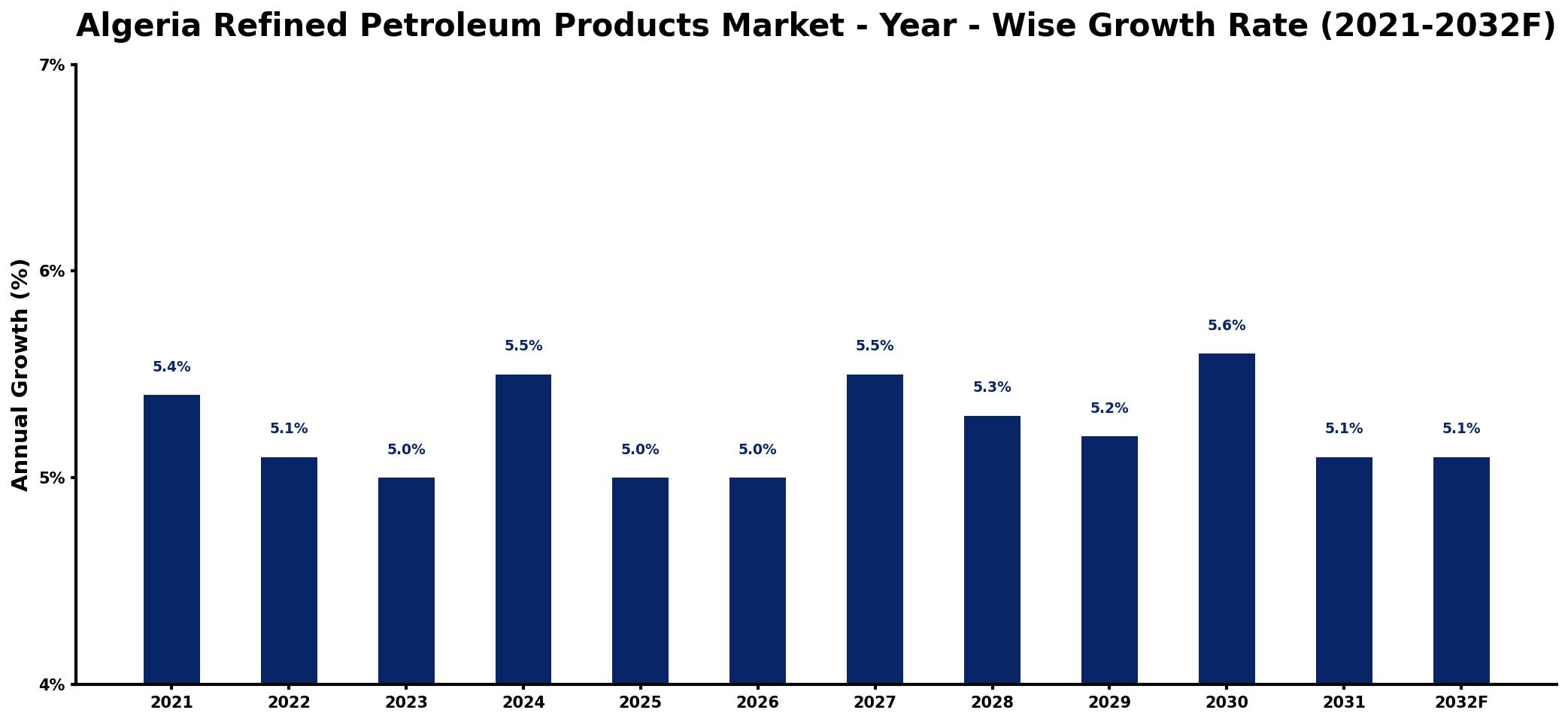
The table below presents the year‑wise growth rates along with the key drivers influencing the market
| Year | Growth Rate | Major Drivers |
| 2021 | 5.4% | Increased domestic energy consumption |
| 2022 | 5.1% | Rising industrial production capacity |
| 2023 | 5.0% | Growing transportation sector demand |
| 2024 | 5.5% | Expansion of renewable energy initiatives |
| 2025 | 5.0% | Boost in foreign investment inflow |
| 2026 | 5.0% | Strengthened infrastructure development projects |
| 2027 | 5.5% | Higher consumer spending trends |
| 2028 | 5.3% | Increased urbanization and population growth |
| 2029 | 5.2% | Growing export opportunities emerging |
| 2030 | 5.6% | Enhanced technological advancements adoption |
| 2031 | 5.1% | growing commercial sector adoption |
| 2032 | 5.1% | Increased government policy support |
Note: Market size estimations and growth projections presented in this report are based on 6Wresearch's proprietary forecasting methodology, utilizing the latest available industry data, government publications, and primary research inputs.
Algeria Refined Petroleum Products Market Synopsis
The most significant force shaping the Algeria refined petroleum products market today is the ongoing modernization of the refining infrastructure, primarily driven by the governments commitment to enhancing energy security. This strategic focus has resulted in initiatives aimed at upgrading existing facilities and increasing production capabilities, thus positioning the country for sustainable growth.
In addition to modernization efforts, Algerias strategic geographical position in North Africa enables it to play a vital role in supplying refined petroleum products to neighboring markets. The interplay between local demand and export opportunities creates a dynamic market landscape, even as challenges like infrastructure deficits and regulatory hurdles remain.
Algeria Refined Petroleum Products Market Key Takeaways
- The market is poised for significant growth, driven by both domestic needs and export opportunities.
- Modernization efforts are essential to enhance the efficiency and quality of refined products.
- Sustainability trends are leading to a shift towards low-sulfur fuels and renewable energy sources.
- The government plays a crucial role through regulation and subsidies, impacting pricing and production.
- Opportunities for strategic partnerships with international firms are on the rise to boost technology and capacity.
Evaluation of Restraints in Algeria Refined Petroleum Products Market
Despite its growth potential, the Algeria refined petroleum products market faces a series of restraints that could impede its progress. Fluctuating global oil prices remain a critical concern, as they can directly impact profitability and investment decisions for local players. Additionally, government subsidies intended to stabilize the market may distort prices and create inefficiencies, complicating the relationship between domestic production and imports. The infrastructure for refining and distribution is currently inadequate, resulting in a continued reliance on imported refined products, which further exposes the market to external shocks and supply chain vulnerabilities.
Algeria Refined Petroleum Products Market Trends
Current trends in the Algeria refined petroleum products market reveal a strong shift toward cleaner energy solutions. The increasing regulatory focus on low-sulfur fuels aligns with global sustainability goals, prompting both consumers and producers to adapt. Additionally, there is a growing interest in digitalization and automation within operations, aimed at enhancing productivity and reducing operational costs. As partnerships with international firms become more common, Algeria is positioning itself to harness advanced technologies and improve overall market efficiency.
Algeria Refined Petroleum Products Market Opportunities
The Algeria refined petroleum products market offers numerous opportunities for investment and growth. With an increasing demand for petroleum products, investors can find potential in modernizing refining infrastructure to meet international standards. Expanding distribution networks, particularly in underserved areas, presents further avenues for development. Additionally, partnerships with local entities can enhance market knowledge and facilitate technology transfer, ultimately boosting production capabilities and efficiency across the sector.
Government Initiatives in the Algeria Refined Petroleum Products Market
The Algerian government actively regulates the refined petroleum products market to stabilize prices and ensure product quality. Price controls are implemented to keep fuel affordable for consumers, while strict quality standards are enforced to maintain safety and performance. Additionally, subsidies are provided to support domestic production, aiming to reduce dependency on imports and bolster local refining capabilities. Through these policies, the government seeks to create a balanced and self-sufficient refined petroleum products market.
Future Insights of the Algeria Refined Petroleum Products Market
Looking ahead to 2026-2032, the Algeria refined petroleum products market is expected to maintain a positive growth trajectory. Increasing industrialization and urbanization in the country will drive demand, particularly as the government continues its efforts to modernize the energy sector. The market's strategic location in North Africa will likely enhance export potential, opening avenues for regional partnerships. Nevertheless, attention must be given to the challenges posed by oil price volatility and evolving regulatory landscapes, which will necessitate proactive planning and investment strategies.
Algeria Refined Petroleum Products Market Latest Developments (2025 - 2026)
Recent developments in the Algeria refined petroleum products market have centered around initiatives to modernize refining infrastructure. Efforts to enhance efficiency and align with international quality standards are underway, driven by government support and investment. There is also a notable increase in partnerships with foreign companies aimed at technology transfer. The focus on cleaner energy and automation in operations continues to gain traction, setting the stage for a more dynamic and resilient market in the near future.
Algeria Refined Petroleum Products Market - Key Attractiveness of the Report
- 10 Years of Market Numbers
- Historical Data Starting from 2022 to 2025
- Base Year: 2025
- Forecast Data until 2032
- Key Performance Indicators Impacting the Market
- Major Upcoming Developments and Projects
Key Highlights of the Report:
- Algeria Refined Petroleum Products Market Outlook
- Market Size of Algeria Refined Petroleum Products Market, 2025
- Forecast of Algeria Refined Petroleum Products Market, 2032
- Historical Data and Forecast of Algeria Refined Petroleum Products Revenues & Volume for the Period 2022-2032F
- Algeria Refined Petroleum Products Market Trend Evolution
- Algeria Refined Petroleum Products Market Drivers and Challenges
- Algeria Refined Petroleum Products Price Trends
- Algeria Refined Petroleum Products Porter's Five Forces
- Algeria Refined Petroleum Products Industry Life Cycle
- Historical Data and Forecast of Algeria Refined Petroleum Products Market Revenues & Volume By Product Type for the Period 2022-2032F
- Historical Data and Forecast of Algeria Refined Petroleum Products Market Revenues & Volume By Diesel for the Period 2022-2032F
- Historical Data and Forecast of Algeria Refined Petroleum Products Market Revenues & Volume By Gasoline for the Period 2022-2032F
- Historical Data and Forecast of Algeria Refined Petroleum Products Market Revenues & Volume By Fuel Oils for the Period 2022-2032F
- Historical Data and Forecast of Algeria Refined Petroleum Products Market Revenues & Volume By Kerosene for the Period 2022-2032F
- Historical Data and Forecast of Algeria Refined Petroleum Products Market Revenues & Volume By Others for the Period 2022-2032F
- Historical Data and Forecast of Algeria Refined Petroleum Products Market Revenues & Volume By Application for the Period 2022-2032F
- Historical Data and Forecast of Algeria Refined Petroleum Products Market Revenues & Volume By Fuel for the Period 2022-2032F
- Historical Data and Forecast of Algeria Refined Petroleum Products Market Revenues & Volume By Chemical for the Period 2022-2032F
- Historical Data and Forecast of Algeria Refined Petroleum Products Market Revenues & Volume By Others for the Period 2022-2032F
- Historical Data and Forecast of Algeria Refined Petroleum Products Market Revenues & Volume By Fraction for the Period 2022-2032F
- Historical Data and Forecast of Algeria Refined Petroleum Products Market Revenues & Volume By Light Distillates for the Period 2022-2032F
- Historical Data and Forecast of Algeria Refined Petroleum Products Market Revenues & Volume By Middle Distillates for the Period 2022-2032F
- Historical Data and Forecast of Algeria Refined Petroleum Products Market Revenues & Volume By Heavy Oils for the Period 2022-2032F
- Algeria Refined Petroleum Products Import Export Trade Statistics
- Market Opportunity Assessment By Product Type
- Market Opportunity Assessment By Application
- Market Opportunity Assessment By Fraction
- Algeria Refined Petroleum Products Top Companies Market Share
- Algeria Refined Petroleum Products Competitive Benchmarking By Technical and Operational Parameters
- Algeria Refined Petroleum Products Company Profiles
- Algeria Refined Petroleum Products Key Strategic Recommendations






































