Argentina Air Traffic Control Market Size, Share & Growth Rate
The Argentina Air Traffic Control Market was estimated at USD 399 Million in 2025 and is projected to reach USD 669 Million by 2032, growing at a CAGR of 7.7% from 2026 to 2032. This growth trajectory is primarily driven by rising air traffic volumes, the urgent need for technological modernization, and significant government investment in infrastructure. As Argentinas aviation sector continues to evolve, enhancing airspace management will be crucial in addressing future demands.
Argentina Air Traffic Control Market Year-wise Growth Rate and Key Drivers
This graph highlights how the Argentina Air Traffic Control Market has steadily grown over the years, supported by major growth factors.
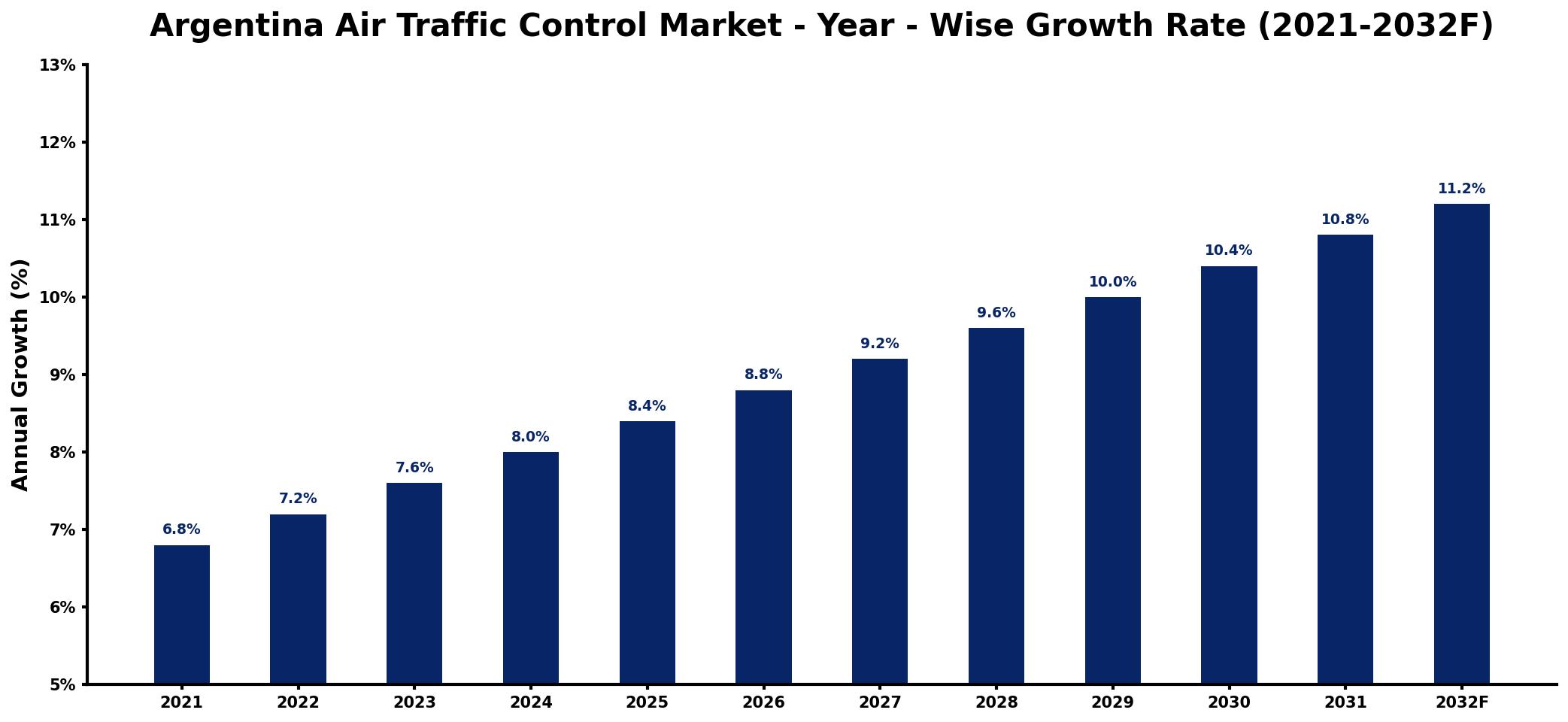
The table below presents the year‑wise growth rates along with the key drivers influencing the market
| Year | Growth Rate | Major Drivers |
| 2021 | 6.8% | Increased investment in infrastructure |
| 2022 | 7.2% | Rising demand for efficiency |
| 2023 | 7.6% | Expansion of international routes |
| 2024 | 8.0% | Growth in tourism sector |
| 2025 | 8.4% | Technological advancements in navigation |
| 2026 | 8.8% | Higher passenger volume forecasts |
| 2027 | 9.2% | Demand for safety enhancements |
| 2028 | 9.6% | Regional economic recovery momentum |
| 2029 | 10.0% | Integration of smart technologies |
| 2030 | 10.4% | Emergence of new carriers |
| 2031 | 10.8% | Increased focus on sustainability |
| 2032 | 11.2% | Development of urban mobility solutions |
Note: Market size estimations and growth projections presented in this report are based on 6Wresearch's proprietary forecasting methodology, utilizing the latest available industry data, government publications, and primary research inputs.
Argentina Air Traffic Control Market Synopsis
Recent observations reveal that the Argentina Air Traffic Control Market is at a pivotal point of transformation, marked by an increasing emphasis on safety and efficiency. The modernization of air traffic control systems is essential as air travel demand surges, compelling stakeholders to seek advanced solutions.
Currently, the market is characterized by a dynamic interplay between government oversight and private sector innovation. As regulatory frameworks evolve, collaboration among entities is expected to enhance operational efficiency and safety standards, thereby ensuring compliance with international aviation norms.
Argentina Air Traffic Control Market Key Takeaways
- The Argentina Air Traffic Control Market is set for significant growth, driven by increasing air traffic and modernization efforts.
- Technological advancements, such as automation and AI, are pivotal in improving air traffic management capabilities.
- Investment opportunities abound in infrastructure upgrades and the development of eco-friendly air traffic solutions.
- Government policies are focused on enhancing safety, efficiency, and compliance with global aviation standards.
- There is a notable trend towards sustainable practices in air traffic control operations.
Evaluation of Restraints in Argentina Air Traffic Control Market
Despite its growth prospects, the Argentina Air Traffic Control Market faces several restraints that hinder its full potential. Outdated infrastructure and insufficient investment in modern technology are primary concerns, often leading to inefficiencies in air traffic management. The reliance on aging radar systems and communication equipment poses significant challenges to safety and operational efficiency. Furthermore, a shortage of skilled air traffic controllers exacerbates these issues, leading to potential delays and safety risks. Addressing these restraints will necessitate substantial investments and innovative solutions to upgrade the air traffic control framework effectively.
Argentina Air Traffic Control Market Trends
The trend towards modernization and digitalization is reshaping the Argentina Air Traffic Control Market. The adoption of advanced technologies, including automation and artificial intelligence, is becoming increasingly common in managing air traffic. This shift not only aims to enhance operational efficiency but also to improve safety standards. Furthermore, there is a growing emphasis on sustainable practices, leading to the development of eco-friendly solutions in air traffic control operations. Collaborative efforts among industry players are also on the rise, streamlining operations while ensuring compliance with evolving regulations.
Argentina Air Traffic Control Market Opportunities
The Argentina Air Traffic Control Market presents numerous investment opportunities, primarily driven by the increasing demand for efficient air traffic management services. Investors can focus on upgrading existing technology systems, implementing automation solutions, and enhancing communication networks to improve overall efficiency and safety. Moreover, partnering with local authorities and aviation stakeholders can create avenues for innovative solution development, addressing the evolving needs of the market. Such investments not only promise returns but also contribute to the long-term modernization of Argentinas aviation infrastructure.
Government Initiatives in the Argentina Air Traffic Control Market
The Argentine Civil Aviation Authority (ANAC) plays a crucial role in regulating the air traffic control market, overseeing the management and operation of services throughout the nation. The government has implemented several initiatives aimed at enhancing safety, efficiency, and modernization of the air traffic control system. By focusing on advanced technology utilization and comprehensive training programs for air traffic controllers, the government seeks to align Argentinas air traffic management practices with international standards. Collaborations with global aviation authorities are also a key element of the government's strategy, designed to facilitate improvements across the sector.
Future Insights of the Argentina Air Traffic Control Market
Looking ahead, the Argentina Air Traffic Control Market is poised for steady growth as it adapts to increasing air travel demands and modernizes its aviation infrastructure. The government's commitment to improving safety and operational efficiency will be a driving force behind market expansion. Technological innovations, such as advanced communication, navigation, and surveillance systems, are expected to significantly enhance the capabilities of air traffic control in the country. Moreover, the expansion of airports and the emergence of low-cost carriers will further contribute to the market's development, promising a landscape rich with opportunities.
Argentina Air Traffic Control Market Latest Developments (2025 - 2026)
Recent developments in the Argentina Air Traffic Control Market indicate a strong focus on technological advancements and infrastructural upgrades. Industry stakeholders are increasingly exploring partnerships aimed at enhancing air traffic management systems. Additionally, new regulatory initiatives are being introduced to better align local practices with international standards. These shifts signal a robust commitment to modernization within the sector, setting the stage for improved operational efficiency and safety in the near future.
Argentina Air Traffic Control Market - Key Attractiveness of the Report
- 10 Years of Market Numbers
- Historical Data Starting from 2022 to 2025
- Base Year: 2025
- Forecast Data until 2032
- Key Performance Indicators Impacting the Market
- Major Upcoming Developments and Projects
Key Highlights of the Report:
- Argentina Air Traffic Control Market Outlook
- Market Size of Argentina Air Traffic Control Market, 2025
- Forecast of Argentina Air Traffic Control Market, 2032
- Historical Data and Forecast of Argentina Air Traffic Control Revenues & Volume for the Period 2022-2032F
- Argentina Air Traffic Control Market Trend Evolution
- Argentina Air Traffic Control Market Drivers and Challenges
- Argentina Air Traffic Control Price Trends
- Argentina Air Traffic Control Porter's Five Forces
- Argentina Air Traffic Control Industry Life Cycle
- Historical Data and Forecast of Argentina Air Traffic Control Market Revenues & Volume By Airspace for the Period 2022-2032F
- Historical Data and Forecast of Argentina Air Traffic Control Market Revenues & Volume By Air Route Traffic Control Centers for the Period 2022-2032F
- Historical Data and Forecast of Argentina Air Traffic Control Market Revenues & Volume By Terminal Radar Approach Control for the Period 2022-2032F
- Historical Data and Forecast of Argentina Air Traffic Control Market Revenues & Volume By Air Traffic Control Tower for the Period 2022-2032F
- Historical Data and Forecast of Argentina Air Traffic Control Market Revenues & Volume By Remote Tower for the Period 2022-2032F
- Historical Data and Forecast of Argentina Air Traffic Control Market Revenues & Volume By Application for the Period 2022-2032F
- Historical Data and Forecast of Argentina Air Traffic Control Market Revenues & Volume By Communication for the Period 2022-2032F
- Historical Data and Forecast of Argentina Air Traffic Control Market Revenues & Volume By Navigation for the Period 2022-2032F
- Historical Data and Forecast of Argentina Air Traffic Control Market Revenues & Volume By Surveillance for the Period 2022-2032F
- Historical Data and Forecast of Argentina Air Traffic Control Market Revenues & Volume By Automation for the Period 2022-2032F
- Historical Data and Forecast of Argentina Air Traffic Control Market Revenues & Volume By Offerings for the Period 2022-2032F
- Historical Data and Forecast of Argentina Air Traffic Control Market Revenues & Volume By Hardware for the Period 2022-2032F
- Historical Data and Forecast of Argentina Air Traffic Control Market Revenues & Volume By Software & Solutions for the Period 2022-2032F
- Historical Data and Forecast of Argentina Air Traffic Control Market Revenues & Volume By Services for the Period 2022-2032F
- Historical Data and Forecast of Argentina Air Traffic Control Market Revenues & Volume By Airport Size for the Period 2022-2032F
- Historical Data and Forecast of Argentina Air Traffic Control Market Revenues & Volume By Large for the Period 2022-2032F
- Historical Data and Forecast of Argentina Air Traffic Control Market Revenues & Volume By Medium for the Period 2022-2032F
- Historical Data and Forecast of Argentina Air Traffic Control Market Revenues & Volume By Small for the Period 2022-2032F
- Historical Data and Forecast of Argentina Air Traffic Control Market Revenues & Volume By Sector for the Period 2022-2032F
- Historical Data and Forecast of Argentina Air Traffic Control Market Revenues & Volume By Commercial for the Period 2022-2032F
- Historical Data and Forecast of Argentina Air Traffic Control Market Revenues & Volume By Military & Defense for the Period 2022-2032F
- Argentina Air Traffic Control Import Export Trade Statistics
- Market Opportunity Assessment By Airspace
- Market Opportunity Assessment By Application
- Market Opportunity Assessment By Offerings
- Market Opportunity Assessment By Airport Size
- Market Opportunity Assessment By Sector
- Argentina Air Traffic Control Top Companies Market Share
- Argentina Air Traffic Control Competitive Benchmarking By Technical and Operational Parameters
- Argentina Air Traffic Control Company Profiles
- Argentina Air Traffic Control Key Strategic Recommendations






































