Argentina Cyber Security Market Size & Growth Rate (2026-2032)
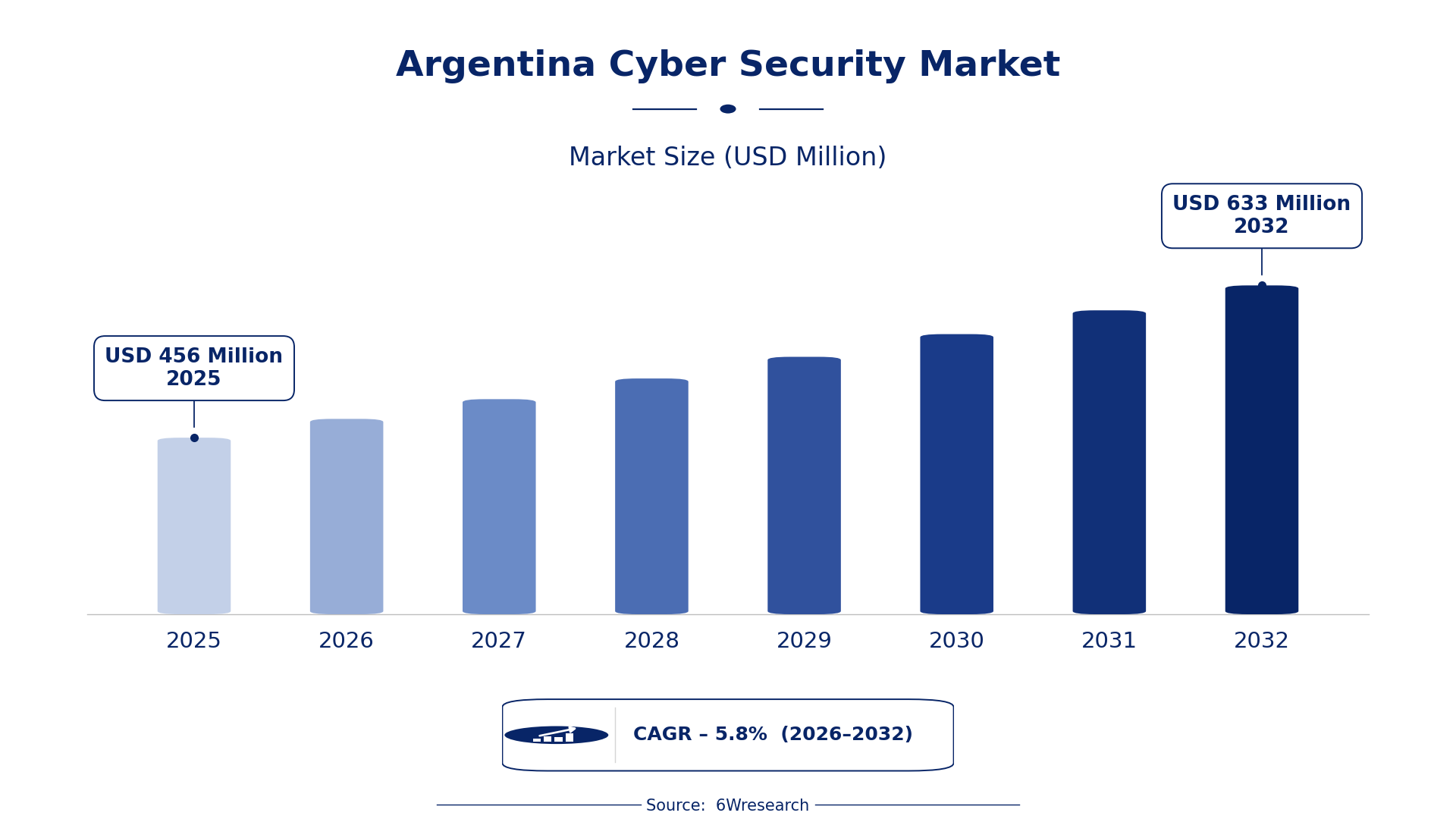
The Argentina Cyber Security Market was estimated at USD 456 Million in 2025 and is projected to reach USD 633 Million by 2032, growing at a CAGR of 5.8% from 2026 to 2032.
Argentina Cyber Security Market Synopsis
The demand for advanced cybersecurity solutions in Argentina is escalating as businesses increasingly move towards digital platforms. This shift is compelling organizations to fortify their defenses against a rising tide of cyber threats, while also ensuring compliance with emerging regulations.
The Argentine government is actively enhancing its cybersecurity framework, which further fuels market growth. Initiatives aimed at improving national cybersecurity infrastructure and promoting public-private partnerships are vital to establishing a more resilient digital environment.
Argentina Cyber Security Market Year-wise Growth Rate and Key Drivers
This graph illustrates the annual growth rates of the Argentina Cyber Security Market from 2021 to 2032, highlighting a steady upward trajectory and projected expansion over the forecast period.
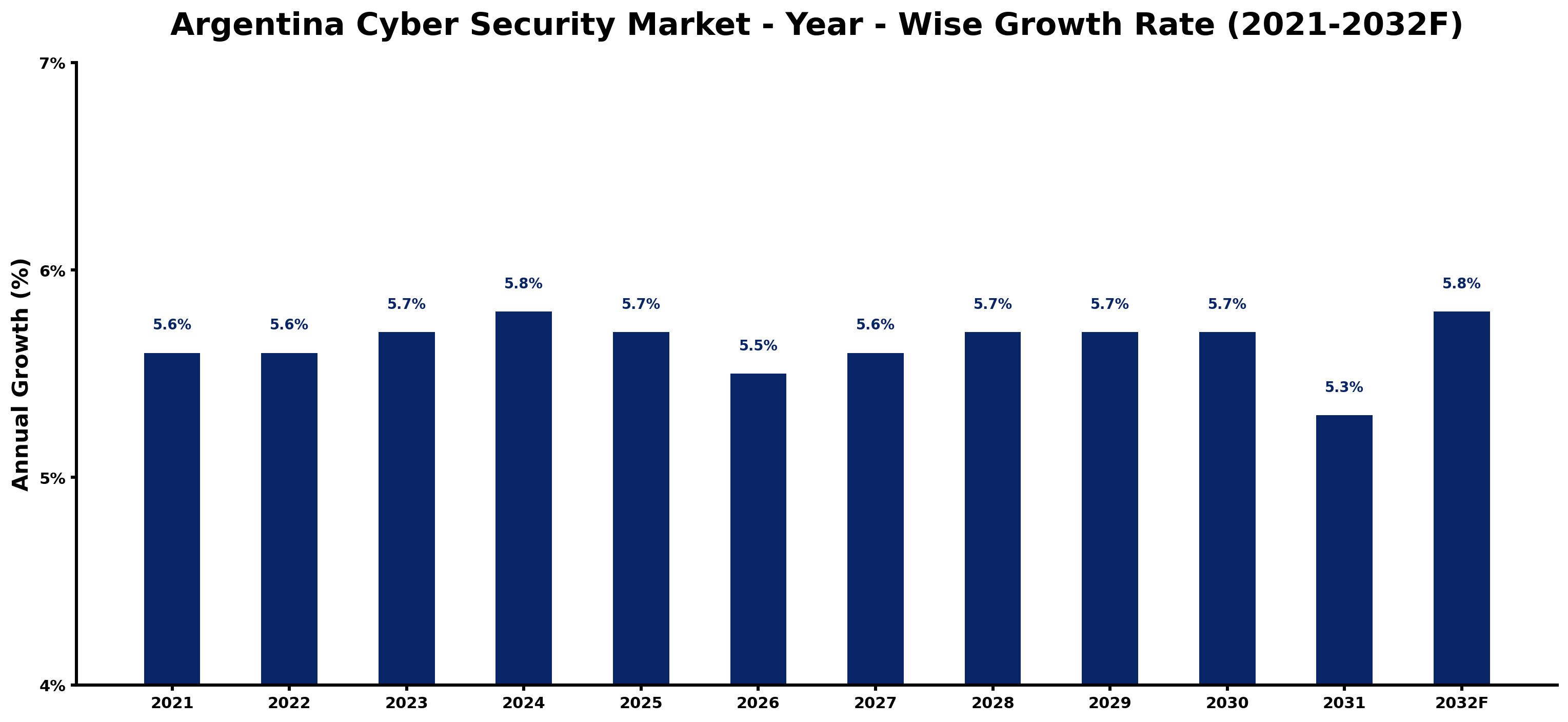
The table below presents the year‑wise growth rates along with the key drivers influencing the market
| Year | Growth Rate | Major Drivers |
| 2021 | 5.6% | Increased cybersecurity regulations from Argentina's Central Bank. |
| 2022 | 5.6% | Growing adoption of e-commerce driving security needs. |
| 2023 | 5.7% | Government's enhanced cybersecurity strategy implementation initiatives. |
| 2024 | 5.8% | Rising cyber threats prompting demand for robust defenses. |
| 2025 | 5.7% | Investment in digital identity verification compliance mandates. |
| 2026 | 5.5% | Surge in remote working fueling data protection requirements. |
| 2027 | 5.6% | Regulatory focus on protecting personal data privacy. |
| 2028 | 5.7% | Emergence of local cyber security startups driving innovation. |
| 2029 | 5.7% | International partnerships bolstering local cybersecurity capacities. |
| 2030 | 5.7% | Increased awareness of ransomware threats enhancing demand. |
| 2031 | 5.3% | National education programs promoting cybersecurity literacy growth. |
| 2032 | 5.8% | Adoption of cloud services necessitating improved security measures. |
Note: Market size estimations and growth projections presented in this report are based on 6Wresearch's proprietary forecasting methodology, utilizing the latest available industry data, government publications, and primary research inputs.
Argentina Cyber Security Market Key Takeaways
Below are some of the specific key takeaways from the market, including:
- Rising internet penetration and digital transformation are primary growth drivers.
- The government is implementing policies to bolster national cybersecurity standards.
- Investment in advanced technologies like AI for threat detection is on the rise.
- Local startups are emerging, diversifying the solutions available in the market.
- Data privacy concerns are leading businesses to prioritize cybersecurity measures.
Evaluation of Restraints in Argentina Cyber Security Market
A significant challenge facing the Argentina Cyber Security Market is the insufficient awareness among many businesses regarding the critical importance of cybersecurity. Many companies struggle with limited financial resources necessary for implementing robust security frameworks. Furthermore, a talent shortage in the cybersecurity sector hampers efforts to establish adequate defenses against ever-more sophisticated cyber threats. Lastly, the current government regulations may not enforce compliance strictly enough, allowing vulnerabilities to persist within organizations.
Argentina Cyber Security Market Trends
The Argentina Cyber Security Market is characterized by a growing emphasis on data privacy and protection, as organizations invest in sophisticated security solutions. The increasing prevalence of remote work has heightened the need for secure connectivity options, driving demand for secure access service edge (SASE) platforms. Additionally, compliance requirements from various regulatory bodies have prompted organizations to enhance their cybersecurity measures significantly. This trend highlights a shift towards proactive strategies to effectively combat evolving cyber threats.
Argentina Cyber Security Market Opportunities
The surge in digital technologies opens numerous investment avenues within the Argentina Cyber Security Market. Notably, there's a strong demand for cybersecurity software development, threat intelligence, and consulting services. The Argentine government's commitment to strengthening cybersecurity offers a favorable regulatory landscape for firms entering this sector. Innovative technologies like AI-driven solutions and cloud security present compelling growth prospects, signaling a substantial return on investment for stakeholders.
Government Initiatives in the Argentina Cyber Security Market
The Argentine government is taking concerted steps to bolster its cybersecurity posture through a variety of initiatives. With a focus on enhancing public safety and economic stability, these policies are designed to protect critical infrastructure and personal data. The implementation of such initiatives is crucial, particularly as the country navigates increased cyber threats.
- A recently launched National Cybersecurity Strategy aimed at fortifying critical infrastructure against cyber threats.
- Current initiatives by the National Cybersecurity Agency (ANSes) focus on improving coordination across sectors.
- A planned regulatory framework to establish data privacy standards expected to be introduced by 2026.
- Public-private partnerships being developed to enhance training and resource allocation for cybersecurity professionals.
- A national campaign promoting cybersecurity awareness and education, currently in its rollout phase.
Future Insights of the Argentina Cyber Security Market
Looking ahead to 2026-2032, the Argentina Cyber Security Market is positioned for robust growth. As cyber threats intensify and regulatory measures become more stringent, organizations are expected to prioritize cybersecurity investment significantly. The integration of advanced technologies such as artificial intelligence and machine learning will likely become standard practice for threat detection and response. Increasing awareness of cybersecurity’s importance among businesses will further drive demand, setting the stage for a market flourishing with opportunity.
Argentina Cyber Security Market Latest Developments
In the past year, the Argentina Cyber Security Market has seen a flurry of activity, characterized by increased collaborations between government entities and the private sector. This collaboration is essential for addressing the pressing cybersecurity needs across industries. As businesses continue to adopt digital solutions, the focus on effective cybersecurity strategies has intensified.
- A major technology vendor launched a comprehensive cloud security solution aimed at small and medium-sized enterprises, which started its rollout in early 2025.
- An ongoing initiative by the government to enhance cybersecurity training programs for local IT professionals is currently underway.
- In late 2025, a partnership was established between several key players to promote best practices for cybersecurity across various sectors.
- An upcoming initiative aims to develop a cybersecurity awareness campaign scheduled to begin in mid-2026.
- A cybersecurity software firm announced plans for a regional expansion expected to commence in Q3 2026, targeting underserved areas.
Argentina Cyber Security Market - Key Attractiveness of the Report
- 10 Years of Market Numbers
- Historical Data Starting from 2022 to 2025
- Base Year: 2025
- Forecast Data until 2032
- Key Performance Indicators Impacting the Market
- Major Upcoming Developments and Projects
Key Highlights of the Report:
- Argentina Cyber Security Market Outlook
- Market Size of Argentina Cyber Security Market, 2025
- Forecast of Argentina Cyber Security Market, 2032
- Historical Data and Forecast of Argentina Cyber Security Revenues & Volume for the Period 2022-2032F
- Argentina Cyber Security Market Trend Evolution
- Argentina Cyber Security Market Drivers and Challenges
- Argentina Cyber Security Price Trends
- Argentina Cyber Security Porter's Five Forces
- Argentina Cyber Security Industry Life Cycle
- Historical Data and Forecast of Argentina Cyber Security Market Revenues & Volume By Component for the Period 2022-2032F
- Historical Data and Forecast of Argentina Cyber Security Market Revenues & Volume By Software for the Period 2022-2032F
- Historical Data and Forecast of Argentina Cyber Security Market Revenues & Volume By Hardware for the Period 2022-2032F
- Historical Data and Forecast of Argentina Cyber Security Market Revenues & Volume By Services for the Period 2022-2032F
- Historical Data and Forecast of Argentina Cyber Security Market Revenues & Volume By Software for the Period 2022-2032F
- Historical Data and Forecast of Argentina Cyber Security Market Revenues & Volume By IAM for the Period 2022-2032F
- Historical Data and Forecast of Argentina Cyber Security Market Revenues & Volume By Antivirus/Antimalware for the Period 2022-2032F
- Historical Data and Forecast of Argentina Cyber Security Market Revenues & Volume By Log Management and SIEM for the Period 2022-2032F
- Historical Data and Forecast of Argentina Cyber Security Market Revenues & Volume By Encryption and Tokenization for the Period 2022-2032F
- Historical Data and Forecast of Argentina Cyber Security Market Revenues & Volume By Compliance and Policy Management for the Period 2022-2032F
- Historical Data and Forecast of Argentina Cyber Security Market Revenues & Volume By Patch Management for the Period 2022-2032F
- Historical Data and Forecast of Argentina Cyber Security Market Revenues & Volume By Other Software for the Period 2022-2032F
- Historical Data and Forecast of Argentina Cyber Security Market Revenues & Volume By Security Type for the Period 2022-2032F
- Historical Data and Forecast of Argentina Cyber Security Market Revenues & Volume By Network Security for the Period 2022-2032F
- Historical Data and Forecast of Argentina Cyber Security Market Revenues & Volume By Cloud Security for the Period 2022-2032F
- Historical Data and Forecast of Argentina Cyber Security Market Revenues & Volume By Application Security for the Period 2022-2032F
- Historical Data and Forecast of Argentina Cyber Security Market Revenues & Volume By Endpoint and IoT Security for the Period 2022-2032F
- Historical Data and Forecast of Argentina Cyber Security Market Revenues & Volume By Deployment Mode for the Period 2022-2032F
- Historical Data and Forecast of Argentina Cyber Security Market Revenues & Volume By Cloud for the Period 2022-2032F
- Historical Data and Forecast of Argentina Cyber Security Market Revenues & Volume By On-premises for the Period 2022-2032F
- Historical Data and Forecast of Argentina Cyber Security Market Revenues & Volume By Organization Size for the Period 2022-2032F
- Historical Data and Forecast of Argentina Cyber Security Market Revenues & Volume By Large Enterprises for the Period 2022-2032F
- Historical Data and Forecast of Argentina Cyber Security Market Revenues & Volume By SMEs for the Period 2022-2032F
- Historical Data and Forecast of Argentina Cyber Security Market Revenues & Volume By Vertical for the Period 2022-2032F
- Historical Data and Forecast of Argentina Cyber Security Market Revenues & Volume By Aerospace and Defense for the Period 2022-2032F
- Historical Data and Forecast of Argentina Cyber Security Market Revenues & Volume By BFSI for the Period 2022-2032F
- Historical Data and Forecast of Argentina Cyber Security Market Revenues & Volume By IT and ITeS for the Period 2022-2032F
- Historical Data and Forecast of Argentina Cyber Security Market Revenues & Volume By Telecommunication for the Period 2022-2032F
- Historical Data and Forecast of Argentina Cyber Security Market Revenues & Volume By Energy and Utilities for the Period 2022-2032F
- Historical Data and Forecast of Argentina Cyber Security Market Revenues & Volume By Retail and eCommerce for the Period 2022-2032F
- Historical Data and Forecast of Argentina Cyber Security Market Revenues & Volume By Healthcare for the Period 2022-2032F
- Historical Data and Forecast of Argentina Cyber Security Market Revenues & Volume By Transportation and Logistics for the Period 2022-2032F
- Argentina Cyber Security Import Export Trade Statistics
- Market Opportunity Assessment By Component
- Market Opportunity Assessment By Software
- Market Opportunity Assessment By Security Type
- Market Opportunity Assessment By Deployment Mode
- Market Opportunity Assessment By Organization Size
- Market Opportunity Assessment By Vertical
- Argentina Cyber Security Top Companies Market Share
- Argentina Cyber Security Competitive Benchmarking By Technical and Operational Parameters
- Argentina Cyber Security Company Profiles
- Argentina Cyber Security Key Strategic Recommendations






































