Argentina Precast Concrete Market Size Growth Rate
The Argentina Precast Concrete Market is projected to witness mixed growth rate patterns during 2025 to 2029. Although the growth rate starts strong at -0.00% in 2025, it steadily loses momentum, ending at -0.00% by 2029.
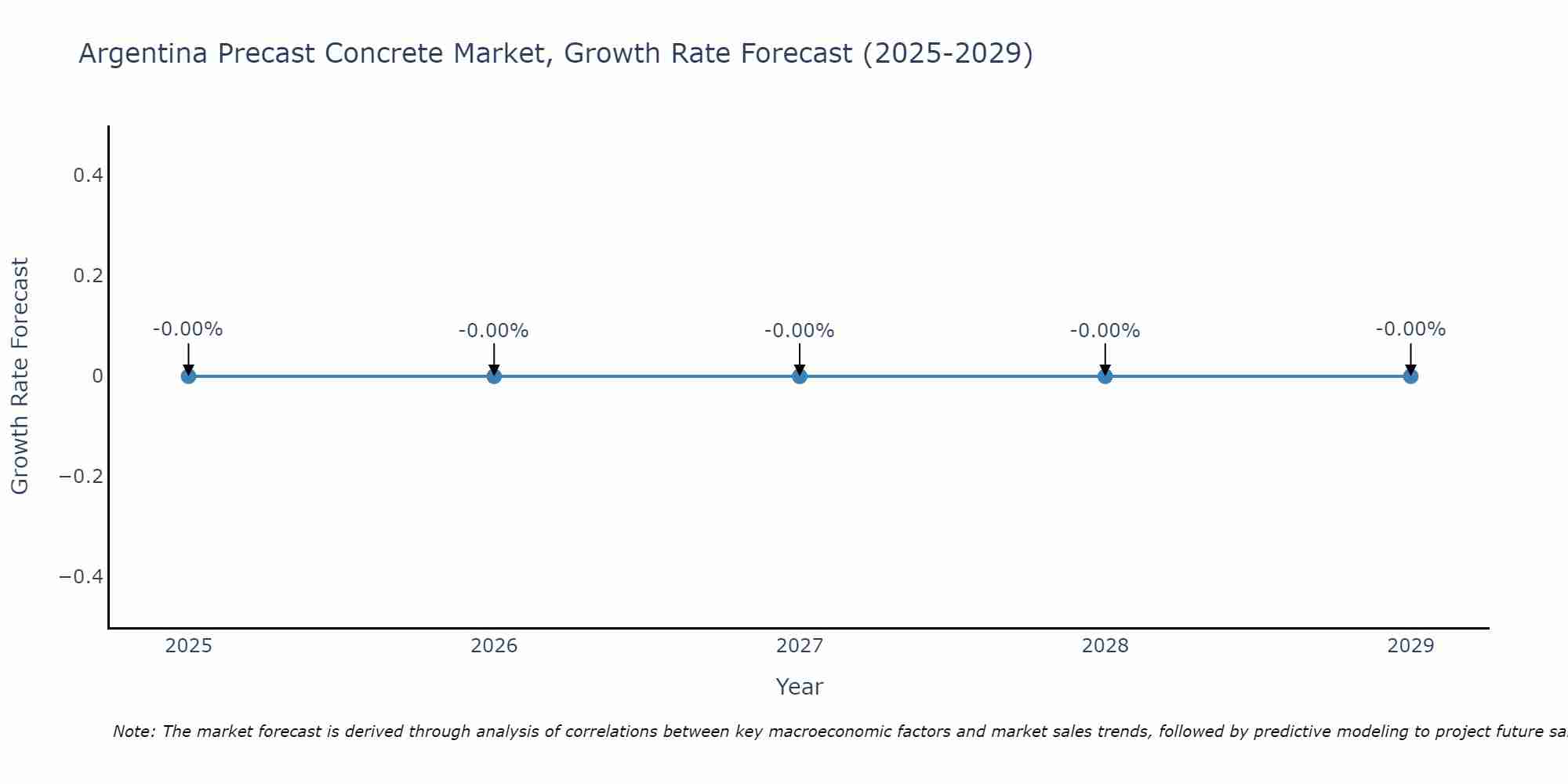
Argentina Precast Concrete Market Growth Rate
According to 6Wresearch internal database and industry insights, the Argentina Precast Concrete Market is projected to grow at a compound annual growth rate (CAGR) of 8.3% during the forecast period (2026-2032).
Topics Covered in the Argentina Precast Concrete Market Report
The Argentina Precast Concrete Market report thoroughly covers the market by product and end-use. The market report provides an unbiased and detailed analysis of ongoing market trends, opportunities/high growth areas, and market drivers, which help stakeholders devise and align their market strategies according to the current and future market dynamics.
Argentina Precast Concrete Market Highlights
| Report Name | Argentina Precast Concrete Market |
| Forecast period | 2026-2032 |
| CAGR | 8.3% |
| Growing Sector | Infrastructure & Non-Residential Construction |
Argentina Precast Concrete Market Synopsis
Argentina Precast Concrete Market is anticipated to record notable growth owing to rising demands for rapid and cost-effective construction processes, coupled with the introduction of infrastructure development projects. Prefabricated building segments are becoming popular among residential, commercial, and industrial sectors owing to their shorter construction time and quality construction material used. Moreover, the involvement of the government in urbanization and infrastructure projects has been instrumental in spurring demand. Increasing knowledge about green building construction materials and the development of real estate activities have been driving growth within the country of Argentina.
Evaluation of Growth Drivers in the Argentina Precast Concrete Market
Below mentioned are some prominent drivers and their influence on the market dynamics:
| Drivers | Primary Segments Affected | Why it Matters (Evidence) |
| Infrastructure Development Projects | Transportation Products; Infrastructure | Government investments increase demand for precast solutions |
| Rising Urbanization | Structural Components; Residential | Growing population drives housing construction |
| Demand for Cost-Effective Construction | All Products; Non-Residential | Precast reduces labor and construction time costs |
| Adoption of Sustainable Building Materials | Architectural Components; All Segments | Precast concrete supports eco-friendly construction practices |
| Expansion of Industrial Construction | Structural Components; Industrial | Industrial projects require durable prefabricated materials |
Argentina Precast Concrete Market is expected to grow at the CAGR of 8.3% during the forecast period of 2026-2032. The factors that will drive growth include increasing investment in the development of infrastructure and rising demand for effective construction techniques. The demand for precast concrete in residential and commercial building applications is increasing owing to its economic benefits and durability. Moreover, government efforts to develop urban housing and infrastructure programs are expected to boost growth in the industry. Sustainability initiatives in the construction industry and the demand for shorter project cycles will also fuel growth in the market.
Evaluation of Restraints in the Argentina Precast Concrete Market
Below mentioned are some major restraints and their influence on the market dynamics:
| Restraints | Primary Segments Affected | What This Means (Evidence) |
| High Initial Setup Costs | Structural Components; Manufacturers | Investment in precast plants is capital intensive |
| Transportation Challenges | All Products; Infrastructure | Logistics issues affect delivery of large components |
| Limited Skilled Workforce | All Segments; Construction | Lack of expertise slows adoption of precast methods |
| Fluctuating Raw Material Prices | All Products; Manufacturers | Cement and steel price volatility impacts costs |
| Design Limitations | Architectural Components; Residential | Customization constraints may limit usage in complex projects |
Argentina Precast Concrete Industry Challenges
Irrespective of massive growth and development, the Argentina Precast Concrete Industry faces several challenges such as high initial investment costs and logistical complexities in transporting large precast components. Many construction firms struggle in implementing these sophisticated precast products due to insufficient availability of skilled workers. Fluctuating costs of basic materials, especially that of cement and steel, pose financial risks to production companies. Another obstacle is that design options may be restricted, making their applications less suitable for certain construction projects. Solving these problems demands constant innovation and development in technology and workforce.
Argentina Precast Concrete Market Trends
Major emerging trends in the Argentina Precast Concrete Market Growth include:
- Advancement in Modular Building Methods: The use of precast concrete in modular buildings is increasing due to its speed of implementation. This development is contributing towards shorter construction periods.
- Increased Adoption of Eco-Friendly Materials: There has been increased adoption of construction materials that are environmentally friendly, such as precast concrete. This has contributed to sustainability in construction.
- Advanced Production Technologies: Advances in manufacturing technologies have increased the efficiency and quality of the products. These technologies include automation in manufacturing.
- Government Infrastructure Projects: Projects by governments for infrastructure development are promoting the use of precast concrete.
Investment Opportunities in the Argentina Precast Concrete Market
Major investment opportunities in the Argentina Precast Concrete Market include:
- Pre-Cast Manufacturing Plants – The creation of production plants has excellent potential for growth. This will help cater to rising demand for construction and infrastructural purposes.
- Infrastructural Development Projects – Undertaking transportation and infrastructure development projects ensures regular demand for pre-cast products. These materials are extensively employed in these sectors.
- Sustainable Building Solutions – Creating eco-friendly pre-cast building materials helps capitalize on prevailing green trends. It enables innovation and diversification.
Construction Technology – Using advanced technology can increase efficiency. It is beneficial for improving productivity and lowering costs.
Top 5 Leading Players in the Argentina Precast Concrete Market
Some leading players operating in the Argentina Precast Concrete Market include:
1. CEMEX S.A.B. de C.V.
| Company Name | CEMEX S.A.B. de C.V. |
|---|---|
| Established Year | 1906 |
| Headquarters | Monterrey, Mexico |
| Official Website | Click Here |
CEMEX is a global leader in building materials, offering precast concrete solutions for infrastructure and construction projects. The company supports large-scale developments in Argentina with high-quality and durable construction products.
2. Holcim Ltd
| Company Name | Holcim Ltd |
|---|---|
| Established Year | 1912 |
| Headquarters | Zug, Switzerland |
| Official Website | Click Here |
Holcim provides a wide range of construction materials, including precast concrete solutions. The company focuses on sustainability and innovation, supporting infrastructure and residential projects across Argentina.
3. CRH plc
| Company Name | CRH plc |
|---|---|
| Established Year | 1970 |
| Headquarters | Dublin, Ireland |
| Official Website | Click Here |
CRH offers diverse building materials, including precast concrete products for construction applications. The company emphasizes efficiency and durability in its solutions, catering to Argentina’s growing construction sector.
4. Buzzi Unicem S.p.A.
| Company Name | Buzzi Unicem S.p.A. |
|---|---|
| Established Year | 1907 |
| Headquarters | Casale Monferrato, Italy |
| Official Website | Click Here |
Buzzi Unicem produces cement and precast concrete products used in infrastructure and building projects. The company supports Argentina’s construction industry with reliable and high-performance materials.
5. LafargeHolcim Argentina
| Company Name | LafargeHolcim Argentina |
|---|---|
| Established Year | 2015 |
| Headquarters | Buenos Aires, Argentina |
| Official Website | Click Here |
LafargeHolcim Argentina delivers advanced precast concrete solutions for residential and infrastructure projects. The company focuses on sustainability and innovation to meet the evolving needs of the construction market.
Government Regulations Introduced in the Argentina Precast Concrete Market
According to Argentina’s Government Data, several measures have been put in place to enhance infrastructure development and construction. Schemes like the National Infrastructure Scheme target the construction of transport systems, residential developments, and infrastructure utilities. As an illustration, the increased expenditure on road and bridge construction is boosting the application of precast concrete elements. Moreover, sustainability policies in construction are fostering the uptake of environmentally friendly building materials. The government is also funding affordable housing developments that depend on efficient precast technology. Such efforts are fostering a conducive climate for market expansion and driving investments in advanced construction techniques in Argentina.
Future Insights of the Argentina Precast Concrete Market
Argentina Precast Concrete Market Share is expected to witness steady growth driven by increasing infrastructure investments and rising demand for efficient construction solutions. The market will gain advantage from government efforts in developing urban areas and providing affordable housing facilities. Developments in technology used in precasting will help improve product quality while reducing costs. Moreover, the shift towards sustainable methods in construction will favor the use of precast products. With increased construction activities in various sectors including residential, commercial and industrial sectors, there will be an increasing demand for precast products.
Market Segmentation Analysis
The report offers a comprehensive study of the subsequent market segments and their leading categories.
Structural Building Components to Dominate the Market – By Product
According to Mohit, Senior Research Analyst, 6Wresearch, structural building components dominate the Argentina Precast Concrete Market. The leading factor behind this is the extensive use of these materials in building projects and have proven to be strong and durable as well as economical.
Infrastructure Segment Leading – By End-use
Infrastructure dominates due to significant government investments in transportation and public utilities. Precast concrete is widely used in bridges, roads, and drainage systems.
Key Attractiveness of the Report
- 10 Years of Market Numbers.
- Historical Data Starting from 2022 to 2025.
- Base Year: 2025.
- Forecast Data until 2032.
- Key Performance Indicators Impacting the Market.
- Major Upcoming Developments and Projects.
Key Highlights of the Report:
- Argentina Precast Concrete Market Outlook
- Market Size of Argentina Precast Concrete Market, 2025
- Forecast of Argentina Precast Concrete Market, 2032
- Historical Data and Forecast of Argentina Precast Concrete Revenues & Volume for the Period 2022 - 2032
- Argentina Precast Concrete Market Trend Evolution
- Argentina Precast Concrete Market Drivers and Challenges
- Argentina Precast Concrete Price Trends
- Argentina Precast Concrete Porter's Five Forces
- Argentina Precast Concrete Industry Life Cycle
- Historical Data and Forecast of Argentina Precast Concrete Market Revenues & Volume By Product for the Period 2022 - 2032
- Historical Data and Forecast of Argentina Precast Concrete Market Revenues & Volume By Structural Building Components for the Period 2022 - 2032
- Historical Data and Forecast of Argentina Precast Concrete Market Revenues & Volume By Architectural Building Components for the Period 2022 - 2032
- Historical Data and Forecast of Argentina Precast Concrete Market Revenues & Volume By Transportation Products for the Period 2022 - 2032
- Historical Data and Forecast of Argentina Precast Concrete Market Revenues & Volume By Water & Waste Handling Products for the Period 2022 - 2032
- Historical Data and Forecast of Argentina Precast Concrete Market Revenues & Volume By Others for the Period 2022 - 2032
- Historical Data and Forecast of Argentina Precast Concrete Market Revenues & Volume By End-use for the Period 2022 - 2032
- Historical Data and Forecast of Argentina Precast Concrete Market Revenues & Volume By Residential for the Period 2022 - 2032
- Historical Data and Forecast of Argentina Precast Concrete Market Revenues & Volume By Non-residential for the Period 2022 - 2032
- Historical Data and Forecast of Argentina Precast Concrete Market Revenues & Volume By Infrastructure for the Period 2022 - 2032
- Argentina Precast Concrete Import Export Trade Statistics
- Market Opportunity Assessment By Product
- Market Opportunity Assessment By End-use
- Argentina Precast Concrete Top Companies Market Share
- Argentina Precast Concrete Competitive Benchmarking By Technical and Operational Parameters
- Argentina Precast Concrete Company Profiles
- Argentina Precast Concrete Key Strategic Recommendations
Market Covered
The report offers a comprehensive study of the subsequent market segments:
By Product
- Structural Building Components
- Architectural Building Components
- Transportation Products
- Water & Waste Handling Products
- Others
By End-use
- Residential
- Non-residential
- Infrastructure






































