Romania Precast Concrete Market Size (2020-2030)
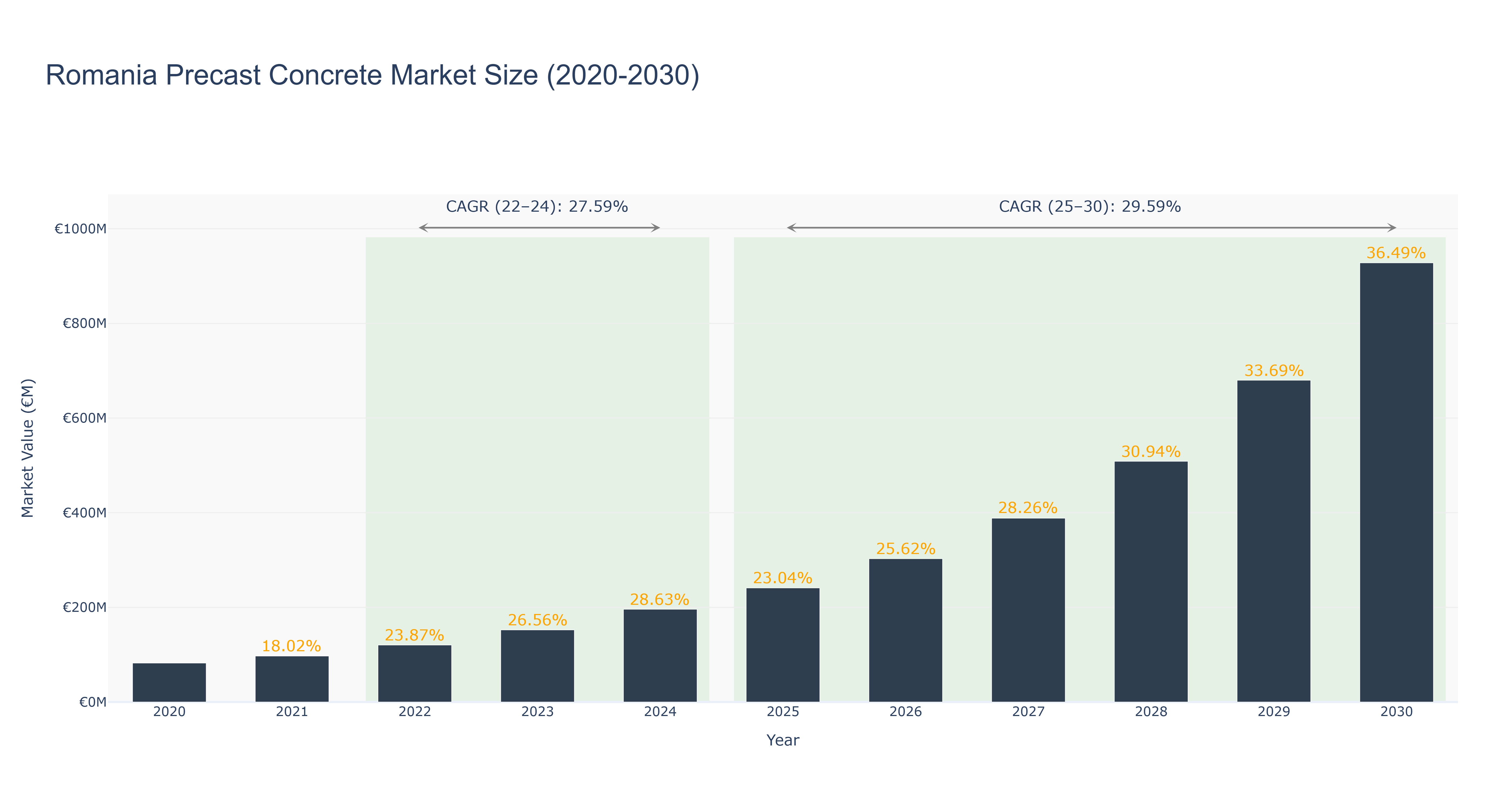
Romania Precast Concrete Market has shown a steady growth trajectory over the years. The market size peaked at €927.89 million in 2030, marking a significant increase from €82.31 million in 2020. The actual market size experienced robust growth from €82.31 million in 2020 to €195.89 million in 2024. Forecasted market size is expected to continue growing from €241.04 million in 2025 to €927.89 million in 2030, with a CAGR of 27.59% for 2022-24 and 29.59% for 2025-30. The market's growth can be attributed to increased infrastructure projects, urbanization, and the government's focus on sustainable construction practices. Recent developments in Romania include the initiation of large-scale infrastructure projects aimed at modernizing transportation networks and enhancing urban development, further driving the demand for precast concrete solutions.
Romania Precast Concrete Market: Production & Trade Performance (2019-2025)
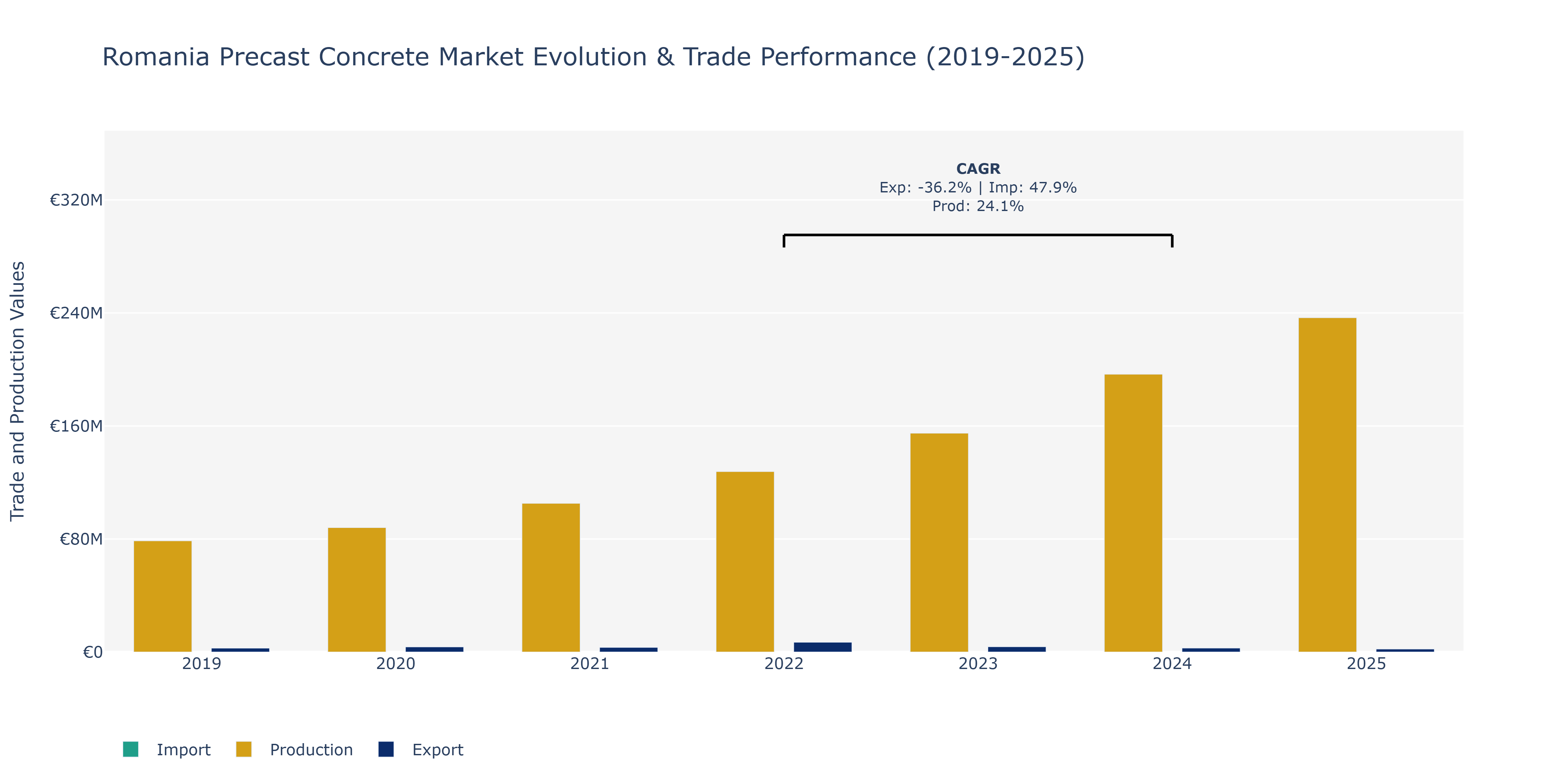
Between 2019 and 2025, Romania's Precast Concrete Market witnessed varied trends in Exports, Imports, and Production. Exports surged from €2.75 million in 2019 to a peak of €6.92 million in 2022 before declining to €2.12 million in 2025. In contrast, Imports experienced a fluctuating pattern, reaching €26.93 million in 2025 after a steady increase since 2019. Production displayed a steady growth trajectory, rising from €78.71 million in 2019 to €236.65 million in 2025. The significant drop in exports post-2022 may be linked to changes in global demand, while the consistent rise in imports could be attributed to increasing infrastructure projects in Romania. Growth in production is indicative of the construction sector's robust performance, likely fueled by government investments and urbanization initiatives. These trends highlight the market's resilience amidst evolving economic landscapes and emphasize the sector's importance in Romania's development plans.
Romania Precast Concrete Market Synopsis
The Romania precast concrete market is experiencing steady growth fueled by the increasing demand for cost-effective and sustainable construction solutions. The market is driven by factors such as rapid urbanization, infrastructure development projects, and a growing emphasis on green building practices. Key players in the industry are focusing on innovation, product development, and strategic partnerships to gain a competitive edge. The residential and commercial construction sectors are the primary end-users of precast concrete products in Romania, with a rising trend towards prefabricated elements for faster construction timelines. The market is expected to continue its positive trajectory in the coming years, supported by government initiatives promoting sustainable construction practices and the adoption of modern building technologies.
Romania Precast Concrete Market Trends
The Romania precast concrete market is experiencing steady growth driven by infrastructure development projects, urbanization, and the increasing demand for cost-effective and sustainable construction solutions. Key trends in the market include the rising adoption of advanced precast technologies to improve construction efficiency and quality, the growing use of precast concrete elements in residential and commercial buildings for faster completion times, and the emphasis on green building practices leading to greater use of environmentally friendly precast materials. Additionally, the market is seeing a surge in demand for customized precast products to meet specific project requirements and aesthetic preferences. Overall, the Romania precast concrete market is poised for continued expansion as the construction industry seeks innovative solutions to meet evolving demands and regulations.
Romania Precast Concrete Market Challenges
In the Romania precast concrete market, several challenges are encountered. One major challenge is the limited awareness and acceptance of precast concrete construction methods among stakeholders including architects, engineers, and developers. This lack of familiarity often leads to reluctance in adopting precast solutions, hindering the market`s growth potential. Additionally, the high initial investment required for setting up precast concrete manufacturing facilities poses a financial barrier for new entrants in the market. Furthermore, the industry faces challenges related to ensuring quality control throughout the production process and maintaining consistent standards across different projects. Addressing these challenges will be crucial for the Romania precast concrete market to realize its full potential and meet the growing demand for efficient and sustainable construction solutions.
Romania Precast Concrete Market Investment Opportunities
The Romania precast concrete market presents promising investment opportunities due to the country`s growing construction industry and increasing demand for infrastructure development. With a focus on sustainable and cost-effective construction methods, precast concrete products are gaining popularity for their durability and efficiency in project timelines. Key investment areas include the production of precast concrete elements such as beams, columns, and panels, as well as the development of precast concrete factories and facilities to meet the rising demand. Additionally, innovation in design and technology within the precast concrete sector can offer attractive investment prospects for companies looking to capitalize on the market`s growth potential and contribute to the modernization of Romania`s construction industry.
Jordan Agar Market Government Policies
Government policies related to the Romania Precast Concrete Market include regulations on quality standards, environmental protection, and safety measures. The Romanian government has implemented strict guidelines for the production and use of precast concrete products to ensure durability and sustainability. Additionally, there are initiatives to promote the use of precast concrete in construction projects to improve efficiency and reduce construction time. The government also supports research and development in the precast concrete industry to enhance innovation and technological advancements. Overall, the regulatory framework aims to foster a competitive and sustainable precast concrete market in Romania while ensuring compliance with national and European Union standards.
Romania Precast Concrete Market Future Outlook
The future outlook for the Romania Precast Concrete Market appears promising, driven by factors such as increasing investment in infrastructure development, growing urbanization, and the rising demand for sustainable construction practices. The market is expected to witness steady growth due to the benefits offered by precast concrete, including cost-effectiveness, enhanced durability, and faster construction times. Additionally, the government`s focus on promoting affordable housing projects and the implementation of stringent building regulations are likely to further propel the market growth. With advancements in technology and the adoption of innovative precast concrete solutions, such as 3D printing and smart building materials, the Romania Precast Concrete Market is poised for expansion in the coming years, offering opportunities for manufacturers, developers, and investors in the construction sector.
Key Highlights of the Report:
- Romania Precast Concrete Market Outlook
- Market Size of Romania Precast Concrete Market, 2021
- Forecast of Romania Precast Concrete Market, 2031
- Historical Data and Forecast of Romania Precast Concrete Revenues & Volume for the Period 2018 - 2031
- Romania Precast Concrete Market Trend Evolution
- Romania Precast Concrete Market Drivers and Challenges
- Romania Precast Concrete Price Trends
- Romania Precast Concrete Porter's Five Forces
- Romania Precast Concrete Industry Life Cycle
- Historical Data and Forecast of Romania Precast Concrete Market Revenues & Volume By Product for the Period 2018 - 2031
- Historical Data and Forecast of Romania Precast Concrete Market Revenues & Volume By Structural Building Components for the Period 2018 - 2031
- Historical Data and Forecast of Romania Precast Concrete Market Revenues & Volume By Architectural Building Components for the Period 2018 - 2031
- Historical Data and Forecast of Romania Precast Concrete Market Revenues & Volume By Transportation Products for the Period 2018 - 2031
- Historical Data and Forecast of Romania Precast Concrete Market Revenues & Volume By Water & Waste Handling Products for the Period 2018 - 2031
- Historical Data and Forecast of Romania Precast Concrete Market Revenues & Volume By Others for the Period 2018 - 2031
- Historical Data and Forecast of Romania Precast Concrete Market Revenues & Volume By End-use for the Period 2018 - 2031
- Historical Data and Forecast of Romania Precast Concrete Market Revenues & Volume By Residential for the Period 2018 - 2031
- Historical Data and Forecast of Romania Precast Concrete Market Revenues & Volume By Non-residential for the Period 2018 - 2031
- Historical Data and Forecast of Romania Precast Concrete Market Revenues & Volume By Infrastructure for the Period 2018 - 2031
- Romania Precast Concrete Import Export Trade Statistics
- Market Opportunity Assessment By Product
- Market Opportunity Assessment By End-use
- Romania Precast Concrete Top Companies Market Share
- Romania Precast Concrete Competitive Benchmarking By Technical and Operational Parameters
- Romania Precast Concrete Company Profiles
- Romania Precast Concrete Key Strategic Recommendations






































