Australia Industrial Computers Market Summary
The australia industrial computers market was estimated at USD 160 Million in 2025 and is projected to reach USD 190 Million by 2032, growing at a CAGR of 2.7% from 2026 to 2032.
Australia Industrial Computers Market Year-wise Growth Rate and Key Drivers
This graph highlights how the Australia Industrial Computers Market has steadily grown over the past five years, supported by major growth factors.
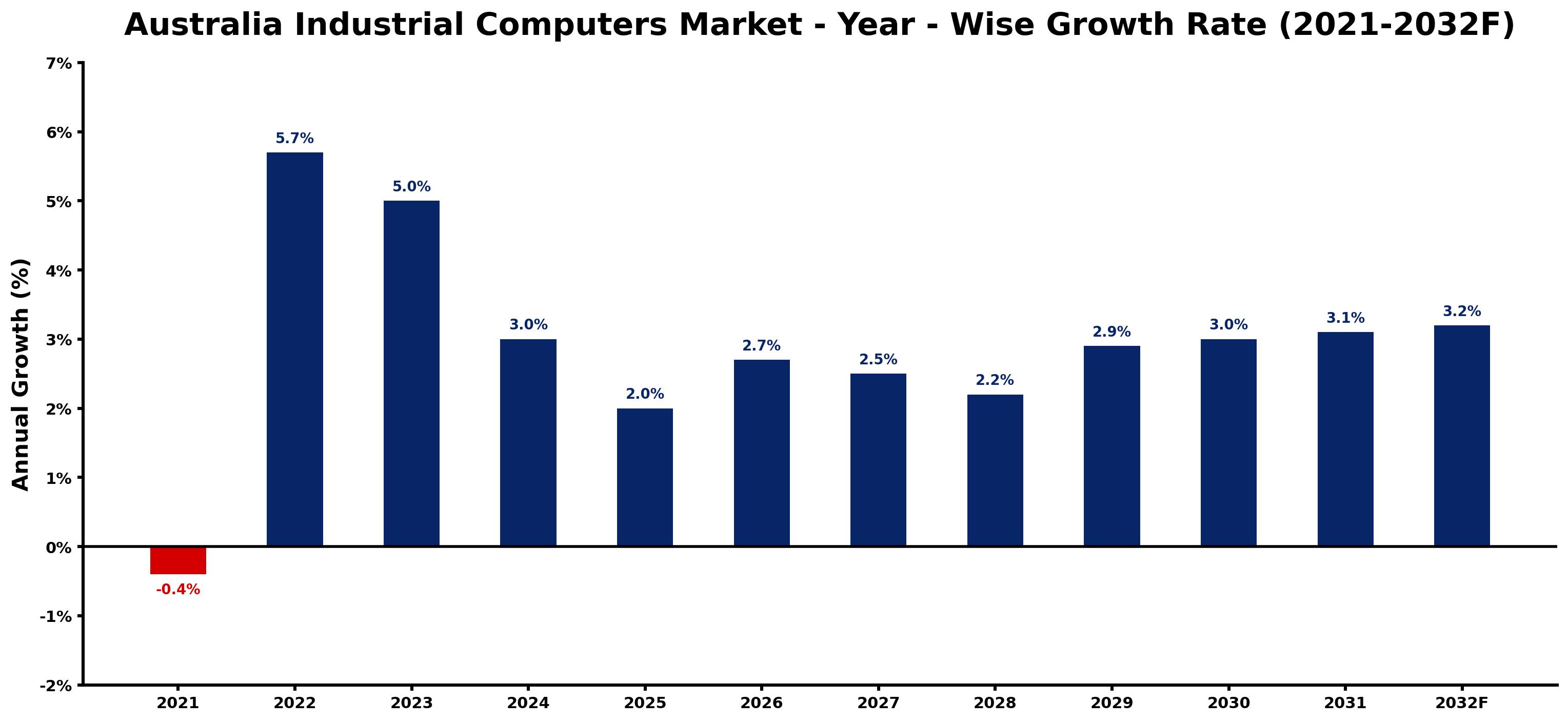
The table below presents the year wise growth rates along with the key drivers influencing the market
| Year | Growth Rate | Major Drivers |
| 2021 | -0.4% | Supply chain disruptions resulted in delayed deliveries, hindering project timelines and reducing overall industrial computer sales. |
| 2022 | 5.7% | Manufacturers increasingly sought rugged computing solutions to withstand harsh environments. |
| 2023 | 5.0% | Supply chain disruptions emphasized the need for robust inventory management systems. |
| 2024 | 3.0% | The push towards Industry 4.0 influenced tech firms to innovate industrial computing solutions. |
| 2025 | 2.0% | Major infrastructure projects began prioritizing real-time data analytics for operational efficiency. |
| 2026 | 2.7% | Cybersecurity concerns led companies to upgrade systems for enhanced data protection. |
| 2027 | 2.5% | Emerging technologies like AI and IoT integrated into industrial devices gained traction. |
| 2028 | 2.2% | Environmental sustainability demands prompted shifts towards energy-efficient industrial computing. |
| 2029 | 2.9% | Remote monitoring and control capabilities became essential for operational continuity. |
| 2030 | 3.0% | Skills development initiatives increased workforce competency in advanced industrial technologies. |
| 2031 | 3.1% | Competitive pressures drove firms to adopt agile computing solutions for faster response times. |
| 2032 | 3.2% | The convergence of IT and OT environments highlighted the need for seamless integration. |
Note - Market size estimations and growth projections presented in this report are based on 6Wresearch's advanced forecasting approach, validated with industry datasets as of June 2026.
Australia Industrial Computers Market Synopsis
The Australia Industrial Computers Market is projected to reach 2.7% and witness significant growth during the forecast period (2026-2032).
Australia Industrial Computers Market Overview
The landscape of the Australia Industrial Computers Market is evolving, driven by factors such as the increasing adoption of automation, the Internet of Things (IoT), and the digital transformation of various industrial sectors. Notable industries, including manufacturing, energy, and transportation, are significantly utilizing industrial computers, which encompass a range of devices like ruggedized PCs, embedded systems, and human-machine interface (HMI) solutions. These computers play a pivotal role in monitoring and controlling industrial processes, thereby enhancing operational efficiency and enabling informed decision-making through real-time data analysis.
Australia Industrial Computers Market Growth Drivers
Several key factors are driving the growth of the Australia Industrial Computers Market:
- Increased demand for robust and reliable computing solutions that can function confidently in harsh industrial environments, ensuring operational continuity.
- Rising requirements for real-time monitoring and control capabilities within automation processes, which necessitate the deployment of high-performance industrial computers.
- Expansion in automation and robotics applications across various sectors, leading to higher adoption rates of specialized industrial computing systems.
- Technological advancements in industrial computers, such as improved durability, energy efficiency, and enhanced connectivity options, catering to modern operational needs.
- The increasing focus on data analytics in industrial operations, compelling businesses to invest in solutions that facilitate data collection and processing efficiently.
Australia Industrial Computers Market Challenges and Restraints
Despite the positive growth trajectory, the Australia Industrial Computers Market faces several challenges:
- The design and manufacture of rugged and high-performance computing solutions that meet the stringent requirements of industrial environments can be complex and costly.
- Ensuring compatibility with existing industrial automation systems while maintaining electromagnetic compatibility (EMC) can pose substantial technical challenges.
- Addressing temperature extremes and mechanical vibrations without compromising size, weight, and power constraints often necessitates innovative engineering solutions.
- Maintaining cybersecurity measures and data protection amidst the increasing connectivity and digitization of industrial operations is crucial, yet challenging.
- The rapid pace of technological advancements may render existing products obsolete, necessitating continuous innovation and adaptation from manufacturers.
Australia Industrial Computers Market Government Investment and Initiatives
Government policy in Australia plays a significant role in shaping the Industrial Computers Market. Various initiatives are in place to promote the integration and adoption of advanced computing technologies within the manufacturing, energy, and transportation sectors. Regulatory frameworks focus on enhancing product reliability and ensuring compliance with cybersecurity standards and interoperability requirements. Moreover, government-backed incentives are expected to support research and development in industrial computing technologies, further driving innovation and competitiveness in the sector.
Australia Industrial Computers Market Latest Developments (May 2025 - June 2026)
Recent developments in the Australia Industrial Computers Market highlight the ongoing evolution of technology and industry needs. Companies are increasingly focusing on creating more integrated computing solutions that utilize IoT capabilities for enhanced data collection and analysis. The trend towards automation continues to gain momentum, with more industries exploring the potential of robotics, thereby boosting the demand for specialized industrial computers. Additionally, advancements in AI and machine learning are being integrated into industrial computing platforms, allowing businesses to leverage predictive analytics and improve operational efficiency. Governmental initiatives aimed at supporting the digital transformation of industries have also encouraged further innovation and investment in this space.
Australia Industrial Computers Market - Key Attractiveness of the Report
- 10 Years of Market Numbers
- Historical Data Starting from 2022 to 2025
- Base Year: 2025
- Forecast Data until 2032
- Key Performance Indicators Impacting the Market
- Major Upcoming Developments and Projects
Key Highlights of the Report:
- Australia Industrial Computers Market Outlook
- Market Size of Australia Industrial Computers Market, 2025
- Forecast of Australia Industrial Computers Market, 2032
- Historical Data and Forecast of Australia Industrial Computers Revenues & Volume for the Period 2022-2032F
- Australia Industrial Computers Market Trend Evolution
- Australia Industrial Computers Market Drivers and Challenges
- Australia Industrial Computers Price Trends
- Australia Industrial Computers Porter's Five Forces
- Australia Industrial Computers Industry Life Cycle
- Historical Data and Forecast of Australia Industrial Computers Market Revenues & Volume By Type for the Period 2022-2032F
- Historical Data and Forecast of Australia Industrial Computers Market Revenues & Volume By Panel for the Period 2022-2032F
- Historical Data and Forecast of Australia Industrial Computers Market Revenues & Volume By Box for the Period 2022-2032F
- Historical Data and Forecast of Australia Industrial Computers Market Revenues & Volume By Embedded for the Period 2022-2032F
- Historical Data and Forecast of Australia Industrial Computers Market Revenues & Volume By Din Rail for the Period 2022-2032F
- Historical Data and Forecast of Australia Industrial Computers Market Revenues & Volume By Rack Mount for the Period 2022-2032F
- Historical Data and Forecast of Australia Industrial Computers Market Revenues & Volume By Thin Client for the Period 2022-2032F
- Historical Data and Forecast of Australia Industrial Computers Market Revenues & Volume By Technology for the Period 2022-2032F
- Historical Data and Forecast of Australia Industrial Computers Market Revenues & Volume By Resistive for the Period 2022-2032F
- Historical Data and Forecast of Australia Industrial Computers Market Revenues & Volume By Capacitive for the Period 2022-2032F
- Historical Data and Forecast of Australia Industrial Computers Market Revenues & Volume By Others for the Period 2022-2032F
- Historical Data and Forecast of Australia Industrial Computers Market Revenues & Volume By ?End Use for the Period 2022-2032F
- Historical Data and Forecast of Australia Industrial Computers Market Revenues & Volume By Automotive for the Period 2022-2032F
- Historical Data and Forecast of Australia Industrial Computers Market Revenues & Volume By Chemicals for the Period 2022-2032F
- Historical Data and Forecast of Australia Industrial Computers Market Revenues & Volume By Electronics for the Period 2022-2032F
- Historical Data and Forecast of Australia Industrial Computers Market Revenues & Volume By Oil & Gas for the Period 2022-2032F
- Historical Data and Forecast of Australia Industrial Computers Market Revenues & Volume By Food & Beverages for the Period 2022-2032F
- Historical Data and Forecast of Australia Industrial Computers Market Revenues & Volume By Pharmaceuticals for the Period 2022-2032F
- Historical Data and Forecast of Australia Industrial Computers Market Revenues & Volume By Others for the Period 2022-2032F
- Australia Industrial Computers Import Export Trade Statistics
- Market Opportunity Assessment By Type
- Market Opportunity Assessment By Technology
- Market Opportunity Assessment By ?End Use
- Australia Industrial Computers Top Companies Market Share
- Australia Industrial Computers Competitive Benchmarking By Technical and Operational Parameters
- Australia Industrial Computers Company Profiles
- Australia Industrial Computers Key Strategic Recommendations






































