Australia Stainless Steel Round Bar Market: Import Trend Analysis
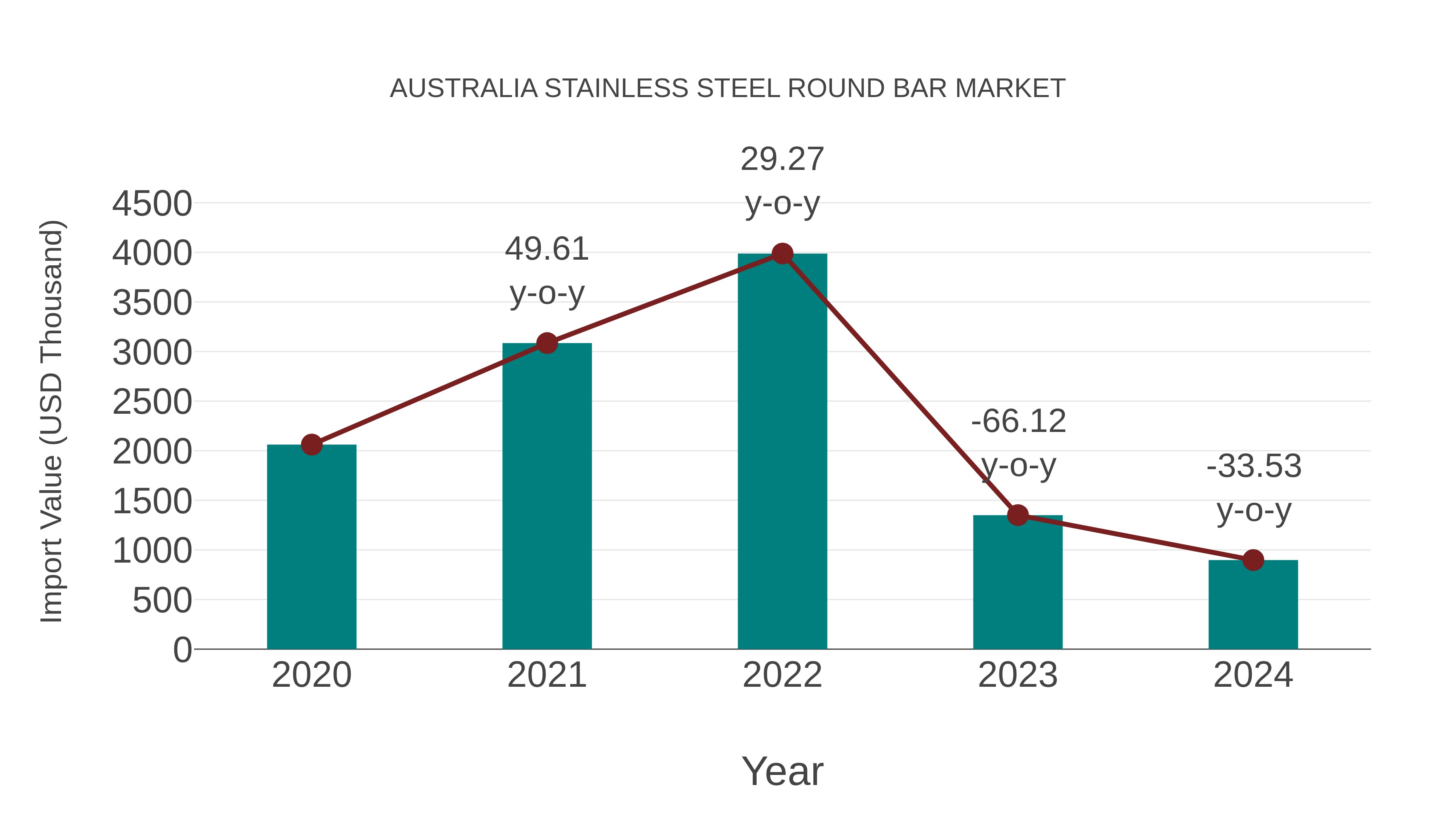
Australia`s import trend for the stainless steel round bar market experienced a notable decline from 2023 to 2024, with a growth rate of -33.53%. The compound annual growth rate (CAGR) for the period 2020-2024 stood at -18.76%. This decline could be attributed to shifts in demand dynamics or changes in trade policies impacting the market stability.
Australia Stainless Steel Round Bar Market Overview
The market for stainless steel round bars in Australia is witnessing significant growth owing to the robust demand from various end-use industries. Stainless steel round bars are widely utilized in construction, manufacturing, and infrastructure projects due to their exceptional mechanical properties, including high tensile strength and corrosion resistance. In the construction sector, stainless steel round bars are extensively employed in building structures, bridges, and architectural elements due to their aesthetic appeal and longevity. Moreover, the burgeoning infrastructure development activities in Australia further drive the demand for stainless steel round bars.
Drivers of the market
The Australia stainless steel round bar market is propelled by the thriving construction and infrastructure sectors, where stainless steel round bars find extensive usage in structural applications, reinforcement, and architectural elements. The superior mechanical properties of stainless steel round bars, including high tensile strength, corrosion resistance, and durability, make them indispensable in demanding environments such as marine and coastal areas. Furthermore, the burgeoning demand for stainless steel round bars in the manufacturing of machinery, equipment, and automotive components contributes significantly to market growth. Additionally, the increasing adoption of stainless steel round bars in the food and beverage industry, owing to their hygienic properties and ease of cleaning, augments market expansion.
Challenges of the market
In Australia, the stainless steel round bar market encounters challenges related to intense competition from alternative materials and overseas manufacturers. Market players must navigate through volatile pricing dynamics influenced by global supply and demand fluctuations. Moreover, ensuring compliance with quality standards and meeting specific customer requirements present ongoing challenges, demanding continuous innovation and investment in research and development.
Government Policy of the market
In the stainless steel round bar market, the Australia government implements policies to support local manufacturing and innovation. This includes subsidies for companies investing in advanced manufacturing technologies, tax incentives for research and development, and trade agreements to facilitate exports. Moreover, regulatory frameworks address issues like fair competition, anti-dumping measures, and compliance with international standards to maintain the integrity of the market.
Key Highlights of the Report:
- Australia Stainless Steel Round Bar Market Outlook
- Market Size of Australia Stainless Steel Round Bar Market, 2025
- Forecast of Australia Stainless Steel Round Bar Market, 2032
- Historical Data and Forecast of Australia Stainless Steel Round Bar Revenues & Volume for the Period 2022-2032F
- Australia Stainless Steel Round Bar Market Trend Evolution
- Australia Stainless Steel Round Bar Market Drivers and Challenges
- Australia Stainless Steel Round Bar Price Trends
- Australia Stainless Steel Round Bar Porter's Five Forces
- Australia Stainless Steel Round Bar Industry Life Cycle
- Historical Data and Forecast of Australia Stainless Steel Round Bar Market Revenues & Volume By Product for the Period 2022-2032F
- Historical Data and Forecast of Australia Stainless Steel Round Bar Market Revenues & Volume By Cr-Ni for the Period 2022-2032F
- Historical Data and Forecast of Australia Stainless Steel Round Bar Market Revenues & Volume By Duplex & Super Duplex for the Period 2022-2032F
- Historical Data and Forecast of Australia Stainless Steel Round Bar Market Revenues & Volume By High Nickel Alloys for the Period 2022-2032F
- Australia Stainless Steel Round Bar Import Export Trade Statistics
- Market Opportunity Assessment By Product
- Australia Stainless Steel Round Bar Top Companies Market Share
- Australia Stainless Steel Round Bar Competitive Benchmarking By Technical and Operational Parameters
- Australia Stainless Steel Round Bar Company Profiles
- Australia Stainless Steel Round Bar Key Strategic Recommendations






































