United Arab Emirates (UAE) Stainless Steel Round Bar Market Size, Share & Growth Rate
The United Arab Emirates (UAE) Stainless Steel Round Bar Market was estimated at USD 1004 Million in 2025 and is projected to reach USD 1749 Million by 2032, growing at a CAGR of 8.3% from 2026 to 2032. This growth trajectory is primarily fueled by the burgeoning construction sector, where high-strength materials are in high demand. Moreover, robust contributions from the automotive and aerospace industries further amplify the market's expansion, reflecting the critical role stainless steel round bars play in modern manufacturing.
United Arab Emirates (UAE) Stainless Steel Round Bar Market Year-wise Growth Rate and Key Drivers
This graph highlights how the United Arab Emirates (UAE) Stainless Steel Round Bar Market has steadily grown over the years, supported by major growth factors.
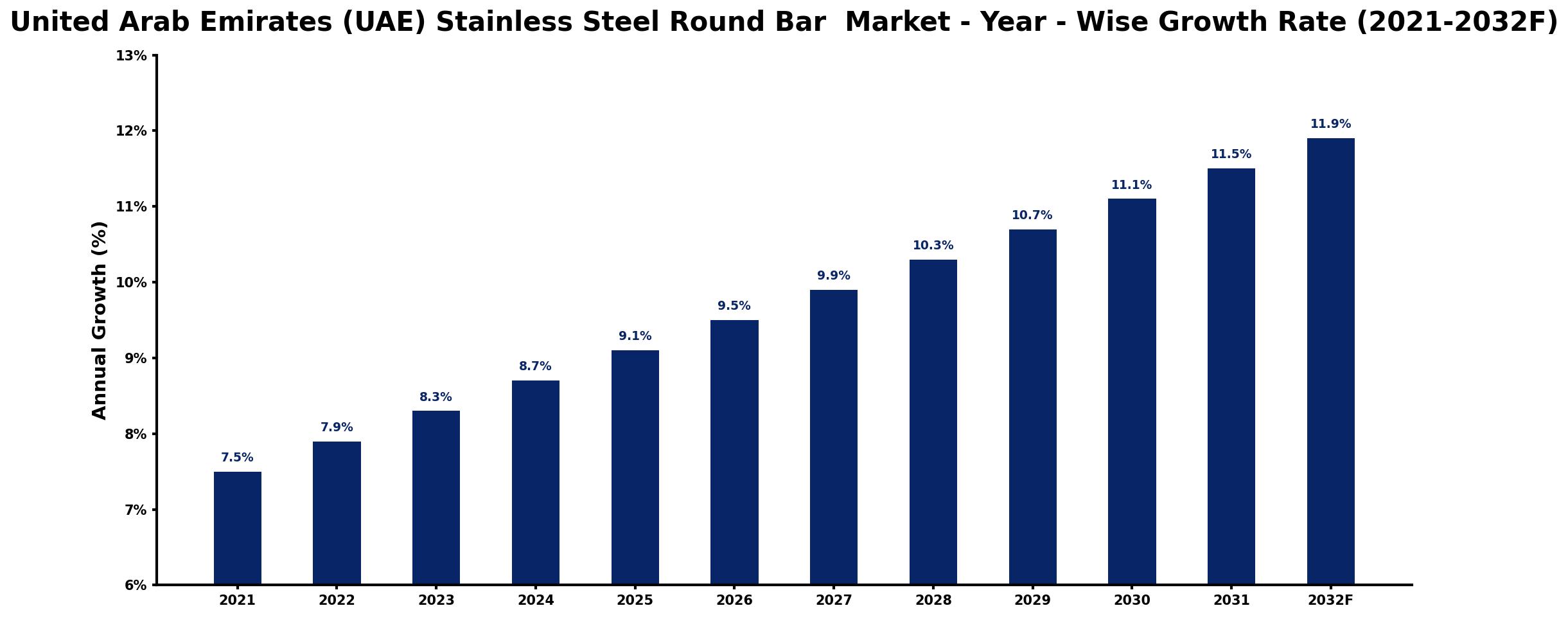
The table below presents the year‑wise growth rates along with the key drivers influencing the market
| Year | Growth Rate | Major Drivers |
| 2021 | 7.5% | Construction sector expansion initiatives |
| 2022 | 7.9% | Increased government infrastructure investments |
| 2023 | 8.3% | Rising demand from manufacturing sector |
| 2024 | 8.7% | Growing energy sector projects |
| 2025 | 9.1% | Boost in construction activities |
| 2026 | 9.5% | Technological advancements in production |
| 2027 | 9.9% | Surge in automotive industry requirements |
| 2028 | 10.3% | Emergence of renewable energy projects |
| 2029 | 10.7% | Heightened demand from aerospace sector |
| 2030 | 11.1% | Expansion of logistics and transport |
| 2031 | 11.5% | Increased focus on sustainability efforts |
| 2032 | 11.9% | Growing urbanization and population growth |
Note: Market size estimations and growth projections presented in this report are based on 6Wresearch's proprietary forecasting methodology, utilizing the latest available industry data, government publications, and primary research inputs.
United Arab Emirates (UAE) Stainless Steel Round Bar Market Synopsis
The most significant force currently shaping the UAE stainless steel round bar market is the substantial demand from the construction sector, which emphasizes high-strength and corrosion-resistant materials. These attributes are vital for infrastructure development, propelling market growth in tandem with a surge in urbanization.
In addition to construction, the automotive and aerospace industries are major consumers of stainless steel round bars, requiring materials that exhibit excellent mechanical properties. This diverse application spectrum not only sustains demand but also fosters an environment ripe for innovation and advancement in production technologies.
United Arab Emirates (UAE) Stainless Steel Round Bar Market Key Takeaways
- The market is driven by strong demand across construction, automotive, and aerospace sectors.
- Technological advancements in steel production are enhancing the quality and efficiency of stainless steel round bars.
- Price fluctuations of key alloying elements remain a concern for maintaining market stability.
- Emerging opportunities are expected from the oil and gas sector, which increasingly relies on corrosion-resistant materials.
- Competition from imported stainless steel products presents challenges but also catalyzes local innovation.
Evaluation of Restraints in United Arab Emirates (UAE) Stainless Steel Round Bar Market
Despite the promising growth, the UAE stainless steel round bar market faces several restraints. Price fluctuations of nickel and other alloying elements create cost-related challenges that could deter buyers, especially in cost-sensitive industries. Additionally, ensuring a stable supply chain for raw materials is crucial to meet the escalating demand while maintaining quality and pricing standards. Furthermore, competition from imported products can undermine local manufacturers, necessitating strategic responses to safeguard market positions.
United Arab Emirates (UAE) Stainless Steel Round Bar Market Trends
Current trends in the UAE stainless steel round bar market include a growing emphasis on sustainability and eco-friendly production practices. Manufacturers are increasingly adopting green technologies to minimize the environmental impact of steel production. Moreover, there is a rising focus on developing high-performance alloys that offer enhanced strength and corrosion resistance, catering to the specific needs of demanding applications in aerospace and automotive sectors.
United Arab Emirates (UAE) Stainless Steel Round Bar Market Opportunities
Opportunities for growth within the UAE stainless steel round bar market are abundant. The ongoing expansion of infrastructure projects provides a solid foundation for demand, particularly in the construction sector. Additionally, as the oil and gas industry evolves with the adoption of advanced materials, there is potential for increased consumption of stainless steel round bars. Investment in research and development can also yield innovative solutions, opening new avenues for market participants.
Government Initiatives in the United Arab Emirates (UAE) Stainless Steel Round Bar Market
The UAE government is actively investing in initiatives aimed at enhancing the manufacturing capabilities of the stainless steel sector. Public spending on infrastructure projects has surged, with policies encouraging the use of locally sourced materials. Additionally, incentives for research and development in sustainable production processes aim to promote innovation within the stainless steel industry, bolstering both local economies and environmental standards.
Future Insights of the United Arab Emirates (UAE) Stainless Steel Round Bar Market
Looking ahead to the period of 2026-2032, the UAE stainless steel round bar market is poised for significant developments. As construction and industrial sectors continue to expand, the need for durable, high-performance materials will only increase. Furthermore, the integration of advanced technologies in production and material science will facilitate the creation of superior products that meet evolving industry standards, positioning the market for sustained growth.
United Arab Emirates (UAE) Stainless Steel Round Bar Market Latest Developments (2025 - 2026)
Recent industry developments indicate a shift towards collaborative ventures among manufacturers to enhance product offerings. Additionally, there has been a noticeable increase in investment directed towards automated production processes aimed at improving efficiency and reducing costs. These trends reflect the industry's response to the competitive landscape and the need for continual innovation to meet the demands of a diverse customer base.
United Arab Emirates (UAE) Stainless Steel Round Bar Market - Key Attractiveness of the Report
- 10 Years of Market Numbers
- Historical Data Starting from 2022 to 2025
- Base Year: 2025
- Forecast Data until 2032
- Key Performance Indicators Impacting the Market
- Major Upcoming Developments and Projects
Key Highlights of the Report:
- United Arab Emirates (UAE) Stainless Steel Round Bar Market Outlook
- Market Size of United Arab Emirates (UAE) Stainless Steel Round Bar Market, 2025
- Forecast of United Arab Emirates (UAE) Stainless Steel Round Bar Market, 2032
- Historical Data and Forecast of United Arab Emirates (UAE) Stainless Steel Round Bar Revenues & Volume for the Period 2022-2032F
- United Arab Emirates (UAE) Stainless Steel Round Bar Market Trend Evolution
- United Arab Emirates (UAE) Stainless Steel Round Bar Market Drivers and Challenges
- United Arab Emirates (UAE) Stainless Steel Round Bar Price Trends
- United Arab Emirates (UAE) Stainless Steel Round Bar Porter's Five Forces
- United Arab Emirates (UAE) Stainless Steel Round Bar Industry Life Cycle
- Historical Data and Forecast of United Arab Emirates (UAE) Stainless Steel Round Bar Market Revenues & Volume By Product for the Period 2022-2032F
- Historical Data and Forecast of United Arab Emirates (UAE) Stainless Steel Round Bar Market Revenues & Volume By Cr-Ni for the Period 2022-2032F
- Historical Data and Forecast of United Arab Emirates (UAE) Stainless Steel Round Bar Market Revenues & Volume By Duplex & Super Duplex for the Period 2022-2032F
- Historical Data and Forecast of United Arab Emirates (UAE) Stainless Steel Round Bar Market Revenues & Volume By High Nickel Alloys for the Period 2022-2032F
- United Arab Emirates (UAE) Stainless Steel Round Bar Import Export Trade Statistics
- Market Opportunity Assessment By Product
- United Arab Emirates (UAE) Stainless Steel Round Bar Top Companies Market Share
- United Arab Emirates (UAE) Stainless Steel Round Bar Competitive Benchmarking By Technical and Operational Parameters
- United Arab Emirates (UAE) Stainless Steel Round Bar Company Profiles
- United Arab Emirates (UAE) Stainless Steel Round Bar Key Strategic Recommendations






































