Azerbaijan Dyestuff For Cotton Market Size, Share & Growth Rate
The Azerbaijan Dyestuff For Cotton Market was estimated at USD 1474 Million in 2025 and is projected to reach USD 2582 Million by 2032, growing at a CAGR of 8.3% from 2026 to 2032. This robust growth trajectory is primarily driven by the textile industry's expansion, which increasingly demands high-quality, vibrant dyestuffs for cotton fabrics. Additionally, growing consumer awareness around sustainable and eco-friendly dyeing processes is shaping the purchasing decisions of manufacturers, further propelling market dynamics.
Azerbaijan Dyestuff For Cotton Market Year-wise Growth Rate and Key Drivers
This graph highlights how the Azerbaijan Dyestuff For Cotton Market has steadily grown over the years, supported by major growth factors.
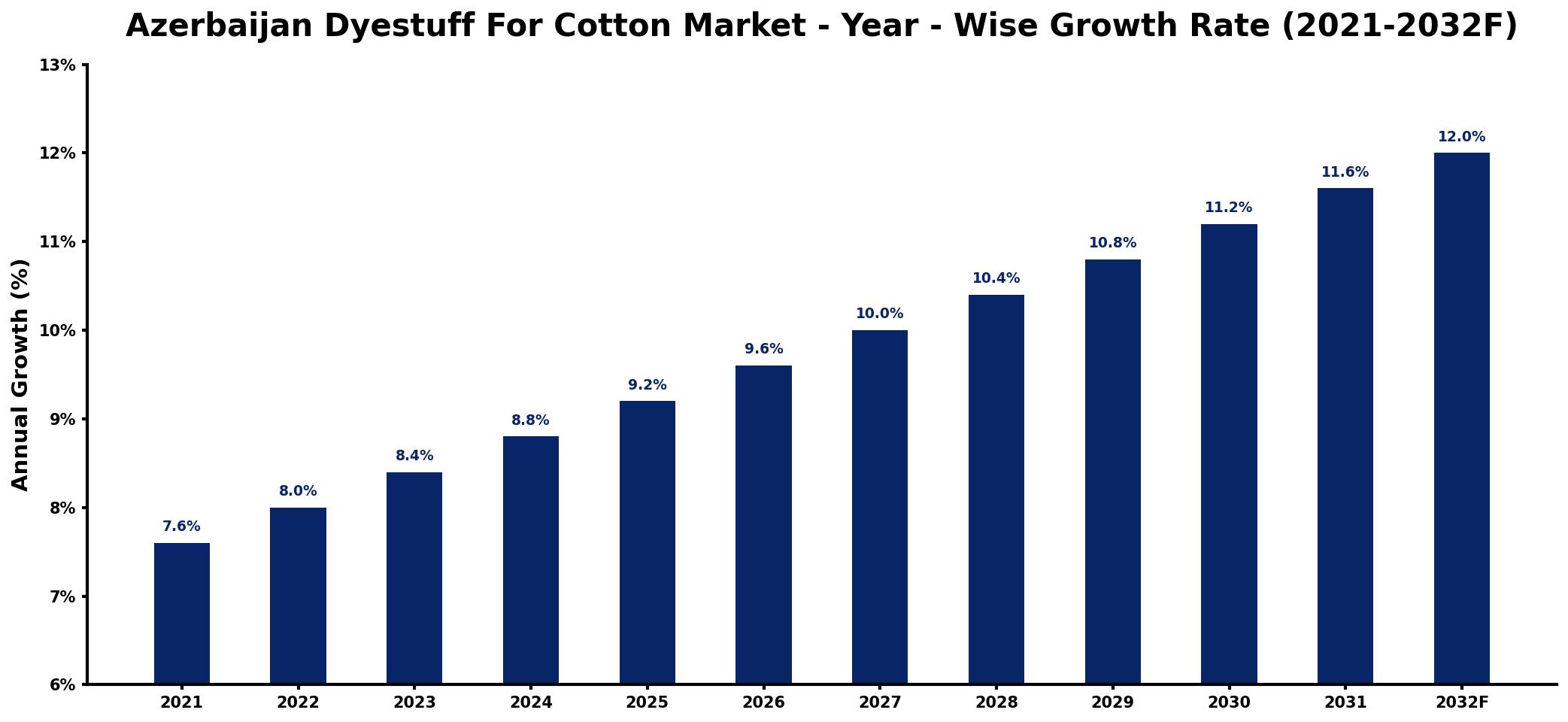
The table below presents the year‑wise growth rates along with the key drivers influencing the market
| Year | Growth Rate | Major Drivers |
| 2021 | 7.6% | increased textile manufacturing activities |
| 2022 | 8.0% | growing demand for eco-friendly solutions |
| 2023 | 8.4% | expansion of fashion industry trends |
| 2024 | 8.8% | rising exports to international markets |
| 2025 | 9.2% | investment in production technologies |
| 2026 | 9.6% | enhanced consumer awareness initiatives |
| 2027 | 10.0% | development of innovative colorants |
| 2028 | 10.4% | strengthening of local supply chains |
| 2029 | 10.8% | collaboration with global brands |
| 2030 | 11.2% | emergence of sustainable practices |
| 2031 | 11.6% | adoption of digital textile printing |
| 2032 | 12.0% | increased focus on customization |
Note: Market size estimations and growth projections presented in this report are based on 6Wresearch's proprietary forecasting methodology, utilizing the latest available industry data, government publications, and primary research inputs.
Azerbaijan Dyestuff For Cotton Market Synopsis
The strongest force currently shaping the Azerbaijan Dyestuff for Cotton Market is the rising consumer preference for sustainable and environmentally friendly dyeing solutions. As global trends lean toward sustainability, local manufacturers are compelled to innovate and adapt to these changing demands.
Furthermore, advancements in digital printing technology are revolutionizing the dyestuff landscape, allowing for intricate designs and customization on cotton textiles. This transformation reflects a growing commitment from suppliers to enhance product quality while adhering to sustainable practices.
Azerbaijan Dyestuff For Cotton Market Key Takeaways
- Rapid growth is driven by increasing demand for eco-friendly dyeing processes.
- Technological advancements, such as digital printing, are reshaping market offerings.
- Government initiatives are fostering a favorable investment climate in the textile sector.
- Rising consumer disposable income is amplifying demand for high-quality, customized fabrics.
- Ongoing product innovations focus on sustainability and quality enhancement.
Evaluation of Restraints in Azerbaijan Dyestuff For Cotton Market
Despite its growth potential, the Azerbaijan Dyestuff for Cotton Market faces notable restraints. The fluctuating prices of raw materials significantly impact production costs, creating challenges in pricing consistency for manufacturers. Moreover, limited access to high-quality dye materials constrains the ability of businesses to produce the vibrant, long-lasting colors that customers demand. The presence of counterfeit products further undermines market integrity, hindering the reputation of legitimate suppliers. Tackling these issues requires strategic alliances, investment in R&D, and stringent quality control measures to ensure product authenticity.
Azerbaijan Dyestuff For Cotton Market Trends
Current trends in the Azerbaijan Dyestuff for Cotton Market are heavily influenced by the consumer demand for sustainable and eco-friendly products. The market is seeing a notable rise in the adoption of natural and organic dyes as textile manufacturers pivot towards environmentally conscious solutions. Additionally, advancements in dye technology are enabling manufacturers to produce more vibrant and durable colors, catering to the shifting preferences of end-users.
Azerbaijan Dyestuff For Cotton Market Opportunities
There are significant investment opportunities in the Azerbaijan Dyestuff for Cotton Market, particularly as the textile industry continues to flourish. With the nation positioned as a strategic hub between Europe and Asia, Azerbaijan has the potential to serve as a vital exporter of dyed cotton textiles. Moreover, the government's supportive policies for local production and international trade agreements create a robust environment for developing dyestuff production facilities. Investing in eco-friendly dyeing technologies is particularly appealing, aligning with global shifts towards sustainable textile practices.
Government Initiatives in the Azerbaijan Dyestuff For Cotton Market
The Azerbaijani government is actively promoting the dyestuff for cotton market through various initiatives aimed at boosting the local textile industry. This includes providing incentives and subsidies for local dyestuff manufacturers to encourage production and innovation. Moreover, protective tariffs on imported dyestuffs aim to secure a competitive edge for domestic producers. Regulations are also in place to ensure that environmental standards are met, aligning local practices with international norms.
Future Insights of the Azerbaijan Dyestuff For Cotton Market
Looking ahead to 2026-2032, the Azerbaijan Dyestuff for Cotton Market is set for sustained growth driven by evolving consumer demands for high-quality and sustainable textile solutions. As technological advancements pave the way for new dyeing processes, manufacturers will likely prioritize eco-friendly practices to remain competitive. With rising disposable incomes fueling demand for customized textiles, the market is positioned for long-term expansion, aligning with global sustainability trends.
Azerbaijan Dyestuff For Cotton Market Latest Developments (2025 - 2026)
Recent developments in the Azerbaijan Dyestuff for Cotton Market indicate a strong momentum towards sustainable practices and innovation. Industry players are increasingly investing in research and development to create eco-friendly dye solutions that meet modern consumer expectations. Furthermore, partnerships among local textile manufacturers and dyestuff suppliers are enhancing the quality and efficiency of dye production processes, indicating a strategic shift towards competitiveness in both domestic and international markets.
Azerbaijan Dyestuff For Cotton Market - Key Attractiveness of the Report
- 10 Years of Market Numbers
- Historical Data Starting from 2022 to 2025
- Base Year: 2025
- Forecast Data until 2032
- Key Performance Indicators Impacting the Market
- Major Upcoming Developments and Projects
Key Highlights of the Report:
- Azerbaijan Dyestuff For Cotton Market Outlook
- Market Size of Azerbaijan Dyestuff For Cotton Market, 2025
- Forecast of Azerbaijan Dyestuff For Cotton Market, 2032
- Historical Data and Forecast of Azerbaijan Dyestuff For Cotton Revenues & Volume for the Period 2022-2032F
- Azerbaijan Dyestuff For Cotton Market Trend Evolution
- Azerbaijan Dyestuff For Cotton Market Drivers and Challenges
- Azerbaijan Dyestuff For Cotton Price Trends
- Azerbaijan Dyestuff For Cotton Porter's Five Forces
- Azerbaijan Dyestuff For Cotton Industry Life Cycle
- Historical Data and Forecast of Azerbaijan Dyestuff For Cotton Market Revenues & Volume By Types for the Period 2022-2032F
- Historical Data and Forecast of Azerbaijan Dyestuff For Cotton Market Revenues & Volume By Reactive Dyes for the Period 2022-2032F
- Historical Data and Forecast of Azerbaijan Dyestuff For Cotton Market Revenues & Volume By Disperse Dyes for the Period 2022-2032F
- Historical Data and Forecast of Azerbaijan Dyestuff For Cotton Market Revenues & Volume By Direct Dyes for the Period 2022-2032F
- Historical Data and Forecast of Azerbaijan Dyestuff For Cotton Market Revenues & Volume By Sulfur Dyes for the Period 2022-2032F
- Historical Data and Forecast of Azerbaijan Dyestuff For Cotton Market Revenues & Volume By Optical Brighteners for the Period 2022-2032F
- Historical Data and Forecast of Azerbaijan Dyestuff For Cotton Market Revenues & Volume By Applications for the Period 2022-2032F
- Historical Data and Forecast of Azerbaijan Dyestuff For Cotton Market Revenues & Volume By Non-Woven for the Period 2022-2032F
- Historical Data and Forecast of Azerbaijan Dyestuff For Cotton Market Revenues & Volume By Health Care for the Period 2022-2032F
- Historical Data and Forecast of Azerbaijan Dyestuff For Cotton Market Revenues & Volume By Personal Care for the Period 2022-2032F
- Historical Data and Forecast of Azerbaijan Dyestuff For Cotton Market Revenues & Volume By Others for the Period 2022-2032F
- Azerbaijan Dyestuff For Cotton Import Export Trade Statistics
- Market Opportunity Assessment By Types
- Market Opportunity Assessment By Applications
- Azerbaijan Dyestuff For Cotton Top Companies Market Share
- Azerbaijan Dyestuff For Cotton Competitive Benchmarking By Technical and Operational Parameters
- Azerbaijan Dyestuff For Cotton Company Profiles
- Azerbaijan Dyestuff For Cotton Key Strategic Recommendations






































