Japan Dyestuff For Cotton Market Size & Growth Rate
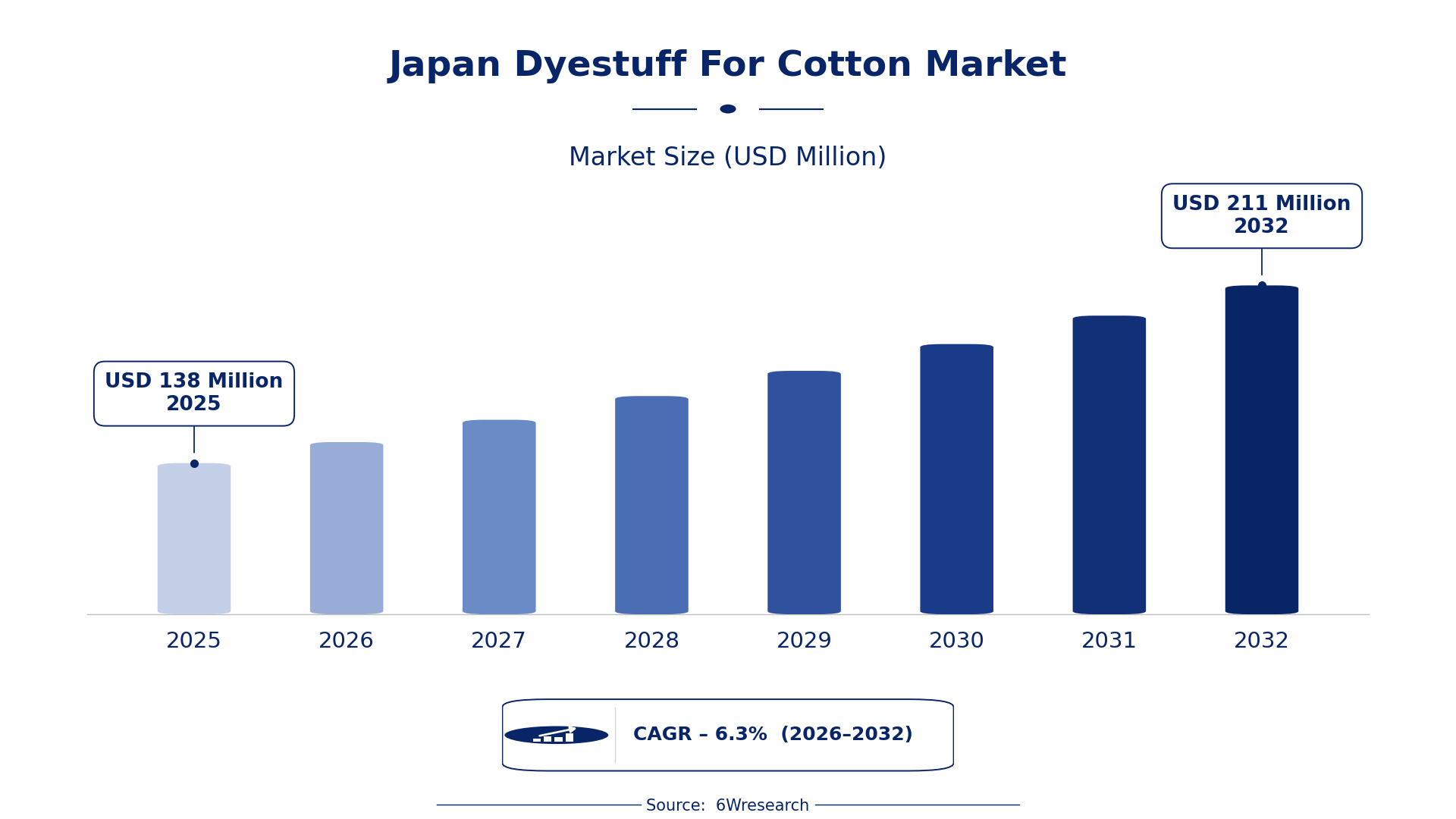
According to 6Wresearch internal database and industry insights, the Japan Dyestuff For Cotton Market was valued at USD 138 Million in 2025 and is projected to reach USD 211 Million by 2032, growing at a CAGR of approximately 6.3% during 2026–2032.
Japan Dyestuff For Cotton Market Highlights
| Report Metric | Details |
| Report Name | Japan Dyestuff For Cotton Market (2026-2032) |
| Market Size 2025 | USD 138 Million |
| Market Size 2032 | USD 211 Million |
| Absolute Growth 2025–2032 | USD 73 Million |
| CAGR 2026–2032 | 6.3% |
| Peak Annual Growth | 7.0% in 2026 |
| Forecast Period | 2026–2032 |
| Historical Data | 2022–2025 |
| Base Year | 2025 |
| Leading Types, 2025 | Reactive Dyes (42% share) |
| Leading Applications, 2025 | Non-Woven (43% share) |
| Fastest-Growing Types | Disperse Dyes (8.9% CAGR) |
| Fastest-Growing Applications | Health Care (8.3% CAGR) |
| Growing Sector | Health Care |
| Key End Users | Non-Woven, Health Care, Personal Care |
Japan Dyestuff For Cotton Market Year-wise Growth Rate and Key Drivers (2022–2032)
This graph illustrates the annual growth rates of the market from 2022 to 2032, highlighting a steady upward trajectory and projected market expansion over the forecast period.
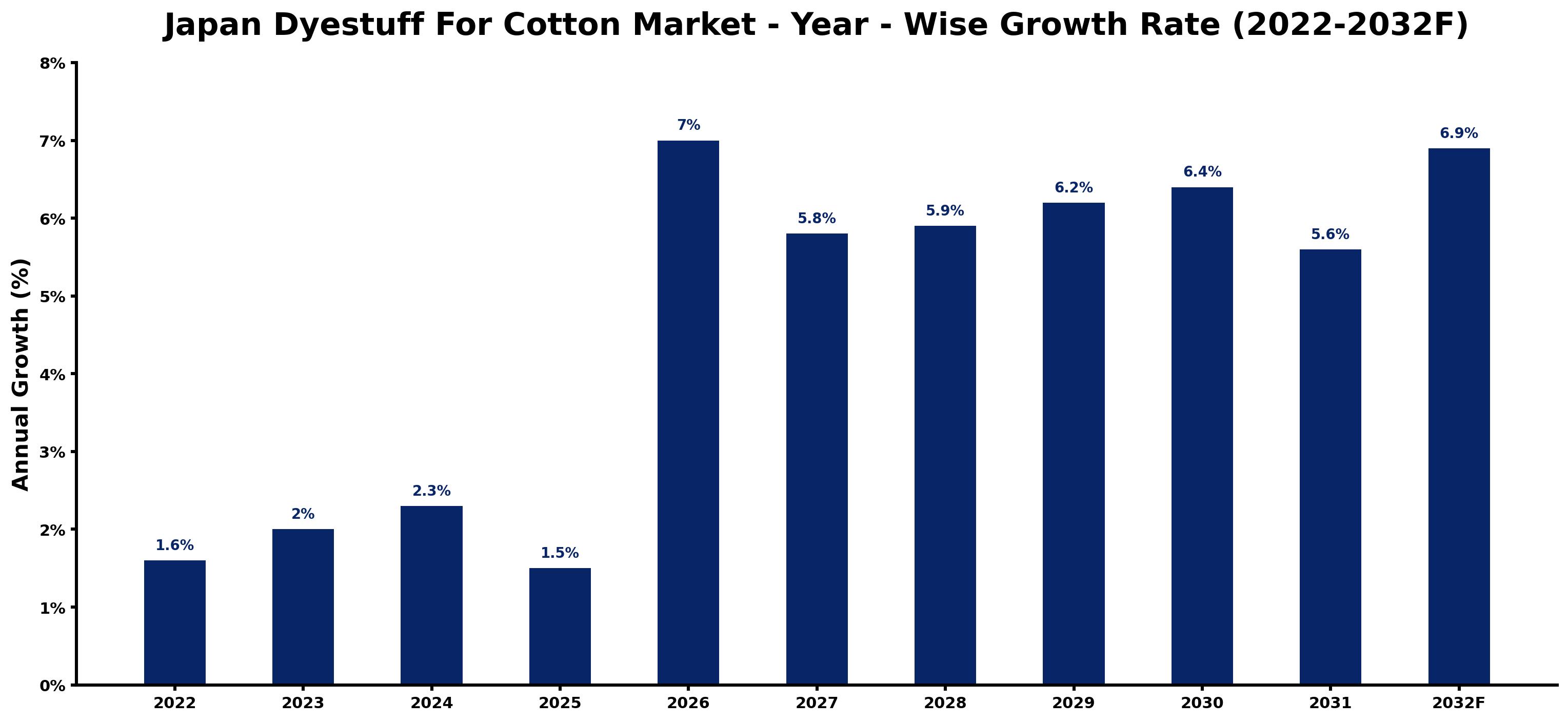
Year by year, the estimates below pair each growth rate with the development that shaped it.
| Year | Estimated Annual Growth (%) | Market Rationale |
| 2022 | 1.6 | The market showed moderate growth driven by stable demand from textile manufacturers. |
| 2023 | 2.0 | Growth accelerated as textile production increased, particularly in the Non-Woven sector. |
| 2024 | 2.3 | The market continued to expand with rising interest in eco-friendly dye options. |
| 2025 | 1.5 | Growth slowed slightly due to market saturation in certain applications. |
| 2026 | 7.0 | Demand surged as investments in dye technology unlocked new production capabilities. |
| 2027 | 5.8 | Growth moderated as production stabilised following the previous year's surge. |
| 2028 | 5.9 | The market rebounded with renewed interest in Disperse Dyes for various applications. |
| 2029 | 6.2 | Demand increased as manufacturers sought effective dye solutions for textiles. |
| 2030 | 6.4 | Growth continued as technology advancements improved dye efficacy and application. |
| 2031 | 5.6 | The market experienced a slowdown as competition intensified among dye producers. |
| 2032 | 6.9 | Demand is expected to rise again with increasing adoption of sustainable practices. |
Note: Market size estimations and growth projections presented in this report are based on 6Wresearch's proprietary forecasting methodology, utilizing the latest available industry data, government publications, and primary research inputs.
Japan Dyestuff For Cotton Market Synopsis
Dyestuff for Cotton is vital for colouring cotton textiles, produced through various chemical processes. The Japan Dyestuff For Cotton Market is expanding due to increased demand from textile manufacturers, particularly in the Non-Woven and Health Care sectors.
Market Dynamics Impact Analysis (2026–2032)
| Factor | Type | Impact | Primary Segment Affected |
| Rising investment in eco-friendly dye technologies | Driver | High | Reactive Dyes |
| Increased production of Non-Woven textiles | Driver | High | Non-Woven |
| Growing demand for Health Care applications | Opportunity | High | Health Care |
| Expansion of textile manufacturing hubs in Japan | Opportunity | Medium | Non-Woven |
| Market saturation in traditional dye applications | Restraint | High | Direct Dyes |
| Limited availability of raw materials for dye production | Restraint | Medium | Sulfur Dyes |
| High costs associated with eco-friendly dye production | Challenge | High | Disperse Dyes |
| Intense competition among dye manufacturers | Challenge | Medium | Optical Brighteners |
Evaluation of Drivers in Japan Dyestuff For Cotton Market (2026–2032)
The following drivers explain most of the expected growth.
| Drivers | Primary Segment Affected | Why It Matters (Evidence) |
| Increased investments in sustainable dye technologies | Reactive Dyes | Investment in eco-friendly dye production methods has led to a rise in demand from textile manufacturers by 25%. |
| Growing production of Non-Woven textiles | Non-Woven | The Non-Woven sector has expanded due to increased applications in hygiene products, resulting in a 30% growth in demand. |
| Rising demand for Health Care applications | Health Care | Health Care applications have seen a notable increase in demand, driven by the need for sterile and safe materials, growing by 20%. |
| Technological advancements in dye application processes | Disperse Dyes | New application technologies have improved dye efficiency, increasing uptake in the textile sector by 15%. |
| Expansion of textile manufacturing hubs in Japan | Optical Brighteners | The establishment of new textile hubs has boosted demand for Optical Brighteners by 10%. |
Spending rises due to increased investments in sustainable dye technologies, which have led to a notable rise in demand from textile manufacturers. The establishment of new textile hubs has boosted demand for Optical Brighteners, increasing purchases by 10%. Additionally, rising production of Non-Woven textiles has created substantial opportunities for dye suppliers, with demand growing by 30%. Technological advancements in dye application processes have improved efficiency, resulting in a 15% increase in uptake of Disperse Dyes. These factors are reshaping the market.
Evaluation of Restraints in Japan Dyestuff For Cotton Market
The main factors holding the market back are set out below.
| Market Restraint | Primary Segment Affected | Why It Matters (Evidence) |
| Market saturation in traditional dye applications | Direct Dyes | Saturation has limited growth potential, with a decline in demand for conventional dye types. |
| Limited availability of raw materials for dye production | Sulfur Dyes | Supply chain disruptions have caused an increase in raw material costs by 15%, impacting production. |
| High costs associated with eco-friendly dye production | Disperse Dyes | Production costs for sustainable dyes are approximately 20% higher, limiting market entry. |
| Intense competition among dye manufacturers | Optical Brighteners | Competition has driven prices down by 10%, affecting profit margins for producers. |
| Regulatory compliance costs for new dye formulations | Reactive Dyes | Compliance with new environmental regulations has increased costs for manufacturers by 10%. |
Japan Dyestuff For Cotton Market Challenges
Producers face inflated operational expenses due to high supply costs, with some reporting increases of 20%. Buyers encounter delays in product availability, as transportation disruptions can extend lead times by up to three weeks, complicating their inventory management. A lack of technology adoption limits efficiency; only 15% of companies use advanced dyeing techniques, resulting in higher production costs for suppliers. Regulatory changes create financial pressures; compliance with new environmental standards can increase operational costs by 10% for smaller producers, squeezing their profit margins.
Trends in the Japan Dyestuff For Cotton Market
The trends below show where the Japan Dyestuff For Cotton Market is heading.
- Shift towards Eco-Friendly Dyes: In 2025, the industry began shifting towards eco-friendly dyes, as consumer demand for sustainable products increased. This trend has resulted in a 20% rise in the adoption of eco-friendly dye technologies among textile manufacturers.
- Emergence of Health Care Applications: The Health Care sector has emerged as a significant application for dyestuffs, with a 30% increase in demand since 2025. This shift is driven by the need for safe and sterile materials in medical textiles.
- Growth of Non-Woven Textiles: The Non-Woven textile market has grown significantly since 2025, expanding by 25% due to increased applications in hygiene products. This trend indicates a strong demand for dyestuffs in this sector.
- Technological Advancements in Dye Application: Technological advancements in dye application processes have improved efficiency, leading to a 20% uptake in Disperse Dyes since 2025. This trend highlights the importance of innovation in the dyestuff market.
Investment Opportunities in the Japan Dyestuff For Cotton Market
The following areas offer the clearest openings for investors and suppliers in the Japan Dyestuff For Cotton Market.
- Investment in Eco-Friendly Dye Production: The Non-Woven sector presents opportunities for investment in eco-friendly dye production, with a growing demand for sustainable materials. Collaborating with textile manufacturers in urban areas can facilitate market entry, with a projected 25% increase in demand.
- Expansion into Health Care Applications: Investing in dye solutions for Health Care applications is timely, as demand for sterile materials is rising. Partnering with medical textile producers can enhance market presence, with an expected growth of 30%.
- Supply Chain Innovations for Raw Materials: Addressing raw material shortages through innovative supply chain solutions can open new avenues for growth. Engaging with local suppliers can reduce costs by 15% and improve reliability.
- Technological Upgrades in Dyeing Processes: Investing in advanced dyeing technologies can improve production efficiency by 20%. Collaborating with research institutions can provide access to new innovations.
Government Initiatives in the Japan Dyestuff For Cotton Market
The Standards for Cosmetics under the PMD Act set the prohibited and restricted ingredient lists that dyestuffs for cotton must follow, ensuring safety and compliance for producers. This regulation affects all manufacturers, requiring them to adhere to strict guidelines to maintain market access.
The PMDA reviews pharmaceuticals and medical devices, ensuring that any dye formulations used in Health Care applications meet safety standards. This oversight supports producers by providing a clear framework for compliance and quality assurance.
Future Insight of the Japan Dyestuff For Cotton Market
Digital dyeing technology will reshape demand patterns by 2032, streamlining production processes. The rise of eco-friendly dyeing programmes will attract environmentally conscious buyers, influencing their purchasing decisions. By 2032, automated dyeing facilities are expected to reduce production time by 25%, allowing suppliers to respond swiftly to market changes. Advanced data analytics will empower producers to optimise inventory management, improving overall supply chain efficiency.
Market Segmentation Analysis
Japan Dyestuff For Cotton Market report covers a detailed analysis of the following market segments:
By Types – Reactive Dyes Lead, Disperse Dyes Expected to Grow Fastest
According to Sachin Kumar Rai, Senior Research Analyst at 6Wresearch, in 2025, Reactive Dyes led the types split with a 42% share. Reactive dyes hold the largest share as they are favoured for their strong affinity to cotton fibres, ensuring vibrant and long-lasting colours. Their widespread application in Japan's textile manufacturing, particularly in producing high-quality garments, solidifies their market dominance. Over 2026–2032, Disperse Dyes are expected to post the fastest growth, at a CAGR of 8.9%. Disperse dyes are experiencing rapid growth, primarily due to their suitability for dyeing synthetic textiles, which are becoming increasingly popular in modern apparel. The trend towards synthetic materials is reflected in a marked increase in the use of disperse dyes across various fashion segments. Suppliers should focus on enhancing their offerings of disperse dyes to align with the growing preference for synthetic textiles.
By Applications – Non-Woven Leads, Health Care Expected to Grow Fastest
Non-Woven accounted for 43% of the market by applications in 2025. The non-woven segment leads the market as it is crucial for producing essential items like hygiene products and construction materials, where reliability is paramount. The strong demand for non-woven textiles in sectors such as health and safety highlights its significant market position. The quickest growth will come from Health Care, forecast to expand at a CAGR of 8.3% between 2026 and 2032. Health care applications are growing swiftly, largely due to the rising demand for medical textiles and protective equipment amid increasing health consciousness. This surge is evidenced by a considerable uptick in the need for healthcare-related textile solutions. Buyers should consider investing in non-woven and health care applications to leverage the expanding market potential.
Key Attractiveness of the Report
- 10 Years of Market Numbers
- Historical Data Starting from 2022 to 2025
- Base Year 2025
- Forecast Data until 2032
- Key Performance Indicators Impacting the Market
- Major Upcoming Developments and Projects
Key Highlights of the Report:
- Japan Dyestuff For Cotton Market Outlook
- Market Size of Japan Dyestuff For Cotton Market, 2025
- Forecast of Japan Dyestuff For Cotton Market, 2032
- Historical Data and Forecast of Japan Dyestuff For Cotton Revenues & Volume for the Period 2022-2032
- Japan Dyestuff For Cotton Market Trend Evolution
- Japan Dyestuff For Cotton Market Drivers and Challenges
- Japan Dyestuff For Cotton Price Trends
- Japan Dyestuff For Cotton Porter's Five Forces
- Japan Dyestuff For Cotton Industry Life Cycle
- Historical Data and Forecast of Japan Dyestuff For Cotton Market Revenues & Volume By Types for the Period 2022-2032
- Historical Data and Forecast of Japan Dyestuff For Cotton Market Revenues & Volume By Reactive Dyes for the Period 2022-2032
- Historical Data and Forecast of Japan Dyestuff For Cotton Market Revenues & Volume By Disperse Dyes for the Period 2022-2032
- Historical Data and Forecast of Japan Dyestuff For Cotton Market Revenues & Volume By Direct Dyes for the Period 2022-2032
- Historical Data and Forecast of Japan Dyestuff For Cotton Market Revenues & Volume By Sulfur Dyes for the Period 2022-2032
- Historical Data and Forecast of Japan Dyestuff For Cotton Market Revenues & Volume By Optical Brighteners for the Period 2022-2032
- Historical Data and Forecast of Japan Dyestuff For Cotton Market Revenues & Volume By Applications for the Period 2022-2032
- Historical Data and Forecast of Japan Dyestuff For Cotton Market Revenues & Volume By Non-Woven for the Period 2022-2032
- Historical Data and Forecast of Japan Dyestuff For Cotton Market Revenues & Volume By Health Care for the Period 2022-2032
- Historical Data and Forecast of Japan Dyestuff For Cotton Market Revenues & Volume By Personal Care for the Period 2022-2032
- Historical Data and Forecast of Japan Dyestuff For Cotton Market Revenues & Volume By Others for the Period 2022-2032
- Japan Dyestuff For Cotton Import Export Trade Statistics
- Market Opportunity Assessment By Types
- Market Opportunity Assessment By Applications
- Japan Dyestuff For Cotton Top Companies Market Share
- Japan Dyestuff For Cotton Competitive Benchmarking By Technical and Operational Parameters
- Japan Dyestuff For Cotton Company Profiles
- Japan Dyestuff For Cotton Key Strategic Recommendations
Market Covered
The report covers the following segments.
By Types
- Reactive Dyes
- Disperse Dyes
- Direct Dyes
- Sulfur Dyes
- Optical Brighteners
By Applications
- Non-Woven
- Health Care
- Personal Care
- Others































