Brazil Distilled Water Market Size, Share & Growth Rate
The Brazil Distilled Water Market was estimated at USD 453 Million in 2025 and is projected to reach USD 540 Million by 2032, growing at a CAGR of 2.5% from 2026 to 2032. This growth trajectory is largely influenced by rising purity standards across various sectors, particularly pharmaceuticals and laboratories, which increasingly require high-quality distilled water. Additionally, the automotive industry's reliance on distilled water for battery production adds another layer of demand, positioning the market for further expansion.
Brazil Distilled Water Market Year-wise Growth Rate and Key Drivers
This graph highlights how the Brazil Distilled Water Market has steadily grown over the years, supported by major growth factors.
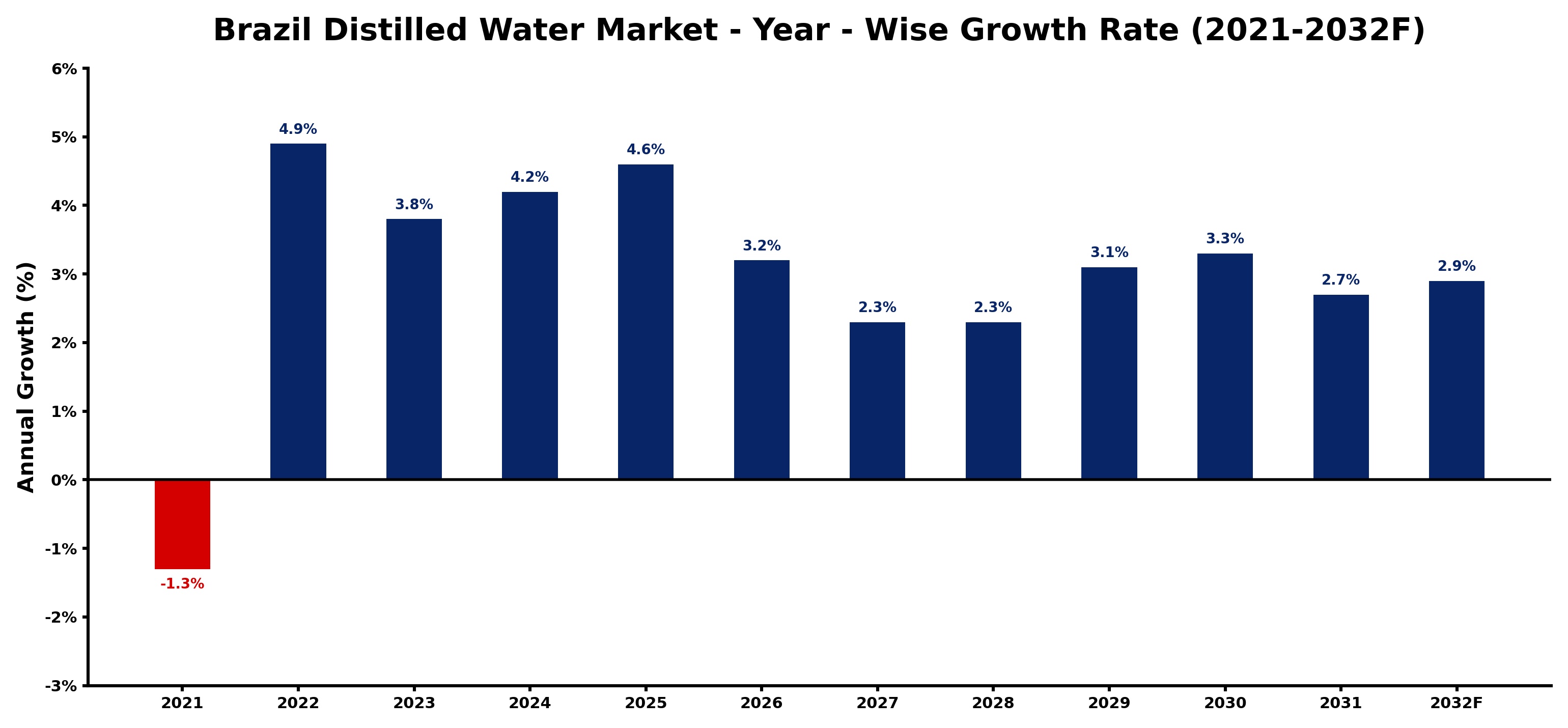
The table below presents the year‑wise growth rates along with the key drivers influencing the market
| Year | Growth Rate | Major Drivers |
| 2021 | -1.3% | Consumer preferences shifted downward |
| 2022 | 4.9% | Health awareness drove consumption growth |
| 2023 | 3.8% | Sustainability trends increased demand |
| 2024 | 4.2% | E-commerce expansion improved accessibility |
| 2025 | 4.6% | Product innovation attracted new consumers |
| 2026 | 3.2% | Distribution network enhancements facilitated reach |
| 2027 | 2.3% | Increased urbanization boosted sales |
| 2028 | 2.3% | Wellness trends promoted product usage |
| 2029 | 3.1% | Brand loyalty strengthened market position |
| 2030 | 3.3% | Promotional campaigns increased visibility |
| 2031 | 2.7% | Partnerships expanded market opportunities |
| 2032 | 2.9% | Consumer education enhanced product understanding |
Note - Market size estimations and growth projections presented in this report are based on 6Wresearch’s advanced forecasting approach, validated with industry datasets as of June 2026.
Brazil Distilled Water Market Synopsis
The most significant force shaping the Brazil Distilled Water Market is the stringent demand for purity within industrial applications. Industries like pharmaceuticals and electronics are not only expanding but are also pushing for higher quality standards, creating a solid foundation for sustained market growth.
In addition to industrial demand, consumer awareness regarding water quality has increased, fostering a shift towards distilled water for both residential and commercial uses. This awareness, coupled with government policies supporting sustainable water practices, reinforces the market's expansion prospects.
Brazil Distilled Water Market Key Takeaways
- Steady growth forecasted, with a projected market size of USD 540 Million by 2032.
- Industries such as pharmaceuticals, laboratories, and automotive batteries are driving demand.
- Government policies are focused on ensuring quality and promoting sustainable practices.
- Infrastructure development is crucial to overcoming distribution challenges in remote areas.
- Rising consumer awareness is augmenting demand for high-quality distilled water.
Evaluation of Restraints in Brazil Distilled Water Market
While the Brazil Distilled Water Market shows promise, it is not without its challenges. Water scarcity remains a pressing issue, directly impacting the supply chain and production capabilities. Furthermore, the need to adhere to stringent quality standards demands substantial investment in quality control and sanitation protocols. Distribution hurdles, especially in less accessible regions, also pose significant limitations, necessitating enhanced logistics and storage solutions to ensure product availability.
Brazil Distilled Water Market Trends
An emerging trend in the Brazil Distilled Water Market is the increasing integration of advanced purification technologies. Innovations such as multi-stage distillation and advanced filtration systems are not only enhancing the purity of distilled water but are also improving operational efficiencies. Additionally, there is a notable shift towards eco-friendly practices, where industries seek sustainable methods to produce and package distilled water, aligning with global environmental standards.
Brazil Distilled Water Market Opportunities
Investment opportunities in the Brazil Distilled Water Market are significant, particularly in enhancing infrastructure for water purification and distribution. Technological advancements offer a pathway for new entrants to innovate and capture market share. Moreover, sectors like electronics and automotive are poised for growth, creating a demand for high-quality distilled water that companies can tap into. Collaborations with government initiatives aimed at improving water management can also open doors for strategic partnerships and funding.
Government Initiatives in the Brazil Distilled Water Market
The Brazilian government actively implements policies that ensure the quality of distilled water products and promote sustainable water management. Regulatory frameworks include stringent quality standards for production and monitoring of water sources to safeguard public health. Furthermore, initiatives aimed at encouraging investment in water infrastructure seek to enhance production efficiencies and address ongoing challenges related to water scarcity. These efforts are crucial for fostering a stable and reliable distilled water market.
Future Insights of the Brazil Distilled Water Market
Looking ahead to the period from 2026 to 2032, the Brazil Distilled Water Market is expected to evolve significantly. Continued growth in critical industries such as healthcare and automotive will bolster demand for high-quality distilled water. Furthermore, ongoing government support and technological advancements are likely to enhance production capabilities and sustainability efforts. As consumer preferences shift towards cleaner, high-purity options, the market stands to benefit from an increasingly health-conscious populace, setting the stage for robust expansion.
Brazil Distilled Water Market Latest Developments (May 2025 - June 2026)
Recent developments in the Brazil Distilled Water Market indicate a focus on advancing production technologies to meet rising quality standards. Industry players are exploring innovative methods to enhance purification processes and expand distribution channels, particularly in underserved regions. Additionally, collaborations with regulatory bodies are increasing to ensure compliance with evolving health and safety standards, positioning companies to better respond to market demands.
Brazil Distilled Water Market - Key Attractiveness of the Report
- 10 Years of Market Numbers
- Historical Data Starting from 2022 to 2025
- Base Year: 2025
- Forecast Data until 2032
- Key Performance Indicators Impacting the Market
- Major Upcoming Developments and Projects
Key Highlights of the Report:
- Brazil Distilled Water Market Outlook
- Market Size of Brazil Distilled Water Market, 2025
- Forecast of Brazil Distilled Water Market, 2032
- Historical Data and Forecast of Brazil Distilled Water Revenues & Volume for the Period 2022-2032F
- Brazil Distilled Water Market Trend Evolution
- Brazil Distilled Water Market Drivers and Challenges
- Brazil Distilled Water Price Trends
- Brazil Distilled Water Porter's Five Forces
- Brazil Distilled Water Industry Life Cycle
- Historical Data and Forecast of Brazil Distilled Water Market Revenues & Volume By Types for the Period 2022-2032F
- Historical Data and Forecast of Brazil Distilled Water Market Revenues & Volume By Pharmaceutical Grade for the Period 2022-2032F
- Historical Data and Forecast of Brazil Distilled Water Market Revenues & Volume By Industrial Grade for the Period 2022-2032F
- Historical Data and Forecast of Brazil Distilled Water Market Revenues & Volume By Applications for the Period 2022-2032F
- Historical Data and Forecast of Brazil Distilled Water Market Revenues & Volume By Drinking for the Period 2022-2032F
- Historical Data and Forecast of Brazil Distilled Water Market Revenues & Volume By Chemical and Biological Laboratories for the Period 2022-2032F
- Historical Data and Forecast of Brazil Distilled Water Market Revenues & Volume By Automotive Cooling Systems and Batteries for the Period 2022-2032F
- Historical Data and Forecast of Brazil Distilled Water Market Revenues & Volume By Medical for the Period 2022-2032F
- Historical Data and Forecast of Brazil Distilled Water Market Revenues & Volume By Others for the Period 2022-2032F
- Brazil Distilled Water Import Export Trade Statistics
- Market Opportunity Assessment By Types
- Market Opportunity Assessment By Applications
- Brazil Distilled Water Top Companies Market Share
- Brazil Distilled Water Competitive Benchmarking By Technical and Operational Parameters
- Brazil Distilled Water Company Profiles
- Brazil Distilled Water Key Strategic Recommendations






































