Bulgaria Packaged Water Market Top 5 Importing Countries and Market Competition (HHI) Analysis
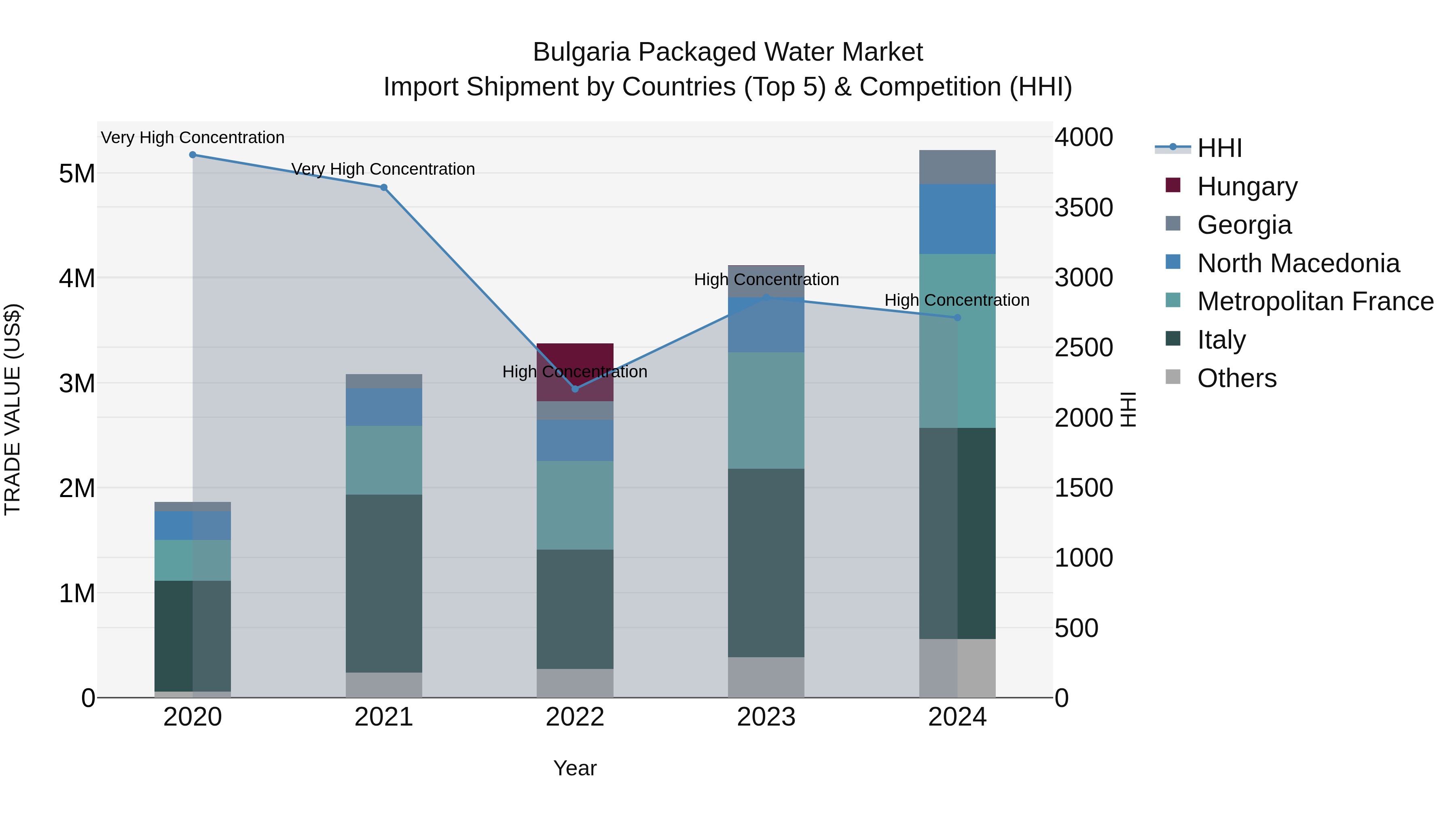
The packaged water import Market Top 5 Importing Countries and Market Competition (HHI) Analysis in Bulgaria saw significant growth in 2024, with top exporting countries being Italy, Metropolitan France, North Macedonia, Georgia, and Turkey. The high Herfindahl-Hirschman Index (HHI) indicates a concentrated Market Top 5 Importing Countries and Market Competition (HHI) Analysis landscape. The impressive Compound Annual Growth Rate (CAGR) of 29.34% from 2020 to 2024 and a growth rate of 26.66% in 2023-2024 reflect a robust demand for imported packaged water in Bulgaria, presenting opportunities for further Market Top 5 Importing Countries and Market Competition (HHI) Analysis expansion and competition among key exporters.
Bulgaria Packaged water Market Overview
The packaged water market in Bulgaria has experienced steady growth in recent years, driven by increasing health consciousness among consumers and a growing preference for convenient and portable hydration options. Key players in the market offer a variety of products including still, sparkling, flavored, and functional waters to cater to different consumer preferences. The market is highly competitive, with both domestic and international brands vying for market share through product innovation, marketing campaigns, and distribution strategies. Factors such as changing lifestyles, urbanization, and a shift towards healthier beverage choices are expected to continue driving growth in the packaged water market in Bulgaria. Additionally, environmental concerns have led to a rise in demand for sustainable packaging solutions, prompting companies to explore eco-friendly alternatives to traditional plastic bottles.
Bulgaria Packaged water Market Trends and Opportunities
The Bulgaria Packaged water market is experiencing strong growth driven by increasing health consciousness among consumers and a shift towards convenient and portable hydration solutions. With a rising emphasis on hydration and wellness, there is a growing demand for functional and enhanced water products, such as vitamin-infused waters and flavored variants. Additionally, the trend of sustainable packaging is gaining traction, leading to opportunities for eco-friendly packaging solutions in the market. Key players are focusing on product innovation, branding, and expanding distribution channels to capitalize on the growing demand. The market also presents opportunities for strategic partnerships with retailers and online platforms to reach a wider consumer base and drive sales. Overall, the Bulgaria Packaged water market is poised for further growth and innovation in the coming years.
Bulgaria Packaged water Market Challenges
In the Bulgaria Packaged water market, one of the main challenges faced is increasing competition from both local and international brands. This intense competition puts pressure on pricing strategies and profit margins for companies operating in the market. Additionally, there is a growing consumer demand for eco-friendly packaging solutions, leading to the need for companies to invest in sustainable packaging options. Another challenge is the strict regulations and standards imposed by authorities regarding the quality and safety of packaged water products, which require companies to constantly ensure compliance and invest in quality control measures. Overall, navigating these challenges while maintaining profitability and meeting evolving consumer preferences poses a significant hurdle for players in the Bulgaria Packaged water market.
Bulgaria Packaged water Market Drivers
The Bulgaria Packaged water market is primarily driven by increasing health consciousness among consumers, leading to a growing preference for safe and convenient hydration options. The rise in disposable income levels and changing lifestyles are also key drivers, as consumers seek on-the-go and portable packaging solutions for their hydration needs. The expanding tourism industry in Bulgaria further fuels the demand for packaged water, as travelers look for reliable and safe drinking water options. Additionally, concerns about water quality and contamination issues in certain regions are driving consumers towards packaged water as a trusted source of clean drinking water. The easy availability of a variety of packaged water products in different sizes and formats also contributes to the market growth in Bulgaria.
Bulgaria Packaged water Market Government Policy
Government policies related to the Bulgaria Packaged water Market focus on ensuring the safety, quality, and labeling standards of packaged water products. The Bulgarian Food Safety Agency (BFSA) regulates the production, distribution, and sale of packaged water to safeguard consumer health. This includes monitoring compliance with national and EU regulations, conducting inspections, and issuing licenses to manufacturers and distributors. The government also imposes strict labeling requirements to provide consumers with accurate information about the contents and origin of packaged water products. Additionally, there are regulations in place to prevent false advertising and misleading claims in the packaged water market. Overall, the government policies aim to maintain the integrity of the packaged water market in Bulgaria and protect consumers from potential health risks.
Bulgaria Packaged water Market Future Outlook
The Bulgaria packaged water market is expected to witness steady growth in the coming years, driven by factors such as increasing health consciousness among consumers, growing concerns about water quality, and the convenience offered by packaged water products. The market is likely to benefit from the rising demand for on-the-go hydration solutions and the shift towards healthier beverage options. Additionally, the expanding tourism sector in Bulgaria is expected to create opportunities for packaged water companies catering to both domestic and international visitors. With a focus on innovation, sustainability, and marketing strategies that highlight the purity and quality of their products, companies in the Bulgaria packaged water market can capitalize on these trends to maintain a competitive edge and drive growth in the future.
Key Highlights of the Report:
- Bulgaria Packaged water Market Outlook
- Market Size of Bulgaria Packaged water Market, 2024
- Forecast of Bulgaria Packaged water Market, 2031
- Historical Data and Forecast of Bulgaria Packaged water Revenues & Volume for the Period 2021- 2031
- Bulgaria Packaged water Market Trend Evolution
- Bulgaria Packaged water Market Drivers and Challenges
- Bulgaria Packaged water Price Trends
- Bulgaria Packaged water Porter's Five Forces
- Bulgaria Packaged water Industry Life Cycle
- Historical Data and Forecast of Bulgaria Packaged water Market Revenues & Volume By Product for the Period 2021- 2031
- Historical Data and Forecast of Bulgaria Packaged water Market Revenues & Volume By Still for the Period 2021- 2031
- Historical Data and Forecast of Bulgaria Packaged water Market Revenues & Volume By Carbonated for the Period 2021- 2031
- Historical Data and Forecast of Bulgaria Packaged water Market Revenues & Volume By Flavored for the Period 2021- 2031
- Historical Data and Forecast of Bulgaria Packaged water Market Revenues & Volume By Functional for the Period 2021- 2031
- Bulgaria Packaged water Import Export Trade Statistics
- Market Opportunity Assessment By Product
- Bulgaria Packaged water Top Companies Market Share
- Bulgaria Packaged water Competitive Benchmarking By Technical and Operational Parameters
- Bulgaria Packaged water Company Profiles
- Bulgaria Packaged water Key Strategic Recommendations






































