Chile Bromine Market Top 5 Importing Countries and Market Competition (HHI) Analysis
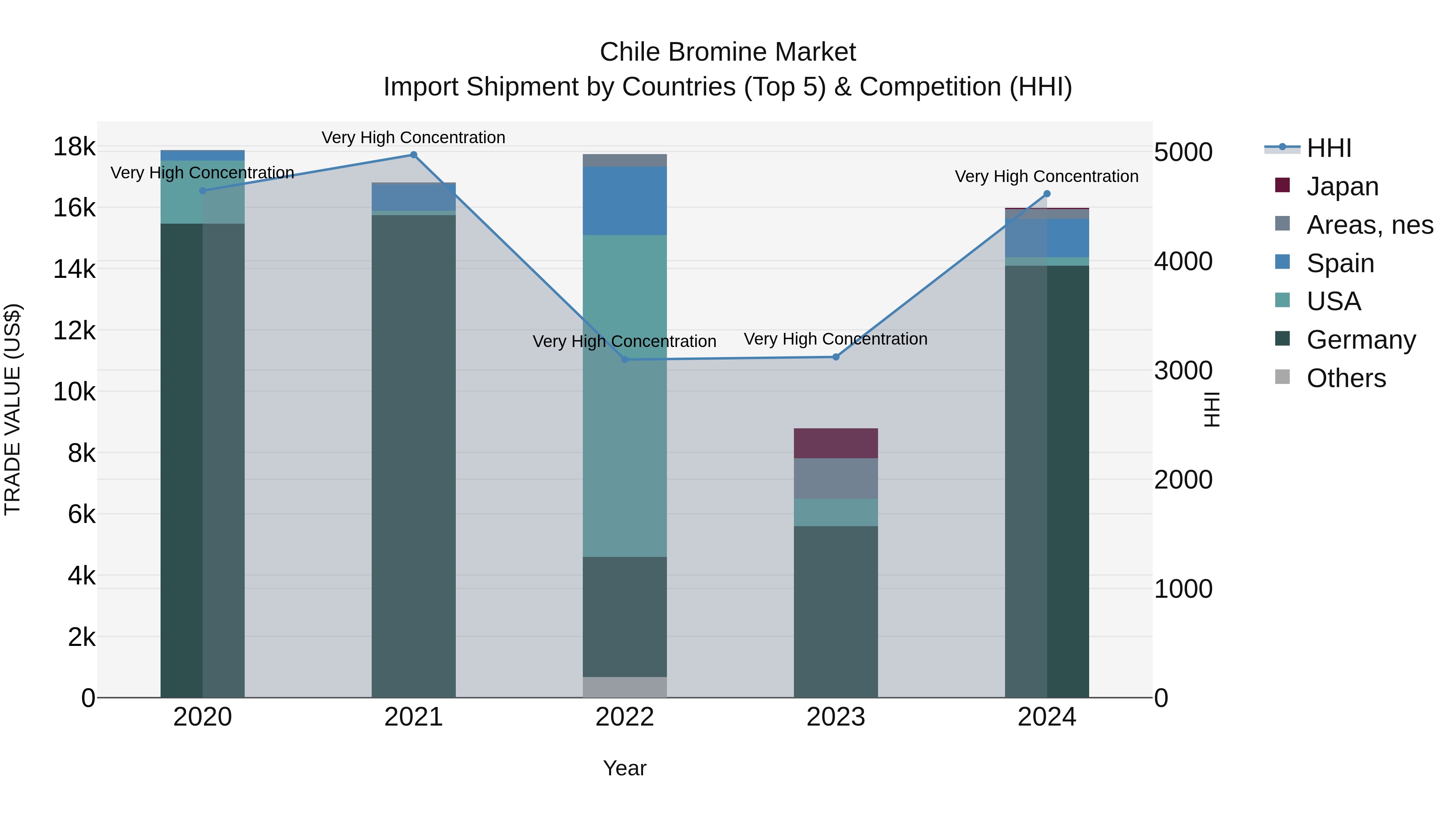
Chile`s bromine import market in 2024 continued to be dominated by key exporters such as Germany, Spain, Areas, nes, USA, and Japan. The high Herfindahl-Hirschman Index (HHI) indicates a concentrated market structure. Despite a negative compound annual growth rate (CAGR) from 2020 to 2024, the impressive growth rate of 81.72% from 2023 to 2024 suggests a potential shift or surge in demand for bromine imports in Chile. It will be interesting to monitor how these trends evolve in the coming years.
Chile Bromine Market Overview
The Chile Bromine Market is experiencing steady growth driven by increasing demand from various industries such as flame retardants, oil and gas drilling, and pharmaceuticals. Chile is one of the leading producers of bromine globally, benefiting from its abundant natural resources and mining expertise. The market is expected to continue its growth trajectory due to the rising need for flame retardants in construction materials and electronics, as well as the expanding oil and gas exploration activities in the region. Furthermore, the pharmaceutical industry is also a key consumer of bromine for the production of various medications. Overall, the Chile Bromine Market presents lucrative opportunities for investors and industry players looking to capitalize on the growing demand for bromine-based products.
Chile Bromine Market Trends
The Chile Bromine Market is experiencing steady growth due to increasing demand from various industries such as flame retardants, oil and gas drilling, and pharmaceuticals. The market is witnessing a shift towards eco-friendly and sustainable bromine derivatives, driven by growing environmental concerns and stringent regulations. Additionally, the rising use of bromine compounds in water treatment applications is further fueling market growth. Key players in the Chile Bromine Market are focusing on innovation and product development to meet the evolving needs of end-users. The market is also witnessing collaborations and partnerships among companies to expand their market presence and enhance their product offerings. Overall, the Chile Bromine Market is expected to continue its growth trajectory in the coming years, driven by increasing industrial applications and the shift towards sustainable solutions.
Chile Bromine Market Challenges
In the Chile Bromine Market, some challenges faced include fluctuating global demand and prices, increased competition from other bromine-producing countries, regulatory changes impacting production and export processes, and environmental concerns regarding bromine extraction and disposal. Additionally, the market may be influenced by geopolitical factors and trade policies that could disrupt supply chains and impact prices. Companies operating in the Chile Bromine Market need to stay agile in response to these challenges, diversify their product offerings, explore new markets, and invest in sustainable production practices to ensure long-term success in a dynamic and competitive industry landscape.
Chile Bromine Market Investment Opportunities
The Chile Bromine Market offers several investment opportunities for potential investors. With the increasing demand for bromine in various industries such as flame retardants, oil & gas drilling, and pharmaceuticals, there is a growing market for bromine products in Chile. Investing in bromine production facilities or mining operations in Chile can be lucrative due to the country`s significant bromine reserves and favorable mining regulations. Additionally, the expanding global market for bromine-based products presents opportunities for Chilean companies to export their products internationally. Investing in research and development of innovative bromine applications or sustainable production methods can also be a promising avenue for investors looking to capitalize on the growth potential of the Chile Bromine Market.
Chile Bromine Market Government Policy
The Chilean government has implemented policies to regulate the Bromine Market, primarily focused on environmental protection and sustainable development. Regulations include setting limits on bromine emissions, monitoring bromine production processes to ensure compliance with safety standards, and promoting responsible waste management practices within the industry. Additionally, the government has established incentives for companies to invest in research and development of eco-friendly bromine extraction and production methods. These policies aim to balance the economic benefits of the bromine industry with environmental concerns, ensuring that Chile`s bromine market remains competitive while minimizing its impact on the environment.
Chile Bromine Market Future Outlook
The Chile Bromine Market is expected to witness steady growth in the coming years, driven by increasing demand from various industries such as flame retardants, oil and gas drilling, and pharmaceuticals. The market is likely to benefit from the expanding construction sector, where bromine-based flame retardants are widely used. Additionally, the oil and gas industry`s recovery is expected to boost the demand for bromine compounds for drilling fluids. The growing focus on environmental regulations and the shift towards sustainable practices may also drive the market towards more eco-friendly bromine production methods. Overall, the Chile Bromine Market is poised for growth opportunities, with key players focusing on innovation and expanding their product portfolios to meet the evolving industry demands.
Key Highlights of the Report:
- Chile Bromine Market Outlook
- Market Size of Chile Bromine Market, 2021
- Forecast of Chile Bromine Market, 2031
- Historical Data and Forecast of Chile Bromine Revenues & Volume for the Period 2021 - 2031
- Chile Bromine Market Trend Evolution
- Chile Bromine Market Drivers and Challenges
- Chile Bromine Price Trends
- Chile Bromine Porter's Five Forces
- Chile Bromine Industry Life Cycle
- Historical Data and Forecast of Chile Bromine Market Revenues & Volume By Derivative for the Period 2021 - 2031
- Historical Data and Forecast of Chile Bromine Market Revenues & Volume By Organobromine for the Period 2021 - 2031
- Historical Data and Forecast of Chile Bromine Market Revenues & Volume By Clear Brine Fluids for the Period 2021 - 2031
- Historical Data and Forecast of Chile Bromine Market Revenues & Volume By Hydrogen Bromide for the Period 2021 - 2031
- Historical Data and Forecast of Chile Bromine Market Revenues & Volume By Application for the Period 2021 - 2031
- Historical Data and Forecast of Chile Bromine Market Revenues & Volume By Flame Retardants for the Period 2021 - 2031
- Historical Data and Forecast of Chile Bromine Market Revenues & Volume By Oil & Gas Drilling for the Period 2021 - 2031
- Historical Data and Forecast of Chile Bromine Market Revenues & Volume By PTA Synthesis for the Period 2021 - 2031
- Historical Data and Forecast of Chile Bromine Market Revenues & Volume By Water Treatment & Biocides for the Period 2021 - 2031
- Historical Data and Forecast of Chile Bromine Market Revenues & Volume By Pesticides for the Period 2021 - 2031
- Historical Data and Forecast of Chile Bromine Market Revenues & Volume By HBr Flow Batteries for the Period 2021 - 2031
- Historical Data and Forecast of Chile Bromine Market Revenues & Volume By Pharmaceuticals for the Period 2021 - 2031
- Historical Data and Forecast of Chile Bromine Market Revenues & Volume By Others for the Period 2021 - 2031
- Chile Bromine Import Export Trade Statistics
- Market Opportunity Assessment By Derivative
- Market Opportunity Assessment By Application
- Chile Bromine Top Companies Market Share
- Chile Bromine Competitive Benchmarking By Technical and Operational Parameters
- Chile Bromine Company Profiles
- Chile Bromine Key Strategic Recommendations






































