Chile Cloud Computing Market Size & Growth Rate (2026-2032)
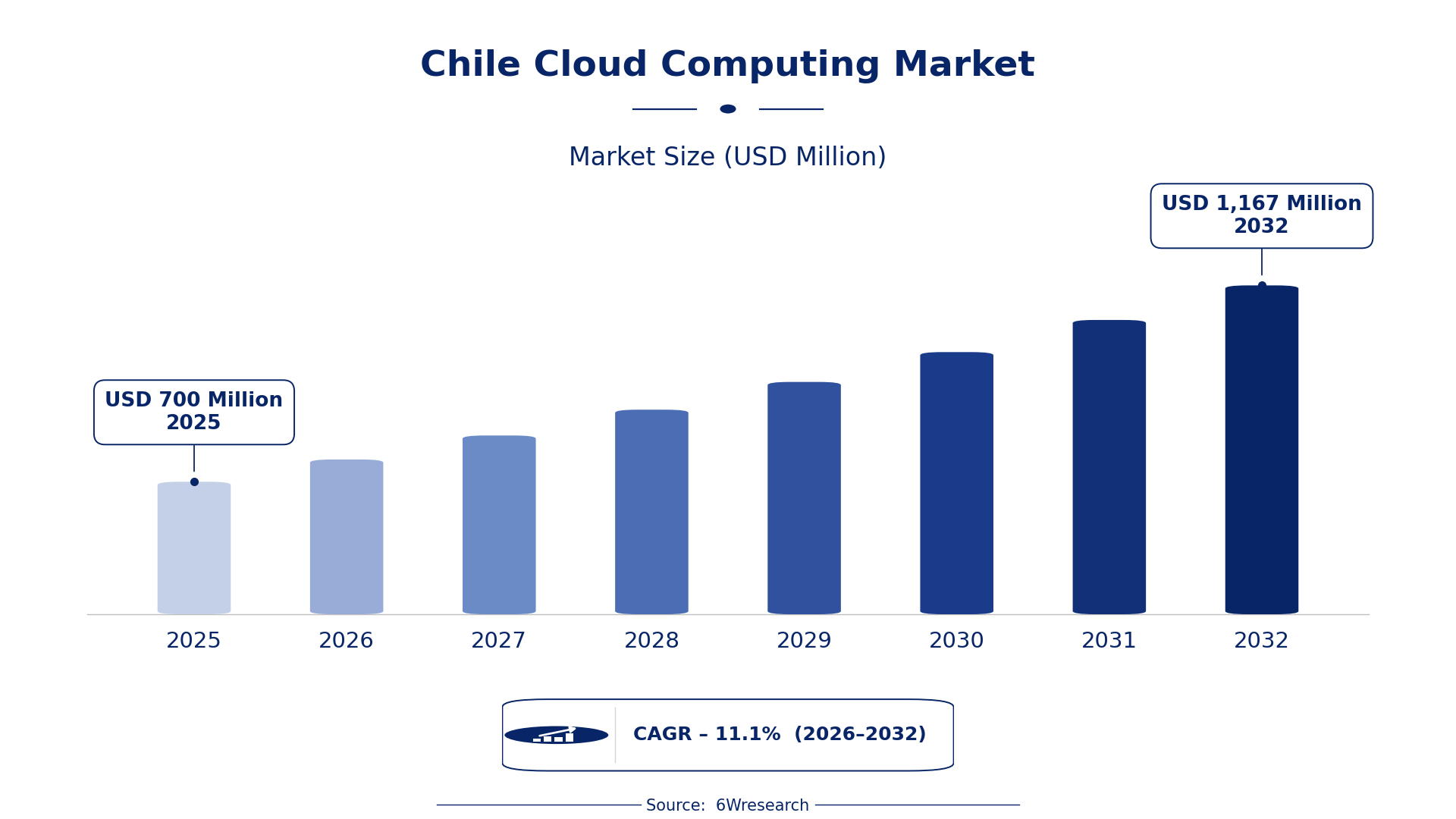
The Chile Cloud Computing Market was estimated at USD 700 Million in 2025 and is projected to reach USD 1167 Million by 2032, growing at a CAGR of 11.1% from 2026 to 2032.
Chile Cloud Computing Market Synopsis
The Chile cloud computing market is on an upward trajectory, fueled by the escalating adoption of digital solutions across various sectors. Healthcare, finance, and government entities are increasingly leveraging cloud technologies to enhance their operational efficiency and service delivery.
With a stable economic backdrop and rising internet penetration rates, the demand for cloud services is growing. Government initiatives aimed at digital transformation further catalyze this shift, presenting vast potential for local and international cloud service providers.
Chile Cloud Computing Market Year-wise Growth Rate and Key Drivers
This graph illustrates the annual growth rates of the Chile Cloud Computing Market from 2021 to 2032, highlighting a steady upward trajectory and projected expansion over the forecast period.
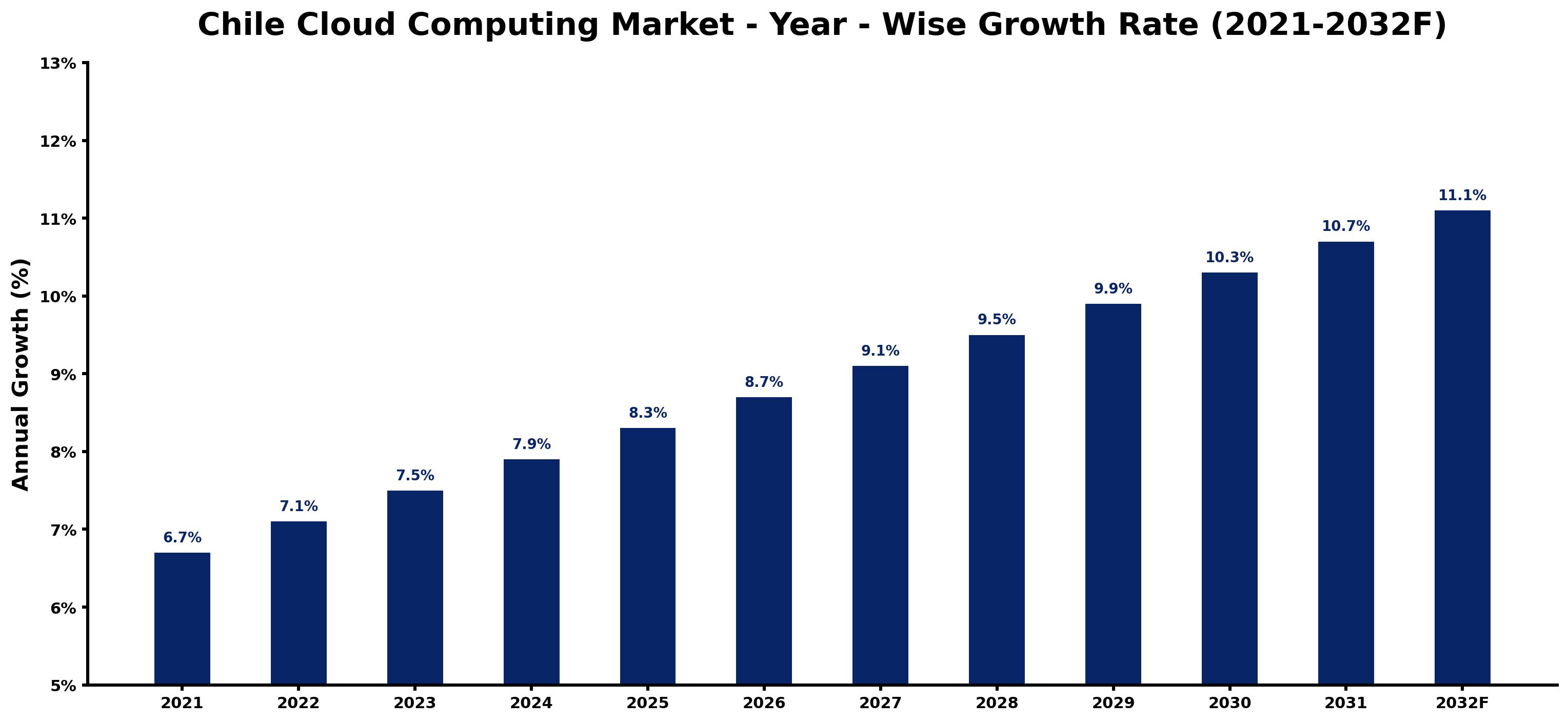
The table below presents the year‑wise growth rates along with the key drivers influencing the market
| Year | Growth Rate | Major Drivers |
| 2021 | 6.7% | Increased investments from local startups in cloud solutions. |
| 2022 | 7.1% | Emergence of fintech regulations boosting cloud security standards. |
| 2023 | 7.5% | Rising e-commerce activities driving demand for scalable cloud infrastructure. |
| 2024 | 7.9% | Government programs supporting cloud migration for SMEs. |
| 2025 | 8.3% | Growth of IoT applications necessitating robust cloud services. |
| 2026 | 8.7% | Educational institutions adopting cloud for remote learning solutions. |
| 2027 | 9.1% | Higher digital literacy driving cloud adoption across industries. |
| 2028 | 9.5% | Support from CORFO for innovative cloud-based projects. |
| 2029 | 9.9% | Increased use of AI applications enhancing cloud service offerings. |
| 2030 | 10.3% | Rising consumer data privacy concerns driving cloud security investments. |
| 2031 | 10.7% | Booming gaming industry requiring advanced cloud gaming platforms. |
| 2032 | 11.1% | Local companies leveraging cloud for digital marketing strategies. |
Note: Market size estimations and growth projections presented in this report are based on 6Wresearch's proprietary forecasting methodology, utilizing the latest available industry data, government publications, and primary research inputs.
Chile Cloud Computing Market Key Takeaways
Below are some of the specific key takeaways from the market, including:
- The Chilean cloud computing market is experiencing substantial growth driven by digital transformation initiatives.
- Hybrid cloud solutions are gaining traction as organizations seek flexible IT infrastructures.
- Edge computing is emerging as a critical component, addressing latency and data processing needs.
- Government policies are fostering an environment conducive to cloud adoption across sectors.
- Data security and compliance remain paramount concerns that businesses must address to ensure successful cloud integration.
Evaluation of Restraints in Chile Cloud Computing Market
Despite its growth potential, the Chile cloud computing market faces several restraints that can impede its expansion. Chief among these are data privacy and security concerns, given the sensitive nature of information stored in the cloud. Compliance with both local regulations and international standards can be cumbersome, particularly for companies that operate across borders.
Additionally, infrastructure limitations in certain regions pose connectivity challenges that affect service adoption. A shortage of skilled professionals in cloud technologies further complicates matters, as businesses may struggle to find the expertise necessary for successful implementation. Addressing these issues is essential for realizing the full potential of cloud computing in Chile.
Chile Cloud Computing Market Trends
Several trends are shaping the Chile cloud computing market. The shift towards hybrid cloud solutions is prominent, with organizations seeking to balance on-premises and cloud resources. This flexibility allows businesses to tailor their IT infrastructures to specific operational needs, driving efficiency.
on top of that, the rise of edge computing is gaining momentum as businesses seek to process data closer to its source, which enhances responsiveness and reduces latency. A heightened focus on data security and regulatory compliance is also influencing cloud adoption, as organizations strive to protect sensitive information and adhere to legal frameworks.
Chile Cloud Computing Market Opportunities
The opportunities within the Chile cloud computing market are substantial. Increasing demand for scalable and cost-effective IT solutions presents a ripe environment for service providers. As businesses accelerate their digital transformation efforts, they are increasingly recognizing the benefits of cloud technologies, such as flexibility, agility, and cost savings.
Additionally, emerging technologies like artificial intelligence and the Internet of Things are creating new use cases for cloud computing, further driving demand. The focus on innovation and a supportive regulatory environment allows cloud service providers to expand their offerings and cater to evolving business needs effectively.
Government Initiatives in the Chile Cloud Computing Market
The Chilean government has recognized the importance of cloud computing in advancing its digital economy and has put forth several initiatives to bolster the market. By promoting digital transformation across both public and private sectors, these initiatives aim to enhance the overall infrastructure and capabilities necessary for cloud adoption.
- A recently completed National Digital Strategy aimed at increasing digital maturity across all sectors.
- Currently ongoing initiatives include the Digital Talent Plan, which focuses on developing skilled professionals in technology.
- The establishment of the National Cloud Computing Policy encourages businesses to adopt cloud solutions.
- Upcoming plans involve a national digital infrastructure upgrade programme, expected to enhance connectivity and accessibility by 2028.
Future Insights of the Chile Cloud Computing Market
Looking ahead to 2026-2032, the Chile cloud computing market is set for continued expansion. Increasing demand for cloud services, driven by digital transformation across industries, will remain a primary growth catalyst. As businesses increasingly recognize the operational advantages of cloud solutions, market players can expect a steady rise in demand.
on top of that, government support through various initiatives will play a crucial role in shaping the future of the market. Investments in infrastructure and a focus on data security will further enhance the adoption of cloud computing, paving the way for innovation and growth.
Chile Cloud Computing Market Latest Developments
Recent activity in the Chile cloud computing market has highlighted significant progress and innovation. Over the last 12-14 months, various developments have emerged, showcasing the commitment of both public and private sectors to enhance cloud capabilities and service offerings.
- A major technology vendor launched a new cloud-based analytics platform in early 2025, aimed at improving business intelligence for local companies.
- An initiative that began in mid-2025 and remains underway is the upgrade of existing data centers to enhance service reliability and speed.
- A partnership between a leading regional operator and a global cloud service provider is expected to facilitate wider access to cloud solutions across Chile by Q4 2025.
- Plans for a new public-private collaboration aimed at expanding cloud services to underserved regions are set to kick off in 2026.
Chile Cloud Computing Market - Key Attractiveness of the Report
- 10 Years of Market Numbers
- Historical Data Starting from 2022 to 2025
- Base Year: 2025
- Forecast Data until 2032
- Key Performance Indicators Impacting the Market
- Major Upcoming Developments and Projects
Key Highlights of the Report:
- Chile Cloud Computing Market Outlook
- Market Size of Chile Cloud Computing Market, 2025
- Forecast of Chile Cloud Computing Market, 2032
- Historical Data and Forecast of Chile Cloud Computing Revenues & Volume for the Period 2022-2032F
- Chile Cloud Computing Market Trend Evolution
- Chile Cloud Computing Market Drivers and Challenges
- Chile Cloud Computing Price Trends
- Chile Cloud Computing Porter's Five Forces
- Chile Cloud Computing Industry Life Cycle
- Historical Data and Forecast of Chile Cloud Computing Market Revenues & Volume By Service Model for the Period 2022-2032F
- Historical Data and Forecast of Chile Cloud Computing Market Revenues & Volume By Infrastructure as a Service for the Period 2022-2032F
- Historical Data and Forecast of Chile Cloud Computing Market Revenues & Volume By Platform as a Service for the Period 2022-2032F
- Historical Data and Forecast of Chile Cloud Computing Market Revenues & Volume By Software as a Service for the Period 2022-2032F
- Historical Data and Forecast of Chile Cloud Computing Market Revenues & Volume By Infrastructure as a Service for the Period 2022-2032F
- Historical Data and Forecast of Chile Cloud Computing Market Revenues & Volume By Primary Storage for the Period 2022-2032F
- Historical Data and Forecast of Chile Cloud Computing Market Revenues & Volume By Disaster Recovery and Backup for the Period 2022-2032F
- Historical Data and Forecast of Chile Cloud Computing Market Revenues & Volume By Archiving for the Period 2022-2032F
- Historical Data and Forecast of Chile Cloud Computing Market Revenues & Volume By Computer for the Period 2022-2032F
- Historical Data and Forecast of Chile Cloud Computing Market Revenues & Volume By Platform as a Service for the Period 2022-2032F
- Historical Data and Forecast of Chile Cloud Computing Market Revenues & Volume By Application Development and Platforms for the Period 2022-2032F
- Historical Data and Forecast of Chile Cloud Computing Market Revenues & Volume By Application Testing and Quality for the Period 2022-2032F
- Historical Data and Forecast of Chile Cloud Computing Market Revenues & Volume By Analytics and Reporting for the Period 2022-2032F
- Historical Data and Forecast of Chile Cloud Computing Market Revenues & Volume By Integration and Orchestration for the Period 2022-2032F
- Historical Data and Forecast of Chile Cloud Computing Market Revenues & Volume By Data Management for the Period 2022-2032F
- Historical Data and Forecast of Chile Cloud Computing Market Revenues & Volume By Software as a Service for the Period 2022-2032F
- Historical Data and Forecast of Chile Cloud Computing Market Revenues & Volume By Customer Relationship Management for the Period 2022-2032F
- Historical Data and Forecast of Chile Cloud Computing Market Revenues & Volume By Enterprise Resource Management for the Period 2022-2032F
- Historical Data and Forecast of Chile Cloud Computing Market Revenues & Volume By Human Capital Management for the Period 2022-2032F
- Historical Data and Forecast of Chile Cloud Computing Market Revenues & Volume By Content Management for the Period 2022-2032F
- Historical Data and Forecast of Chile Cloud Computing Market Revenues & Volume By Collaboration and Productivity Suites for the Period 2022-2032F
- Historical Data and Forecast of Chile Cloud Computing Market Revenues & Volume By Supply Chain Management for the Period 2022-2032F
- Historical Data and Forecast of Chile Cloud Computing Market Revenues & Volume By Others for the Period 2022-2032F
- Historical Data and Forecast of Chile Cloud Computing Market Revenues & Volume By Organization Size for the Period 2022-2032F
- Historical Data and Forecast of Chile Cloud Computing Market Revenues & Volume By Large Enterprises for the Period 2022-2032F
- Historical Data and Forecast of Chile Cloud Computing Market Revenues & Volume By SMEs for the Period 2022-2032F
- Historical Data and Forecast of Chile Cloud Computing Market Revenues & Volume By Deployment Model for the Period 2022-2032F
- Historical Data and Forecast of Chile Cloud Computing Market Revenues & Volume By Public Cloud for the Period 2022-2032F
- Historical Data and Forecast of Chile Cloud Computing Market Revenues & Volume By Private Cloud for the Period 2022-2032F
- Historical Data and Forecast of Chile Cloud Computing Market Revenues & Volume By Verticals for the Period 2022-2032F
- Historical Data and Forecast of Chile Cloud Computing Market Revenues & Volume By BFSI for the Period 2022-2032F
- Historical Data and Forecast of Chile Cloud Computing Market Revenues & Volume By Telecommunication for the Period 2022-2032F
- Historical Data and Forecast of Chile Cloud Computing Market Revenues & Volume By IT & ITeS for the Period 2022-2032F
- Historical Data and Forecast of Chile Cloud Computing Market Revenues & Volume By Government & Public Sector for the Period 2022-2032F
- Historical Data and Forecast of Chile Cloud Computing Market Revenues & Volume By Retail & Consumer Goods for the Period 2022-2032F
- Historical Data and Forecast of Chile Cloud Computing Market Revenues & Volume By Manufacturing for the Period 2022-2032F
- Historical Data and Forecast of Chile Cloud Computing Market Revenues & Volume By Energy & Utility for the Period 2022-2032F
- Historical Data and Forecast of Chile Cloud Computing Market Revenues & Volume By Media & Entertainment for the Period 2022-2032F
- Chile Cloud Computing Import Export Trade Statistics
- Market Opportunity Assessment By Service Model
- Market Opportunity Assessment By Infrastructure as a Service
- Market Opportunity Assessment By Platform as a Service
- Market Opportunity Assessment By Software as a Service
- Market Opportunity Assessment By Organization Size
- Market Opportunity Assessment By Deployment Model
- Market Opportunity Assessment By Verticals
- Chile Cloud Computing Top Companies Market Share
- Chile Cloud Computing Competitive Benchmarking By Technical and Operational Parameters
- Chile Cloud Computing Company Profiles
- Chile Cloud Computing Key Strategic Recommendations






































