Chile Medical Tubing Market Size, Share & Growth Rate
The Chile Medical Tubing Market was estimated at USD 191 Million in 2025 and is projected to reach USD 253 Million by 2032, growing at a CAGR of 4.1% from 2026 to 2032. This growth trajectory is primarily attributed to the increasing geriatric population and the heightened demand for sophisticated healthcare solutions. The rising number of medical procedures involving tubing, such as intravenous therapies and catheterizations, further underscores the expanding market potential.
Chile Medical Tubing Market Year-wise Growth Rate and Key Drivers
This graph highlights how the Chile Medical Tubing Market has steadily grown over the years, supported by major growth factors.
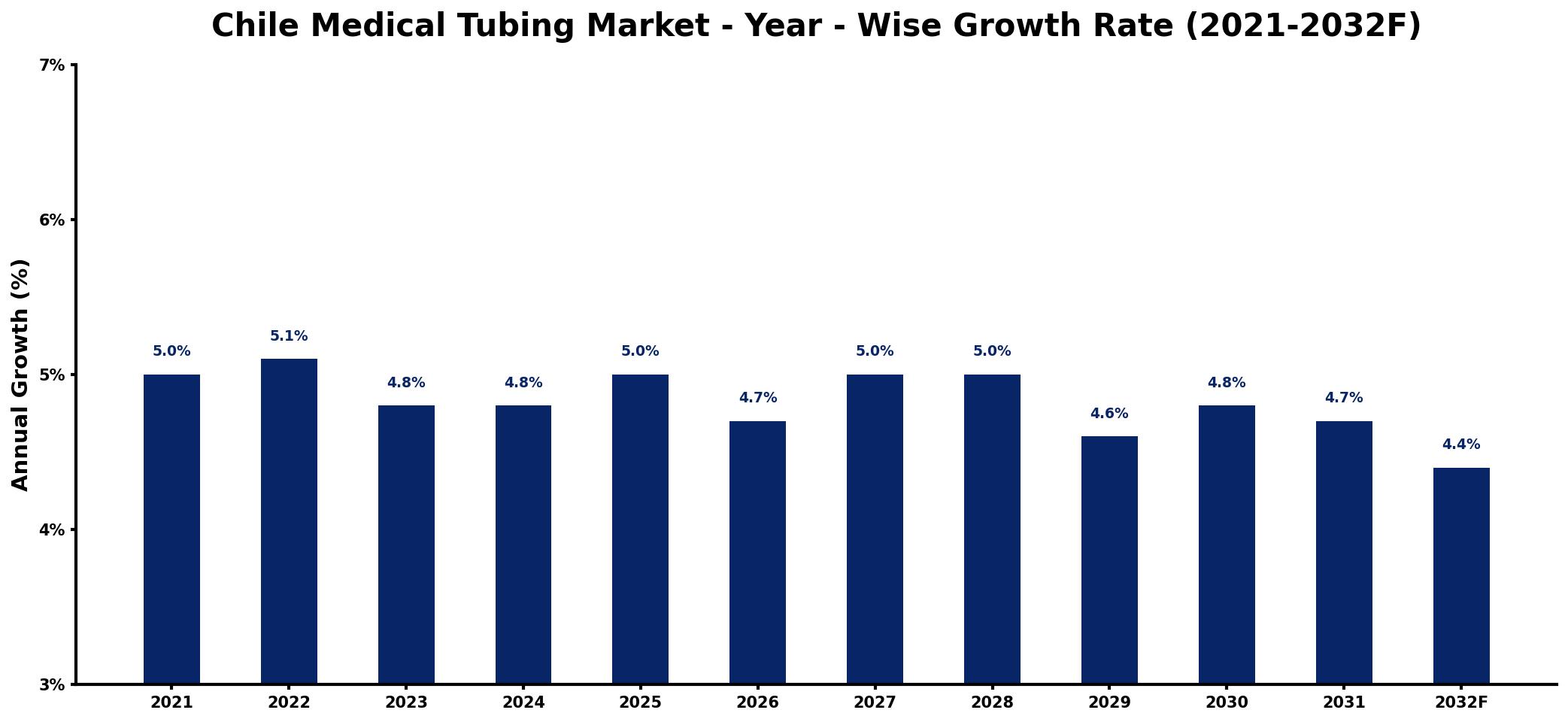
The table below presents the year‑wise growth rates along with the key drivers influencing the market
| Year | Growth Rate | Major Drivers |
| 2021 | 5.0% | Rising healthcare infrastructure investments |
| 2022 | 5.1% | Increased demand for biocompatible materials |
| 2023 | 4.8% | Expansion of healthcare facilities network |
| 2024 | 4.8% | Growing focus on patient safety |
| 2025 | 5.0% | Advancements in manufacturing technology |
| 2026 | 4.7% | Surge in telehealth service adoption |
| 2027 | 5.0% | Increase in preventive healthcare measures |
| 2028 | 5.0% | Growth in surgical procedures volume |
| 2029 | 4.6% | Emergence of innovative therapeutic solutions |
| 2030 | 4.8% | Strengthening regulatory compliance standards |
| 2031 | 4.7% | Boost in global healthcare collaborations |
| 2032 | 4.4% | Rise in aging population demands |
Note: Market size estimations and growth projections presented in this report are based on 6Wresearch's proprietary forecasting methodology, utilizing the latest available industry data, government publications, and primary research inputs.
Chile Medical Tubing Market Synopsis
In recent years, the Chile Medical Tubing Market has experienced notable momentum, driven by technological advancements and escalating healthcare expenditures. This positive outlook is set against a backdrop of increasing regulatory oversight, ensuring that products adhere to the highest safety standards.
As we move forward, the market is expected to align closely with evolving healthcare needs, particularly concerning minimally invasive procedures. Innovations in materials and designs are becoming crucial as manufacturers strive to enhance patient comfort and product performance while navigating stringent regulatory landscapes.
Chile Medical Tubing Market Key Takeaways
- The market is significantly driven by an aging population and rising healthcare expenditure.
- Technological advancements are leading to innovative materials and designs in medical tubing.
- Increasing demand for minimally invasive procedures is reshaping market dynamics.
- Regulatory compliance remains a critical factor influencing production costs and market entry.
- Investment opportunities are ripe due to an ongoing focus on healthcare infrastructure enhancement.
Evaluation of Restraints in Chile Medical Tubing Market
The Chile Medical Tubing Market faces several restraints that could hinder growth. Chief among these are the stringent regulatory frameworks mandated by the Chilean Ministry of Health, which, while ensuring quality, often increase production costs. Smaller players find it particularly challenging to navigate these compliance requirements. Additionally, the competition from imported medical tubing products exerts pricing pressure, impacting domestic manufacturers' profitability. Supply chain disruptions and rising raw material costs further complicate the landscape, necessitating constant innovation and differentiation from market players.
Chile Medical Tubing Market Trends
A notable trend within the Chile Medical Tubing Market is the increasing preference for materials like silicone and PVC, recognized for their flexibility and biocompatibility. As healthcare professionals aim for improved patient outcomes, the demand for specialized tubing applications, such as drug delivery systems and respiratory devices, is on the rise. Furthermore, a strong emphasis on infection control measures has led to a growing market for disposable medical tubing products, reflecting a shift towards safety and prevention in healthcare settings.
Chile Medical Tubing Market Opportunities
Investors and manufacturers in the Chile Medical Tubing Market can capitalize on the growing demand for high-quality medical devices. The emphasis on innovative and technologically advanced products opens doors for companies willing to invest in research and development. The ongoing efforts to improve healthcare infrastructure in Chile present further opportunities for market players, as this enhances the adoption of advanced medical technologies across various healthcare sectors.
Government Initiatives in the Chile Medical Tubing Market
The Chilean government plays a vital role in shaping the medical tubing landscape through regulations implemented by the Ministry of Health. These guidelines ensure that medical tubing products adhere to strict safety and quality standards. Additionally, the government is actively working on policies that promote the development and regulation of medical devices, creating a supportive environment for growth in the medical tubing sector.
Future Insights of the Chile Medical Tubing Market
Looking ahead to the period between 2026 and 2032, the Chile Medical Tubing Market is well-positioned for steady growth. The increasing focus on quality healthcare services, coupled with advancements in medical technology, will drive market expansion. The ongoing demand for disposable medical tubing products in response to infection control needs further bolsters this outlook. As the healthcare system in Chile continues to evolve, innovation in medical tubing materials and applications will be paramount to meet emerging healthcare demands.
Chile Medical Tubing Market Latest Developments (2025 - 2026)
Recent developments in the Chile Medical Tubing Market indicate a shift toward the integration of smart technologies into medical devices. Manufacturers are exploring the incorporation of sensors and monitoring systems into tubing products to enhance patient care. Meanwhile, collaboration between healthcare providers and manufacturers is fostering innovation, as stakeholders seek to align product offerings with the latest healthcare practices.
Chile Medical Tubing Market - Key Attractiveness of the Report
- 10 Years of Market Numbers
- Historical Data Starting from 2022 to 2025
- Base Year: 2025
- Forecast Data until 2032
- Key Performance Indicators Impacting the Market
- Major Upcoming Developments and Projects
Key Highlights of the Report:
- Chile Medical Tubing Market Outlook
- Market Size of Chile Medical Tubing Market, 2025
- Forecast of Chile Medical Tubing Market, 2032
- Historical Data and Forecast of Chile Medical Tubing Revenues & Volume for the Period 2022-2032F
- Chile Medical Tubing Market Trend Evolution
- Chile Medical Tubing Market Drivers and Challenges
- Chile Medical Tubing Price Trends
- Chile Medical Tubing Porter's Five Forces
- Chile Medical Tubing Industry Life Cycle
- Historical Data and Forecast of Chile Medical Tubing Market Revenues & Volume By Material for the Period 2022-2032F
- Historical Data and Forecast of Chile Medical Tubing Market Revenues & Volume By Plastics for the Period 2022-2032F
- Historical Data and Forecast of Chile Medical Tubing Market Revenues & Volume By Rubbers for the Period 2022-2032F
- Historical Data and Forecast of Chile Medical Tubing Market Revenues & Volume By Specialty Polymers for the Period 2022-2032F
- Historical Data and Forecast of Chile Medical Tubing Market Revenues & Volume By Structure for the Period 2022-2032F
- Historical Data and Forecast of Chile Medical Tubing Market Revenues & Volume By Single-lumen for the Period 2022-2032F
- Historical Data and Forecast of Chile Medical Tubing Market Revenues & Volume By Co-extruded for the Period 2022-2032F
- Historical Data and Forecast of Chile Medical Tubing Market Revenues & Volume By Multi-lumen for the Period 2022-2032F
- Historical Data and Forecast of Chile Medical Tubing Market Revenues & Volume By Tapered Or Bump Tubing for the Period 2022-2032F
- Historical Data and Forecast of Chile Medical Tubing Market Revenues & Volume By Braided Tubing for the Period 2022-2032F
- Historical Data and Forecast of Chile Medical Tubing Market Revenues & Volume By Application for the Period 2022-2032F
- Historical Data and Forecast of Chile Medical Tubing Market Revenues & Volume By Bulk Disposable Tubing for the Period 2022-2032F
- Historical Data and Forecast of Chile Medical Tubing Market Revenues & Volume By Catheters & Cannulas for the Period 2022-2032F
- Historical Data and Forecast of Chile Medical Tubing Market Revenues & Volume By Drug Delivery System for the Period 2022-2032F
- Historical Data and Forecast of Chile Medical Tubing Market Revenues & Volume By Special Applications for the Period 2022-2032F
- Chile Medical Tubing Import Export Trade Statistics
- Market Opportunity Assessment By Material
- Market Opportunity Assessment By Structure
- Market Opportunity Assessment By Application
- Chile Medical Tubing Top Companies Market Share
- Chile Medical Tubing Competitive Benchmarking By Technical and Operational Parameters
- Chile Medical Tubing Company Profiles
- Chile Medical Tubing Key Strategic Recommendations






































