China 5G Backhaul Market Size & Growth Rate
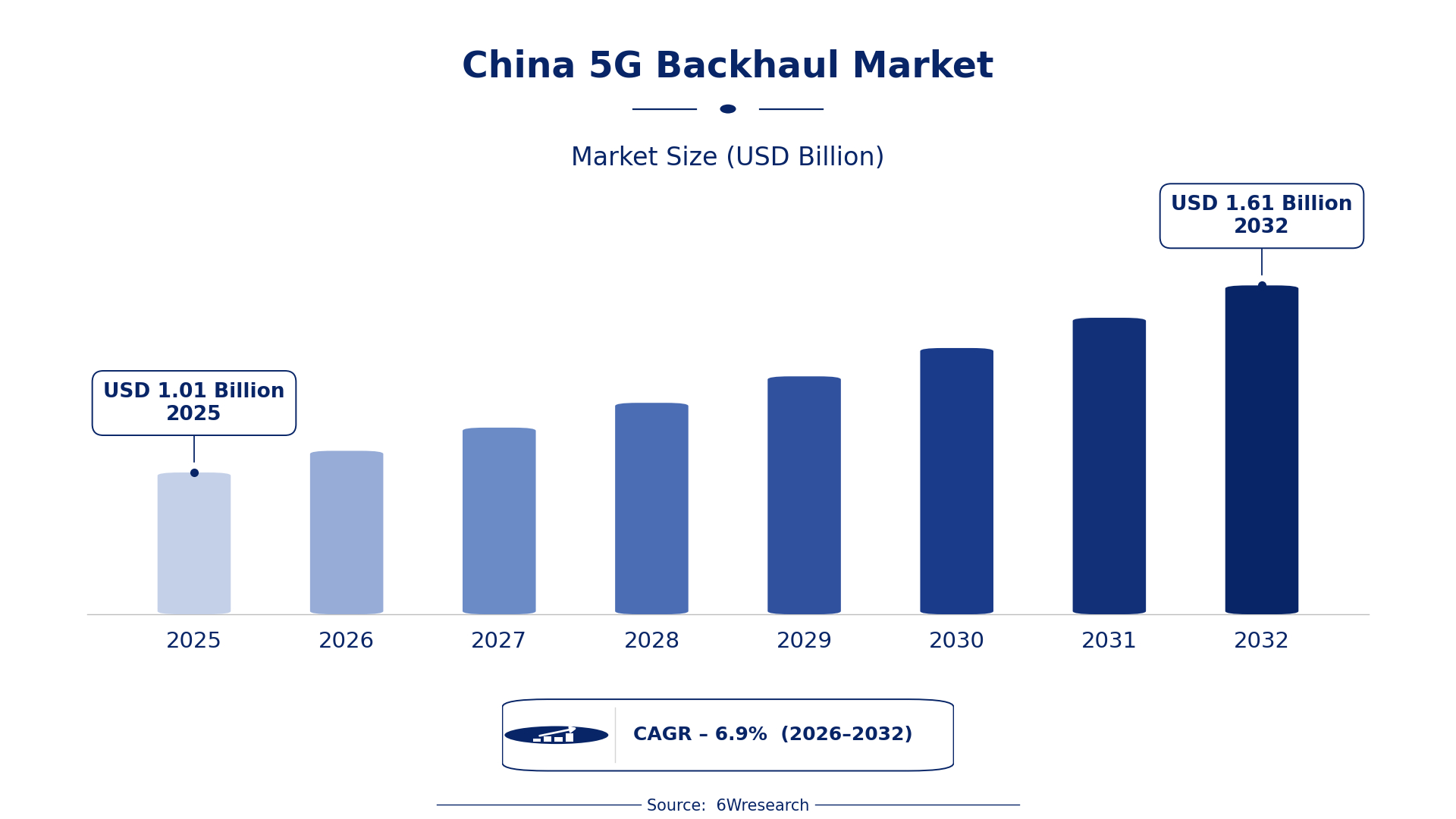
According to 6Wresearch internal database and industry insights, the China 5G Backhaul Market was valued at USD 1.01 billion in 2025 and is projected to reach USD 1.61 billion by 2032, growing at a CAGR of approximately 6.9% during 2026–2032.
China 5G Backhaul Market Highlights
| Report Metric | Details |
| Report Name | China 5G Backhaul Market |
| Market Size 2025 | USD 1.01 billion |
| Market Size 2032 | USD 1.61 billion |
| Absolute Growth 2025–2032 | USD 0.60 billion |
| CAGR 2026–2032 | 6.9% |
| Peak Annual Growth | 9.1% in 2031 |
| Forecast Period | 2026–2032 |
| Historical Data | 2022–2025 |
| Base Year | 2025 |
| Leading Product Type, 2025 | Fiber Backhaul (45% share) |
| Leading Technology Type, 2025 | Optical Fiber (38% share) |
| Leading Network Type, 2025 | 5G NR (37% share) |
| Leading End User, 2025 | Mobile Network Operators (46% share) |
| Leading Distribution Channel, 2025 | Direct Sales (47% share) |
| Fastest-Growing Product Type | Microwave Backhaul (9.6% CAGR) |
| Fastest-Growing Technology Type | Millimeter Wave (9.6% CAGR) |
| Fastest-Growing Network Type | Small Cells (9.2% CAGR) |
| Fastest-Growing End User | Smart City Providers (8.4% CAGR) |
| Fastest-Growing Distribution Channel | Online Platforms (8.7% CAGR) |
| Growing Sector | Telecommunications |
| Key End Users | Mobile Network Operators, Telecom Infrastructure, Smart City Providers |
China 5G Backhaul Market Year-wise Growth Rate and Key Drivers (2022–2032)
This graph illustrates the annual growth rates of the market from 2022 to 2032, highlighting a steady upward trajectory and projected market expansion over the forecast period.
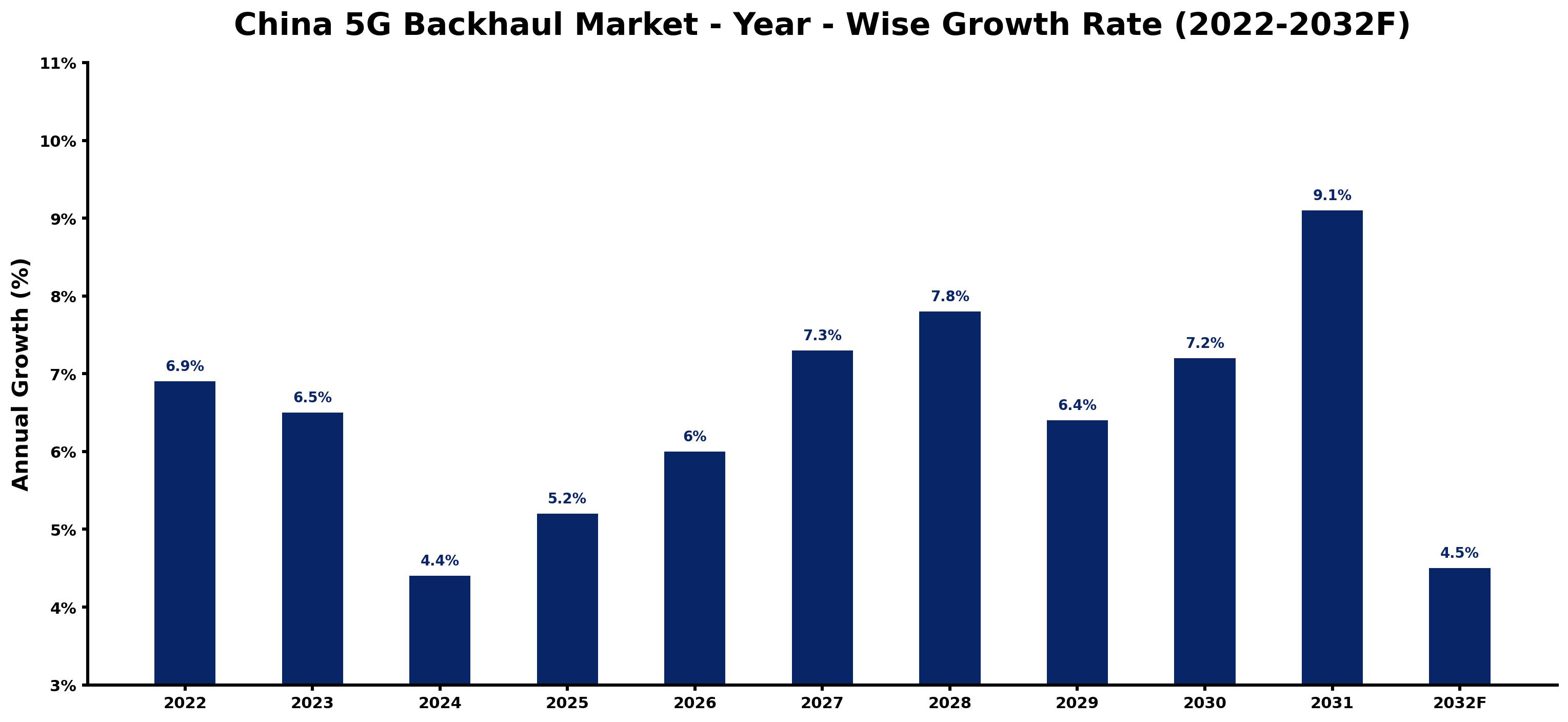
Each row of the following table gives one year's estimated growth and the event or demand shift that explains it.
| Year | Estimated Annual Growth (%) | Market Rationale |
| 2022 | 6.9 | The market experienced strong demand due to the rapid expansion of 5G infrastructure. |
| 2023 | 6.5 | Growth slowed slightly as investments in 5G backhaul began to stabilise under the 14th Five-Year Plan. |
| 2024 | 4.4 | The market continued to grow, albeit at a slower pace, reflecting ongoing infrastructure development in urban areas. |
| 2025 | 5.2 | Demand increased as urban areas expanded their 5G networks, driving backhaul needs for Mobile Network Operators. |
| 2026 | 6.0 | Growth is expected to accelerate as new projects under the 14th Five-Year Plan are initiated. |
| 2027 | 7.3 | The market will see further growth due to rising mobile data traffic and user demand for connectivity. |
| 2028 | 7.8 | Continued investment in smart city initiatives will boost backhaul infrastructure requirements in cities like Shenzhen. |
| 2029 | 6.4 | Growth is projected to slow as the market begins to adjust to previous high levels of expansion. |
| 2030 | 7.2 | A rebound in growth is expected as new technologies are adopted in urban deployments. |
| 2031 | 9.1 | The market will peak with substantial investments in 5G infrastructure and related technologies. |
| 2032 | 4.5 | Growth is projected to moderate as the market stabilises after reaching peak demand. |
Note: Market size estimations and growth projections presented in this report are based on 6Wresearch's proprietary forecasting methodology, utilizing the latest available industry data, government publications, and primary research inputs.
China 5G Backhaul Market Synopsis
5G Backhaul in China refers to the technology and infrastructure that connects core networks to radio access networks in 5G systems. It primarily utilises fiber optics and microwave links to ensure reliable connectivity. The China 5G Backhaul Market is experiencing growth driven by over 1.6 billion mobile subscribers and substantial investments in 5G infrastructure under the 14th Five-Year Plan. Urban areas like Beijing and Shanghai are leading this expansion, creating a strong demand for backhaul solutions.
Market Dynamics Impact Analysis (2026–2032)
| Factor | Type | Impact | Primary Segment Affected |
| Increasing mobile subscriber base driving demand for connectivity solutions. | Driver | High | Mobile Network Operators |
| Expansion of smart city initiatives requiring backhaul infrastructure. | Opportunity | High | Smart City Providers |
| High installation costs for advanced backhaul technologies limiting market entry. | Restraint | Medium | Fiber Backhaul |
| Limited availability of skilled workforce for 5G backhaul installation. | Challenge | High | Telecom Infrastructure |
| Rapid urbanisation increasing the need for high-capacity data transport. | Driver | High | Urban Deployment |
| Emerging demand for microwave backhaul solutions in remote areas. | Opportunity | Medium | Microwave Backhaul |
| Regulatory hurdles in obtaining approvals for new installations. | Restraint | Medium | Ethernet Backhaul |
| Technological advancements creating pressure to upgrade existing systems. | Challenge | Medium | Optical Fiber |
Evaluation of Drivers in China 5G Backhaul Market (2026–2032)
The table below links each growth driver to the segment it affects and the evidence for it.
| Drivers | Primary Segment Affected | Why It Matters (Evidence) |
| Expansion of 5G infrastructure investments supporting backhaul solutions. | Fiber Backhaul | In 2023, China had over 1.6 billion mobile subscribers, increasing demand for reliable connectivity. |
| Rising mobile data traffic necessitating enhanced backhaul capabilities. | Microwave Backhaul | The China Academy of Information and Communications Technology predicts growth in mobile data traffic by 2025. |
| Government initiatives promoting 5G deployment across urban and rural areas. | Ethernet Backhaul | The National Development and Reform Commission supports 5G infrastructure investments under the 14th Five-Year Plan. |
| Urbanisation trends driving the need for high-capacity data transport. | Urban Deployment | Urban areas like Beijing and Shanghai are leading in 5G deployment, influencing backhaul demand. |
| Smart city projects requiring backhaul networks for IoT applications. | Smart City Providers | Smart city initiatives in cities like Shenzhen require backhaul networks for IoT applications. |
In 2023, China had over 1.6 billion mobile subscribers, significantly boosting demand for backhaul solutions. The National Development and Reform Commission's 14th Five-Year Plan promotes 5G infrastructure investments, facilitating extensive backhaul capabilities across urban and rural areas. Urban centres like Beijing and Shanghai are leading 5G deployment, driving further demand for reliable connectivity.
Evaluation of Restraints in China 5G Backhaul Market
The table below lists the restraints and the evidence behind each.
| Market Restraint | Primary Segment Affected | Why It Matters (Evidence) |
| High installation costs for advanced backhaul technologies limiting market entry. | Fiber Backhaul | The cost of deploying fiber optics can be prohibitive for smaller operators, restricting market participation. |
| Regulatory hurdles in obtaining approvals for new installations. | Ethernet Backhaul | Lengthy approval processes can delay project timelines, impacting overall market growth. |
| Limited availability of skilled workforce for 5G backhaul installation. | Telecom Infrastructure | The shortage of trained personnel can slow down the deployment of necessary infrastructure. |
| Technological advancements creating pressure to upgrade existing systems. | Optical Fiber | Operators face challenges in keeping up with rapid technological changes, risking obsolescence. |
| Market saturation in urban areas leading to intensified competition. | Urban Deployment | In highly populated regions, competition among providers can limit profit margins and growth potential. |
China 5G Backhaul Market Challenges
The China 5G Backhaul market encounters regulatory challenges that hinder infrastructure development, as local authorities enforce inconsistent standards, delaying project approvals for telecom operators. Material costs have escalated, with fiber optics rising by 15% in the past year, straining budgets for network expansion among producers. Intense competition among telecom providers forces suppliers to lower prices, which can compromise the quality of infrastructure investments. Urban buyers in cities like Beijing and Shanghai face inconsistent service quality due to rapid 5G deployment, negatively affecting user satisfaction and retention.
Trends in the China 5G Backhaul Market
Four trends stand out in the China 5G Backhaul Market.
- Shift Towards Microwave Backhaul Solutions: Mobile Network Operators are increasingly turning to microwave backhaul solutions to connect remote areas. In 2023, demand for microwave backhaul surged, reflecting its importance in expanding coverage where fibre is not feasible.
- Urban Areas Leading 5G Deployment: Cities like Beijing and Shanghai are spearheading 5G deployment, significantly influencing backhaul demand. By mid-2023, over 2 million 5G base stations were reported, highlighting the need for effective backhaul solutions.
- Integration of IoT in Smart Cities: Smart city initiatives are prioritising the integration of IoT applications, creating a demand for robust backhaul networks. In Shenzhen, substantial investments are being made to support these technologies, driving the need for connectivity.
- Growth of Online Platforms for Distribution: Online platforms are emerging as a preferred distribution channel for 5G backhaul solutions. With a projected CAGR of 8.7% from 2026 to 2032, this trend reflects changing buyer preferences.
Investment Opportunities in the China 5G Backhaul Market
Below are the investment opportunities with the strongest case in the China 5G Backhaul Market.
- Partnerships for Infrastructure Development: Now is an ideal time to invest in partnerships for developing 5G backhaul infrastructure. Collaborating with Mobile Network Operators can facilitate market entry and expansion in this growing sector.
- Investment in Microwave Backhaul Solutions: The demand for microwave backhaul solutions is growing, especially in remote areas. With significant subscriber numbers, investing in this technology can meet the needs of underserved regions.
- Supply of Optical Fiber Technologies: The need for high-capacity data transport is driving demand for optical fiber technologies. Engaging with Telecom Infrastructure providers can facilitate entry into this growing market.
- Direct Sales Channels Expansion: Expanding direct sales channels can capture the growing demand for 5G backhaul solutions. With a 47% share in 2025, focusing on this distribution method can improve market reach.
Government Initiatives in the China 5G Backhaul Market
The Ministry of Industry and Information Technology introduced the '5G+ Industrial Internet' initiative in 2022, which improves connectivity across various sectors, complementing the 14th Five-Year Plan for Economic and Social Development. This initiative aims to enhance the integration of 5G technology in manufacturing and logistics, facilitating better communication and data transfer. The State Council's 'New Infrastructure' initiative, approved in 2020, allocates significant resources for 5G deployment, impacting producers by streamlining infrastructure development.
In 2023, the National Telecommunications Regulatory Authority approved funding for the establishment of a '5G Innovation Center'. This centre, aimed at promoting research and development in backhaul technologies, will support industry stakeholders in improving their capabilities and adopting new solutions. The Ministry of Industry and Information Technology oversees the implementation of 5G standards, ensuring compliance and facilitating smoother operations for producers and buyers.
Future Insight of the China 5G Backhaul Market
The China 5G Backhaul market will undergo transformative changes by 2032, driven by advancements in fibre optic technology and increased government support for digital infrastructure. By 2025, mobile data traffic is expected to surge, necessitating enhanced backhaul solutions to accommodate 1 million connections per square kilometre in urban areas. Smart city initiatives in Shenzhen will generate demand for robust backhaul networks tailored for IoT applications, creating new opportunities for suppliers. As the market matures, buyers will benefit from improved connectivity and faster data transmission speeds, enhancing their overall experience.
Market Segmentation Analysis
The analysis below covers each segmentation, its leading category in 2025 and its fastest-growing category through 2032.
By Product Type – Fiber Backhaul Dominated, Microwave Backhaul Expected to Grow Fastest
According to Shubham Deep, Research Manager at 6Wresearch, the largest product type category in 2025 was Fiber Backhaul, with a 45% share of total revenue. Fiber Backhaul commands the largest share due to its vital function in ensuring high-speed data transmission for 5G networks. The extensive optical fiber network in China, exceeding 5 million kilometers, is a key enabler for this technology's dominance. Over 2026–2032, Microwave Backhaul is expected to post the fastest growth, at a CAGR of 9.6%. Microwave Backhaul is rapidly growing as it effectively connects remote areas where fiber optics are not feasible. This growth is largely driven by the need to provide 5G services to underserved regions, thereby expanding overall network coverage. Suppliers should prioritise the development of microwave backhaul solutions to seize emerging opportunities in remote connectivity.
By Technology Type – Optical Fiber Dominated, Millimeter Wave Expected to Grow Fastest
Optical Fiber held a 38% share of the China 5G Backhaul Market by technology type in 2025. Optical Fiber holds the largest market share due to its essential role in high-capacity data transmission for 5G backhaul systems. Its extensive deployment across China, with over 5 million kilometres of optical fibre, supports the growing demand for reliable connectivity solutions. Millimeter Wave is set to record the highest CAGR in this split, 9.6% over 2026–2032. Millimeter Wave technology is rapidly expanding because it delivers high-capacity, short-range connections, particularly in urban environments. The ongoing 5G infrastructure expansion in major cities like Beijing and Shanghai is a significant factor driving this growth. Suppliers should prioritise millimeter wave solutions to meet the increasing demand for advanced network capabilities in urban areas.
By Network Type – 5G NR Dominated, Small Cells Expected to Grow Fastest
With a 37% revenue share in 2025, 5G NR was the largest network type category. 5G NR commands the largest share as it serves as the backbone for next-generation mobile networks. The establishment of over 2 million 5G base stations significantly boosts the backhaul market's growth. The quickest growth will come from Small Cells, forecast to expand at a CAGR of 9.2% between 2026 and 2032. Small Cells are experiencing the fastest growth as they enhance coverage and capacity in densely populated urban areas. The anticipated surge in mobile data traffic by 2025 will further accelerate the expansion of this segment. Suppliers must focus on small cell solutions to effectively meet the rising demands for urban connectivity.
By End User – Mobile Network Operators Dominated, Smart City Providers Expected to Grow Fastest
In 2025, Mobile Network Operators led the end user split with a 46% share. Mobile Network Operators dominate the market as they are the primary users of backhaul solutions for delivering mobile services. Their extensive infrastructure investments are critical for supporting the vast number of mobile subscribers in China. Smart City Providers are projected to grow fastest, at a CAGR of 8.4% during 2026–2032. Smart City Providers are experiencing the fastest growth as they integrate backhaul solutions for IoT applications and smart services. The push for smart city initiatives in cities like Shenzhen is a key factor in this trend. Suppliers should target smart city providers to align with the growing demand for integrated backhaul solutions.
By Distribution Channel – Direct Sales Dominated, Online Platforms Expected to Grow Fastest
Direct Sales took a 47% share of distribution channel in 2025, more than any other category. Direct Sales is the leading distribution channel, enabling suppliers to build strong relationships with key clients in the telecommunications sector. This approach allows for tailored solutions that address specific customer needs effectively. Over 2026–2032, Online Platforms are expected to post the fastest growth, at a CAGR of 8.7%. Online Platforms are rapidly gaining traction, providing suppliers with broader reach and easier access to backhaul solutions. This trend reflects the shifting buyer preferences towards digital channels in the market. Suppliers should enhance their online presence to effectively capture the growing demand for backhaul solutions through digital avenues.
Key Attractiveness of the Report
- 10 Years of Market Numbers
- Historical Data Starting from 2022 to 2025
- Base Year 2025
- Forecast Data until 2032
- Key Performance Indicators Impacting the Market
- Major Upcoming Developments and Projects
Key Highlights of the Report:
- China 5G Backhaul Market Outlook
- Market Size of China 5G Backhaul Market, 2025
- Forecast of China 5G Backhaul Market, 2032
- Historical Data and Forecast of China 5G Backhaul Revenues & Volume for the Period 2022 - 2032F
- China 5G Backhaul Market Trend Evolution
- China 5G Backhaul Market Drivers and Challenges
- China 5G Backhaul Price Trends
- China 5G Backhaul Porter's Five Forces
- China 5G Backhaul Industry Life Cycle
- Historical Data and Forecast of China 5G Backhaul Market Revenues & Volume By Product Type for the Period 2022 - 2032F
- Historical Data and Forecast of China 5G Backhaul Market Revenues & Volume By Fiber Backhaul for the Period 2022 - 2032F
- Historical Data and Forecast of China 5G Backhaul Market Revenues & Volume By Microwave Backhaul for the Period 2022 - 2032F
- Historical Data and Forecast of China 5G Backhaul Market Revenues & Volume By Satellite Backhaul for the Period 2022 - 2032F
- Historical Data and Forecast of China 5G Backhaul Market Revenues & Volume By Ethernet Backhaul for the Period 2022 - 2032F
- Historical Data and Forecast of China 5G Backhaul Market Revenues & Volume By Technology Type for the Period 2022 - 2032F
- Historical Data and Forecast of China 5G Backhaul Market Revenues & Volume By Optical Fiber for the Period 2022 - 2032F
- Historical Data and Forecast of China 5G Backhaul Market Revenues & Volume By Millimeter Wave for the Period 2022 - 2032F
- Historical Data and Forecast of China 5G Backhaul Market Revenues & Volume By LEO/MEO Satellites for the Period 2022 - 2032F
- Historical Data and Forecast of China 5G Backhaul Market Revenues & Volume By IP/MPLS for the Period 2022 - 2032F
- Historical Data and Forecast of China 5G Backhaul Market Revenues & Volume By Network Type for the Period 2022 - 2032F
- Historical Data and Forecast of China 5G Backhaul Market Revenues & Volume By 5G NR for the Period 2022 - 2032F
- Historical Data and Forecast of China 5G Backhaul Market Revenues & Volume By Small Cells for the Period 2022 - 2032F
- Historical Data and Forecast of China 5G Backhaul Market Revenues & Volume By Rural Coverage for the Period 2022 - 2032F
- Historical Data and Forecast of China 5G Backhaul Market Revenues & Volume By Urban Deployment for the Period 2022 - 2032F
- Historical Data and Forecast of China 5G Backhaul Market Revenues & Volume By End User for the Period 2022 - 2032F
- Historical Data and Forecast of China 5G Backhaul Market Revenues & Volume By Mobile Network Operators for the Period 2022 - 2032F
- Historical Data and Forecast of China 5G Backhaul Market Revenues & Volume By Telecom Infrastructure for the Period 2022 - 2032F
- Historical Data and Forecast of China 5G Backhaul Market Revenues & Volume By Remote Area Networks for the Period 2022 - 2032F
- Historical Data and Forecast of China 5G Backhaul Market Revenues & Volume By Smart City Providers for the Period 2022 - 2032F
- Historical Data and Forecast of China 5G Backhaul Market Revenues & Volume By Distribution Channel for the Period 2022 - 2032F
- Historical Data and Forecast of China 5G Backhaul Market Revenues & Volume By Direct Sales for the Period 2022 - 2032F
- Historical Data and Forecast of China 5G Backhaul Market Revenues & Volume By Industrial Suppliers for the Period 2022 - 2032F
- Historical Data and Forecast of China 5G Backhaul Market Revenues & Volume By Online Platforms for the Period 2022 - 2032F
- Historical Data and Forecast of China 5G Backhaul Market Revenues & Volume By Specialty Stores for the Period 2022 - 2032F
- China 5G Backhaul Import Export Trade Statistics
- Market Opportunity Assessment By Product Type
- Market Opportunity Assessment By Technology Type
- Market Opportunity Assessment By Network Type
- Market Opportunity Assessment By End User
- Market Opportunity Assessment By Distribution Channel
- China 5G Backhaul Top Companies Market Share
- China 5G Backhaul Competitive Benchmarking By Technical and Operational Parameters
- China 5G Backhaul Company Profiles
- China 5G Backhaul Key Strategic Recommendations
Market Covered
This report examines the market across the segments below.
By Product Type
- Fiber Backhaul
- Microwave Backhaul
- Satellite Backhaul
- Ethernet Backhaul
By Technology Type
- Optical Fiber
- Millimeter Wave
- LEO/MEO Satellites
- IP/MPLS
By Network Type
- 5G NR
- Small Cells
- Rural Coverage
- Urban Deployment
By End User
- Mobile Network Operators
- Telecom Infrastructure
- Remote Area Networks
- Smart City Providers
By Distribution Channel
- Direct Sales
- Industrial Suppliers
- Online Platforms
- Specialty Stores































