China 6-Axis Robot Market Size & Growth Rate
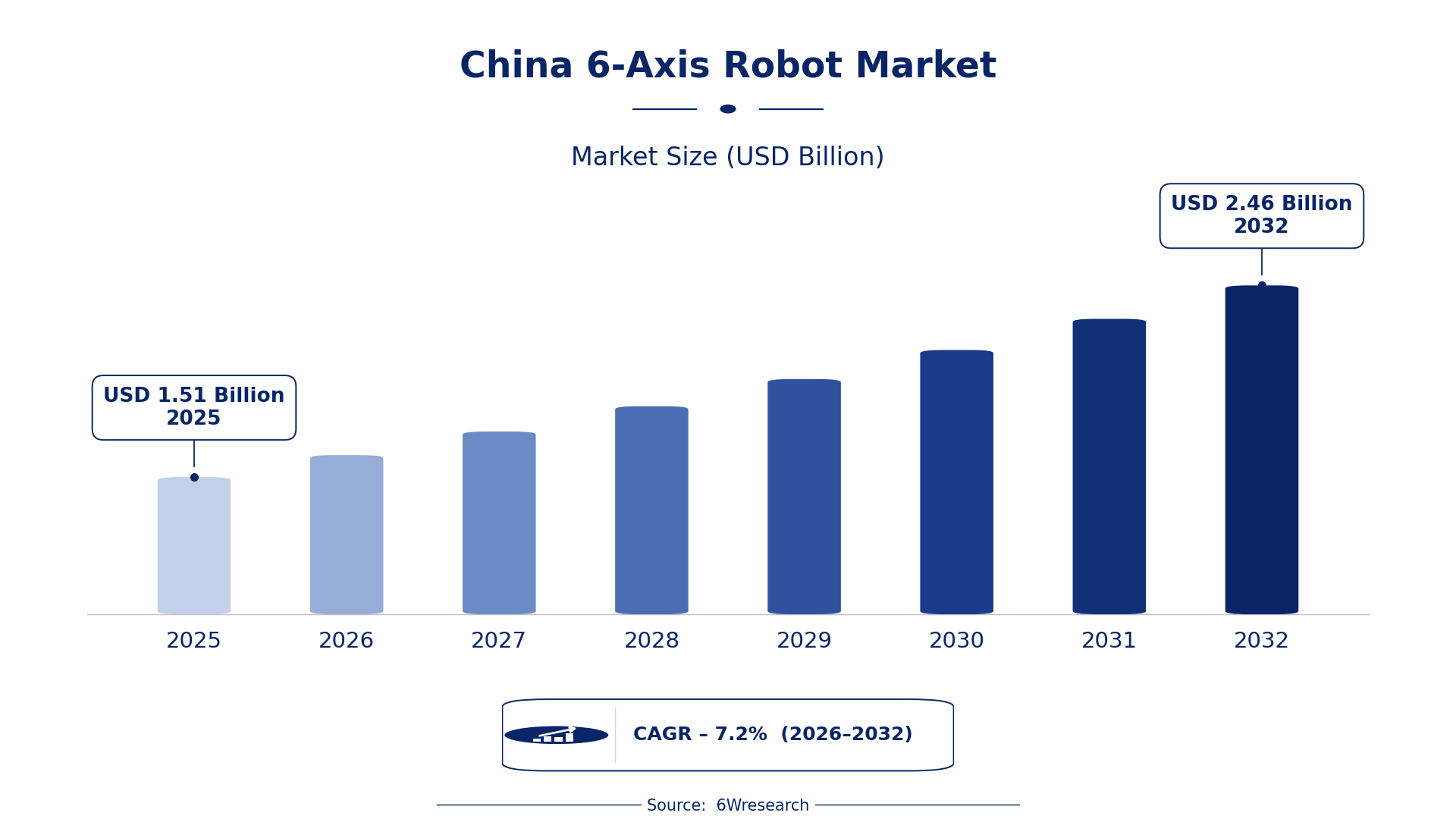
According to 6Wresearch internal database and industry insights, the China 6-Axis Robot Market was valued at USD 1.51 billion in 2025 and is projected to reach USD 2.46 billion by 2032, growing at a CAGR of approximately 7.2% during 2026–2032.
China 6-Axis Robot Market Highlights
| Report Metric | Details |
| Report Name | China 6-Axis Robot Market |
| Market Size 2025 | USD 1.51 billion |
| Market Size 2032 | USD 2.46 billion |
| Absolute Growth 2025–2032 | USD 0.95 billion |
| CAGR 2026–2032 | 7.2% |
| Peak Annual Growth | 9.3% in 2030 |
| Forecast Period | 2026–2032 |
| Historical Data | 2022–2025 |
| Base Year | 2025 |
| Leading Robot Type, 2025 | Articulated Robots (48% share) |
| Leading Payload Capacity, 2025 | Variable Payload (67% share) |
| Leading Application, 2025 | Welding (48% share) |
| Leading Distribution Channel, 2025 | Robotics OEMs (44% share) |
| Leading End User, 2025 | Automotive Manufacturing (45% share) |
| Fastest-Growing Robot Type | Collaborative Robots (8.4% CAGR) |
| Fastest-Growing Application | Assembly (8.7% CAGR) |
| Fastest-Growing Distribution Channel | Direct Sales (8.4% CAGR) |
| Fastest-Growing End User | Electronics Assembly Plants (8.8% CAGR) |
| Growing Sector | Assembly |
| Key End Users | Welding, Assembly, Material Handling, Packaging |
China 6-Axis Robot Market Year-wise Growth Rate and Key Drivers (2022–2032)
This graph illustrates the annual growth rates of the market from 2022 to 2032, highlighting a steady upward trajectory and projected market expansion over the forecast period.
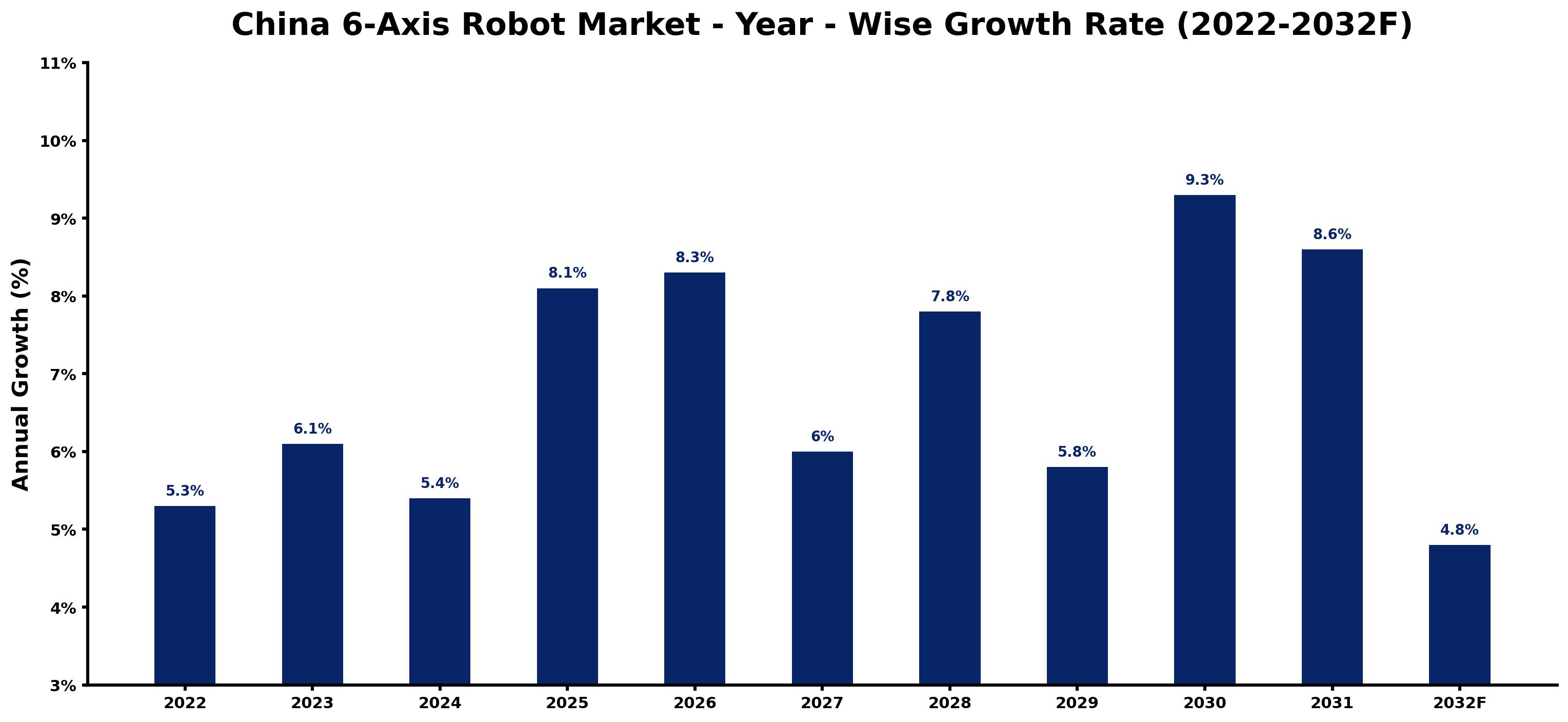
The table below sets out the estimated growth rate for each year and the main factor behind it.
| Year | Estimated Annual Growth (%) | Market Rationale |
| 2022 | 5.3 | The market grew steadily, reflecting ongoing automation trends in manufacturing. |
| 2023 | 6.1 | Increased investments in robotics technology drove faster growth this year. |
| 2024 | 5.4 | Growth slowed slightly due to market adjustments and project completions. |
| 2025 | 8.1 | The peak growth was driven by strong demand from the automotive sector. |
| 2026 | 8.3 | Continued investment in robotics technology supported further growth. |
| 2027 | 6.0 | Growth slowed as the market began to stabilise after rapid expansion. |
| 2028 | 7.8 | A rebound in demand from electronics manufacturing spurred growth. |
| 2029 | 5.8 | Growth slowed again, reflecting a maturing market and project completions. |
| 2030 | 9.3 | The market peaked due to heightened demand for automation in various sectors. |
| 2031 | 8.6 | Growth slowed as the market stabilised after reaching its peak. |
| 2032 | 4.8 | The market continues to grow, albeit at a slower pace as it matures. |
Note: Market size estimations and growth projections presented in this report are based on 6Wresearch's proprietary forecasting methodology, utilizing the latest available industry data, government publications, and primary research inputs.
China 6-Axis Robot Market Synopsis
The 6-Axis Robot Market in China includes industrial robots featuring six rotational joints, primarily utilised for welding, assembly, and material handling. These robots play a key role in sectors such as automotive and electronics manufacturing. The market is growing due to rising automation, especially in the automotive sector, which represents about 40% of total installations. Furthermore, the 'Robotics Industry Development Plan' initiated in 2023 promotes this growth by encouraging innovation and competitiveness in the robotics field. Consequently, the market is anticipated to expand considerably in the upcoming years.
Market Dynamics Impact Analysis (2026–2032)
| Factor | Type | Impact | Primary Segment Affected |
| Rising investments in automation technology | Driver | High | Welding |
| Increased demand from the automotive sector | Driver | High | Automotive Manufacturing |
| Growing adoption of robots in electronics manufacturing | Opportunity | High | Electronics Assembly Plants |
| Expansion of collaborative robot applications | Opportunity | Medium | Collaborative Robots |
| High initial costs of robotic systems | Restraint | High | Articulated Robots |
| Limited awareness of robotics benefits among SMEs | Restraint | Medium | Variable Payload |
| The 6-Axis Robot market in China faces a skills gap | Challenge | High | Collaborative Robots |
| Regulatory compliance challenges for new entrants | Challenge | Medium | Welding |
Evaluation of Drivers in China 6-Axis Robot Market (2026–2032)
Key forces behind demand, with the segment each one moves most, are listed below.
| Drivers | Primary Segment Affected | Why It Matters (Evidence) |
| Increased investment in automation technology | Welding | This investment leads to higher demand for advanced welding robots, particularly in automotive manufacturing. |
| Growing demand from the automotive sector | Automotive Manufacturing | The automotive industry accounts for approximately 40% of total robot installations, driving consistent demand. |
| Rising adoption of robotics in electronics | Electronics Assembly Plants | The electronics sector has seen a 30% increase in robot adoption over the last three years, boosting demand. |
| Expansion of collaborative robots | Collaborative Robots | Collaborative robots are projected to grow by 25% annually through 2025, increasing overall market demand. |
| Support from government initiatives | Variable Payload | The 'Made in China 2025' initiative emphasises robotics, driving demand for versatile robots. |
Growth in the 6-Axis Robot market in China comes from increased investment in automation technology, particularly in the automotive sector. The automotive industry, accounting for around 40% of total installations, drives consistent demand for advanced welding solutions. The electronics sector has experienced a 30% increase in robot adoption over the last three years, further boosting interest in automation. Collaborative robots are projected to grow by 25% annually through 2025, expanding their applications across various industries. Support from the 'Made in China 2025' strategy drives demand for versatile robots, ensuring continued market growth.
Evaluation of Restraints in China 6-Axis Robot Market
The main factors holding the market back are set out below.
| Market Restraint | Primary Segment Affected | Why It Matters (Evidence) |
| High initial costs of robotic systems | Articulated Robots | The high costs deter small manufacturers from investing in advanced robotic solutions. |
| Limited awareness of robotics benefits among SMEs | Variable Payload | Small and medium enterprises often lack knowledge about automation advantages, hindering adoption. |
| Regulatory compliance challenges for new entrants | Welding | New entrants face difficulties in meeting safety and performance standards, slowing market entry. |
| Skills gap in the workforce | Collaborative Robots | The shortage of skilled workers limits effective implementation of automation systems, impacting productivity. |
| Market saturation in certain sectors | Automotive Manufacturing | High levels of automation in established automotive plants reduce new robot installations. |
China 6-Axis Robot Market Challenges
The China 6-Axis Robot Market contends with significant supply chain disruptions, particularly due to reliance on specific components sourced from limited regions, which can delay production timelines for manufacturers. Increased competition among local producers has intensified price wars, reducing profit margins for suppliers and potentially compromising product quality. Rising costs of raw materials, such as metals and plastics, have escalated the average production cost of a 6-axis robot by approximately 15%, impacting buyers' budgets significantly. A shortage of skilled technicians in robotics hampers manufacturers' ability to fully utilise these advanced systems, resulting in underperformance in automation efforts.
Trends in the China 6-Axis Robot Market
Buyers and suppliers in the China 6-Axis Robot Market are adjusting to the following trends.
- Shift Towards Collaborative Robots: The demand for collaborative robots is increasing as industries aim to improve human-robot collaboration. In 2023, the market for collaborative robots is expected to grow by 25%, reflecting a change in automation strategies.
- Increased Focus on Robotics Standards: The introduction of ISO 10218 standards in 2021 has enhanced safety and performance in robotics. This standardisation is likely to boost market confidence and drive adoption across various sectors.
- Growth in Electronics Automation: The electronics assembly sector is progressively adopting automation solutions, with a 30% rise in robot usage over the past three years. This trend highlights the necessity for efficiency in production processes.
- Expansion of Robotics in Food Processing: The food and beverage industry is projected to install 15,000 new robots by 2025, showcasing a growing trend towards automation in packaging and processing.
Investment Opportunities in the China 6-Axis Robot Market
Several openings in the China 6-Axis Robot Market merit attention from investors.
- Rising Demand for Automation in SMEs: With a projected 15% increase in automation adoption among SMEs, there is a considerable opportunity to provide affordable robotic solutions. Targeting small manufacturers in the Yangtze River Delta region can facilitate market entry.
- Investment in Robotics for Electronics: Electronics assembly plants are enhancing their automation capabilities, anticipating a 30% rise in robot adoption. Suppliers should concentrate on delivering tailored solutions to satisfy this growing demand.
- Expansion of Robotics in Food and Beverage: The food and beverage industry is expected to install 15,000 new robots by 2025, presenting opportunities for suppliers of packaging and processing automation solutions.
- Collaborative Robots for Enhanced Efficiency: With collaborative robots projected to grow by 25% annually through 2025, suppliers should focus on developing versatile solutions for diverse applications in manufacturing.
Government Initiatives in the China 6-Axis Robot Market
In 2021, the Ministry of Industry and Information Technology launched the 'Robotics Industry Development Plan' to stimulate innovation and competitiveness in the robotics sector. This plan aims to enhance standards and safety, building on previous guidelines established in 2020. The initiative promotes investments in advanced robotics technologies, which are crucial for addressing the growing demand across various industries.
The National Development and Reform Commission's '14th Five-Year Plan' aims to allocate substantial funding for automation projects, supporting small and medium enterprises. This plan will strengthen the capabilities of local manufacturers and is expected to approve numerous projects centred on robotics innovation and development.
Future Insight of the China 6-Axis Robot Market
By 2032, buyers and suppliers in the China 6-Axis Robot Market can anticipate a notable shift towards increased automation driven by the 'Intelligent Manufacturing Development Plan', which aims to enhance automation in manufacturing sectors. The National Development and Reform Commission's backing through various subsidies will further bolster production capabilities. The food and beverage industry is projected to install 15,000 new robots by 2025, indicating strong growth in demand. Additionally, the 'Robot + AI' strategy will improve automation capabilities, positioning the market for substantial advancements.
Market Segmentation Analysis
The report offers a comprehensive study of the following market segments and their leading categories in the market.
By Robot Type – Articulated Robots Dominated, Collaborative Robots Expected to Grow Fastest
According to Shubham Deep, Research Manager at 6Wresearch, Articulated Robots accounted for a 48% market share by robot type in 2025. Articulated robots command the largest market share due to their extensive use in complex tasks that require flexibility, especially in sectors like automotive manufacturing. Their integral role in processes such as welding and assembly highlights their necessity in these industries. Collaborative Robots are projected to grow fastest, at a CAGR of 8.4% during 2026–2032. Collaborative robots are experiencing rapid growth as they are engineered to work safely alongside humans, which enhances operational efficiency. The surge in their adoption within the electronics sector, where safety and productivity are paramount, is a key factor in their increasing market presence. Suppliers should prioritise the development of collaborative robot solutions to meet the rising demand in the market.
By Payload Capacity – Variable Payload Dominated and Is Expected to Record the Fastest Growth
Variable Payload held a 67% share of the China 6-Axis Robot Market by payload capacity in 2025. Variable payload robots lead the market share due to their capability to handle a diverse range of tasks, making them suitable for various applications. Their adaptability is particularly valued in industries like automotive and electronics, where different payloads are common. Its lead should widen, with a projected CAGR of 8.3% during 2026–2032, the highest in this split. Variable payload robots are also the fastest-growing segment, driven by the increasing need for adaptable automation solutions in manufacturing. The demand for robots that can efficiently manage various weights and sizes of components is propelling this growth. Suppliers should focus on developing variable payload robots to seize the expanding market opportunity.
By Application – Welding Dominated, Assembly Expected to Grow Fastest
Welding took a 48% share of application in 2025, more than any other category. Welding applications lead the market share as they are vital for the automotive and metal fabrication industries, where precision and speed are essential. The automotive sector's heavy reliance on welding processes for assembly further cements this segment's dominance. Over 2026–2032, Assembly is expected to post the fastest growth, at a CAGR of 8.7%. Assembly is the fastest-growing application driven by the increasing demand for efficiency in electronics and automotive manufacturing. As production lines become more automated, the necessity for robots in assembly processes is escalating significantly. This growth suggests that suppliers should enhance their offerings in assembly-focused robotic solutions to align with industry demands.
By Distribution Channel – Robotics OEMs Dominated, Direct Sales Expected to Grow Fastest
The largest distribution channel category in 2025 was Robotics OEMs, with a 44% share of total revenue. Robotics OEMs command the largest market share as they are the primary manufacturers of robots and automation solutions, offering a wide array of products tailored to various industries. Their established relationships with major sectors like automotive and electronics strengthen their market position. Direct Sales is set to record the highest CAGR in this split, 8.4% over 2026–2032. Direct sales represent the fastest-growing distribution channel, reflecting a trend where buyers prefer purchasing robots directly from manufacturers for better pricing and support. This shift underscores the importance of direct engagement between suppliers and customers in the market. Suppliers must strengthen their direct sales strategies to align with the evolving purchasing preferences of buyers.
By End User – Automotive Manufacturing Dominated, Electronics Assembly Plants Expected to Grow Fastest
With a 45% revenue share in 2025, Automotive Manufacturing was the largest end user category. Automotive manufacturing is the largest end user of 6-axis robots in China, representing a substantial portion of installations due to the industry's high demand for automation in production processes. The ongoing expansion of the automotive sector reinforces its leading position in the market. Electronics Assembly Plants are projected to grow fastest, at a CAGR of 8.8% during 2026–2032. Electronics assembly plants are the fastest-growing end user segment as they adopt automation to boost efficiency and lower production costs. This trend is propelled by rapid technological advancements and the increasing need for precision in electronics manufacturing. Suppliers should focus on developing tailored solutions for electronics assembly to capitalise on this emerging market segment.
Key Attractiveness of the Report
- 10 Years of Market Numbers
- Historical Data Starting from 2022 to 2025
- Base Year 2025
- Forecast Data until 2032
- Key Performance Indicators Impacting the Market
- Major Upcoming Developments and Projects
Key Highlights of the Report:
- China 6-Axis Robot Market Outlook
- Market Size of China 6-Axis Robot Market, 2025
- Forecast of China 6-Axis Robot Market, 2032
- Historical Data and Forecast of China 6-Axis Robot Revenues & Volume for the Period 2022 - 2032F
- China 6-Axis Robot Market Trend Evolution
- China 6-Axis Robot Market Drivers and Challenges
- China 6-Axis Robot Price Trends
- China 6-Axis Robot Porter's Five Forces
- China 6-Axis Robot Industry Life Cycle
- Historical Data and Forecast of China 6-Axis Robot Market Revenues & Volume By Robot Type for the Period 2022 - 2032F
- Historical Data and Forecast of China 6-Axis Robot Market Revenues & Volume By Articulated Robots for the Period 2022 - 2032F
- Historical Data and Forecast of China 6-Axis Robot Market Revenues & Volume By SCARA Robots for the Period 2022 - 2032F
- Historical Data and Forecast of China 6-Axis Robot Market Revenues & Volume By Cartesian Robots for the Period 2022 - 2032F
- Historical Data and Forecast of China 6-Axis Robot Market Revenues & Volume By Collaborative Robots for the Period 2022 - 2032F
- Historical Data and Forecast of China 6-Axis Robot Market Revenues & Volume By Payload Capacity for the Period 2022 - 2032F
- Historical Data and Forecast of China 6-Axis Robot Market Revenues & Volume By Low ( 10 kg) for the Period 2022 - 2032F
- Historical Data and Forecast of China 6-Axis Robot Market Revenues & Volume By Medium (10 50 kg) for the Period 2022 - 2032F
- Historical Data and Forecast of China 6-Axis Robot Market Revenues & Volume By High ( 50 kg) for the Period 2022 - 2032F
- Historical Data and Forecast of China 6-Axis Robot Market Revenues & Volume By Variable Payload for the Period 2022 - 2032F
- Historical Data and Forecast of China 6-Axis Robot Market Revenues & Volume By Application for the Period 2022 - 2032F
- Historical Data and Forecast of China 6-Axis Robot Market Revenues & Volume By Welding for the Period 2022 - 2032F
- Historical Data and Forecast of China 6-Axis Robot Market Revenues & Volume By Assembly for the Period 2022 - 2032F
- Historical Data and Forecast of China 6-Axis Robot Market Revenues & Volume By Material Handling for the Period 2022 - 2032F
- Historical Data and Forecast of China 6-Axis Robot Market Revenues & Volume By Packaging for the Period 2022 - 2032F
- Historical Data and Forecast of China 6-Axis Robot Market Revenues & Volume By Distribution Channel for the Period 2022 - 2032F
- Historical Data and Forecast of China 6-Axis Robot Market Revenues & Volume By Robotics OEMs for the Period 2022 - 2032F
- Historical Data and Forecast of China 6-Axis Robot Market Revenues & Volume By Direct Sales for the Period 2022 - 2032F
- Historical Data and Forecast of China 6-Axis Robot Market Revenues & Volume By Industrial Suppliers for the Period 2022 - 2032F
- Historical Data and Forecast of China 6-Axis Robot Market Revenues & Volume By Online Platforms for the Period 2022 - 2032F
- Historical Data and Forecast of China 6-Axis Robot Market Revenues & Volume By End User for the Period 2022 - 2032F
- Historical Data and Forecast of China 6-Axis Robot Market Revenues & Volume By Automotive Manufacturing for the Period 2022 - 2032F
- Historical Data and Forecast of China 6-Axis Robot Market Revenues & Volume By Electronics Assembly Plants for the Period 2022 - 2032F
- Historical Data and Forecast of China 6-Axis Robot Market Revenues & Volume By Aerospace Production Units for the Period 2022 - 2032F
- Historical Data and Forecast of China 6-Axis Robot Market Revenues & Volume By Food & Beverage Industry for the Period 2022 - 2032F
- China 6-Axis Robot Import Export Trade Statistics
- Market Opportunity Assessment By Robot Type
- Market Opportunity Assessment By Payload Capacity
- Market Opportunity Assessment By Application
- Market Opportunity Assessment By Distribution Channel
- Market Opportunity Assessment By End User
- China 6-Axis Robot Top Companies Market Share
- China 6-Axis Robot Competitive Benchmarking By Technical and Operational Parameters
- China 6-Axis Robot Company Profiles
- China 6-Axis Robot Key Strategic Recommendations
Market Covered
Segments analysed in this report are listed below.
By Robot Type
- Articulated Robots
- SCARA Robots
- Cartesian Robots
- Collaborative Robots
By Payload Capacity
- Low ( 50 kg)
- Variable Payload
By Application
- Welding
- Assembly
- Material Handling
- Packaging
By Distribution Channel
- Robotics OEMs
- Direct Sales
- Industrial Suppliers
- Online Platforms
By End User
- Automotive Manufacturing
- Electronics Assembly Plants
- Aerospace Production Units
- Food & Beverage Industry































