China ABUS (Automated Breast Ultrasound System) Market Size & Growth Rate
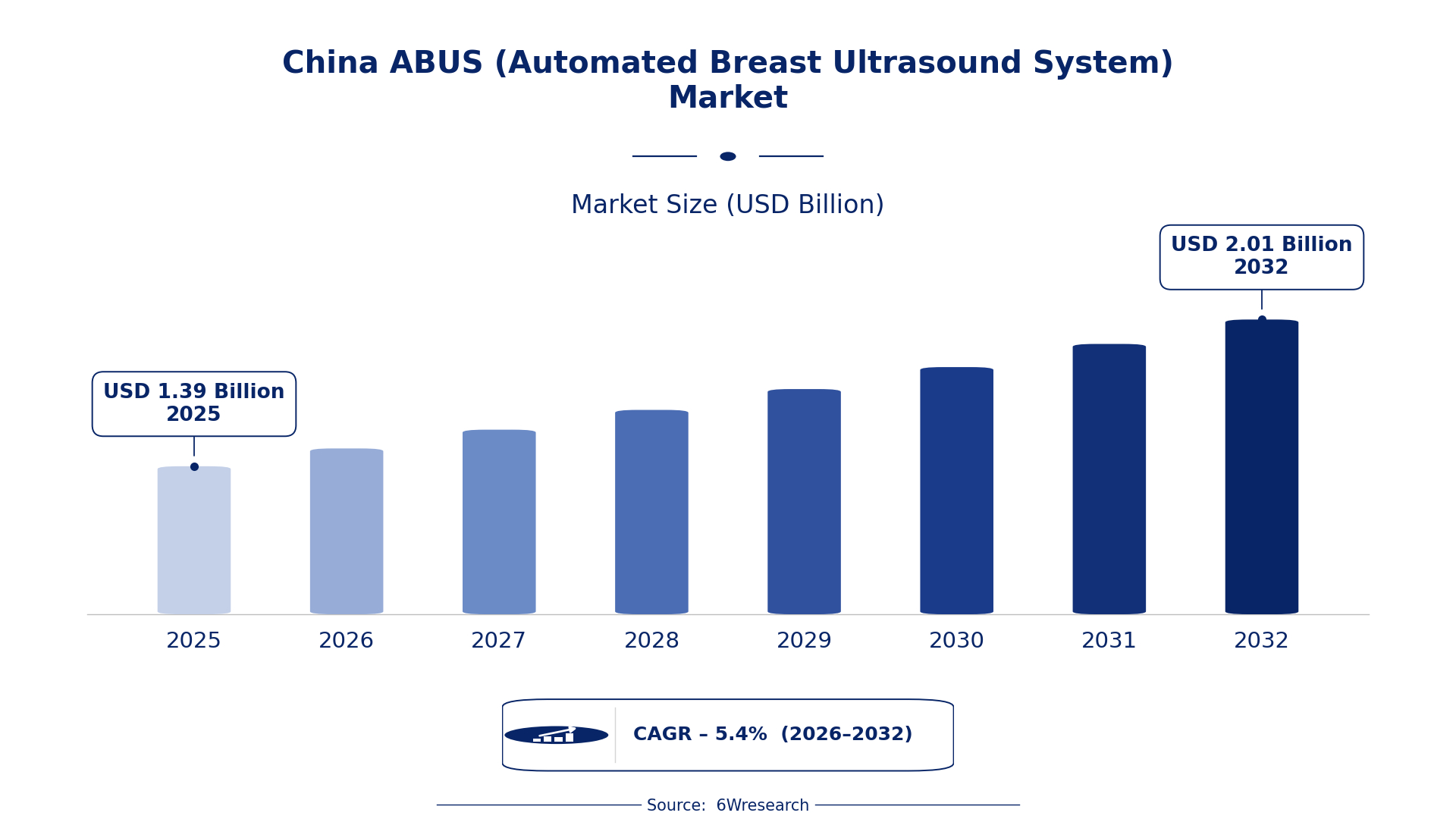
According to 6Wresearch internal database and industry insights, the China ABUS (Automated Breast Ultrasound System) Market was valued at USD 1.39 billion in 2025 and is projected to reach USD 2.01 billion by 2032, growing at a CAGR of approximately 5.4% during 2026–2032.
China ABUS (Automated Breast Ultrasound System) Market Highlights
| Report Metric | Details |
| Report Name | China ABUS (Automated Breast Ultrasound System) Market |
| Market Size 2025 | USD 1.39 billion |
| Market Size 2032 | USD 2.01 billion |
| Absolute Growth 2025–2032 | USD 0.62 billion |
| CAGR 2026–2032 | 5.4% |
| Peak Annual Growth | 7.7% in 2027 |
| Forecast Period | 2026–2032 |
| Historical Data | 2022–2025 |
| Base Year | 2025 |
| Leading System Type, 2025 | 3D ABUS Systems (44% share) |
| Leading Imaging Technology, 2025 | AI-Based Imaging (46% share) |
| Leading Distribution Channel, 2025 | Hospital Networks (49% share) |
| Leading End User, 2025 | Hospitals and Specialty Clinics (54% share) |
| Fastest-Growing System Type | Integrated ABUS Solutions (7.0% CAGR) |
| Fastest-Growing Distribution Channel | Medical Equipment Dealers (6.7% CAGR) |
| Fastest-Growing End User | Breast Cancer Clinics (6.8% CAGR) |
| Growing Sector | Diagnostic Imaging |
| Key End Users | Hospitals, Specialty Clinics, Diagnostic Centers, Breast Cancer Clinics |
China ABUS (Automated Breast Ultrasound System) Market Year-wise Growth Rate and Key Drivers (2022–2032)
This graph illustrates the annual growth rates of the market from 2022 to 2032, highlighting a steady upward trajectory and projected market expansion over the forecast period.
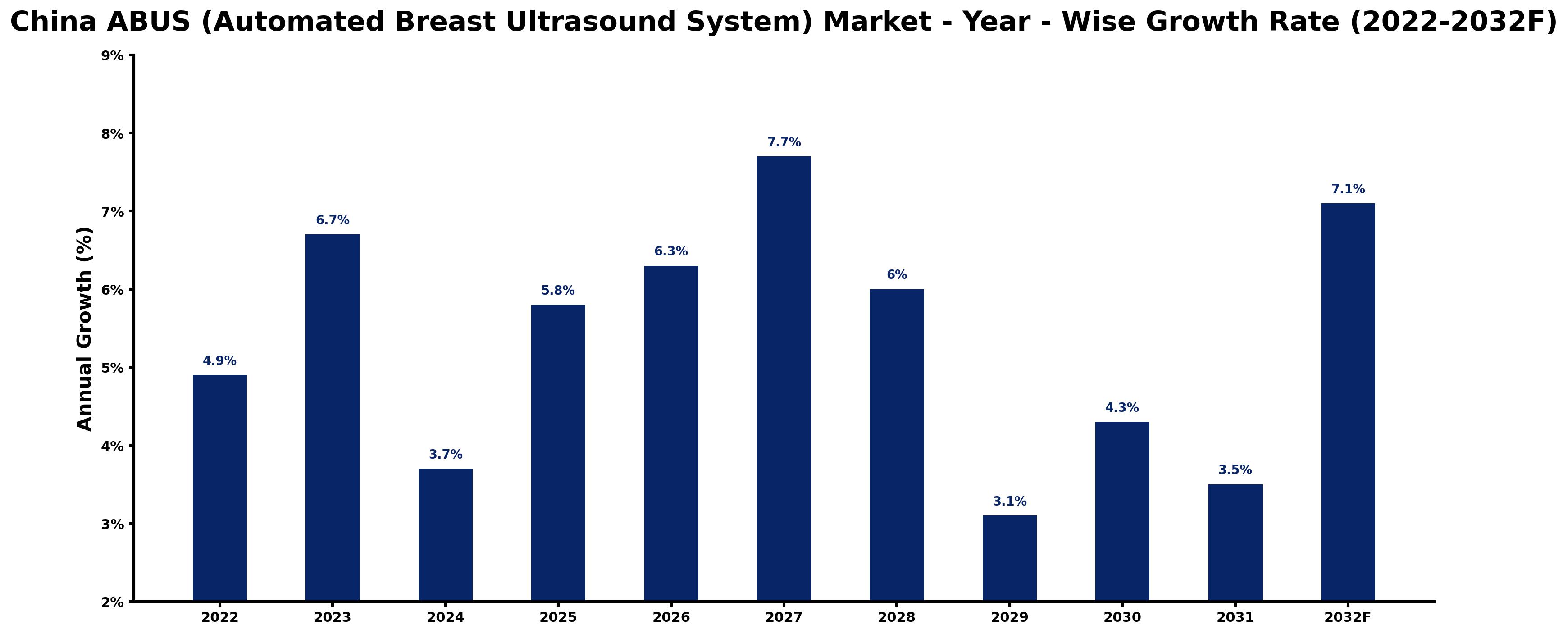
The table below sets out the estimated growth rate for each year and the main factor behind it.
| Year | Estimated Annual Growth (%) | Market Rationale |
| 2022 | 4.9 | The market exhibited steady growth due to increasing awareness of breast cancer screening initiatives. |
| 2023 | 6.7 | Demand surged as breast cancer cases rose, reaching approximately 300,000 reported cases. |
| 2024 | 3.7 | Growth slowed as hospitals adjusted to new screening protocols and advanced imaging technologies. |
| 2025 | 5.8 | An increase in funding for the National Cancer Prevention and Control Plan spurred faster growth in the market. |
| 2026 | 6.3 | The integration of AI-based imaging technologies in urban hospitals is expected to enhance diagnostic capabilities. |
| 2027 | 7.7 | A peak in growth will be driven by the launch of new breast cancer awareness initiatives in urban areas. |
| 2028 | 6.0 | Growth is projected to slow as market saturation begins to affect new system installations. |
| 2029 | 3.1 | Demand will continue to slow as hospitals focus on optimising existing resources and technologies. |
| 2030 | 4.3 | Growth is expected to accelerate again as the installed base of ABUS systems expands further. |
| 2031 | 3.5 | A slowdown is projected as competition increases among medical imaging technologies. |
| 2032 | 7.1 | Growth will rebound with rising investments in innovative medical imaging solutions. |
Note: Market size estimations and growth projections presented in this report are based on 6Wresearch's proprietary forecasting methodology, utilizing the latest available industry data, government publications, and primary research inputs.
China ABUS (Automated Breast Ultrasound System) Market Synopsis
The China ABUS (Automated Breast Ultrasound System) Market encompasses advanced imaging technology used for breast cancer detection. These systems employ ultrasound waves to produce detailed images of breast tissue and are primarily utilized in hospitals and diagnostic centers. The market is expanding due to rising breast cancer cases, increased funding for screening initiatives, and advancements in imaging technology. With over 1,000 diagnostic centers in China, demand is driven by domestic users and the government's focus on improving breast cancer screening protocols.
Market Dynamics Impact Analysis (2026–2032)
| Factor | Type | Impact | Primary Segment Affected |
| Increasing breast cancer awareness and screening initiatives | Driver | High | Diagnostic Centers |
| Integration of AI-based imaging technologies | Driver | High | AI-Based Imaging |
| Expansion of breast cancer clinics in urban areas | Opportunity | High | Breast Cancer Clinics |
| Deployment of mobile health units for outreach | Opportunity | Medium | Mobile Health Units |
| High costs associated with advanced imaging systems | Restraint | High | 3D ABUS Systems |
| Limited access to advanced imaging technology in rural areas | Restraint | Medium | Portable ABUS Devices |
| Regulatory hurdles for new medical device approvals | Challenge | High | Integrated ABUS Solutions |
| Competition from alternative imaging technologies | Challenge | Medium | Conventional Imaging |
Evaluation of Drivers in China ABUS (Automated Breast Ultrasound System) Market (2026–2032)
Below mentioned are some major drivers and their influence on market dynamics.
| Drivers | Primary Segment Affected | Why It Matters (Evidence) |
| Rising breast cancer cases | Diagnostic Centers | The number of breast cancer cases reported in 2022 increased demand for imaging services. |
| Government funding for screening initiatives | Breast Cancer Clinics | The government allocated 500 million RMB for cancer research and early detection technologies in 2023. |
| Adoption of AI-based imaging technologies | AI-Based Imaging | AI-based imaging is integrated into 50% of new ABUS systems, improving diagnostic accuracy for healthcare providers. |
| Expansion of urban healthcare facilities | Hospitals and Specialty Clinics | Urban hospitals are adopting advanced imaging technologies to improve breast cancer detection capabilities. |
| Development of mobile health outreach programs | Mobile Health Units | Mobile health units deployed in 20 provinces are increasing access to breast cancer screening. |
Urban hospitals are integrating AI-based imaging technologies into new ABUS systems, which enhances diagnostic accuracy. Mobile health units deployed across various provinces are increasing access to breast cancer screening, driving further demand. The installed base of ABUS systems is expanding, reflecting the growing need for effective breast cancer detection.
Evaluation of Restraints in China ABUS (Automated Breast Ultrasound System) Market
Below mentioned are some major restraints and their influence on market dynamics.
| Market Restraint | Primary Segment Affected | Why It Matters (Evidence) |
| High costs of advanced imaging systems | 3D ABUS Systems | The high investment required for 3D ABUS systems limits their adoption in some healthcare facilities. |
| Limited access to technology in rural areas | Portable ABUS Devices | Rural health facilities struggle to acquire portable ABUS devices due to budget constraints. |
| Regulatory delays in device approvals | Integrated ABUS Solutions | Strict regulatory requirements can delay the introduction of new ABUS solutions to the market. |
| Competition from alternative imaging technologies | Conventional Imaging | Conventional imaging methods remain prevalent, impacting the market share of ABUS systems. |
| Insufficient training for healthcare professionals | AI-Based Imaging | A lack of trained personnel to operate advanced imaging systems can hinder their effective use. |
China ABUS (Automated Breast Ultrasound System) Market Challenges
The China ABUS market still has to solve a few problems, starting with a skills gap in healthcare professionals. Many diagnostic centers lack trained staff to operate advanced imaging technologies, which delays breast cancer detection for patients. Competition among diagnostic centers is intense, leading to price wars that can compromise service quality and reduce investment in new technology. Regulatory hurdles also pose challenges, as compliance with ISO 13485 can slow down the introduction of new ABUS systems, impacting hospitals' ability to upgrade their equipment. The high cost of advanced ABUS systems remains a barrier for rural health outreach programs, limiting access to essential breast cancer screening services for underserved populations.
Trends in the China ABUS (Automated Breast Ultrasound System) Market
Several trends are reshaping the China ABUS (Automated Breast Ultrasound System) Market; the most important are set out below.
- Shift towards AI-Based Imaging in Urban Hospitals: Urban hospitals in China are increasingly adopting AI-based imaging technologies for breast cancer detection. In 2023, AI-based imaging was integrated into many new ABUS systems, improving diagnostic accuracy for healthcare providers.
- Expansion of Mobile Health Units for Screening: Mobile health units are being deployed across various provinces in China to improve breast cancer screening access. This initiative aims to reach underserved populations, reflecting a growing commitment to early detection.
- Increase in Breast Cancer Clinics: Breast cancer clinics in Beijing report a notable increase in patient consultations since 2021, indicating a rising focus on breast health. This trend highlights the growing demand for specialized breast cancer services.
- Government Initiatives for Breast Cancer Awareness: The Chinese government launched a breast cancer awareness initiative targeting urban populations in 2023. This effort aims to improve screening rates and educate the public about breast cancer risks.
Investment Opportunities in the China ABUS (Automated Breast Ultrasound System) Market
Investors looking at the China ABUS (Automated Breast Ultrasound System) Market should consider the following areas.
- Growing Demand for Advanced Imaging Solutions: With the increasing breast cancer cases, there is a heightened need for advanced imaging solutions. Hospitals and specialty clinics are investing in new technologies to improve diagnostic capabilities.
- Investment in Mobile Health Outreach: The deployment of mobile health units presents an opportunity to expand breast cancer screening in rural areas. Investing in these units can improve access to diagnostics for underserved populations.
- Expansion of Breast Cancer Clinics: The rise in patient consultations at breast cancer clinics indicates a need for more specialized services. Investing in these clinics can meet the increasing demand for breast health services.
- Integration of AI Technologies in Imaging: The integration of AI technologies into imaging systems presents a key opportunity. Hospitals can improve diagnostic accuracy and efficiency by investing in AI-based imaging solutions.
Government Initiatives in the China ABUS (Automated Breast Ultrasound System) Market
In 2021, the National Health Commission launched the 'Breast Cancer Early Detection and Treatment Program' aiming to reduce mortality rates by 15% by 2025. This initiative focuses on improving screening rates and early detection methods for breast cancer. The updated 'National Cancer Prevention and Control Plan (2021-2025)' includes increased funding for breast cancer screening initiatives, ensuring better access to diagnostic services across the country. The Ministry of Health's commitment to these programmes is expected to positively impact breast cancer outcomes in China.
In 2023, the Chinese government allocated substantial funding for cancer research and early detection technologies through the National Medical Products Administration. This funding supports the development and approval of medical devices, including ABUS systems. The streamlined approval pathway introduced in 2020 facilitates faster entry of new technologies into the market, benefiting both producers and buyers. These initiatives aim to improve the overall effectiveness of breast cancer screening and treatment in China.
Future Insight of the China ABUS (Automated Breast Ultrasound System) Market
The China ABUS market is set for significant changes by 2032, driven by several key developments. The government’s initiative to increase breast cancer screening rates to 70% by 2025 will expand the demand for ABUS systems across urban and rural areas. Integration of AI-based imaging technologies into new systems will improve diagnostic accuracy and efficiency. The deployment of mobile health units in 20 provinces will enhance access to screening services, particularly in remote regions. With over 300,000 breast cancer cases reported in 2022, hospitals will increasingly adopt advanced imaging technologies to address rising patient consultations.
Market Segmentation Analysis
The analysis below covers each segmentation, its leading category in 2025 and its fastest-growing category through 2032.
By System Type – 3D ABUS Systems Dominated, Integrated ABUS Solutions Expected to Grow Fastest
According to Shubham Deep, Research Manager at 6Wresearch, 3D ABUS Systems held a 44% share of the China ABUS (Automated Breast Ultrasound System) Market by system type in 2025. 3D ABUS Systems hold the largest share in the China ABUS market because they provide enhanced imaging crucial for accurate breast cancer diagnosis. Their extensive use in over 5,000 hospitals highlights their significance in clinical settings across the country. Integrated ABUS Solutions are projected to grow fastest, at a CAGR of 7.0% during 2026–2032. Integrated ABUS Solutions are rapidly gaining traction as they offer comprehensive breast imaging solutions, particularly in urban hospitals where advanced technologies are increasingly adopted. This growth is bolstered by government initiatives aimed at improving breast cancer screening protocols, ensuring a widening lead for 3D systems. Suppliers should prioritise the development of integrated solutions to meet the rising demand in urban healthcare facilities.
By Imaging Technology – AI-Based Imaging Dominated and Is Expected to Record the Fastest Growth
AI-Based Imaging took a 46% share of imaging technology in 2025, more than any other category. AI-Based Imaging commands the largest market share due to its increasing application in enhancing diagnostic accuracy, which is vital for effective breast cancer detection. The integration of advanced imaging technologies into 50% of new ABUS systems illustrates its essential role in contemporary practices. Its lead should widen, with a projected CAGR of 8.0% during 2026–2032, the highest in this split. The rapid growth of AI-Based Imaging is propelled by its ability to improve diagnostic precision, allowing healthcare providers to achieve better patient outcomes. As more facilities adopt these advanced imaging technologies, this trend is expected to continue, further solidifying its market position. Buyers should focus on AI-based solutions to elevate diagnostic capabilities and improve patient care.
By Distribution Channel – Hospital Networks Dominated, Medical Equipment Dealers Expected to Grow Fastest
The largest distribution channel category in 2025 was Hospital Networks, with a 49% share of total revenue. Hospital Networks hold the largest share as they are the primary users of ABUS systems for patient care, facilitating access to advanced imaging technologies. Their established infrastructure allows for efficient integration of these systems into routine breast cancer screening. Over 2026–2032, Medical Equipment Dealers are expected to post the fastest growth, at a CAGR of 6.7%. Medical Equipment Dealers are growing rapidly as they serve as intermediaries for distribution, catering to the increasing demand for ABUS systems across various healthcare settings. This channel's expansion reflects the need for more accessible imaging solutions in diverse environments. Suppliers must strengthen relationships with medical equipment dealers to ensure wider distribution of their products.
By End User – Hospitals and Specialty Clinics Dominated, Breast Cancer Clinics Expected to Grow Fastest
With a 54% revenue share in 2025, Hospitals and Specialty Clinics was the largest end user category. Hospitals and Specialty Clinics dominate the market as they provide comprehensive breast care, effectively utilising ABUS systems for diagnosis and treatment. Their established patient base and resources make them critical players in the breast imaging market. The quickest growth will come from Breast Cancer Clinics, forecast to expand at a CAGR of 6.8% between 2026 and 2032. Breast Cancer Clinics are experiencing the fastest growth due to their dedicated focus on breast health and cancer detection, aligning with government initiatives to boost screening rates. This targeted approach attracts an increasing number of patients seeking specialised care, enhancing the overall market dynamics. Providers should explore partnerships with breast cancer clinics to enhance service offerings and capture a growing patient demographic.
Key Attractiveness of the Report
- 10 Years of Market Numbers
- Historical Data Starting from 2022 to 2025
- Base Year 2025
- Forecast Data until 2032
- Key Performance Indicators Impacting the Market
- Major Upcoming Developments and Projects
Key Highlights of the Report:
- China ABUS (Automated Breast Ultrasound System) Market Outlook
- Market Size of China ABUS (Automated Breast Ultrasound System) Market, 2025
- Forecast of China ABUS (Automated Breast Ultrasound System) Market, 2032
- Historical Data and Forecast of China ABUS (Automated Breast Ultrasound System) Revenues & Volume for the Period 2022 - 2032F
- China ABUS (Automated Breast Ultrasound System) Market Trend Evolution
- China ABUS (Automated Breast Ultrasound System) Market Drivers and Challenges
- China ABUS (Automated Breast Ultrasound System) Price Trends
- China ABUS (Automated Breast Ultrasound System) Porter's Five Forces
- China ABUS (Automated Breast Ultrasound System) Industry Life Cycle
- Historical Data and Forecast of China ABUS (Automated Breast Ultrasound System) Market Revenues & Volume By System Type for the Period 2022 - 2032F
- Historical Data and Forecast of China ABUS (Automated Breast Ultrasound System) Market Revenues & Volume By 2D ABUS Systems for the Period 2022 - 2032F
- Historical Data and Forecast of China ABUS (Automated Breast Ultrasound System) Market Revenues & Volume By 3D ABUS Systems for the Period 2022 - 2032F
- Historical Data and Forecast of China ABUS (Automated Breast Ultrasound System) Market Revenues & Volume By Portable ABUS Devices for the Period 2022 - 2032F
- Historical Data and Forecast of China ABUS (Automated Breast Ultrasound System) Market Revenues & Volume By Integrated ABUS Solutions for the Period 2022 - 2032F
- Historical Data and Forecast of China ABUS (Automated Breast Ultrasound System) Market Revenues & Volume By Imaging Technology for the Period 2022 - 2032F
- Historical Data and Forecast of China ABUS (Automated Breast Ultrasound System) Market Revenues & Volume By Conventional Imaging for the Period 2022 - 2032F
- Historical Data and Forecast of China ABUS (Automated Breast Ultrasound System) Market Revenues & Volume By Advanced Imaging for the Period 2022 - 2032F
- Historical Data and Forecast of China ABUS (Automated Breast Ultrasound System) Market Revenues & Volume By Handheld Units for the Period 2022 - 2032F
- Historical Data and Forecast of China ABUS (Automated Breast Ultrasound System) Market Revenues & Volume By AI-Based Imaging for the Period 2022 - 2032F
- Historical Data and Forecast of China ABUS (Automated Breast Ultrasound System) Market Revenues & Volume By Distribution Channel for the Period 2022 - 2032F
- Historical Data and Forecast of China ABUS (Automated Breast Ultrasound System) Market Revenues & Volume By Hospital Networks for the Period 2022 - 2032F
- Historical Data and Forecast of China ABUS (Automated Breast Ultrasound System) Market Revenues & Volume By Direct Manufacturer Sales for the Period 2022 - 2032F
- Historical Data and Forecast of China ABUS (Automated Breast Ultrasound System) Market Revenues & Volume By Medical Equipment Dealers for the Period 2022 - 2032F
- Historical Data and Forecast of China ABUS (Automated Breast Ultrasound System) Market Revenues & Volume By Online Platforms for the Period 2022 - 2032F
- Historical Data and Forecast of China ABUS (Automated Breast Ultrasound System) Market Revenues & Volume By End User for the Period 2022 - 2032F
- Historical Data and Forecast of China ABUS (Automated Breast Ultrasound System) Market Revenues & Volume By Diagnostic Centers for the Period 2022 - 2032F
- Historical Data and Forecast of China ABUS (Automated Breast Ultrasound System) Market Revenues & Volume By Breast Cancer Clinics for the Period 2022 - 2032F
- Historical Data and Forecast of China ABUS (Automated Breast Ultrasound System) Market Revenues & Volume By Mobile Health Units for the Period 2022 - 2032F
- Historical Data and Forecast of China ABUS (Automated Breast Ultrasound System) Market Revenues & Volume By Hospitals and Specialty Clinics for the Period 2022 - 2032F
- China ABUS (Automated Breast Ultrasound System) Import Export Trade Statistics
- Market Opportunity Assessment By System Type
- Market Opportunity Assessment By Imaging Technology
- Market Opportunity Assessment By Distribution Channel
- Market Opportunity Assessment By End User
- China ABUS (Automated Breast Ultrasound System) Top Companies Market Share
- China ABUS (Automated Breast Ultrasound System) Competitive Benchmarking By Technical and Operational Parameters
- China ABUS (Automated Breast Ultrasound System) Company Profiles
- China ABUS (Automated Breast Ultrasound System) Key Strategic Recommendations
Market Covered
This report examines the market across the segments below.
By System Type
- 2D ABUS Systems
- 3D ABUS Systems
- Portable ABUS Devices
- Integrated ABUS Solutions
By Imaging Technology
- Conventional Imaging
- Advanced Imaging
- Handheld Units
- AI-Based Imaging
By Distribution Channel
- Hospital Networks
- Direct Manufacturer Sales
- Medical Equipment Dealers
- Online Platforms
By End User
- Diagnostic Centers
- Breast Cancer Clinics
- Mobile Health Units
- Hospitals and Specialty Clinics































