China Academic Integrity Software Market Size & Growth Rate
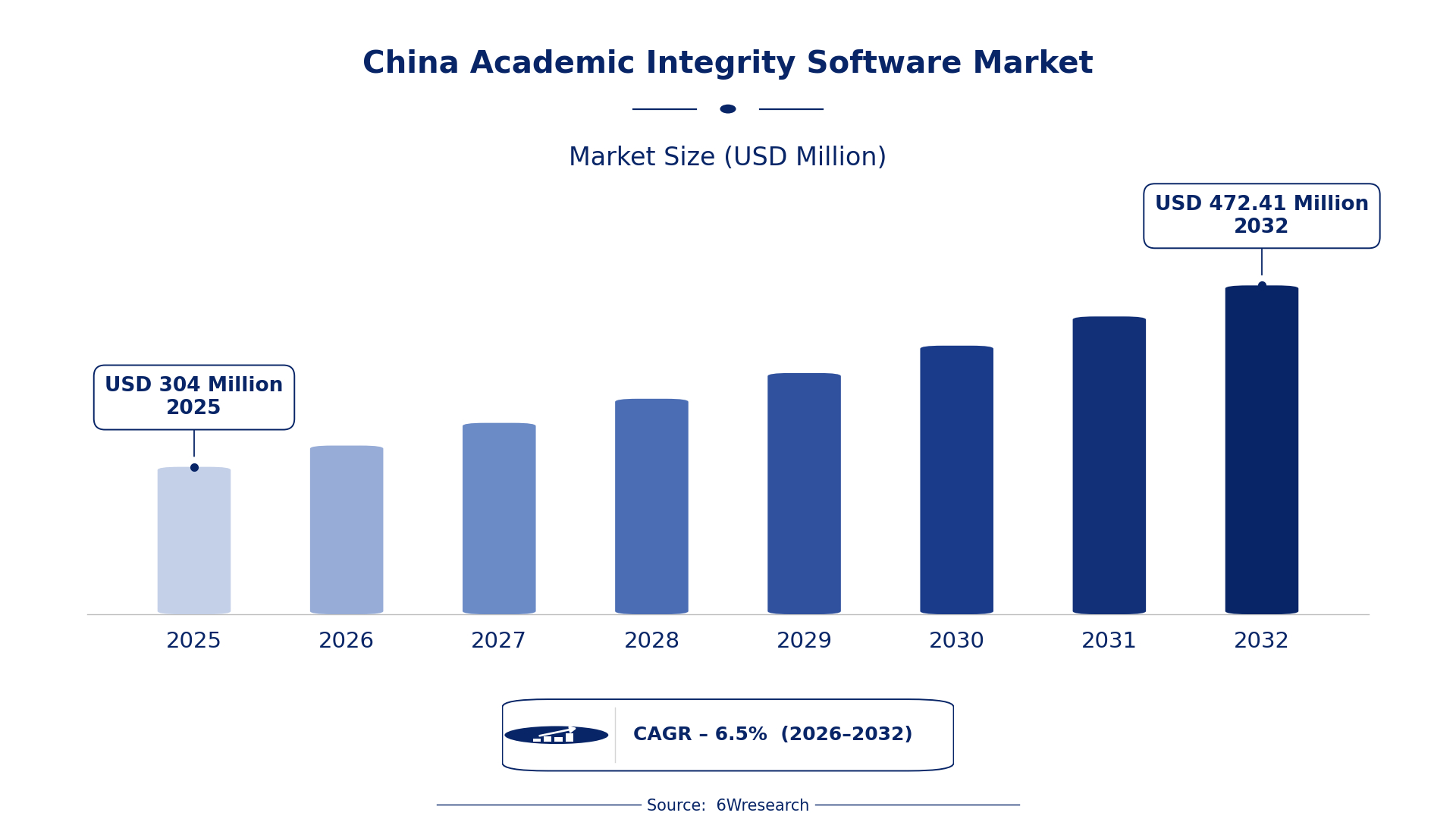
According to 6Wresearch internal database and industry insights, the China Academic Integrity Software Market was valued at USD 304.0 million in 2025 and is projected to reach USD 472.41 million by 2032, growing at a CAGR of approximately 6.5% during 2026–2032.
China Academic Integrity Software Market Highlights
| Report Metric | Details |
| Report Name | China Academic Integrity Software Market |
| Market Size 2025 | USD 304.0 million |
| Market Size 2032 | USD 472.41 million |
| Absolute Growth 2025–2032 | USD 168.41 million |
| CAGR 2026–2032 | 6.5% |
| Peak Annual Growth | 8.7% in 2026 |
| Forecast Period | 2026–2032 |
| Historical Data | 2022–2025 |
| Base Year | 2025 |
| Leading Software Type, 2025 | Plagiarism Detection (49% share) |
| Leading Deployment Model, 2025 | Cloud-Based (39% share) |
| Leading Distribution Channel, 2025 | Direct Sales (36% share) |
| Leading End User, 2025 | Universities (33% share) |
| Fastest-Growing Software Type | AI-Driven Proctoring (7.7% CAGR) |
| Fastest-Growing Deployment Model | SaaS (8.3% CAGR) |
| Fastest-Growing Distribution Channel | Online Subscriptions (8.6% CAGR) |
| Fastest-Growing End User | Online Learning Platforms (9.0% CAGR) |
| Growing Sector | Higher Education |
| Key End Users | Universities, Online Learning Platforms, Testing Agencies |
China Academic Integrity Software Market Year-wise Growth Rate and Key Drivers (2022–2032)
This graph illustrates the annual growth rates of the market from 2022 to 2032, highlighting a steady upward trajectory and projected market expansion over the forecast period.
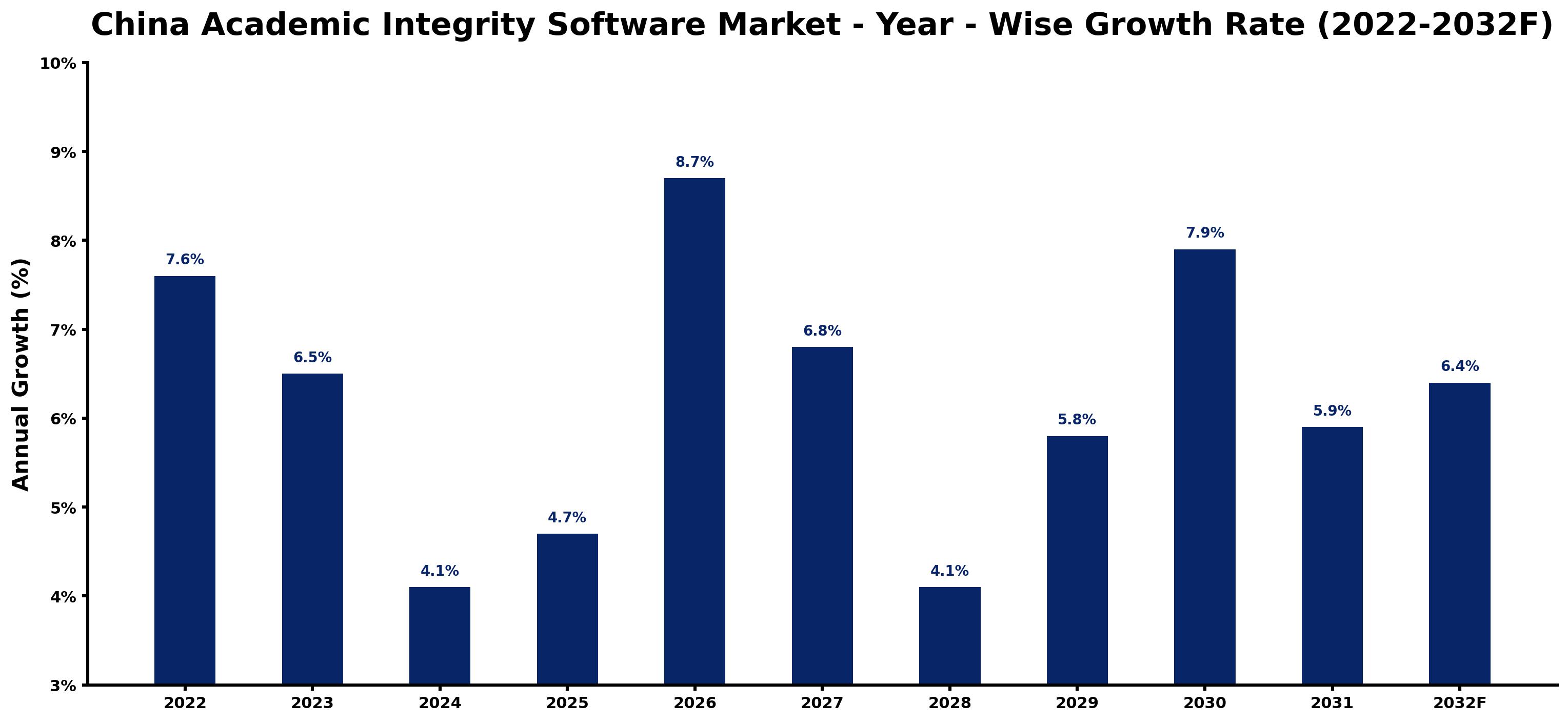
Annual growth estimates for each year appear below with the principal reason behind them, explaining the shifts that set the pace of the market.
| Year | Estimated Annual Growth (%) | Market Rationale |
| 2022 | 7.6 | The market experienced solid growth due to increased adoption of plagiarism detection tools in educational institutions. |
| 2023 | 6.5 | Growth slowed as the Ministry of Education's guidelines for academic integrity began to take effect. |
| 2024 | 4.1 | The market continued to grow but at a slower pace as institutions adjusted to new standards. |
| 2025 | 4.7 | Demand picked up again as universities expanded their use of cloud-based solutions for academic integrity. |
| 2026 | 8.7 | The market is expected to peak with widespread adoption of AI-driven proctoring tools in online learning environments. |
| 2027 | 6.8 | Growth is projected to slow as the market matures and competition intensifies among software providers. |
| 2028 | 4.1 | The market is expected to see a further slowdown as institutions focus on cost-effective solutions amid budget constraints. |
| 2029 | 5.8 | Demand is projected to increase as online learning platforms adopt more sophisticated integrity solutions. |
| 2030 | 7.9 | Growth is expected to accelerate again as universities seek to improve their academic integrity measures. |
| 2031 | 5.9 | The market is projected to experience a slight slowdown as institutions evaluate their software investments. |
| 2032 | 6.4 | Growth is expected to pick up as the Digital Education Action Plan continues to drive innovation in academic integrity. |
Note: Market size estimations and growth projections presented in this report are based on 6Wresearch's proprietary forecasting methodology, utilizing the latest available industry data, government publications, and primary research inputs.
China Academic Integrity Software Market Synopsis
The China Academic Integrity Software Market includes tools that support ethical standards in education, such as plagiarism detection and exam monitoring. In 2022, more than 2,500 universities in China employed these solutions, demonstrating a strong commitment to academic honesty. The market is expanding due to rising demand from educational institutions, influenced by national guidelines and the growing use of AI-driven tools. The Digital Education Action Plan further promotes this growth by enhancing online learning integrity and compliance with standards.
Market Dynamics Impact Analysis (2026–2032)
| Factor | Type | Impact | Primary Segment Affected |
| Increased adoption of plagiarism detection tools in universities | Driver | High | Plagiarism Detection |
| Growing demand for AI-driven proctoring solutions in online education | Driver | High | AI-Driven Proctoring |
| Rising need for secure examination processes in higher education | Opportunity | High | Exam Monitoring Tools |
| Expansion of online learning platforms requiring integrity solutions | Opportunity | High | Online Learning Platforms |
| Budget constraints affecting software investments in institutions | Restraint | Medium | Plagiarism Detection |
| Competition among software providers leading to price wars | Restraint | Medium | Plagiarism Detection |
| Limited awareness of the benefits of authorship verification tools | Challenge | Medium | Authorship Verification |
| Slow integration of integrity software in research institutions | Challenge | Medium | Research Institutions |
Evaluation of Drivers in China Academic Integrity Software Market (2026–2032)
The main growth drivers and the segments they affect most are set out below.
| Drivers | Primary Segment Affected | Why It Matters (Evidence) |
| Increased implementation of plagiarism detection tools | Plagiarism Detection | Over 2,500 universities in China now utilise these tools, driving demand for software solutions. |
| Adoption of AI-driven proctoring tools | AI-Driven Proctoring | More than 1,000 online learning platforms are integrating these solutions to ensure exam integrity. |
| Growing preference for cloud-based solutions | Cloud-Based | Approximately 60% of the market is represented by cloud solutions, preferred for their accessibility. |
| Rising online subscription models | Online Subscriptions | Online subscriptions for academic integrity software increased by 30% in the past year, reflecting changing purchasing patterns. |
| Support from educational authorities | Exam Monitoring Tools | The Beijing Education Commission's mandate for exam monitoring tools in all higher education institutions drives demand. |
The growth of the Academic Integrity Software market in China is driven by the increased use of plagiarism detection tools, a heightened demand for AI-driven proctoring solutions, and a growing preference for cloud-based systems. The installed base of plagiarism detection software surpasses 1 million licenses, showcasing widespread adoption among educational institutions. Over 1,000 online learning platforms are now integrating AI-driven proctoring solutions to maintain exam integrity, improving the reliability of assessments. The Beijing Education Commission's requirement for exam monitoring tools further fuels this growth, prompting educational institutions to increase their purchases. The preference for SaaS models among 70% of universities indicates a shift towards subscription-based solutions that provide flexibility and cost-effectiveness.
Evaluation of Restraints in China Academic Integrity Software Market
The table below lists the restraints and the evidence behind each.
| Market Restraint | Primary Segment Affected | Why It Matters (Evidence) |
| Budget constraints affecting software investments | Plagiarism Detection | Many institutions face financial limitations, impacting their ability to invest in new software solutions. |
| Competition among software providers leading to price wars | Plagiarism Detection | Intense competition results in lower prices, which may affect the perceived value of quality solutions. |
| Limited awareness of the benefits of authorship verification tools | Authorship Verification | Many institutions do not fully understand the importance of authorship verification, limiting its adoption. |
| Slow integration of integrity software in research institutions | Research Institutions | Research institutions often prioritise other technologies, delaying the adoption of integrity software. |
| Regulatory compliance challenges for educational institutions | Exam Monitoring Tools | Institutions must navigate complex regulations, which can hinder the timely implementation of monitoring tools. |
China Academic Integrity Software Market Challenges
Buyers in the China Academic Integrity Software market face significant supply chain issues as reliance on a limited number of domestic developers can delay essential software updates, impacting over 2,500 universities. Regulatory challenges arise from the Ministry of Education's enforcement of compliance with national guidelines, which increases costs for educational institutions that must implement specific tools. Skills shortages in software engineering restrict the ability to innovate, hindering the effectiveness of tools used by more than 1 million licensed users. Rising expenses are evident as online subscriptions for academic integrity software surged by 30% last year, straining budgets for educational institutions nationwide.
Trends in the China Academic Integrity Software Market
The trends below show where the China Academic Integrity Software Market is heading.
- Shift towards AI-Driven Proctoring Solutions: In 2023, the adoption of AI-driven proctoring tools surged among online learning platforms, with over 1,000 platforms integrating these solutions. This shift improves exam integrity and ensures fairness in assessments.
- Increasing Preference for Cloud-Based Solutions: Cloud-based solutions accounted for approximately 60% of the academic integrity software market in 2022. This trend reflects the demand for accessible and scalable software options in educational settings.
- Growth of Online Subscriptions for Integrity Software: Online subscriptions for academic integrity software increased by 30% in the past year, indicating a shift towards flexible purchasing models that cater to the needs of educational institutions.
- Implementation of National Guidelines for Academic Integrity: The 2022 'Guidelines for Promoting Academic Integrity in Higher Education' issued by the Ministry of Education emphasised the need for plagiarism detection tools in universities, driving demand for compliance.
Investment Opportunities in the China Academic Integrity Software Market
Below are the investment opportunities with the strongest case in the China Academic Integrity Software Market.
- Rising Demand for Exam Monitoring Tools: With the Beijing Education Commission mandating exam monitoring tools, institutions are increasingly seeking reliable solutions. This creates an opportunity for suppliers to meet the growing needs of over 2,500 universities.
- Expansion of Online Learning Platforms: The surge in online learning platforms presents an opportunity to supply AI-driven proctoring solutions. With over 1,000 platforms adopting these tools, partnerships with educational institutions can facilitate market entry.
- Growing Need for Plagiarism Detection Tools: As more universities adopt academic integrity measures, the demand for plagiarism detection tools is rising. Suppliers can target the 60% market share of cloud-based solutions for effective entry.
- Investment in SaaS Models for Flexibility: The preference for SaaS models among 70% of universities highlights an opportunity for investment in subscription-based solutions. Collaborating with universities can improve market penetration.
Government Initiatives in the China Academic Integrity Software Market
The 2021 'National Educational Informationization Development Plan' initiated by the Ministry of Education encourages the use of digital tools, including academic integrity software. This initiative aims to elevate educational standards and integrity across institutions. Following this, the 2022 'Guidelines for Promoting Academic Integrity in Higher Education' stressed the importance of plagiarism detection tools in universities, further reinforcing the government's commitment to academic integrity. The 2023 'Digital Learning Promotion Program' seeks to integrate advanced technologies, including AI-driven proctoring, into online education, thereby improving the integrity of assessments.
In 2022, the Ministry of Education approved funding for the implementation of integrity software in over 1,000 educational institutions. The China Association of Higher Education supports the integration of integrity software, facilitating partnerships between universities and software developers. These initiatives aim to ensure compliance with national standards and improve the overall quality of education.
Future Insight of the China Academic Integrity Software Market
The China Academic Integrity Software market is set to undergo notable changes by 2032, driven by the 'Digital Education Action Plan' aimed at enhancing online learning integrity. The shift to cloud-based solutions will continue, with 60% of the market adopting these adaptable models. Increased implementation of exam monitoring tools will follow the Beijing Education Commission's directive, ensuring compliance across all higher education institutions. The adoption of National Standards of China for data security will build greater trust and reliability among users.
Market Segmentation Analysis
The report offers a comprehensive study of the following market segments and their leading categories in the market.
By Software Type – Plagiarism Detection Dominated, AI-Driven Proctoring Expected to Grow Fastest
According to Shubham Deep, Research Manager at 6Wresearch, Plagiarism Detection accounted for a 49% market share by software type in 2025. Plagiarism detection holds the largest share due to its critical role in maintaining academic integrity across over 2,500 universities in China. The Ministry of Education's national guidelines further reinforce its necessity in educational environments. The quickest growth will come from AI-Driven Proctoring, forecast to expand at a CAGR of 7.7% between 2026 and 2032. AI-driven proctoring is rapidly gaining traction, with more than 1,000 online learning platforms adopting these tools to enhance remote assessment integrity. This growth is propelled by the government's 'Digital Education Action Plan' aimed at bolstering online learning integrity. Suppliers should focus on developing robust proctoring solutions to meet the rising demand from educational institutions.
By Deployment Model – Cloud-Based Dominated, SaaS Expected to Grow Fastest
Cloud-Based held a 39% share of the China Academic Integrity Software Market by deployment model in 2025. Cloud-based solutions dominate the market because they offer accessibility and scalability, making them ideal for the diverse needs of educational institutions. Approximately 60% of the academic integrity software market in China is attributed to this deployment model. SaaS are set to record the highest CAGR in this split, 8.3% over 2026–2032. SaaS models are growing quickly, with 70% of universities preferring this approach for its cost-effectiveness and flexibility. The increasing trend towards online subscriptions, which rose by 30% in the past year, further supports this growth. Buyers are encouraged to consider SaaS options for their affordability and ease of integration into existing systems.
By Distribution Channel – Direct Sales Dominated, Online Subscriptions Expected to Grow Fastest
Direct Sales took a 36% share of distribution channel in 2025, more than any other category. Direct sales dominate the market as the primary acquisition method for academic integrity software, allowing institutions to obtain tailored solutions that address their specific educational needs. This method is particularly effective in the education sector, where direct engagement is essential. Online Subscriptions are projected to grow fastest, at a CAGR of 8.6% during 2026–2032. Online subscriptions are quickly becoming the preferred model, reflecting a shift towards convenient access to software services among institutions. The increase in online subscription rates indicates a growing preference for flexible purchasing options. Suppliers should enhance their online subscription offerings to align with the changing purchasing preferences of educational institutions.
By End User – Universities Dominated, Online Learning Platforms Expected to Grow Fastest
With a 33% revenue share in 2025, Universities was the largest end user category. Universities represent the largest share of end users for academic integrity software, as they are pivotal in upholding ethical standards among students. The extensive installed base of over 1 million licenses in these institutions underscores their commitment to academic integrity. Over 2026–2032, Online Learning Platforms are expected to post the fastest growth, at a CAGR of 9.0%. Online learning platforms are witnessing the fastest growth in this segment, utilising integrity software to ensure course credibility. This trend is particularly notable as the demand for online education continues to escalate. Suppliers need to tailor their solutions to meet the specific needs of online learning platforms as they become increasingly integral to the education sector.
Key Attractiveness of the Report
- 10 Years of Market Numbers
- Historical Data Starting from 2022 to 2025
- Base Year 2025
- Forecast Data until 2032
- Key Performance Indicators Impacting the Market
- Major Upcoming Developments and Projects
Key Highlights of the Report:
- China Academic Integrity Software Market Outlook
- Market Size of China Academic Integrity Software Market, 2025
- Forecast of China Academic Integrity Software Market, 2032
- Historical Data and Forecast of China Academic Integrity Software Revenues & Volume for the Period 2022 - 2032F
- China Academic Integrity Software Market Trend Evolution
- China Academic Integrity Software Market Drivers and Challenges
- China Academic Integrity Software Price Trends
- China Academic Integrity Software Porter's Five Forces
- China Academic Integrity Software Industry Life Cycle
- Historical Data and Forecast of China Academic Integrity Software Market Revenues & Volume By Software Type for the Period 2022 - 2032F
- Historical Data and Forecast of China Academic Integrity Software Market Revenues & Volume By Plagiarism Detection for the Period 2022 - 2032F
- Historical Data and Forecast of China Academic Integrity Software Market Revenues & Volume By Exam Monitoring Tools for the Period 2022 - 2032F
- Historical Data and Forecast of China Academic Integrity Software Market Revenues & Volume By Authorship Verification for the Period 2022 - 2032F
- Historical Data and Forecast of China Academic Integrity Software Market Revenues & Volume By AI-Driven Proctoring for the Period 2022 - 2032F
- Historical Data and Forecast of China Academic Integrity Software Market Revenues & Volume By Deployment Model for the Period 2022 - 2032F
- Historical Data and Forecast of China Academic Integrity Software Market Revenues & Volume By Cloud-Based for the Period 2022 - 2032F
- Historical Data and Forecast of China Academic Integrity Software Market Revenues & Volume By On-Premise for the Period 2022 - 2032F
- Historical Data and Forecast of China Academic Integrity Software Market Revenues & Volume By SaaS for the Period 2022 - 2032F
- Historical Data and Forecast of China Academic Integrity Software Market Revenues & Volume By Hybrid for the Period 2022 - 2032F
- Historical Data and Forecast of China Academic Integrity Software Market Revenues & Volume By Distribution Channel for the Period 2022 - 2032F
- Historical Data and Forecast of China Academic Integrity Software Market Revenues & Volume By Direct Sales for the Period 2022 - 2032F
- Historical Data and Forecast of China Academic Integrity Software Market Revenues & Volume By EdTech Distributors for the Period 2022 - 2032F
- Historical Data and Forecast of China Academic Integrity Software Market Revenues & Volume By Online Subscriptions for the Period 2022 - 2032F
- Historical Data and Forecast of China Academic Integrity Software Market Revenues & Volume By Partner Networks for the Period 2022 - 2032F
- Historical Data and Forecast of China Academic Integrity Software Market Revenues & Volume By End User for the Period 2022 - 2032F
- Historical Data and Forecast of China Academic Integrity Software Market Revenues & Volume By Universities for the Period 2022 - 2032F
- Historical Data and Forecast of China Academic Integrity Software Market Revenues & Volume By Online Learning Platforms for the Period 2022 - 2032F
- Historical Data and Forecast of China Academic Integrity Software Market Revenues & Volume By Research Institutions for the Period 2022 - 2032F
- Historical Data and Forecast of China Academic Integrity Software Market Revenues & Volume By Testing Agencies for the Period 2022 - 2032F
- China Academic Integrity Software Import Export Trade Statistics
- Market Opportunity Assessment By Software Type
- Market Opportunity Assessment By Deployment Model
- Market Opportunity Assessment By Distribution Channel
- Market Opportunity Assessment By End User
- China Academic Integrity Software Top Companies Market Share
- China Academic Integrity Software Competitive Benchmarking By Technical and Operational Parameters
- China Academic Integrity Software Company Profiles
- China Academic Integrity Software Key Strategic Recommendations
Market Covered
The report offers an extensive study of the following market segments.
By Software Type
- Plagiarism Detection
- Exam Monitoring Tools
- Authorship Verification
- AI-Driven Proctoring
By Deployment Model
- Cloud-Based
- On-Premise
- SaaS
- Hybrid
By Distribution Channel
- Direct Sales
- EdTech Distributors
- Online Subscriptions
- Partner Networks
By End User
- Universities
- Online Learning Platforms
- Research Institutions
- Testing Agencies































