China Academic Software Market Size & Growth Rate
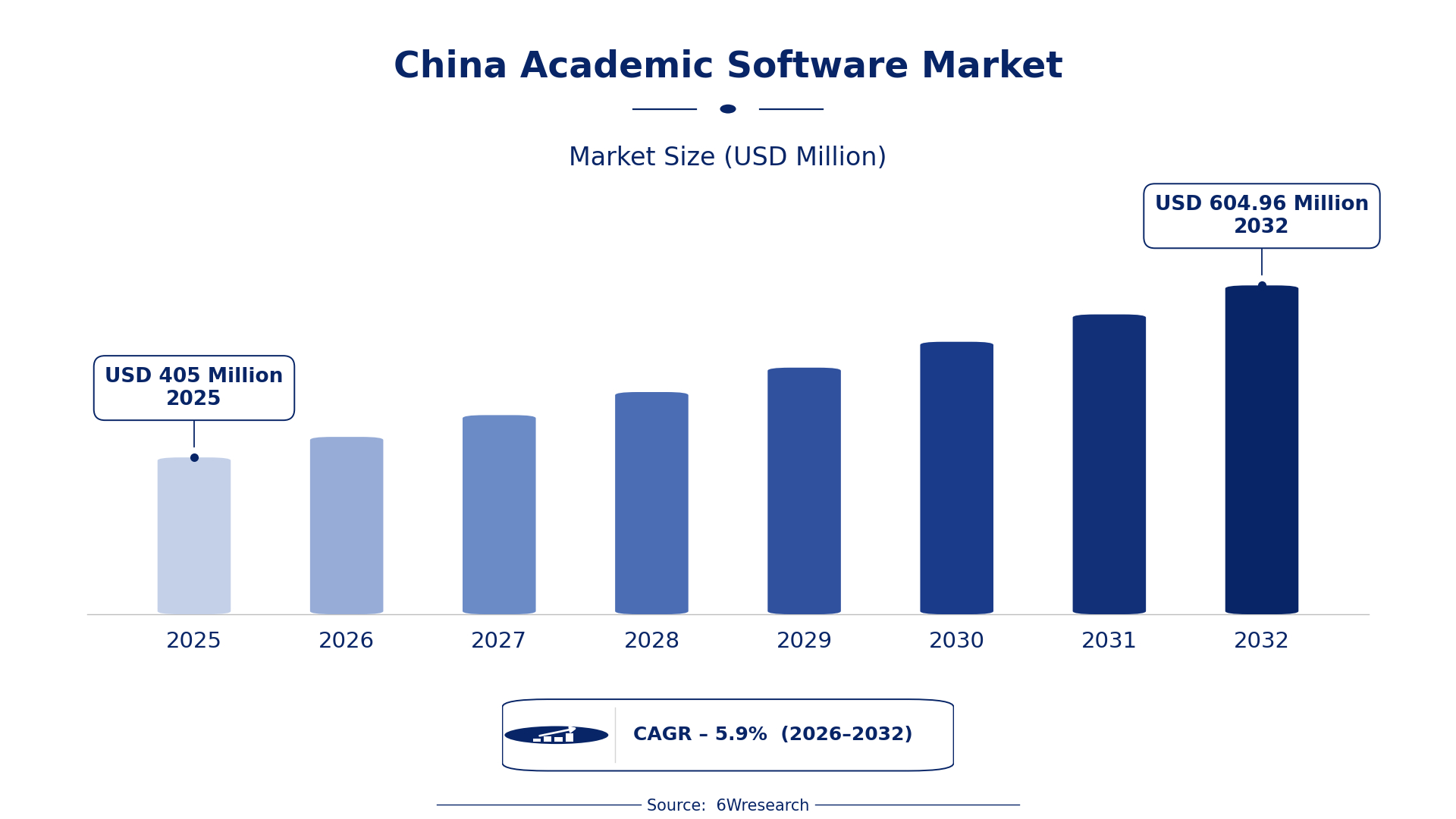
According to 6Wresearch internal database and industry insights, the China Academic Software Market was valued at USD 405.0 million in 2025 and is projected to reach USD 604.96 million by 2032, growing at a CAGR of approximately 5.9% during 2026–2032.
China Academic Software Market Highlights
| Report Metric | Details |
| Report Name | China Academic Software Market |
| Market Size 2025 | USD 405.0 million |
| Market Size 2032 | USD 604.96 million |
| Absolute Growth 2025–2032 | USD 199.96 million |
| CAGR 2026–2032 | 5.9% |
| Peak Annual Growth | 6.8% in 2026 |
| Forecast Period | 2026–2032 |
| Historical Data | 2022–2025 |
| Base Year | 2025 |
| Leading Software Type, 2025 | Learning Management Systems (48% share) |
| Leading User Category, 2025 | Higher Education (44% share) |
| Leading Distribution Channel, 2025 | SaaS Providers (42% share) |
| Leading End User, 2025 | Universities and Colleges (40% share) |
| Fastest-Growing Software Type | Virtual Labs Software (7.7% CAGR) |
| Fastest-Growing Distribution Channel | EdTech Companies (7.4% CAGR) |
| Fastest-Growing End User | Educational Boards (7.7% CAGR) |
| Growing Sector | K–12 Education |
| Key End Users | Universities and Colleges, K–12 Schools, Educational Boards, Online Educators |
China Academic Software Market Year-wise Growth Rate and Key Drivers (2022–2032)
This graph illustrates the annual growth rates of the market from 2022 to 2032, highlighting a steady upward trajectory and projected market expansion over the forecast period.
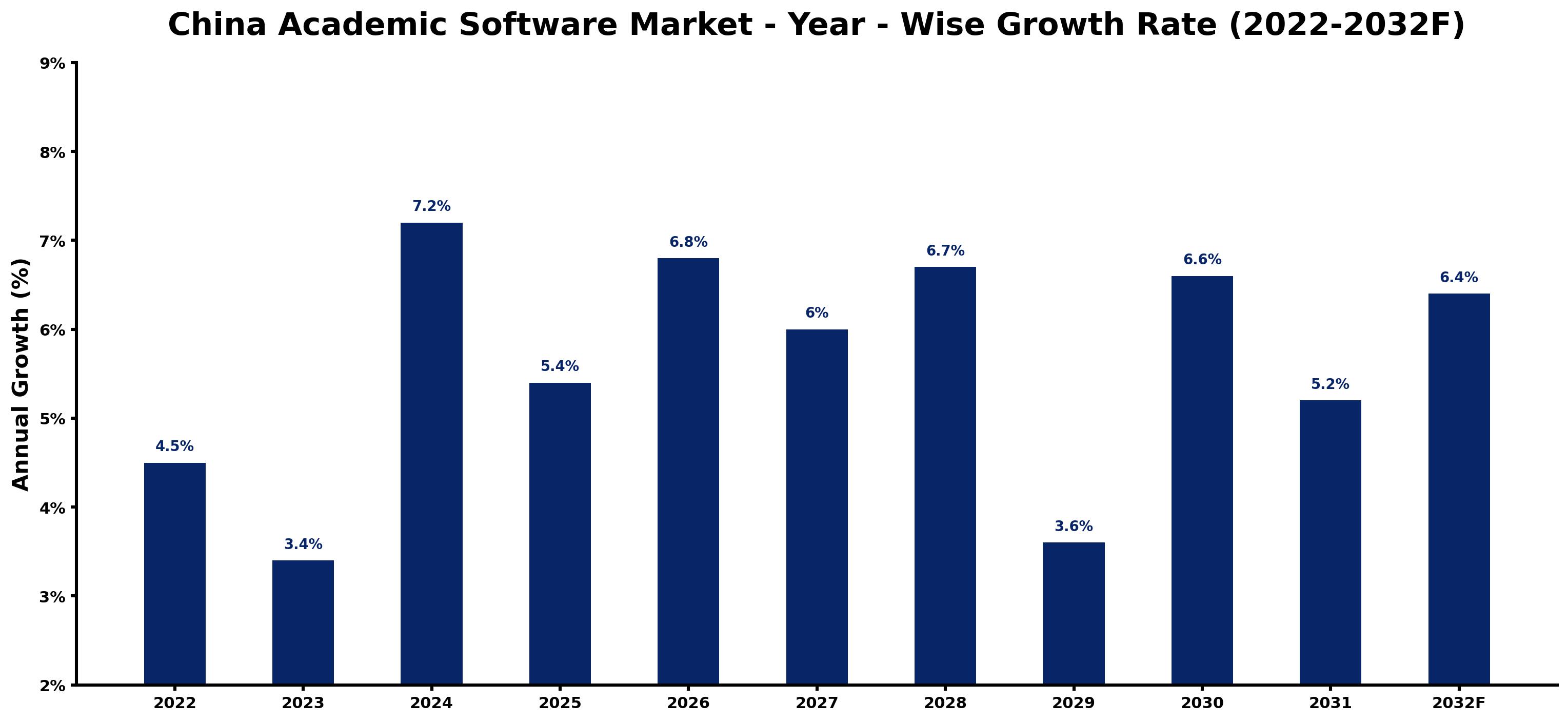
Each row of the following table gives one year's estimated growth and the event or demand shift that explains it.
| Year | Estimated Annual Growth (%) | Market Rationale |
| 2022 | 4.5 | The market experienced steady growth, reflecting the ongoing digital transformation driven by the National Education Technology Plan. |
| 2023 | 3.4 | Growth slowed due to the impact of global economic conditions and the National Strategy for Educational Informatization. |
| 2024 | 7.2 | Demand surged as educational institutions increasingly adopted advanced academic software solutions under the Digital Education Development Plan. |
| 2025 | 5.4 | Growth decelerated as institutions focused on optimising existing software investments amid budget considerations. |
| 2026 | 6.8 | A resurgence in demand is expected to occur, driven by new educational initiatives and technology integration from the Smart Campus Construction Program. |
| 2027 | 6.0 | Demand growth is projected to slow as universities reassess their software needs amid budget constraints. |
| 2028 | 6.7 | Demand is expected to increase again, supported by the expansion of online education platforms and the growing user base. |
| 2029 | 3.6 | Growth will decelerate as institutions reassess their software needs amid financial limitations. |
| 2030 | 6.6 | A rebound in demand is projected, driven by new educational policies and funding initiatives from the EdTech Innovation Fund. |
| 2031 | 5.2 | Growth is expected to slow as institutions focus on improving software utilisation and integration in educational settings. |
| 2032 | 6.4 | Demand is projected to rise as educational technology continues to evolve and expand across various sectors. |
Note: Market size estimations and growth projections presented in this report are based on 6Wresearch's proprietary forecasting methodology, utilizing the latest available industry data, government publications, and primary research inputs.
China Academic Software Market Synopsis
The China Academic Software Market encompasses various digital tools designed for educational purposes, including Learning Management Systems and virtual labs. These tools improve learning experiences and facilitate remote education. The market is expanding due to demand from over 300 million students enrolled in K–12 education and the increasing integration of technology in classrooms. The National Education Technology Plan and the Digital Education Development Plan are key drivers of this growth, promoting the adoption of advanced academic software across educational institutions.
Market Dynamics Impact Analysis (2026–2032)
| Factor | Type | Impact | Primary Segment Affected |
| Increasing adoption of Learning Management Systems in higher education institutions | Driver | High | Learning Management Systems |
| Growth in online education platforms expanding user bases | Driver | High | Higher Education |
| Rising demand for virtual labs in K–12 education | Opportunity | High | Virtual Labs Software |
| Growing need for educational software in rural schools | Opportunity | High | Educational Boards |
| Budget constraints limiting software investments in institutions | Restraint | High | Universities and Colleges |
| Challenges in software integration across various educational levels | Restraint | Medium | SaaS Providers |
| The Academic Software market in China faces significant regulatory hurdles | Challenge | High | Content Authoring Tools |
| Competition from international software providers complicates market entry | Challenge | Medium | ERP for Education |
Evaluation of Drivers in China Academic Software Market (2026–2032)
The table below links each growth driver to the segment it affects and the evidence for it.
| Drivers | Primary Segment Affected | Why It Matters (Evidence) |
| High student enrollment in K–12 education drives demand for academic software | K–12 Schools | With over 300 million students enrolled, schools require effective software solutions to manage educational content and administration. |
| The integration of technology in classrooms supports software adoption | Higher Education | The National Education Technology Plan emphasises technology use, leading to increased purchases of academic software. |
| The rise of online education platforms boosts demand for virtual labs | Virtual Labs Software | Over 100 million users have joined online education platforms, necessitating advanced virtual lab solutions for practical training. |
| Government initiatives promote educational technology improvements | Educational Boards | The Ministry of Education allocated 1 billion RMB for technology enhancements in rural schools, increasing software demand. |
| Growing focus on digital infrastructure enhances software integration | Universities and Colleges | The Smart Campus Construction Program supports universities in adopting advanced academic software, driving further demand. |
With over 300 million students in K–12 education, schools require effective software solutions for efficient management. The National Education Technology Plan emphasises technology integration, leading to increased purchases of academic software. Online education platforms have seen user growth exceeding 100 million, necessitating advanced virtual lab solutions for practical training.
Evaluation of Restraints in China Academic Software Market
The following restraints limit how fast demand can grow.
| Market Restraint | Primary Segment Affected | Why It Matters (Evidence) |
| Budget constraints limiting software investments in educational institutions | Universities and Colleges | Many universities face financial limitations, restricting their ability to invest in new academic software solutions, impacting their operational efficiency. |
| Integration challenges across various educational levels hinder software adoption | SaaS Providers | The complexity of integrating software into existing systems can deter institutions from adopting new solutions, causing delays in implementation. |
| Regulatory hurdles complicate the development of academic software | Content Authoring Tools | Compliance with national standards can delay software deployment and increase development costs, affecting local developers' competitiveness. |
| Competition from international providers affects local market share | ERP for Education | Local providers struggle to compete with established international brands, impacting their market presence and limiting growth opportunities. |
| Limited awareness of software benefits among educators | K–12 Schools | Some educators remain unaware of the advantages of academic software, hindering adoption rates and affecting student outcomes. |
China Academic Software Market Challenges
In the China Academic Software Market, over 300 million students enrolled in K–12 education struggle with inadequate access to suitable academic software, limiting their educational outcomes. This challenge stems from a lack of local development and a heavy reliance on imports, causing delays for schools that require effective learning tools. Producers face hurdles in keeping pace with rapid technological advancements, which reduces their ability to compete effectively in the market. As a result, buyers, including educational institutions, often encounter outdated software that can negatively impact teaching quality and student engagement.
Trends in the China Academic Software Market
Several trends are reshaping the China Academic Software Market; the most important are set out below.
- Shift towards Virtual Labs in Education: The Ministry of Education promotes virtual labs to improve practical learning experiences in science education. As a result, the adoption of virtual labs has increased significantly, with a reported 50% rise in K–12 schools in 2023.
- Transition to Cloud-Based Academic Software: Since 2021, educational institutions have increasingly adopted cloud-based solutions for academic software. This shift has resulted in SaaS Providers capturing 42% of the market share by 2025, improving accessibility and collaboration.
- Emergence of Smart Campus Initiatives: The Smart Campus Construction Program initiated in 2023 supports universities in adopting advanced academic software solutions. This initiative is expected to drive demand significantly as institutions modernise their educational infrastructure.
- Growing Focus on Quality Standards for Educational Software: The National Standard for Educational Software (GB/T 35273-2020) sets guidelines for software quality. Compliance with these standards is becoming essential for software developers, influencing purchasing decisions among educational institutions.
Investment Opportunities in the China Academic Software Market
Below are the investment opportunities with the strongest case in the China Academic Software Market.
- K–12 Schools seeking advanced educational tools: K–12 Schools require tailored academic software solutions to enhance curriculum delivery. With over 300 million students enrolled, this sector presents a significant opportunity for suppliers to invest in effective software solutions.
- Universities and Colleges needing integrated management systems: Universities and Colleges are looking for comprehensive ERP solutions to streamline administrative functions. The growing number of institutions, exceeding 2,500, creates a demand for effective management software.
- Rural educational institutions requiring technology upgrades: Rural schools are in urgent need of educational technology improvements. The government's allocation of 1 billion RMB for technology enhancements creates a prime opportunity for suppliers to enter this market.
- Educational Boards focused on software quality and accessibility: Educational Boards are prioritising the adoption of high-quality academic software. The recent updates to the Guidelines for the Development of Educational Software present an opportunity for compliance-focused suppliers.
Government Initiatives in the China Academic Software Market
The Digital Education Development Plan (2021-2025) launched by the Ministry of Education aims to improve digital infrastructure in schools, with a budget of 5 billion RMB. This plan mandates the integration of technology in classrooms, significantly impacting the adoption of academic software. By 2025, the Ministry expects to achieve 90% technology integration across schools, promoting the use of advanced educational tools.
In 2023, the EdTech Innovation Fund was established with a budget of 2 billion RMB to support the development of educational software. The Ministry of Education oversees this fund, providing grants to innovative projects that improve academic software solutions. This initiative encourages local developers to create tailored software for the education sector, fostering growth in the market.
Future Insight of the China Academic Software Market
The China Academic Software Market will undergo significant changes by 2032, driven by the government's commitment to integrate technology in 90% of schools by 2025. This initiative is expected to boost demand for sophisticated academic software solutions tailored for diverse educational needs. The Ministry of Education's promotion of virtual labs will create opportunities for practical learning experiences, necessitating the development of innovative tools. Furthermore, the allocation of 1 billion RMB for educational technology improvements in rural schools will encourage suppliers to expand their offerings to underserved areas.
Market Segmentation Analysis
The report offers a comprehensive study of the following market segments and their leading categories in the market.
By Software Type – Learning Management Systems Dominated, Virtual Labs Software Expected to Grow Fastest
According to Shubham Deep, Research Manager at 6Wresearch, in 2025, Learning Management Systems led the software type split with a 48% share. Learning Management Systems command the largest market share because they are integral to over 80% of higher education institutions in urban areas. Their critical role in course management and student engagement solidifies their importance in the academic software landscape. The quickest growth will come from Virtual Labs Software, forecast to expand at a CAGR of 7.7% between 2026 and 2032. Virtual Labs Software is experiencing rapid growth as the Ministry of Education promotes their use to enhance practical learning in science education. This initiative is expected to drive higher adoption rates among educational institutions seeking to improve hands-on training. Suppliers should focus on enhancing virtual lab offerings to meet the increasing demand in the academic software market.
By User Category – Higher Education Dominated and Is Expected to Record the Fastest Growth
With a 44% revenue share in 2025, Higher Education was the largest user category category. Higher Education captures the largest market share, with over 2,500 universities and colleges actively using advanced academic software solutions. This broad base of users ensures a consistent demand for these tools, reinforcing their leading position in the market. Higher Education is also forecast to expand faster than any other category, at a CAGR of 7.2% over 2026–2032. The growth of Higher Education as a user category is driven by the increasing integration of technology in educational practices, as highlighted in the Ministry of Education's Digital Education Strategy. This initiative aims for 90% technology integration in schools by 2025, further solidifying the segment's prominence. Suppliers must tailor solutions specifically for higher education institutions to address their evolving technological requirements.
By Distribution Channel – SaaS Providers Dominated, EdTech Companies Expected to Grow Fastest
SaaS Providers held a 42% share of the China Academic Software Market by distribution channel in 2025. SaaS Providers dominate the market due to their ability to offer software solutions on a subscription basis, which provides flexibility and accessibility to educational institutions. This model aligns well with the rising demand for scalable academic software solutions. EdTech Companies are set to record the highest CAGR in this split, 7.4% over 2026–2032. EdTech Companies are rapidly gaining momentum as they develop and distribute educational technology solutions that cater to the needs of modern learners. Their responsiveness to market demands positions them for substantial growth in the academic software sector. Suppliers should explore partnerships with EdTech Companies to enhance distribution capabilities and expand their market reach.
By End User – Universities and Colleges Dominated, Educational Boards Expected to Grow Fastest
The largest end user category in 2025 was Universities and Colleges, with a 40% share of total revenue. Universities and Colleges hold the largest market share as they are significant users of complex academic software, driven by the need for effective educational management. Their high software utilisation, with an average student-to-software ratio of 15:1, highlights their dependence on these tools. Over 2026–2032, Educational Boards are expected to post the fastest growth, at a CAGR of 7.7%. Educational Boards are emerging as the fastest-growing end user segment, as they oversee software adoption in schools and increasingly prioritise technology integration. This focus on modernising educational practices is likely to accelerate growth in this segment. Suppliers should engage with Educational Boards to facilitate software adoption and ensure compliance with educational standards.
Key Attractiveness of the Report
- 10 Years of Market Numbers
- Historical Data Starting from 2022 to 2025
- Base Year 2025
- Forecast Data until 2032
- Key Performance Indicators Impacting the Market
- Major Upcoming Developments and Projects
Key Highlights of the Report:
- China Academic Software Market Outlook
- Market Size of China Academic Software Market, 2025
- Forecast of China Academic Software Market, 2032
- Historical Data and Forecast of China Academic Software Revenues & Volume for the Period 2022 - 2032F
- China Academic Software Market Trend Evolution
- China Academic Software Market Drivers and Challenges
- China Academic Software Price Trends
- China Academic Software Porter's Five Forces
- China Academic Software Industry Life Cycle
- Historical Data and Forecast of China Academic Software Market Revenues & Volume By Software Type for the Period 2022 - 2032F
- Historical Data and Forecast of China Academic Software Market Revenues & Volume By Learning Management Systems for the Period 2022 - 2032F
- Historical Data and Forecast of China Academic Software Market Revenues & Volume By Virtual Labs Software for the Period 2022 - 2032F
- Historical Data and Forecast of China Academic Software Market Revenues & Volume By Content Authoring Tools for the Period 2022 - 2032F
- Historical Data and Forecast of China Academic Software Market Revenues & Volume By ERP for Education for the Period 2022 - 2032F
- Historical Data and Forecast of China Academic Software Market Revenues & Volume By User Category for the Period 2022 - 2032F
- Historical Data and Forecast of China Academic Software Market Revenues & Volume By K 12 Schools for the Period 2022 - 2032F
- Historical Data and Forecast of China Academic Software Market Revenues & Volume By Higher Education for the Period 2022 - 2032F
- Historical Data and Forecast of China Academic Software Market Revenues & Volume By Teachers & Trainers for the Period 2022 - 2032F
- Historical Data and Forecast of China Academic Software Market Revenues & Volume By Institutions for the Period 2022 - 2032F
- Historical Data and Forecast of China Academic Software Market Revenues & Volume By Distribution Channel for the Period 2022 - 2032F
- Historical Data and Forecast of China Academic Software Market Revenues & Volume By SaaS Providers for the Period 2022 - 2032F
- Historical Data and Forecast of China Academic Software Market Revenues & Volume By EdTech Companies for the Period 2022 - 2032F
- Historical Data and Forecast of China Academic Software Market Revenues & Volume By Direct Subscriptions for the Period 2022 - 2032F
- Historical Data and Forecast of China Academic Software Market Revenues & Volume By Software Integrators for the Period 2022 - 2032F
- Historical Data and Forecast of China Academic Software Market Revenues & Volume By End User for the Period 2022 - 2032F
- Historical Data and Forecast of China Academic Software Market Revenues & Volume By Educational Boards for the Period 2022 - 2032F
- Historical Data and Forecast of China Academic Software Market Revenues & Volume By Universities and Colleges for the Period 2022 - 2032F
- Historical Data and Forecast of China Academic Software Market Revenues & Volume By Online Educators for the Period 2022 - 2032F
- Historical Data and Forecast of China Academic Software Market Revenues & Volume By School and College Admin Offices for the Period 2022 - 2032F
- China Academic Software Import Export Trade Statistics
- Market Opportunity Assessment By Software Type
- Market Opportunity Assessment By User Category
- Market Opportunity Assessment By Distribution Channel
- Market Opportunity Assessment By End User
- China Academic Software Top Companies Market Share
- China Academic Software Competitive Benchmarking By Technical and Operational Parameters
- China Academic Software Company Profiles
- China Academic Software Key Strategic Recommendations
Market Covered
Segments analysed in this report are listed below.
By Software Type
- Learning Management Systems
- Virtual Labs Software
- Content Authoring Tools
- ERP for Education
By User Category
- K–12 Schools
- Higher Education
- Teachers & Trainers
- Institutions
By Distribution Channel
- SaaS Providers
- EdTech Companies
- Direct Subscriptions
- Software Integrators
By End User
- Educational Boards
- Universities and Colleges
- Online Educators
- School and College Admin Offices































